 PalV's Kasti

On this page
To stitch a Parsi Navjote.">sadra, you start with plain white cotton cloth, in a single layer. J.J. Modi called it "white cambric", FEZANA's lesson plan calls it white muslin (mulmul), and the Dadestan-i Denig asks for a shirt that is pure white and of one fold. Our method at PalV's Kasti begins with a sample sadra. We cut pure cotton maal-maal to its breadth and double it over, then cut the neck and the gariyan, stitch on the sleeves, give the neck a border and make the tiris at the sides. Our Parsi masi does the stitching. Dr Ramiyar P. Karanjia and Ervad Marzban J. Hathiram both say every sadra needs a gireban pocket at the front and a girdo at the back of the neck.
The name is also written Sadreh, Sudre or Sudreh. We write Sadra. What the garment means is covered in our post on the Parsi Sadra meaning. This page is only about how it's put together.
સરોશ રોજ
Sarosh Roj, Tir Mah · 1396 Y.Z.
What cloth is a sadra stitched from?
Always white cloth. Modi, writing in 1922, said the shirt is made of white cambric. FEZANA's Sudreh and Kushti lesson plan (revised 9 March 2023) names white muslin, or mulmul. Dr Karanjia specifies fine white muslin, and Ervad Hathiram white cotton, adding that fancy nets and non-cotton fabrics are not correct.

The texts also want one layer, not two. In E. W. West's translation of the Dadestan-i Denig (chapter 40), the shirt has to be "perfectly pure white and single". Modi reads the same passage as one fold, not double. And the Shayest Ne-Shayest, also in West's translation, says the shirt is not proper "when it is double or thickened".
Our fabric is pure cotton maal-maal from Nav Bharat Mills, 75 GSM, as listed on our order form. In our earlier version of this guide we put the cloth at about 1 metre per sadra. A longer or wider sadra takes more.
Practice varies between families and Agiaries; your family priest's guidance comes first.
Should a sadra be cut from one piece of cloth or two?
Here the sources disagree.
| Source | What it says |
|---|---|
| J.J. Modi, 1922 | Not one continuous piece: two pieces sewn together at the sides, making a front and a back |
| FEZANA lesson plan, 2023 | One fold of cloth, with side seams and no shoulder seams |
| Dr Ramiyar P. Karanjia | A single piece of fine white muslin |
| Ervad Marzban J. Hathiram, Frashogard, 2013 | A single piece. Joining several pieces to save cloth is, he writes, incorrect |
Our own method starts from one cut length of maal-maal, doubled over. If your family follows a different rule, tell us before we cut.
Practice varies between families and Agiaries; your family priest's guidance comes first.
Which parts must be stitched into a sadra?
Dr Karanjia and Ervad Hathiram both describe a sadra of nine seams, though they count them differently. These are the parts they both name:
| Part | Where it sits |
|---|---|
| Gireban (gireh-ban) | A small pocket at the front of the chest. Modi described it as a bag resting a little below the throat |
| Girdo | A crescent-shaped piece at the back of the neck. Both writers say it belongs on every sadra, men's and women's |
| Two sleeves | Cloth stitched on at the sides. Ervad Hathiram says they reach the elbow; Dr Karanjia says a ladies' sadra may have smaller sleeves |
| Front and back | The two large sides, joined at the side seams |
| Slanting (triangular) tiri | At the bottom, on the right for men and the left for women |
| Straight (parallel) tiri | On the left for men and the right for women |
Dr Karanjia's nine are one gireban, one girdo, two sleeves, two sides and three tiris. Ervad Hathiram counts one triangular seam and counts the rim-sewn bottom as his ninth. FEZANA's lesson plan lists two side seams, two sleeve seams, a neck seam, the girdo, the gireban, a straight tiri and a triangular tiri.
Practice varies between families and Agiaries; your family priest's guidance comes first.
How do we stitch a sadra at PalV's Kasti?
Kasti weaving is our main work. We don't stitch sadras ourselves. A Parsi lady, our masi, stitches each one to the measurements the customer gives. These are the steps we first set out on this page in 2021:
- Keep a sample sadra in hand and lay it on the maal-maal to mark the breadth.
- Check the size, then cut the cloth to match.
- Double the cut cloth over.
- Cut out the neck. The sleeve area is shaped at this stage only for a sleeveless sadra.
- Cut the gariyan.
- Stitch the sleeves on.
- Give the neck a border and make the tiris at the sides.
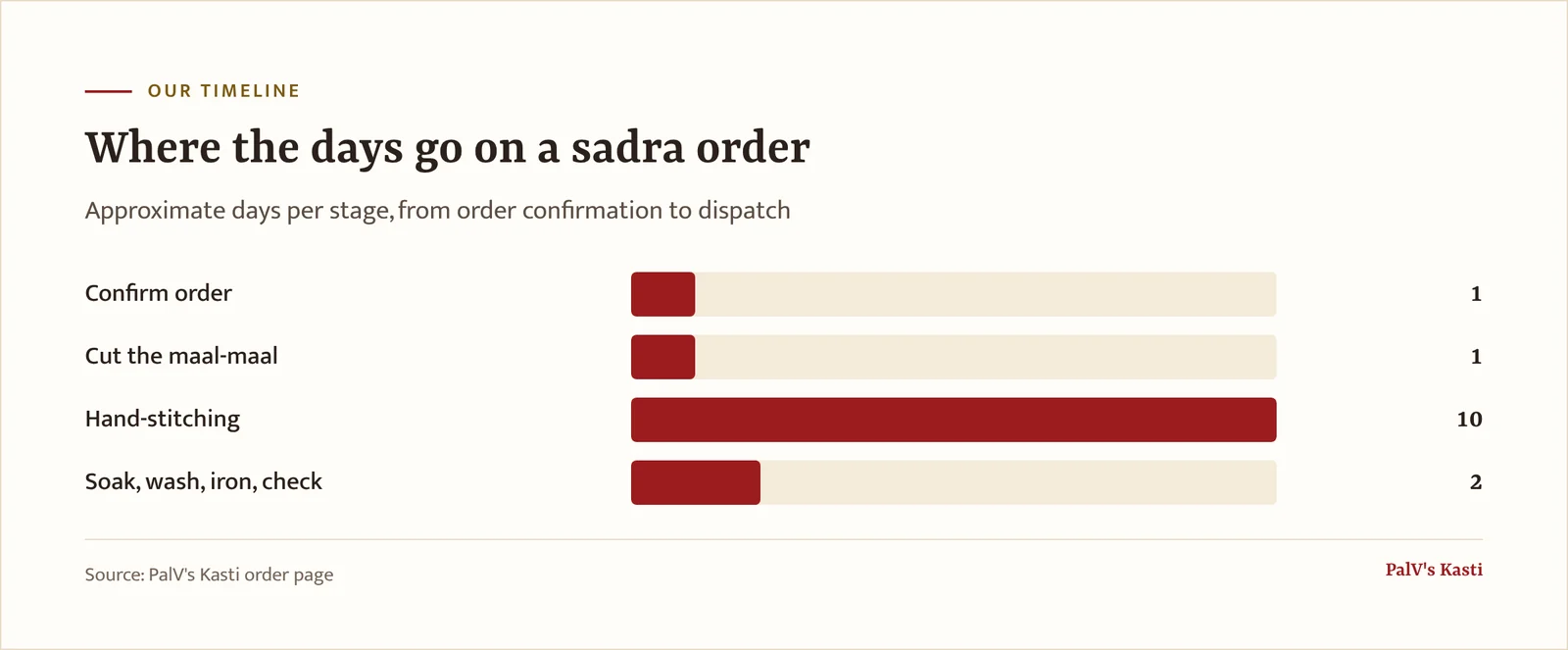
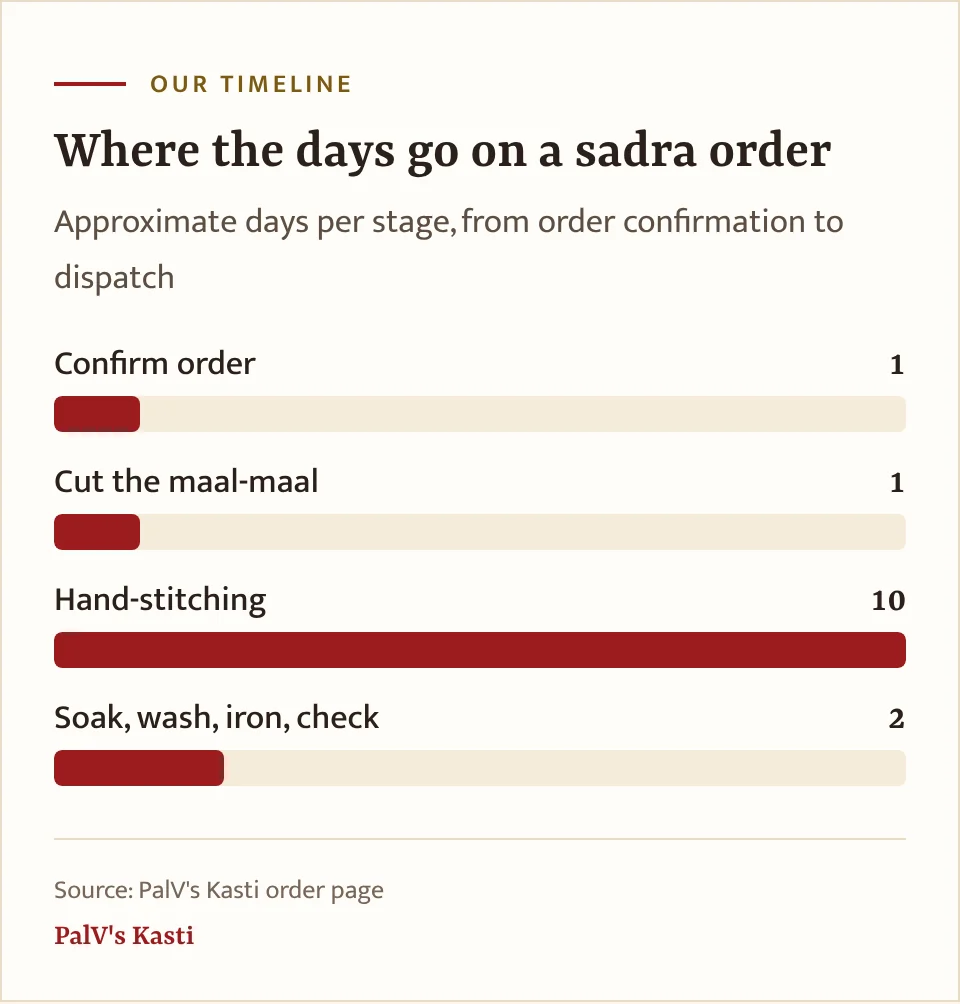
Then the finishing. When the stitched sadra comes back to us, we soak it for 12 hours, wash it, dry it, iron it and check it before packing. We cut the cloth the day after we confirm an order. Stitching takes about 10 days, and dispatch is about 15 working days after confirmation, a little longer when we have many orders.
Measurements come first. Our guide on how to measure a sadra explains each one.
Who stitches our sadras?
Our Parsi masi, by hand, every order. For the wider picture of who makes sadras and kustis now and where Parsis buy them, read who makes sadras and kustis today.
Can a sadra be stitched without sleeves?
Both writers say no. Ervad Hathiram writes that every sudreh must have two sleeves to the elbow, and that there is no such thing as a sleeveless sudreh. Dr Karanjia accepts smaller sleeves on a ladies' sadra for convenience, but says it isn't right to do away with them entirely.
We stitch the styles customers order, and our form includes a men's sleeveless sadra and a women's sadra with straps. If you're unsure, ask your family priest before ordering. You can order a made-to-measure Parsi sadra in any of our four styles. Once it arrives, our guide on how to wear a sadra takes it from there.
Practice varies between families and Agiaries; your family priest's guidance comes first.
Frequently asked questions
How much cloth does one sadra need?
We work on about 1 metre of maal-maal for one sadra. The exact amount depends on the length and width you send us, so a longer or wider sadra takes more cloth. Maal-maal also shrinks about 1 inch on its first wash, which is why our order form offers to add 1 inch to both.
What cloth does PalV's Kasti use for sadras?
We use pure cotton maal-maal from Nav Bharat Mills, 75 GSM, as listed on our order form. Our order page calls it soft mulmul cotton, which matches the white muslin and white cotton the sources describe. Every new sadra is soaked for 12 hours and washed before we pack it.
Does a ladies' sadra need a girdo?
Yes, say both Dr Ramiyar P. Karanjia and Ervad Marzban J. Hathiram. Dr Karanjia calls it a wrong idea that only men's sadras should have a girdo, and Ervad Hathiram writes that the girdo must be on every sudreh, for ladies and gents alike. Both place it at the back of the neck, as a crescent-shaped piece.
Which side do the tiris go on?
Both writers agree here. The slanting, or triangular, tiri goes on the right side for men and the left side for women. The straight, or parallel, tiri goes on the left for men and the right for women. Dr Karanjia counts two slanting tiris; Ervad Hathiram counts one triangular seam.
How long does it take to stitch a sadra?
Our masi takes about 10 days to hand-stitch an order. We confirm on day 1 and cut the cloth on day 2. After stitching, two days go on soaking, washing, drying, ironing and checking. Dispatch is about 15 working days after we confirm the order, and it can run a little longer when orders are heavy.
Why is a sadra washed after stitching?
We soak every finished sadra for 12 hours and then wash it, so that it reaches you pure and soft. It is also dried, ironed and checked before packing. Because maal-maal shrinks about 1 inch on the first wash, our order form lets you add 1 inch to the length and width.