 PalV's Kasti
On this page
Bafaenu is a Parsi pickle of whole ripe or semi-ripe mangoes, first cooked soft in oil and then coated in a sharp paste of mustard powder, vinegar, jaggery, garlic, turmeric and ground spices. The jars are sealed and left for about ten days before anyone opens them. Cookbook writers describe it as pungent, with the cooked skin turning soft and sweet. It is only ever a side, eaten with plain food like dhan-dal or khichdi. You will see it spelt bafenu, baffena, buffena and bafena too. The method below follows Freny J. Deboo's recipe in FEZANA's 2012 book Eat, Live, Pray.
શહેરેવર રોજ
Shehrevar Roj, Tir Mah · 1396 Y.Z.
What is bafaenu (bafenu, buffena)?
It is the Parsi way of pickling a whole mango. Cookbook author Niloufer Mavalvala lists buffena among her favourite Parsi achars and describes it simply as whole ripe mangoes stewed in spices. Bafaenu starts from fruit that is ripe or nearly so, and Freny J. Deboo's recipe, taken from old family books, keeps each mango whole.
Writers on Parsi food tend to single out the mustard. Outlook Traveller, in a 2014 piece on Parsi food in Mumbai, called it "the mustard-and-mango baffena", and a 2018 Parsi Times column described it as tangy and "nose-tingling". Mavalvala, in The World of Parsi Cooking, is frank that it can be strong for a first-timer and calls it an acquired taste. In her description, the cooked skin becomes soft and sweet while the pulp turns into a juicy stew. Because it is a pickle, she adds, it is only ever a side.
Bafaenu should not be confused with the other Parsi mango preserve, Ambakalyo, which in Deboo's recipe is a sweet chutney of peeled, sliced green mango simmered in jaggery with whole spices. It has no mustard and is served as a relish rather than left to mature.
How is bafaenu made?
Freny J. Deboo's recipe in Eat, Live, Pray comes, she writes, from a very old set of family books and handwritten Gujarati cookbooks. It is a large household batch of 25 mangoes, and the measures below are hers, including the "bottle" measures for oil and vinegar.

Ingredients
- 25 semi-ripe whole mangoes, washed and dried very well
- 1½ bottles vinegar
- 3 bottles til (sesame) oil, prepared as in the next section
- 675 g (24 oz) mustard powder
- 3 lb (1½ kg) gaur (jaggery)
- 125 g (4 oz) garlic
- 125 g (8½ tbsp) salt
- 2 tbsp haldi (turmeric) powder
- 1 tbsp cinnamon and 1 tbsp cardamom, each coarsely ground
- 1½ tsp cloves
Method
- Bring the prepared sesame oil to a boil in a big, deep pan.
- Lower in the whole mangoes and let them simmer until tender. Take the pan off the heat and drain the oil away from the fruit.
- Stir every other ingredient into the vinegar to make a paste, adding a tablespoon or two of the oil.
- Coat each mango with the paste and pack the mangoes into wide-mouthed jars.
- Pour whatever masala is left over the top.
- Close the jars tightly and leave them for ten days before you start eating the pickle.
The old way of preparing the pickling oil
Deboo's recipe calls for sesame oil "prepared" in an older style, explained in a box beside it. Three bottles of til oil are brought to the boil and two chapattis, fresh or stale, are fried in it one after another until each side is burnt coal black. The chapattis are thrown away and the oil is strained through muslin. The book notes that ready pickling oil is now sold by some Indian grocers, if you'd rather skip this step.
A smaller batch, with cubed mango
Twenty-five mangoes is a lot for a modern kitchen. Chef Sanjeev Kapoor's "Buffena", published on his website in 2016, uses just two ripe mangoes, peeled and cut into cubes rather than kept whole. Half the oil is heated to smoking point, the heat is lowered and the cubes cook for five minutes. They are then spread with a paste of ground cardamom, clove and cinnamon, chilli powder, turmeric, jaggery, salt, chopped garlic, vinegar and oil. His ingredient list also has mustard seed, which he tells you to sun-dry and powder, though the method does not say at which step it goes in. His version also matures for ten days, and he says it lasts a few months. So the two recipes agree on the waiting time but differ on whole versus cut fruit, and on mustard powder versus home-ground seed.
What do Parsis eat bafaenu with?
Plain, mild food, so the pickle has room to shout. The 2018 Parsi Times column says it is best with dhan-dal. Mavalvala suggests khichri of any kind, kadhi and papad. In Deboo's family, the best meals of her grandmother's and great-aunts' day were plain yellow khichdi with buffena on a rainy day.
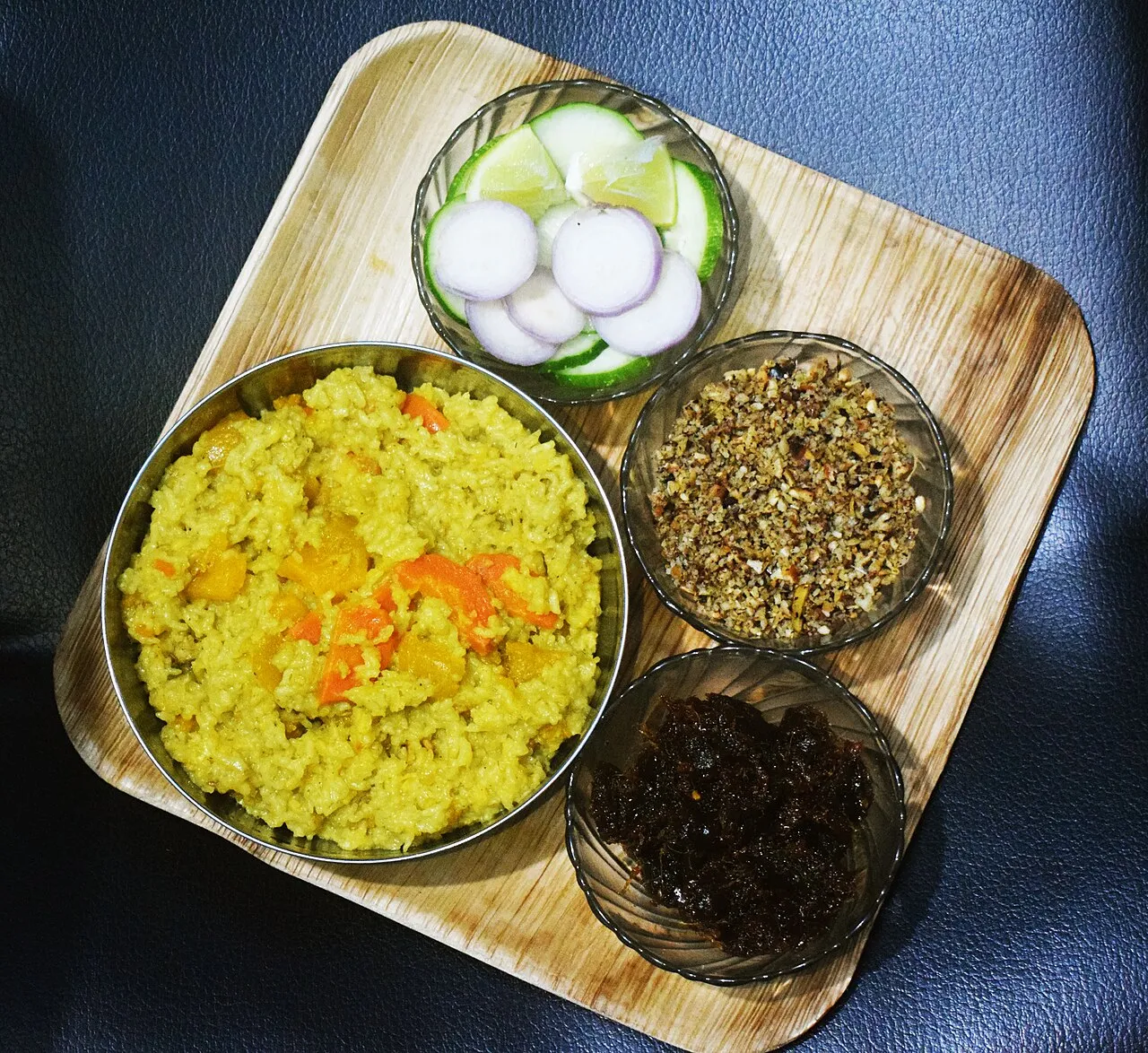
It also has a place in Bahman Mah. Noshir H. Dadrawala, writing in Eat, Live, Pray and again in Parsi Times in 2016, explains that the eleventh month of the Zoroastrian year is dedicated to Bahman Amshaspand, guardian of animals, and that devout Parsis keep away from meat for the whole month. One of his clearest childhood memories of it is a meal of plain khichdi with spicy-tangy bafenu, or with doru, a runny tamarind preparation.
Practice varies between families and Agiaries; your family priest's guidance comes first.
Mangoes turn up across the Parsi kitchen well beyond the pickle jar, which we cover in Parsis and mangoes.
Can you buy bafaenu ready-made?
Sometimes. In 2014 Outlook Traveller reported that the shops selling sandalwood and religious articles on Princess Street in Mumbai sometimes had a few bottles of baffena alongside ambakalio. We could not confirm who stocks it today, so check with a Parsi store near you.
Frequently asked questions
Is bafaenu made with raw or ripe mangoes?
Ripe or nearly ripe. Freny J. Deboo's recipe in FEZANA's Eat, Live, Pray asks for semi-ripe whole mangoes, while Niloufer Mavalvala and Sanjeev Kapoor both use ripe fruit. Deboo keeps the mangoes whole, Kapoor cubes them. Either way, wash the fruit and dry it thoroughly before it goes into the hot oil.
What does bafaenu taste like?
Pungent and sweet together. A 2018 Parsi Times column calls it tangy and nose-tingling, and Freny J. Deboo's recipe uses a large amount of mustard powder with jaggery and vinegar. Niloufer Mavalvala calls it an acquired taste that can feel strong the first time. In her description, the cooked mango skin turns soft and sweet and the flesh becomes juicy.
How long does bafaenu take to mature?
About ten days. Both Freny J. Deboo's whole-mango recipe in FEZANA's Eat, Live, Pray and Sanjeev Kapoor's cubed-mango version tell you to seal the jars and wait ten days before eating. Kapoor says his smaller batch then keeps for a few months. Neither source gives a firm shelf life for the large whole-mango batch.
What is bafaenu eaten with?
Plain dishes that let its sharpness stand out. A 2018 Parsi Times column names dhan-dal as the best match. Niloufer Mavalvala recommends khichri, kadhi and papad. Freny J. Deboo remembers yellow khichdi with buffena as a rainy-day meal, and Noshir Dadrawala remembers the same pairing from Bahman Mah.
Why is bafaenu spelt so many ways?
It is written in English letters in many ways, and the sources we used for this article alone spell it bafenu, baffenu, baffena, buffena, buffenu and bafena. FEZANA's book even uses two spellings on the same page. All of them name the same mustard and ripe-mango pickle. We use bafaenu, but search for any of them.


