 PalV's Kasti
On this page
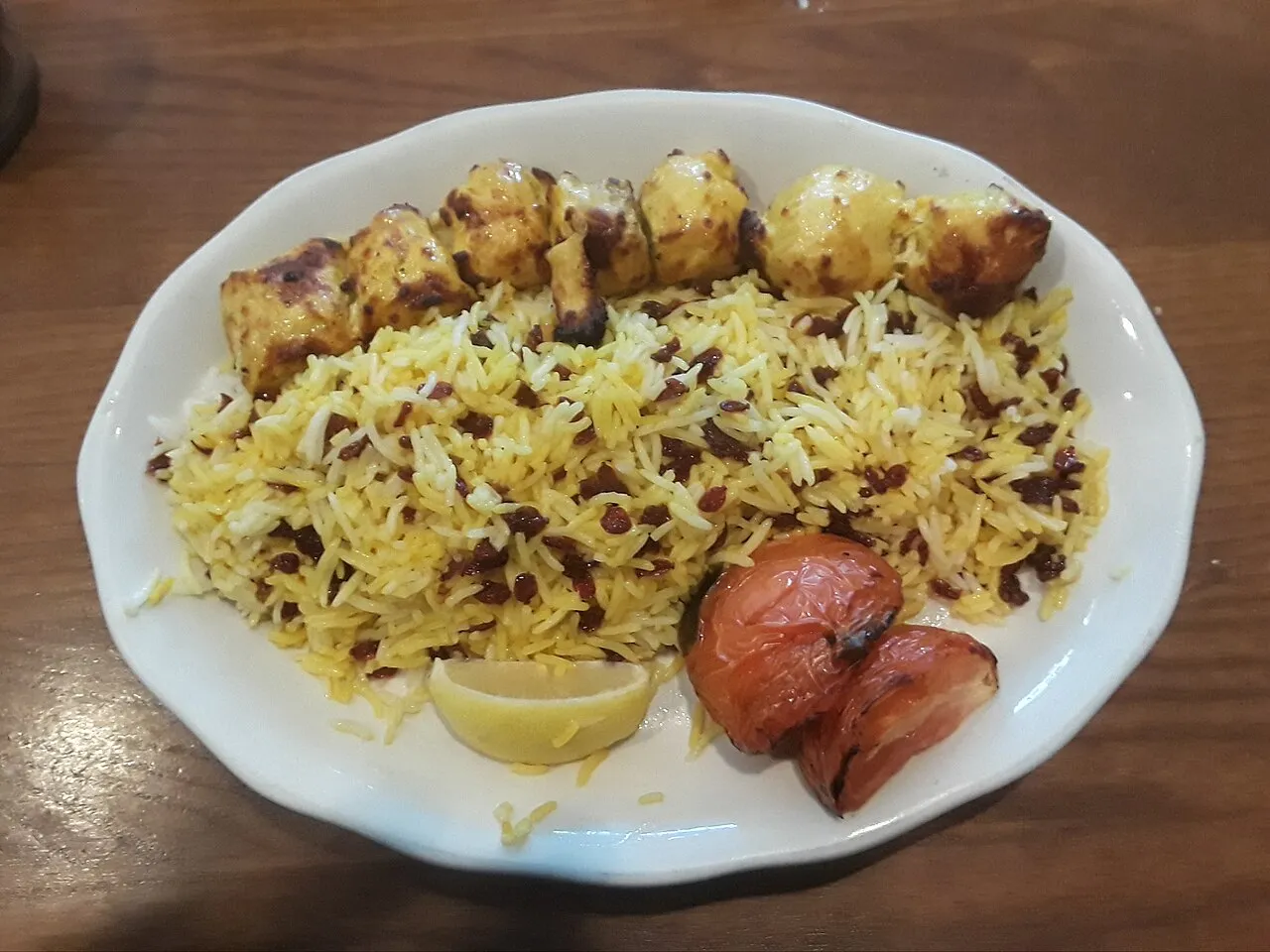
Shirini zereshk palau is a sweet barberry rice with chicken. You poach the chicken in a lightly spiced stock, cook the rice in that same stock, lay the chicken on top, then pour over a sugar syrup of barberries, orange peel, lemon juice and saffron. The pot is sealed and left on very low heat until the rice is done. This method follows cookbook author Niloufer Mavalvala's recipe, published by BBC Travel in March 2023, and it serves six. Her version is mild: no garam masala, and no separate parboiling of the rice in water.
અદીબેહેસત રોજ
Ardibehesht Roj, Tir Mah · 1396 Y.Z.
What does shirini mean in shirini zereshk palau?
Zereshk is the Persian word for barberry, and palau is the rice cooked in stock that Indians know as pulao. Shirini is the part that is personal. In the BBC piece, Mavalvala gives the word three jobs. It means "sweets" in Persian, which suits a rice whose berries are plumped in syrup. It was also the name of her mother, with whom she worked out the recipe. And she says it fits the Haftseen, the Navroz table of seven items whose names begin with "s".
Her cookbook, The World of Parsi Cooking: Food Across Borders, carries the dish as Chicken Palao with Barberries. In the headnote she calls it her mother Shireen's own way of making the palao, which Shireen named Shireen's Zereshk Palao, and notes that the dish is also known as shirini palao. If you want the background on barberries and the Iranian way of cooking barberry rice, our guide to Zereshk palau covers it.
What do you need for shirini zereshk palau?
These quantities are Mavalvala's, for six people.
- For the chicken and stock: 1 kg chicken in 8 pieces, 2 medium onions, 2 tbsp of a neutral oil, 2 tbsp tomato paste, 8 bruised green cardamom pods, a cinnamon stick, 1 tsp peppercorns, 1 tsp salt and 4 cups water.
- For the barberry syrup: ½ cup sugar, 1 cup water, 4 tbsp zereshk (barberries), 2 tbsp thinly julienned orange peel, the juice of 1 lemon, and 1 tsp crushed saffron.
- For the rice: 2 cups rice, cooked in the reserved chicken stock.
- Optional, to finish: almonds, pistachios and sultanas.
If you cannot find barberries, Mavalvala lists goji berries, dry tart cherries or cranberries as stand-ins.
How do you make shirini zereshk palau, step by step?
- Make the stock and poach the chicken. Warm the oil in a large pot on medium-low heat and soften the onions until translucent, stirring now and then (she gives about 7 minutes). Stir in the tomato paste, salt, peppercorns, cinnamon, cardamom and 4 cups of water. Bring it to the boil, drop to a simmer, add the chicken and poach it for 20 minutes. Lift out the chicken and set it aside, and keep the liquid: this is your stock. If you are using breast pieces rather than thighs, take them out halfway so they stay moist.
- Make the barberry syrup. In a small pan, melt the sugar into 1 cup of water on low heat, and only let it boil once the sugar has fully dissolved. When the syrup feels sticky on a spoon, add the barberries, orange peel, lemon juice and saffron, and simmer for a minute so the flavours go into the syrup. Take it off the heat.
- Cook the rice in the stock. Put the rice and stock in a large pot or skillet with a snug lid, on medium heat. Once it boils and the surface of the rice is just showing, arrange the chicken over the rice and press it in lightly with the back of a spoon. Pour the syrup evenly over everything.
- Seal and steam. Cover so that no steam escapes and cook on the lowest heat for 30 to 40 minutes, until the rice is cooked through.
- Rest and serve. Leave it covered for 10 minutes, then move it to a platter and serve straight away, scattered with nuts and sultanas if you like.
Note what is missing. Some barberry rice recipes parboil the rice in water first. Mavalvala told the BBC she cooks it fully in the chicken stock instead, so the long grains soak up the flavour of the stock.
How is it different from Mumbai's berry pulao?
The BBC piece sets her rice against the Mumbai-style version, which it says is believed to have started at the Irani restaurant Britannia & Co. and which brings in Indian pantry spices such as garam masala. Mavalvala leaves those out so that the saffron and the sour-sweet berries carry the dish. She also offers a theory of her own: that the Kohinoor family may first have used meat left over from salli boti. That story, and the gravy Britannia serves with its version, belong to our post on Berry pulao, so we leave them there.
Her tips also point to the Persian version, which she calls Irani berry pollo. It is cooked as a rice cake: the rice at the bottom of a buttered pot is allowed to crisp and caramelise, and the pot is then flipped onto a plate so that the crust, the tahdig, sits on top.
When is shirini zereshk palau served?
This is not an everyday rice. Mavalvala told the BBC that she heaps it on a large silver tray for Navroz and for other family gatherings and special occasions. The Navroz she means is the Persian New Year (Nowruz), which the BBC places between 19 and 22 March, at the spring equinox. Her cookbook headnote says her mother made it for the grandchildren on special occasions, and that it has been their favourite. Of this rice she told the BBC that if you cooked it, it would be the star.
Frequently asked questions
What does shirini mean?
Shirini means "sweets" in Persian. In this dish's name it does more than one thing: Niloufer Mavalvala told the BBC it also honours her mother, Shireen, who created the recipe with her, and that the "s" word suits the Haftseen table laid out for Navroz. The barberries are plumped in a sweet syrup.
Is shirini zereshk palau sweet?
It is a chicken and rice dish with a sweet and tart barberry topping. Mavalvala's recipe uses half a cup of sugar for six servings, boiled into a syrup with tart barberries, orange peel, lemon juice and saffron. That syrup is poured over chicken and rice cooked in a stock of onion, tomato paste, cardamom, cinnamon and peppercorns.
Can I use cranberries or other berries instead of barberries?
Yes. In her BBC recipe, Mavalvala names three substitutes for the 4 tablespoons of zereshk: goji berries, dry tart cherries or cranberries. Whichever you choose, it goes into the sugar syrup at the same step, with the saffron, orange peel and lemon juice, and simmers for about a minute before the syrup is poured over the chicken and rice.
When is shirini zereshk palau served?
It is a dish for special days. Mavalvala serves it piled on a large silver tray at Navroz, the Persian New Year in March, and at family gatherings and other occasions. Her cookbook says her mother Shireen made it for the grandchildren on special occasions. It is not presented as an everyday rice in either source.
What is the difference between shirini palau and Mumbai berry pulao?
According to the BBC, Mumbai's berry pulao, linked to the Irani restaurant Britannia & Co., adds Indian spices such as garam masala, and The Tribune notes that Britannia serves it with a gravy. Mavalvala's shirini palau is milder. It skips the garam masala, cooks the rice entirely in chicken stock, and lets saffron and syrup-plumped barberries lead the flavour.


