PalV's Kasti

On this page
- What does the child receive during the Navjote ceremony itself?
- What do guests traditionally give at a Navjote?
- How much money should you give at a Navjote?
- Do the parents give anything to the priests?
- What gifts are given at an Irani Sedreh-pushi?
- Modern Navjote gift ideas (our suggestions)
- Frequently asked questions
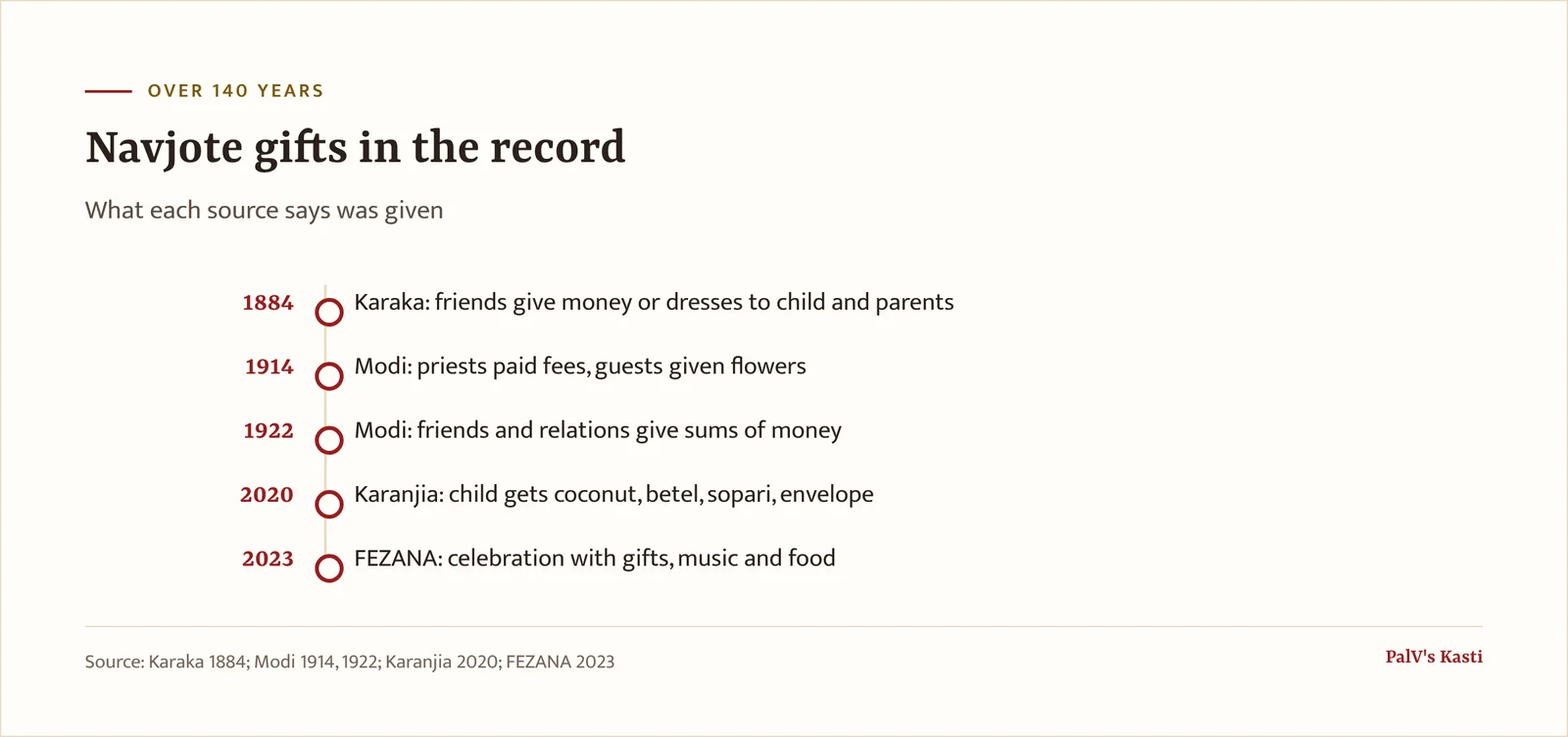
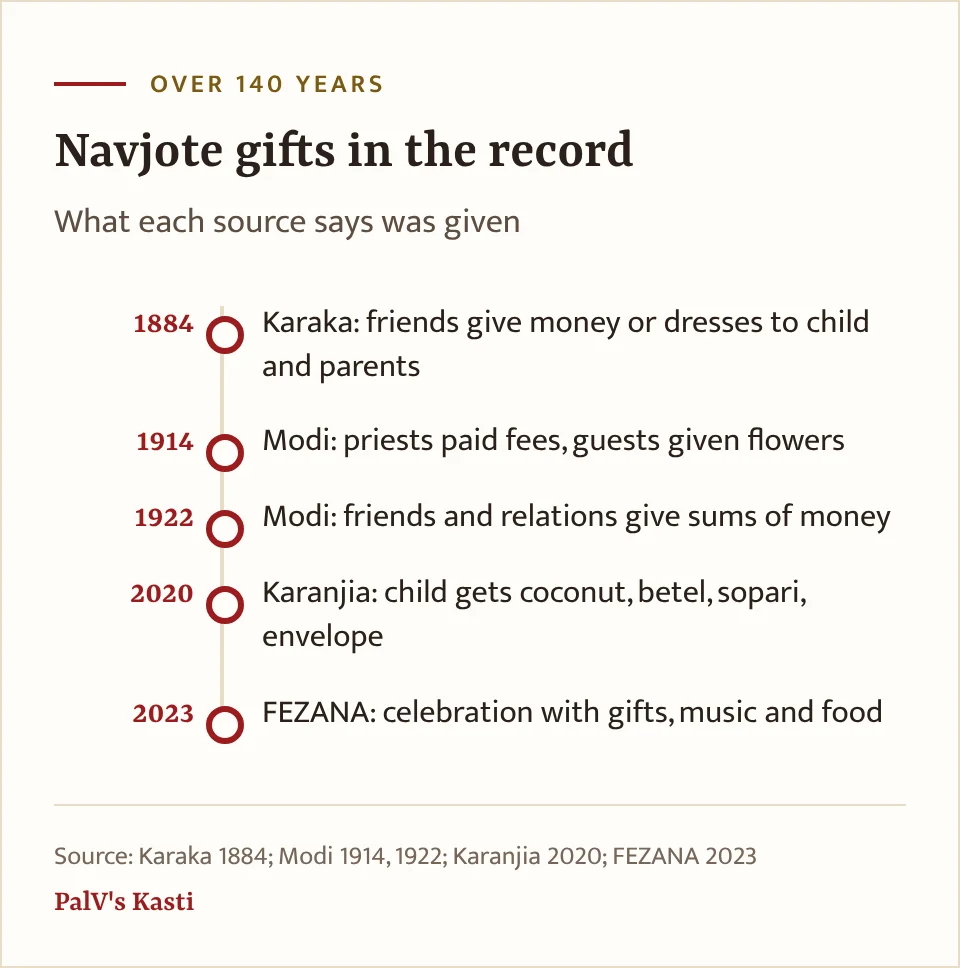
The gift that Parsi sources record again and again at a Navjote is money, given to the child and the parents by friends and relatives. Dosabhai Framji Karaka wrote in 1884 that guests gave "gifts in money or dresses", and J.J. Modi described the same exchange in 1922. During the ceremony itself, Dr Ramiyar Karanjia writes, the priest places a coconut, a betel leaf, sopari and an envelope of money in the child's hands as sagan, a sign of an auspicious day; Modi's accounts also have the priest hand the child betel leaves, a coconut and a few rupees. We found no published source that fixes how much to give. Beyond money and clothes, any "modern" gift is a family's own choice, and the ideas near the end of this page are our suggestions, not custom.
For the full order of the day, start with our guide to the Navjote ceremony. This page sticks to gifts.
શહેરેવર રોજ
Shehrevar Roj, Tir Mah · 1396 Y.Z.
What does the child receive during the Navjote ceremony itself?
Once the sadra and kusti are on and the prayers are said, there is a short, joyful moment of sagan. Dr Ramiyar Karanjia describes it on his website: the priest puts a red kanku mark on the child's forehead with a few grains of rice on it, puts a garland around the child, and gives the child a coconut, a betel leaf, sopari and an envelope of money. A bouquet is then given to the child to hold. For a girl, Karanjia adds, a folded sari is placed over her shoulders, and it may later become the first sari of her life.
Modi's 1922 account in The Religious Ceremonies and Customs of the Parsees lists a similar set of things in the tray that held the child's new clothes: betel leaves, areca nuts, a few pieces of sugar candy, some rice, a coconut, a garland, a small cup of kunkun and a few rupees. The priest later handed these to the child. Modi is careful to add that these things have no part in the religious rite. In India they were simply emblems of good luck.
The two accounts differ on the money. Modi records that the rupees in that tray did not stay with the child: the family priest took them at the end as part of his fee, known as the fee for the giryan or girehban. Karanjia's description has the envelope placed in the child's hands, and says nothing of it going to the priest.
Practice varies between families and Agiaries; your family priest's guidance comes first.
What do guests traditionally give at a Navjote?
Money, and sometimes clothes. Karaka's History of the Parsis (1884) says that once the child had been dressed in new clothes over the sadra, friends and relatives hurried forward with gifts of money or dresses for the child and the parents. Modi's 1922 account says that after the priests leave, friends and relations present the child and the parents with sums of money. Today, Karanjia writes simply that family and friends give gifts and wish the child health and happiness, and a 2023 FEZANA lesson plan for children describes the Navjote as followed by "a celebration with gifts, music and food".
A 2015 guest article on Navjotes and weddings by Hoshang Mandviwalla, on the Frashogard website, refers in passing to "the traditional 'Pehramni' cover"; we explain that custom in our post on the Pehramni gift coin.
Gifts also went the other way. In his 1914 booklet on the Navjote, Modi notes that after the priests were paid, the assembled guests were presented with flowers, and his 1922 book says the same of the friends and relations present.
How much money should you give at a Navjote?
We looked, and we could not find any priest's article, community body or recent news report that names an amount. So we won't invent one. What you put in the envelope depends on how close you are to the family, what you'd give at a wedding in the same circle, and what is comfortable for you. If you're unsure, a quiet word with an older relative in the same family is the most reliable guide you'll get.
Do the parents give anything to the priests?
Yes. Karanjia writes that after the final blessing the parents thank the priest with flowers and money. Modi's 1914 booklet records the same moment from a century earlier: the officiating priest and the other priests are paid their fees. Neither source gives a figure, and fees are something to settle with your own priest when you fix the date.
Practice varies between families and Agiaries; your family priest's guidance comes first.
What gifts are given at an Irani Sedreh-pushi?
Among Iranian Zoroastrians, the record shows families giving as well as receiving. The scholar Mary Boyce, describing a group initiation of boys at the village school in Sharifabad near Yazd in the 1960s (A Persian Stronghold of Zoroastrianism, 1977), writes that families handed round sweets and sherbet, gave each teacher a small tray with a sugar-cone wrapped in green at its centre, and that one family presented the headmaster with an apple studded with three or four silver coins.
Gifts to the newly invested were still part of a group ceremony in 2024. Amordad News reported on 6 September 2024 that at a group Sedreh-pushi held during the Zoroastrian student camp in Iran, the student association's president and several benefactors gave the young people gifts, and each received a commemorative tablet.
Modern Navjote gift ideas (our suggestions)
Nothing in this section is a custom. These are ideas from us, for guests and grandparents who want to give something to keep alongside the envelope:
- A spare sadra and kusti in the child's size, since a child who has just begun wearing them will need more than one set. Our post on the Parsi Sadra meaning explains why the garment matters.
- A Khordeh Avesta or children's prayer book.
- A small silver or gold keepsake engraved with the Navjote date.
- A book on Zoroastrian history written for young readers.
For one Navjote arranged by a community committee in May 2018, Parsi Times reported that the community member who bore the whole cost also gave the child a gold chain, a pendant, bangles and six designer dresses.
If you're hosting rather than attending, our page on Navjote invitation wording covers the card, and Navjote myths and facts clears up a few things guests often get wrong.
Frequently asked questions
What is the traditional gift at a Navjote?
Money. Karaka in 1884 and Modi in 1922 both record friends and relatives presenting money to the child and the parents, and Karaka adds that dresses were also given. Dr Ramiyar Karanjia writes that family and friends still give gifts and wish the child health and happiness, and a 2015 Frashogard article mentions the traditional Pehramni cover.
How much money do you give at a Navjote?
There is no published amount. We found no priest's guidance, community body or recent news report that names one. Families decide by closeness to the child and what they would give at a similar occasion in the same circle. If in doubt, ask an older relative quietly rather than guessing.
What does the priest give the child at the Navjote?
According to Dr Ramiyar Karanjia, after the blessings the priest applies a kanku mark with rice, puts a garland on the child and gives a coconut, a betel leaf, sopari and an envelope of money, all signs of an auspicious day. A bouquet follows, and a girl may have a folded sari placed on her shoulders.
Are gifts part of the religious ritual?
No. J.J. Modi wrote in 1922 that the coconut, betel leaves, sugar candy, rice and money in the tray had nothing to do with the religious part of the ceremony. He called them emblems of good luck in India. In his account, the money went to the family priest as part of his fee.