PalV's Kasti
On this page
- Why is there no Tower of Silence in North America?
- How are the four days of last rites done in North America?
- Do Zoroastrians in America cremate or bury their dead?
- Can a body be flown to India or Iran instead?
- How do local Zoroastrian associations help families?
- What can a family plan in advance?
- Frequently asked questions
Zoroastrian funerals in North America keep the four-day order of prayers used in India and Iran, but the body goes to a crematorium or a cemetery, because there is no Tower of Silence on the continent. In the step-by-step guide that Dr Kersey Antia, a Chicago priest, wrote for FEZANA Journal in 2005, the family uses an ordinary funeral home. Relatives perform the sachkar (the last bath and dressing) there or at home, two mobeds recite the Geh Sarna in the funeral home's hall, and a hearse then takes the body for cremation or burial. The Uthamna on the third day and the Chahrum at sunrise on the fourth are held at the local darbe mehr. Antia also wrote that priests and laity do not agree on whether cremation or burial is better.
શહેરેવર રોજ
Shehrevar Roj, Tir Mah · 1396 Y.Z.
Why is there no Tower of Silence in North America?
Dr Kersey H. Antia, whom FEZANA Journal described in 2005 as high priest of the Chicago Zarathushti community since 1977, wrote that there are no Towers of Silence in North America. He added that government rules there would not allow the community to build one even if it could pay for it, and that priests and laity alike had come to accept cremation or burial. The Juggernaut put it plainly in May 2023: the West has no structures, and no legal precedent, for leaving the dead to the open air.
This is not new for communities abroad. Writing in Encyclopaedia Iranica in 1993, the scholar Mary Boyce noted that Zoroastrians living outside India and Iran have to use general undertakers and public crematoriums, with the religious rites held at home or at the community's place of worship. One law graduate's case for building a dakhma in Texas is discussed in our post on the Tower of Silence in Texas.
How are the four days of last rites done in North America?
The fullest published guide is Antia's "A Guide to Funeral Ceremonies and Prayers", with materials compiled by Roshan Rivetna, for FEZANA Journal (Winter 2005). It points readers to a longer handbook on death rites by Ervads Jehan Bagli and Adi Unwalla, sponsored by NAMC and FEZANA. Antia keeps the traditional sequence and moves each step to the places available in the West. He counts the Zoroastrian day (roz) from sunrise to the next dawn, so a death between midnight and dawn is recorded on the previous day. His outline, in short:
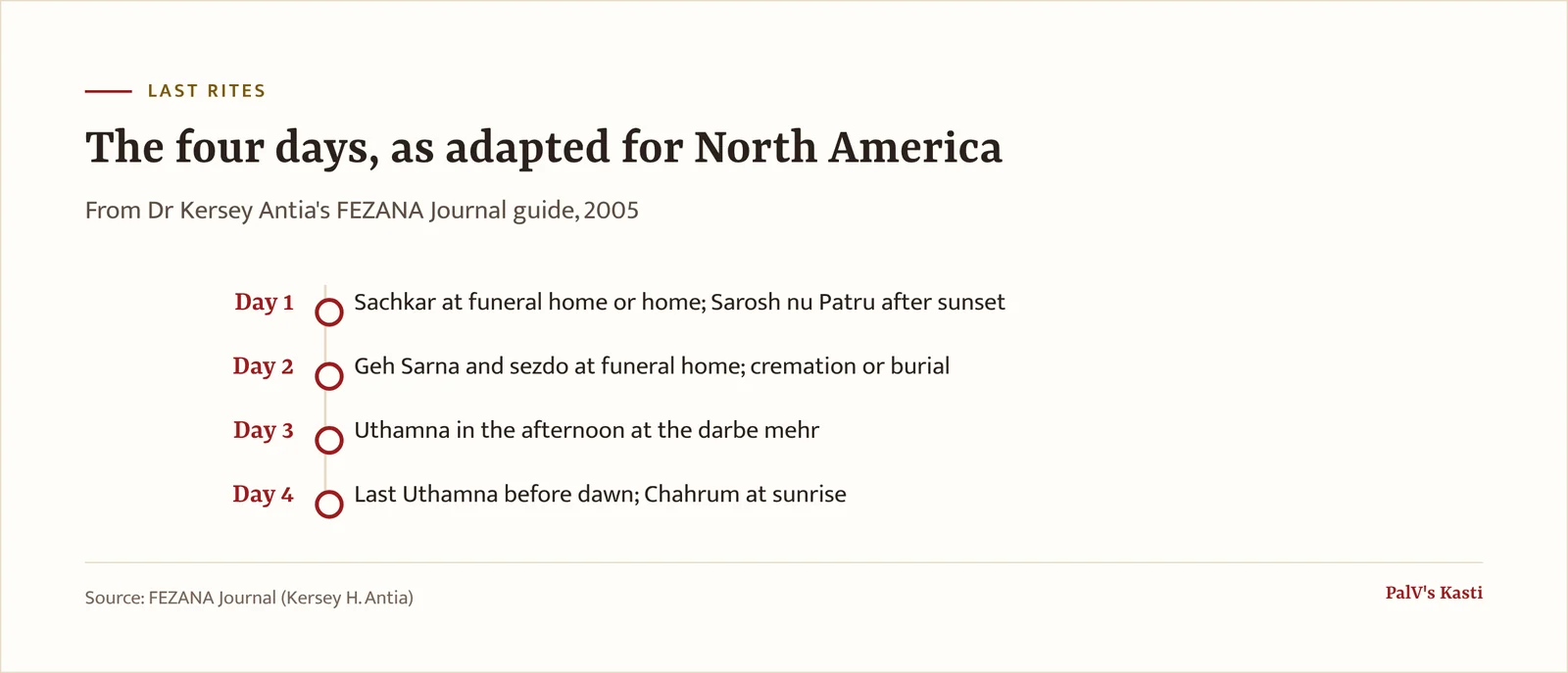
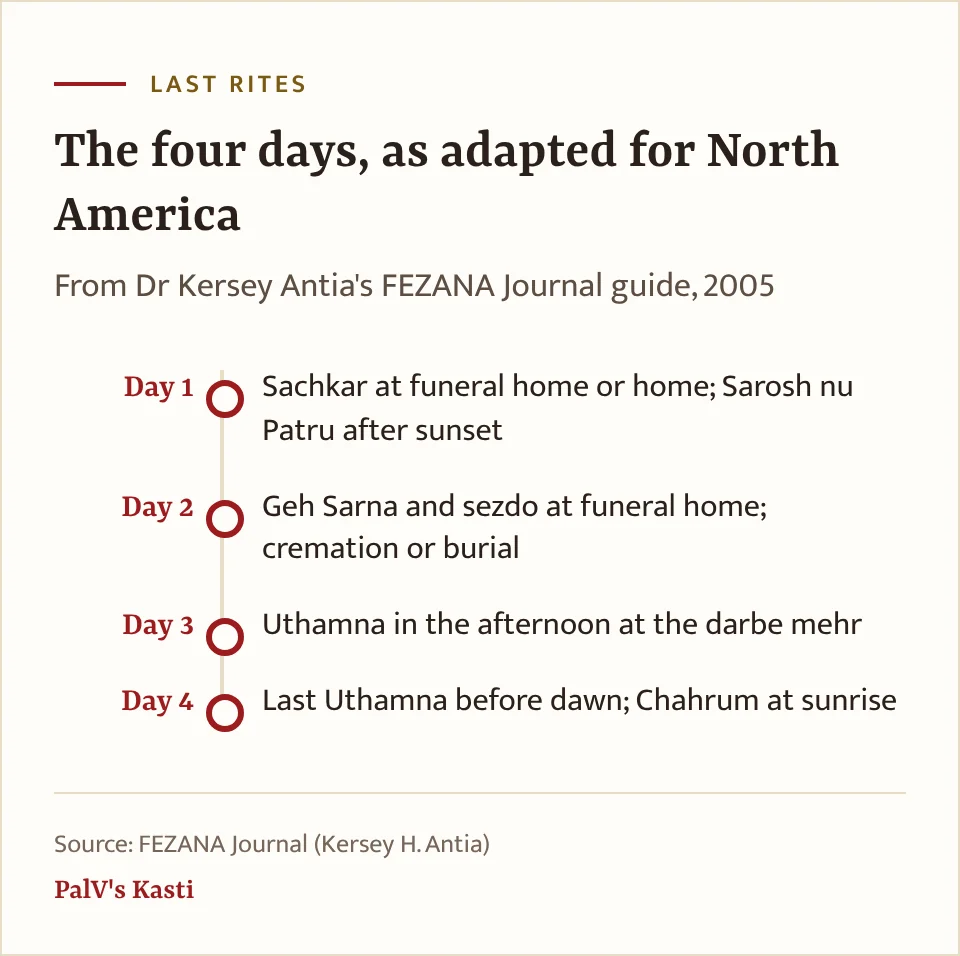
- Day 1: sachkar at the funeral home or at home, ideally in the same or the next gah after death. Sarosh nu Patru after sunset at the darbe mehr.
- Day 2: the Paydast with the Geh Sarna at the funeral home in daylight, then the sezdo, the final homage by family and friends. After it the body goes by hearse to the crematorium or cemetery. Sarosh nu Patru again after sunset.
- Day 3: Uthamna, usually in the afternoon (Uzirin gah) at the darbe mehr, sometimes followed by a memorial service with eulogies and donations to charity.
- Day 4: the last Uthamna just before dawn, then the Chahrum at sunrise.
Where there is no darbe mehr, Antia wrote, these prayers can be done at home. The full traditional order as kept in India is covered in our guide to Parsi death rituals.
The sachkar at a funeral home
In North America the sachkar is done by close relatives, men for a man and women for a woman where possible, according to Antia's guide. The family brings the white clothes, the Navjote.">sudreh and kusti, a divo (oil lamp) and a small afargan with sandalwood and frankincense. Antia notes that only the funeral home's authorised staff may move the body under local rules, so contact with non-Zoroastrians after death can rarely be avoided. In Chicago, he wrote, the association made special arrangements with a funeral home so the family could perform the sachkar there.
The Geh Sarna in the funeral home
J.J. Modi, writing on Bombay practice in 1922, describes the Geh Sarna as two priests, linked by a paiwand and wearing the padan over the mouth, reciting the Ahunavaiti Gatha at a distance from the body. Antia's guide keeps that core and sets it in the main hall of the funeral home or the prayer room of the crematorium or cemetery. He adds that the body's head should never point north, a divo should burn near the head, background music should be switched off, and flowers or wreaths should not be placed on the casket. If no mobeds are available, his guide says two lay Zoroastrian men may recite the Geh Sarna. The funeral home's staff then close the casket and carry it to the hearse.
At the crematorium or the cemetery
At a crematorium, Antia describes the casket being opened once more in the antechamber while the mourners, led by the mobeds, recite Ashem Vohu, Yatha Ahu Vairyo and the Homage unto the Urvans. The ashes reach the family a few days later. Antia's guide lists the options as keeping them in an urn, burying them in a family or community plot, or scattering them where local rules allow. For a burial, the grave is lined with cement-like slabs before the cemetery staff lower the casket. Afterwards, his guide says, everyone who attended should wash, do the Padyab Kusti, bathe and change before going back to normal work.
Practice varies between families and Agiaries; your family priest's guidance comes first.
Do Zoroastrians in America cremate or bury their dead?
Both, and there is no single rule. Antia wrote that neither priests nor laity agree on which method better fits Zoroastrian thought, and that families sometimes combine them by cremating the body and burying the ashes. His own view, set out in a FEZANA Journal commentary in 2005, is that dokhmenashini alone avoids polluting any element of nature, so every other method is a lesser evil. He called cremation "the second best alternative" and burial worse, because it pollutes the earth, and nearby water, for decades and needs individual plots, coffins and upkeep.
Where burial is the only choice, Antia advised surrounding the grave with cement-concrete blocks, as is done in Iran. On ashes he held a firm line: burying cremated ashes is, in his words, "a very un-Zarathushti practice". He suggested that each association keep one small garden plot where the ashes of all its dead could be placed together, closer in spirit to the Tower of Silence. These are Antia's own views, and his guide still lists burial of ashes among the family's options.
Practice varies between families and Agiaries; your family priest's guidance comes first.
Can a body be flown to India or Iran instead?
It has been done, but rarely. Antia's 2005 guide records that on rare occasions the bodies of Parsi Zoroastrians were flown to Mumbai for dokhmenashini. That needed special arrangements with the airline, Doongerwadi and the Bombay Parsi Punchayet. It also mentions a few families who sent their dead to Iran for burial in a Zoroastrian aramgah. We have no current source on the cost, the paperwork or whether these arrangements are still offered, so confirm directly with the BPP before planning on it.
Prayers are easier to send home than the body. Antia notes that the inner liturgies, such as the Yasna and Vendidad, can only be performed in fire temples in India or Iran, and that some Agiaries in India and the Dadar Madressa offer pre-paid plans for death ceremonies over several years. He advises against holding the same ceremonies in more than one place.
How do local Zoroastrian associations help families?
Antia's first step for a bereaved family is to call the nearest Zoroastrian association and the chosen mobeds, who plan the four days and tell the community. He wrote that some associations have set up arrangements with a crematorium and bought plots in a cemetery. The Zoroastrian Association of Chicago, for one, bought a few burial lots in a local cemetery and arranged cremation with the crematorium that serves it.
A 2026 example comes from Ontario. The Zoroastrian Society of Ontario invited members to a funeral pre-planning seminar on 29 August 2026 at the Mehraban Guiv Darb e Meher, presented by Chapel Ridge Funeral Home & Cremation Centre in Markham. According to the society's website, the funeral home has extended preferred pricing to Zoroastrian community members. In Britain, Boyce noted in 1993, the London community has its own chapel at Brookwood cemetery. For how these communities grew, see our post on the Zoroastrian diaspora.
What can a family plan in advance?
Antia's guide recommends a few decisions well before they are needed:
- Choose burial or cremation and tell your relatives, ideally in your will.
- Keep the details of a funeral home and a crematorium or cemetery to hand. You may want to visit and compare costs first.
- Keep a set of sachkar clothes ready: a sudreh and kusti, white cap or scarf, white shirt or blouse, white trousers or skirt, and a white bedsheet. Antia specifies clean, used clothes, not new ones.
- Embalming is not needed, he notes, since the aim is to complete the disposal within a day or two, and an elaborate, expensive casket should be avoided. His guide gave 2005 funeral home costs of US$3,000 to US$4,000, plus at least US$650 for a casket. Expect today's prices to be higher.
To this we would add only practical points: save your association's and your mobed's numbers on more than one family phone, and ask your association now whether it already has an arrangement with a local funeral home.
Frequently asked questions
How are Zoroastrian funerals done in the US and Canada?
The body is taken to a funeral home, where relatives do the sachkar and two mobeds recite the Geh Sarna in daylight. A hearse takes it to a crematorium or cemetery. The Uthamna on the third day and the Chahrum at sunrise on the fourth are held at the darbe mehr or at home, per Dr Kersey Antia's 2005 guide.
Do Zoroastrians cremate or bury in America?
Both are used, because there is no Tower of Silence in North America. Dr Kersey Antia wrote that priests and laity do not agree on which is better. He himself saw cremation as the second-best option after dokhmenashini, and advised a cement-lined grave where burial is the only choice available.
Can a body be flown to India for dokhmenashini?
Dr Kersey Antia's 2005 guide records that this has happened on rare occasions, once the airline, Doongerwadi and the Bombay Parsi Punchayet had agreed to it. A few families have also sent the dead to Iran for burial in a Zoroastrian aramgah. Check current rules and costs with the BPP directly before relying on this.
Who can recite the Geh Sarna if no mobed is available?
Dr Kersey Antia's guide for North America says that in the absence of mobeds, two lay Zoroastrian men may perform the Geh Sarna, reciting the Ahunavaiti Gatha as a pair joined by a paiwand. Practice varies between families and Agiaries, so ask your association's priests first; your family priest's guidance comes first.
What happens to the ashes after a Zoroastrian cremation?
The crematorium returns the ashes to the family a few days later. Antia lists the family's options as an urn, a family or community plot, or scattering where local rules allow. In his own view, burying cremated ashes is un-Zarathushti, and he suggested one shared garden plot for each association.