 PalV's Kasti
On this page
- How many Zoroastrians live outside India and Iran?
- How did trade first carry Parsis abroad?
- When did Zoroastrians first come to Britain?
- Why did Zoroastrians leave India, Pakistan, East Africa and Iran?
- Where do Zoroastrians live in North America?
- Where else have Zoroastrians settled?
- Is the diaspora growing while India's Parsis decline?
- Frequently asked questions
Outside India and Iran, the largest Zoroastrian communities today are in North America, Britain and Australia, with smaller ones in Pakistan, the Gulf states, New Zealand, Singapore, Hong Kong and parts of Europe. Professor Almut Hintze of SOAS describes the Zoroastrian diaspora as forming in two waves. From around 1850, communities grew up along British imperial trade routes in China, Sindh, East Africa and Britain. After the Second World War a second wave went to Canada, the USA, Australia, Germany and Britain, mostly for study and work, joined by families leaving Pakistan, East Africa and, after the 1979 revolution, Iran. The latest censuses count 7,285 Zoroastrians in Canada (2021), 4,088 in England and Wales (2021) and 2,986 in Australia (2021).
શહેરેવર રોજ
Shehrevar Roj, Tir Mah · 1396 Y.Z.
How many Zoroastrians live outside India and Iran?
There is no single count. The censuses of Canada, England and Wales, and Australia list Zoroastrians as a separate group, and they give the firmest numbers we have.
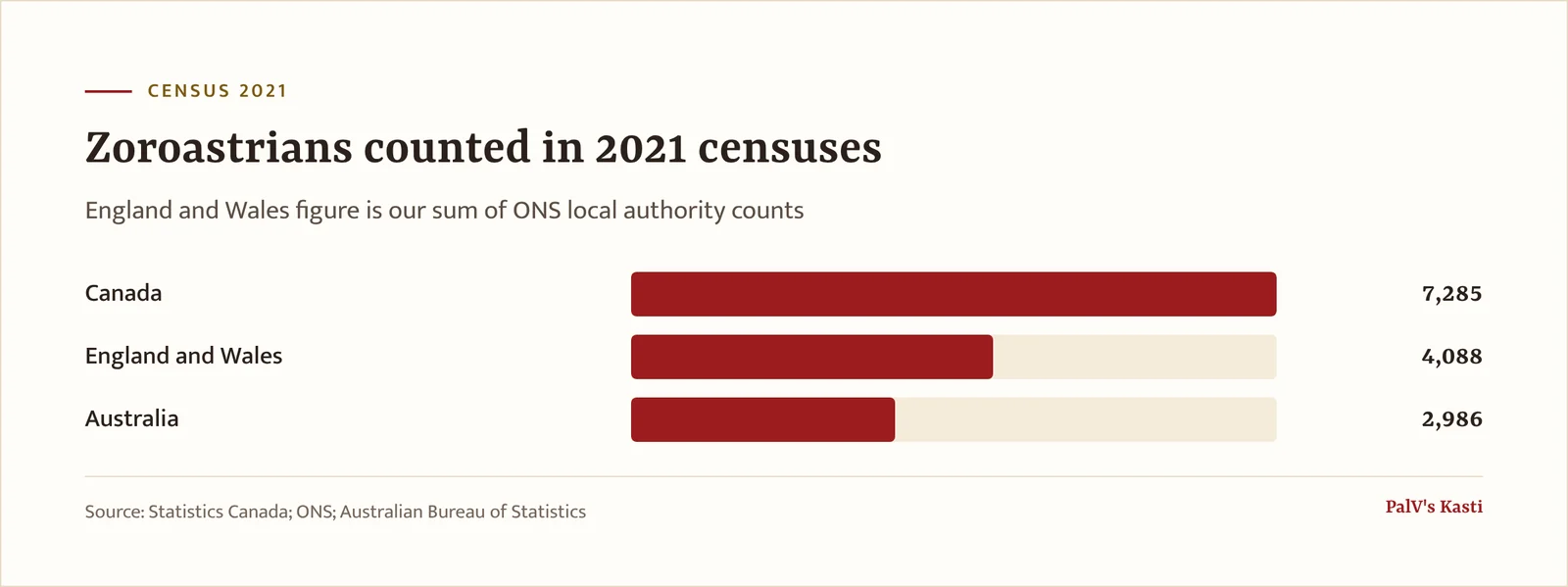

- Canada, 2021: 7,285 Zoroastrians, according to Statistics Canada. Of these, 5,730 were first generation, which means born outside Canada.
- England and Wales, 2021: 4,088, which is our sum of the "Other religion: Zoroastrian" line across every local authority in the Office for National Statistics table TS031. The figure covers England and Wales only, not the whole UK.
- Australia: 2,732 in 2016 and 2,986 in 2021, from the Australian Bureau of Statistics.
For the United States, the figures we have come from community surveys. The best known is the world population table compiled by Roshan Rivetna for the FEZANA Journal (Fall 2013). Its 2012 column gives 14,405 for the USA, 6,442 for Canada, 5,500 for Great Britain, 2,577 for Australia, 1,900 for the Gulf region, 1,675 for Pakistan and 1,231 for New Zealand. FEZANA itself warns that the survey is not a census and that the data received may be incomplete or inconsistent. Estimates for North America vary: Jamsheed Choksy of Indiana University told the Associated Press in 2022 that the United States and Canada together were home to more than 30,000 Zoroastrians.
World totals differ by source. Professor Almut Hintze of SOAS put the community at about 130,000 worldwide in a 2016 British Academy article. Harvard's Pluralism Project says fewer than 200,000. The FEZANA table gives 111,691 for 2012, or 121,962 if Iran's 2011 census figure is used instead of the community estimate. India holds the largest share by far, and our page on the Parsi population in India covers those census figures.
How did trade first carry Parsis abroad?
The earliest settlements outside India grew out of trade, and burial grounds are one way historians trace them. In his Encyclopaedia Iranica history of the early Parsi communities, John R. Hinnells counts 24 burial grounds bought by Parsis, all but one outside the Bombay Presidency. Macao got one in 1829 and Colombo in 1846. He names Calcutta (1822) and Aden (1847) as the few distant places where a dakhma was opened, both centres with wealthy leaders.

China and Hong Kong
FEZANA's teaching material on Zoroastrians around the world says Parsi traders kept warehouses and homes around Canton from the 1790s and began settling in Shanghai in 1847, once the port opened to foreigners. When the centre of the China trade moved to Hong Kong, the Parsi population there grew with it.
East Africa
Zanzibar was the gateway. Farouk Topan, writing in Encyclopaedia Iranica, dates Parsi settlement there to about 1845, and FEZANA names the first settler as Maneckji Mistry, a trader from Surat who moved that year. The Zanzibar Parsis consecrated a fire, set up burial places and formed an anjoman, and families later spread to the mainland. FEZANA also notes that Freddie Mercury was born Farrokh Bulsara in Zanzibar before his family moved to Britain.
Singapore
FEZANA's lesson records the first known Parsi in Singapore in 1827 and a Parsi Lodge near Palmer Road for merchants and religious ceremonies. It says the Parsi Zoroastrian Association of South-East Asia was founded on 29 May 1954, and that a Parsi association formed that year took over the management of the Parsi Lodge charity.
When did Zoroastrians first come to Britain?
The first recorded Zoroastrian in Britain arrived in 1724. Both the Zoroastrian Trust Funds of Europe (ZTFE) and FEZANA give that year, and FEZANA names him as Nowroji Sett. For more than two centuries afterwards the community stayed tiny. ZTFE estimates there were around 50 Zoroastrians in Britain in 1861 and no more than 200 by the end of the Second World War, mostly traders from the Cama, Tata and Wadia families plus a few professionals.

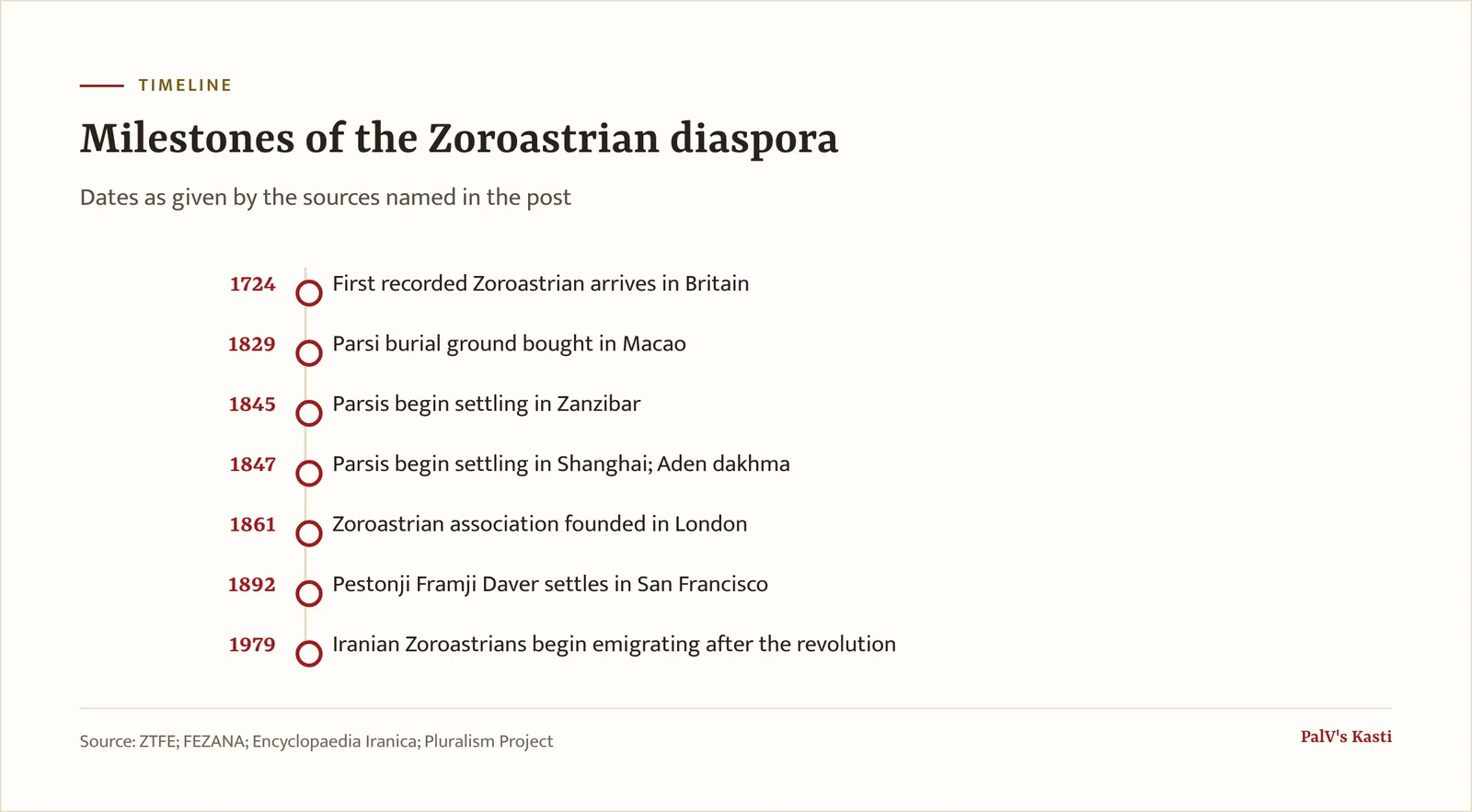

Those few organised early. In August 1861, ZTFE says, Muncherji Hormusji Cama asked Dadabhai Naoroji and others to set up a religious fund for Zoroastrians in Europe. The South Asian Britain: Connecting Histories database records the Zoroastrian Association founded in Kensington that year with Naoroji as its first president. ZTFE, which traces its own origins to that 1861 appeal, describes itself as the oldest religious voluntary organisation of South Asian origin in the UK. Its Zoroastrian Centre is in the London Borough of Harrow. FEZANA adds that the World Zoroastrian Organisation (WZO) came into being in 1980 and is also based in London.
Is there Zoroastrianism in the UK today?
Yes, and London is its centre. Hintze calls the capital one of the most important Zoroastrian centres outside India and Iran. The 2021 census bears that out: by our sum, 2,047 of the 4,088 Zoroastrians in England and Wales live in London's local authority areas, with Barnet (210), Harrow (173) and Westminster (154) the largest. A BBC report from May 2026, on a Zoroastrian migration exhibition at Headstone Manor in Harrow, put the UK community at about 5,000.
ZTFE says its membership grew sharply only in the last half-century or so, first with arrivals from India and Pakistan, then from East Africa, Aden and other former colonies, and from 1979 from Iran.
Why did Zoroastrians leave India, Pakistan, East Africa and Iran?
The second wave had both pull and push. The pull was education and careers. Harvard's Pluralism Project says the 1947 Partition brought fewer opportunities at home, and that many Parsis then went to Britain, with smaller numbers heading to North America. It also notes that from the 1950s and 1960s many Parsis came to the United States for study and jobs.
The push came from political change. Hintze names three causes: growing Islamisation in Pakistan after Independence, the aftermath of the 1979 revolution in Iran, and Black African policies in East Africa. The Pluralism Project says most Iranian Zoroastrians who left after 1979 went to North America, and FEZANA says most of those who came to the United States settled in California. FEZANA adds that more Zoroastrians moved to the Gulf after 1979, and that Zoroastrians from India, Pakistan and Iran now live in the UAE, Oman, Qatar, Bahrain and Kuwait, mostly practising at home.
For the much older journey that brought Zoroastrians from Iran to Gujarat in the first place, see our page on Parsi migration to India.
Where do Zoroastrians live in North America?
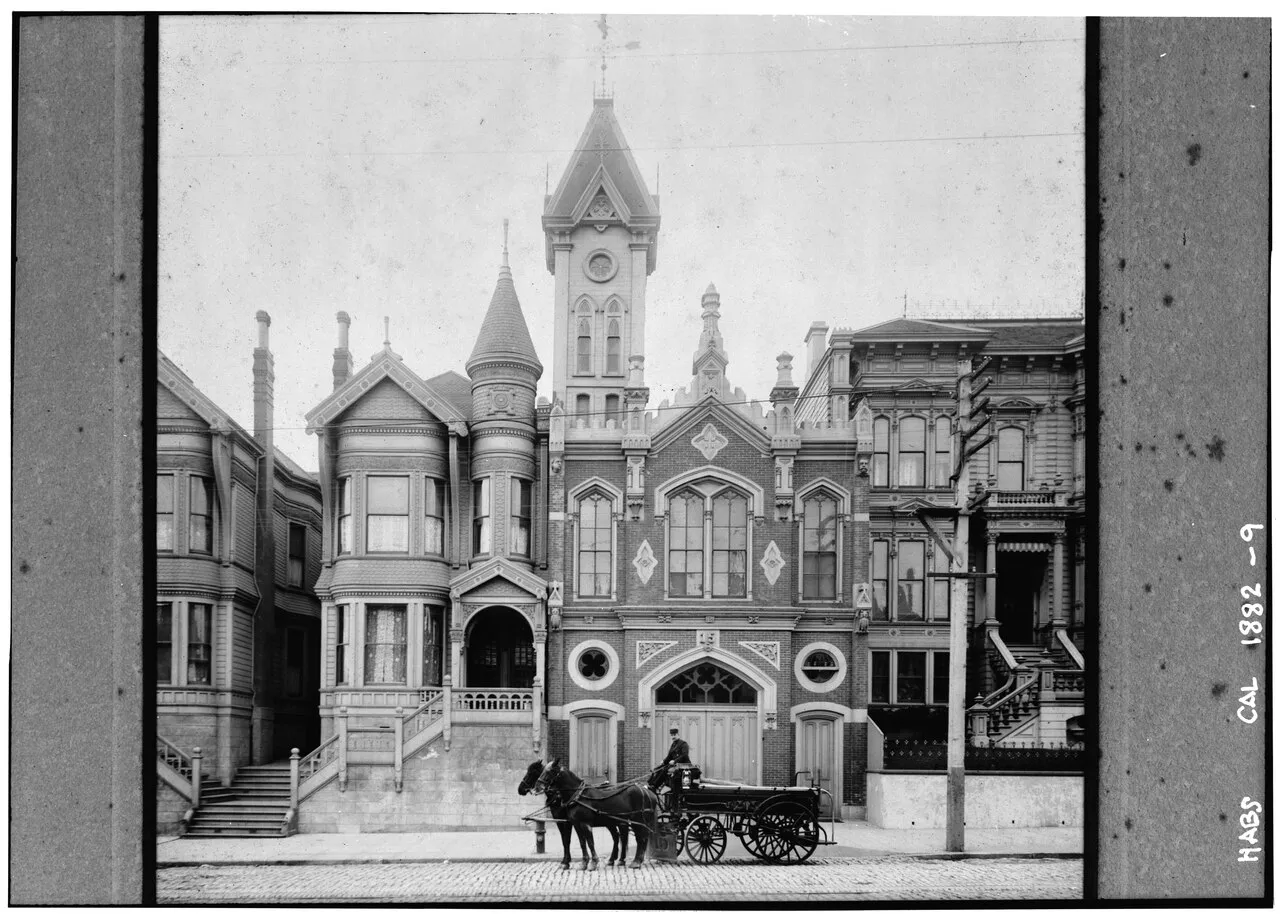
FEZANA names Pestonji Framji Daver as the first known Zoroastrian to settle permanently in North America, and the Pluralism Project also records him arriving in San Francisco in 1892. Numbers stayed small until the student and professional migration of the 1950s and 1960s, then rose again with Iranian families after 1979.
In Canada the 2021 census places most Zoroastrians in two cities: 3,895 in the Toronto metropolitan area and 1,535 in Vancouver. Our page on Parsis in Canada tells that settlement story. For the American picture and the role of the continent-wide federation FEZANA, read Zoroastrians in North America, and for women's lives in particular, Zoroastrian women in the US.
Where else have Zoroastrians settled?
Australia's census count rose from 2,732 in 2016 to 2,986 in 2021. Our page on Zoroastrians in Australia looks at how that community keeps its faith going. In New Zealand, FEZANA says the first Zoroastrian arrived in 1877 with his wife and three children and started a hardware business in Auckland, Shroff and Sons, and that migration has risen steadily since 1960.
In continental Europe, Hintze lists Germany among the post-war destinations, and FEZANA mentions Sweden, France and Switzerland, where a Zoroastrian children's education club first met in 2023. FEZANA's 2012 table gives only a combined estimate of 1,000 for Europe and Central Asia. We could not find a reliable count for any single country. One smaller European community has its own page: Zoroastrians in Italy.
Is the diaspora growing while India's Parsis decline?
Two sources point the same way, though the numbers are rough. An Associated Press report from July 2022 said India's Zoroastrian numbers were falling while they were rising in North America, Britain, Australia and New Zealand. FEZANA's survey points the same way, with the USA up 33.5% and New Zealand up 36.8% between 2004 and 2012, while Pakistan fell 21.0% and the Gulf 13.6%.
Hintze, writing to AP by email, said: "Zoroastrians are doing well in the global diaspora." She added that numbers could stabilise, though secularisation and the marriage laws remained threats. How families abroad hold on to prayers, festivals and language is the subject of Diaspora Zoroastrian identity. How newcomers find housing, work and friends through the community is covered in Parsi immigrant support networks.
Frequently asked questions
How many Zoroastrians live outside India and Iran?
There is no single count. The 2021 censuses found 7,285 Zoroastrians in Canada, 4,088 in England and Wales and 2,986 in Australia. For the United States, FEZANA's 2012 community survey estimated 14,405. Smaller groups live in Pakistan, the Gulf, New Zealand, Singapore and Europe.
Where is the largest Zoroastrian community outside India?
Iran aside, North America has the largest numbers. FEZANA's 2012 survey put the USA at 14,405, and Canada's 2021 census counted 7,285, most of them in the Toronto and Vancouver areas. In Britain, London is the main centre, holding about half the Zoroastrians counted in England and Wales in 2021.
When did Parsis first go to Britain?
The first recorded Zoroastrian visitor reached Britain in 1724, according to both ZTFE and FEZANA. The community stayed very small for two centuries, around 50 people in 1861 and no more than 200 by 1945 by ZTFE's estimate. It grew sharply after the war with arrivals from India, Pakistan, East Africa and Iran.
Why did Zoroastrians leave Iran and Pakistan?
Professor Almut Hintze of SOAS links the departures to growing Islamisation in Pakistan after Independence and to conditions in Iran after the 1979 revolution. Harvard's Pluralism Project says most Iranian Zoroastrians who left after 1979 went to North America, and FEZANA says most of those arriving in the United States settled in California.
Is there Zoroastrianism in the UK?
Yes. The 2021 census counted 4,088 Zoroastrians in England and Wales, about half of them in London, and a 2026 BBC report put the UK figure at about 5,000. The Zoroastrian Trust Funds of Europe, which traces its roots to 1861, runs the Zoroastrian Centre in Harrow, north-west London.


