PalV's Kasti

On this page
A Parsi charitable trust is money or property that a Parsi donor, family or community body has set aside for a charitable purpose and placed with trustees. Parsi charitable trusts in Mumbai today are public trusts under the Maharashtra Public Trusts Act, 1950, and answer to the state's Charity Commissioner. The best known is the Bombay Parsi Punchayet, which Encyclopaedia Iranica calls the largest Zoroastrian institution in modern history and says administered about 1,000 endowments in 1961. The records we cite show Parsi money paying for temples, dharamshalas, schools, hospitals and flats, and some of it, such as Jamsetjee Jeejeebhoy's 1838 dharamshala near Poona, was meant for travellers of every community.
શહેરેવર રોજ
Shehrevar Roj, Tir Mah · 1396 Y.Z.
What is a Parsi charitable trust?
"Parsi trust" describes who founded a trust and, often, who benefits. Under the 1950 Act it is a public trust, regulated like the public trusts of any other community.
Two kinds have existed side by side for a long time. Writing in 1884, the historian D. F. Karaka described funds for poor Parsis "most of which" were held by the trustees of the Parsi Panchayet, with others in the hands of trustees chosen by the donors themselves. Both kinds exist today. The Bombay Parsi Punchayet's own election scheme gives its legal name as the "Funds and Immoveable Properties of the Parsee Punchayet of Bombay" and calls it a registered public charitable trust. Its website also lists a separately named trust, the Seth P. F. Davar Charitable Trust. Family-founded trusts sit outside it. The Tata Trusts, for example, are a group of 14 trusts, among them the Sir Ratan Tata Trust, the Sir Dorabji Tata Trust and the Bai Hirabai Jamsetji Tata Navsari Charitable Institution, all chaired by Noel Tata, according to the Tata Trusts website.
Which law governs Parsi charitable trusts in Mumbai?
The Maharashtra Public Trusts Act, 1950 (Act XXIX of 1950, whose short title was earlier the Bombay Public Trusts Act, 1950) governs them. The points below are from the Charity Commissioner's official print of the Act, as modified up to 19 December 2018. The Maharashtra Public Trusts (Amendment) Act, 2025 (Mah. Act XXII of 2025), published on the Charity Commissioner's site, amends sections 41AA and 58 (trust hospitals and contributions to the administration fund) and leaves the sections below as they were. We have not checked for other changes after 2018, so read the current Act before relying on any section.
- Registration (section 18). The trustee of a public trust must apply to register it with the Deputy or Assistant Charity Commissioner of the region.
- The regulator (section 3). A Charity Commissioner appointed by the State Government superintends how the Act is carried out across Maharashtra.
- Accounts (sections 32 and 33). Trustees keep regular accounts, balanced each year on 31 March unless the Commissioner fixes another day, and audited.
- Property (section 36). No sale, exchange or gift of the trust's immovable property, and no lease of a building or non-agricultural land for more than three years, is valid without the Charity Commissioner's prior sanction.
Before 1950 there was a Parsi-specific law. The 1950 Act lists the Parsee Public Trusts Registration Act, 1936 (Bombay Act XXIII of 1936) in its Schedule A. Trusts registered under that 1936 Act are treated as registered under the 1950 Act, and cases pending under it were transferred to the Charity Commissioner.
How trustees are chosen, removed and held to account, and the disputes that follow, are covered in our guide to Zoroastrian trust management. This is general information, not legal advice; for a specific case, speak to a lawyer.
What did the Bombay Parsi Punchayet's trust funds pay for?
Encyclopaedia Iranica, in J. R. Hinnells's 1989 entry, calls the Bombay Parsi Punchayet "the largest Zoroastrian institution in modern history" and gives a set of dated figures:
- about 1,000 endowments administered in 1961, some of them in rural Gujarat
- 1,797 flats in the 1980s
- twenty-four committees overseeing the work
- assets estimated at Rs 88,090,560 in 1983, with a Bombay office staff of about 200
The same entry says the Punchayet gave substantial support to hospitals, hostels, schools and a madressa for training priests, and funded temples, funeral grounds and countless grants to individual poor Parsis. Those are 20th-century figures. No current official count of its endowments was available to us. Its website today lists a medical help scheme for Parsi and Irani Zoroastrians who cannot afford treatment, paid as a lump sum once a year. Our Bombay Parsi Panchayat guide covers the institution itself.
What kinds of charity did Parsis fund?
In Surat, Iranica records, the three main forms of Parsi charity were building temples, dakhmas and dharamshalas, with many smaller causes besides. Navsari drew money from wealthy Parsis living elsewhere. Sir Jamsetjee Jeejeebhoy, in his later years, gave widely there, including a dar-e mehr, and paid the Gaekwad 11,907 rupees so that Navsari's Parsis would not have to pay the poll tax.
Medical care was another strand. Iranica lists two leper wards at the David Sassoon Asylum funded by Dinbai Petit, ten sanatorium cottages at Lonavla given by J. H. Mody in 1896, and an eye hospital and dispensary at Ahmedabad funded by Naoroji P. Vakil. In Karachi, Edulji Dinshaw's main charities were medical. Karaka's 1884 history adds Pestanji Hormasji Kama's offer of Rs 1,60,000 to build a hospital in Bombay where women would be treated by women doctors.
Some of that money went abroad. Iranica's entry on Manekji Limji Hataria says Sir Dinshaw Maneckji Petit founded the Bombay-based Amelioration Society in 1853. FEZANA's teaching material gives its full name, the Society for the Amelioration of the Condition of Zoroastrians in Persia, and says it funded Hataria's journey to Iran. Iranica also records a fund started in Karachi in 1888 for Iranian Zoroastrian refugees. Endowed prizes and medals are another strand, told in our post on Parsi prize medals. Why Zoroastrians give at all is a question of faith, which our Charity in Zoroastrianism post takes up.
How did Parsi philanthropy shape India beyond the community?
Some Parsi giving was open to everyone. Iranica notes that Jeejeebhoy paid for a dharamshala near Poona in 1838 "for travelers of all communities", that F. S. Parakh gave 25,000 rupees in 1864 for another such dharamshala in Surat, and that Parsi charity in Poona was spread more across communities than in Bombay. Karaka, writing in 1884, called the character of Parsi charity "catholic", meaning broad, while it still looked after its own people.

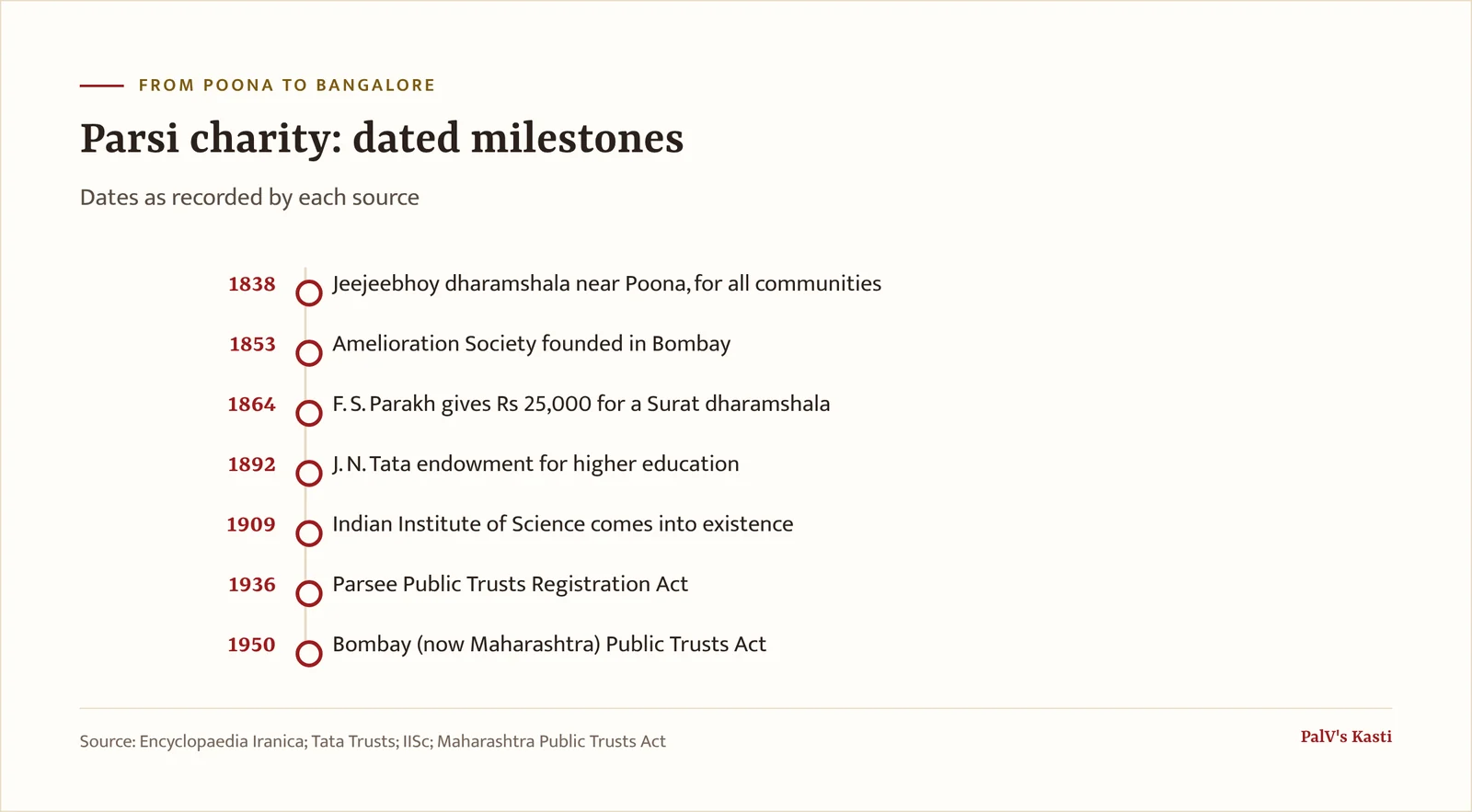
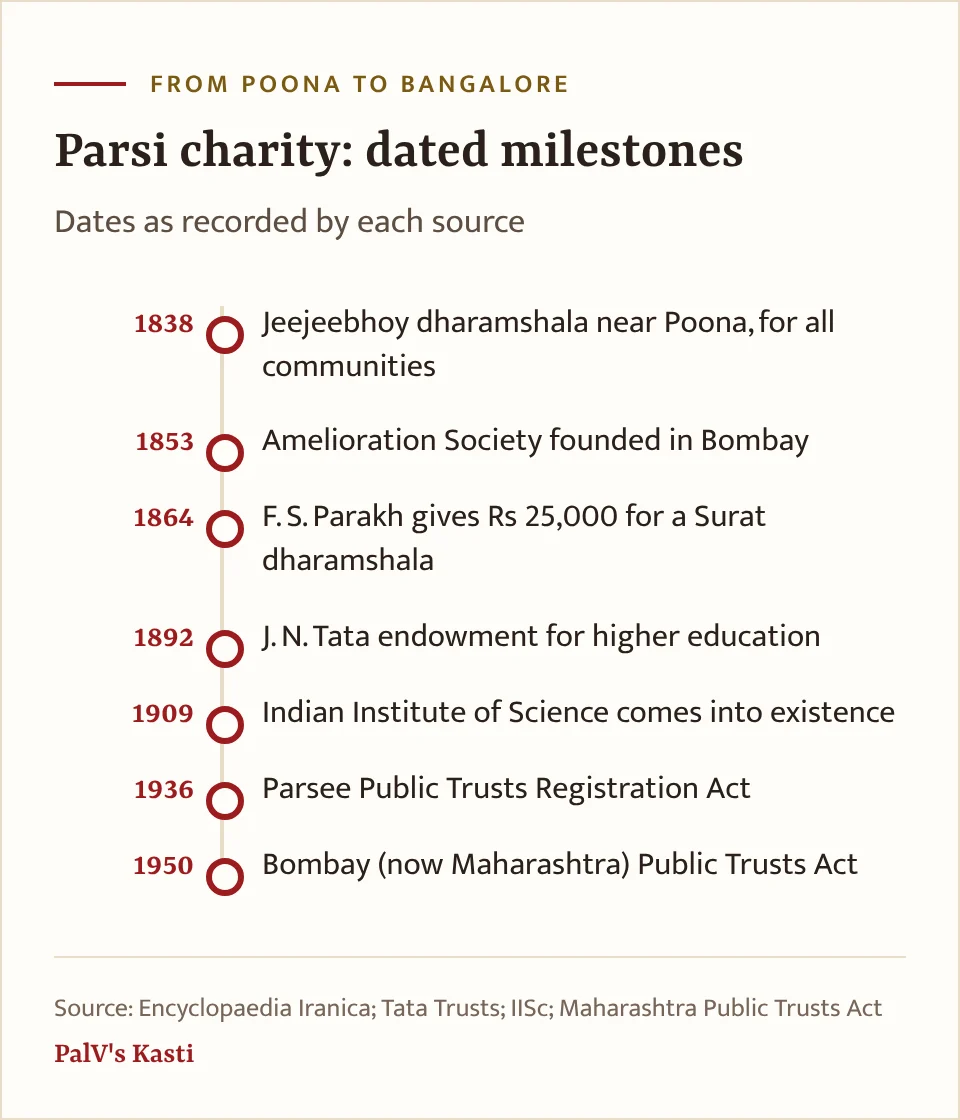
The best-known example is education. According to Tata Trusts, Jamsetji N. Tata set up an endowment in 1892 to help meritorious Indian students "of all castes and creeds" study in England. The Indian Institute of Science, which the institute says he decided to set up, came into existence on 27 May 1909 in Bangalore and took in its first 24 students in 1911, the institute's own history page says. The Tata Trusts website quotes Sir Dorabji Tata's wish that his trust's money go to learning, relief and other charitable purposes "without any distinction of place, nationality or creed".
The people behind these gifts are profiled in our post on Parsi philanthropists, and one long-running family charity has its own post on Cowasjee charity. Whether Parsi charity culture helps or harms the community today is a separate question, set out in each side's own words in our post on Parsi charity critique.
Frequently asked questions
What is a Parsi charitable trust?
It is a public charitable trust founded by Parsis, usually for Parsi or Zoroastrian welfare, education, health, housing or religious places, though some were open to all communities. Some are held by the Bombay Parsi Punchayet as named endowments. Others are separate trusts founded by families or individual donors, such as the trusts in the Tata Trusts group.
Which law governs public trusts in Mumbai?
The Maharashtra Public Trusts Act, 1950 governs them. Trustees must apply to register the trust (section 18), keep accounts balanced each year on 31 March and audited (sections 32 and 33), and get the Charity Commissioner's prior sanction to sell, exchange or gift the trust's immovable property (section 36).
Who regulates Parsi trusts in Maharashtra?
The Charity Commissioner of Maharashtra, appointed by the State Government under section 3 of the Maharashtra Public Trusts Act, 1950, superintends public trusts across the state. Registration applications go to the Deputy or Assistant Charity Commissioner of the region. Parsi trusts follow the same rules as public trusts of every other community.
Was there ever a separate Parsi trust law?
Yes. The Parsee Public Trusts Registration Act, 1936 (Bombay Act XXIII of 1936) applied before the 1950 Act. The 1950 Act lists it in Schedule A, treats trusts registered under it as registered under the new law, and moved cases pending under it to the Charity Commissioner.
How many endowments does the Bombay Parsi Punchayet manage?
The last published figure we found is old. Encyclopaedia Iranica's 1989 entry says the Bombay Parsi Punchayet administered about 1,000 endowments in 1961, including some in rural Gujarat. We could not find a current official count on the Punchayet's website, so treat the 1961 number as history.