PalV's Kasti
On this page
There is no settled answer, and the community's own writers disagree. The sharpest critique came in Parsi Times in August 2017, when philanthropist Dinshaw K. Tamboly argued that well-meant doles may be "creating dependency and destroying personal initiative". The older view, set down by historian D.F. Karaka in 1884, is that Parsis "have always taken care of their own poor", and that Bombay's census recorded only a handful of Parsi beggars. A 2026 Parsi Times essay by Noshir H. Dadrawala credits community funds with giving people "financial security and dignity", and also says giving "must empower rather than encourage dependence". Below we set out each side in its own words. We don't pick a winner.
શહેરેવર રોજ
Shehrevar Roj, Tir Mah · 1396 Y.Z.
What do critics say is wrong with Parsi charity?
Tamboly's essay, "Have Our Charities Become Toxic?", was written for the Navroze issue of Parsi Times. His main complaint is that nobody checks results. The outcomes of the community's charities, he wrote, "are almost entirely unexamined", and people who administer aid "quietly admit that it may be hurting more than helping".
He separates two ideas that are often used as if they meant the same thing. Charity, in his account, eases the pain of a problem. Philanthropy goes after its cause: the old difference between handing someone a fish and teaching them to catch one. The community, he wrote, responds quickly to a crisis but often fails to move from relief to long-term development, and when that shift does not happen in time, "our compassion becomes toxic". He went further and said that free aid over decades had worn down self-sufficiency and the will to start businesses.
Tamboly said he was building on an editorial by Parsi Times editor Anahita Subedar, published on 22 April 2017 under the title "This Toxic Sense Of Entitlement". Her target was an attitude more than any institution. She noted that "We have grants for numerous facilities. We have doles", and that the BPP tells the community it will cater to it, which she said it largely does. Her worry was that privileges meant to ease struggle had become "an excuse to sit back".
What did the 2009 TISS study find?
Tamboly backed his argument with figures from a Tata Institute of Social Sciences (TISS) study published in 2009. We have not been able to open the study itself, so these are the numbers as he quoted them:
- Fewer than one working member per family on average (0.93).
- About two-fifths of households with no working member at all, and two-thirds of those with no regular income.
- A large share of members past working age, and more than a quarter with some form of disability.
- Almost 90% of the economically challenged had studied only up to higher secondary level.
Tamboly himself traced the growing dependency ratio to the community's "skewed demographic profile" and declining numbers. And he did not argue for ending all support: the model he praised keeps charity for the aged and infirm, and offers interest-free help to the able-bodied.
What is the case for Parsi charity as it has worked?
One defence rests on the historical record as Parsis themselves wrote it. In his History of the Parsis (1884), Karaka said the community never asked followers of other religions to fund its institutions, and that dharamshalas and funds, most of them held by the trustees of the Parsi Panchayat, looked after the poor, aged and blind. He cited the then latest Bombay census: of 6,618 male and 2,966 female mendicants in the city, only five men and one woman were Parsis.
Karaka also called Parsi giving "catholic", meaning open to people outside the community, while still minding its own needs. You can read more about the people behind that giving in our piece on Parsi philanthropists, and about how the big endowments are set up in our guide to Parsi charitable trusts.
Writing in Parsi Times on 31 October 2026, Dadrawala makes the modern version of this case. He credits community funds with providing "financial security and dignity to those in distress", and says investment in schools, hospitals and housing has strengthened society across generations. In his account, charity gives immediate help to the vulnerable while philanthropy reaches into education, healthcare and livelihoods, and both "remain equally vital".
Is the worry about dependency new?
No. Even Karaka, proud as he was of Parsi generosity, allowed that some might "carry this virtue to a fault", giving freely while forgetting that charity begins at home. He also recorded a small shift away from free provision. The Parsi Girls' School Association first taught all girls free, began charging well-to-do families a rupee a month from 1862, and in 1873 "abolished all free admissions", setting a fee of eight annas for the poorest. When the Education Commission saw the schools, its president W.W. Hunter praised them for giving instruction "not as a charitable dole" but as something worth paying for.
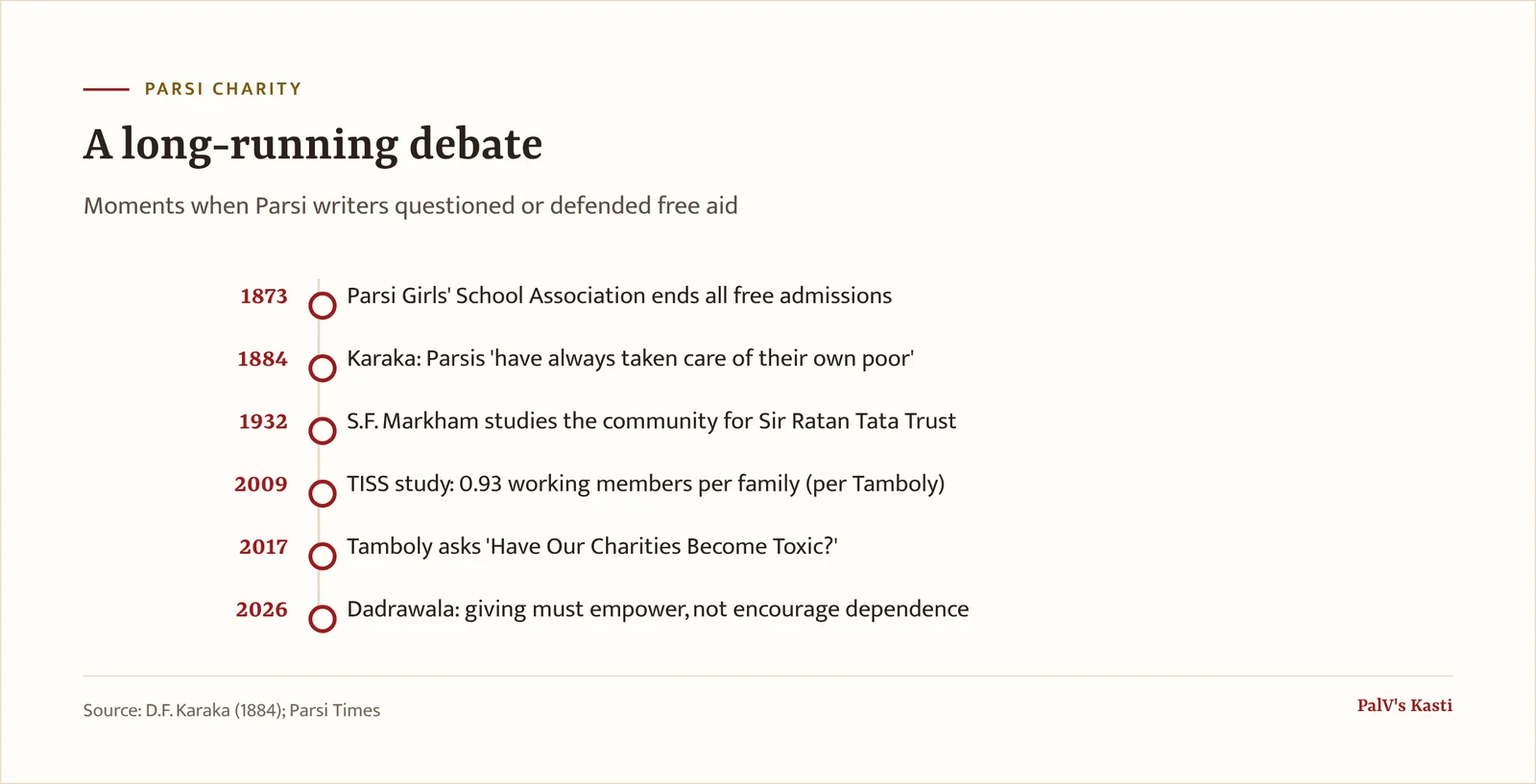

Dadrawala traces the same debate into the twentieth century. He writes that in 1932 the Sir Ratan Tata Trust commissioned S.F. Markham to carry out a sociological study of the community, and that Markham questioned whether recurring handouts "fostered dependency instead of dignity and self-reliance". He also recalls that Jamsetji Tata believed scattered relief, what he called "patchwork philanthropy", such as food in one place and clothing in another, would not bring lasting change.
What do critics propose instead of doles?
Tamboly's main proposal was interest-free loans that help poorer Parsis build small businesses, in place of regular doles. He said the very few trusts that already mix charity for the aged and infirm with such support for the able-bodied had seen "very encouraging" results, though he did not name them or give figures.
Dadrawala's proposals are about how trusts are run. He says charitable institutions must "evolve with changing needs", use their money with care and "measure their impact". Charity, in his words, should offer "a pathway to opportunity, dignity and self-reliance" and never become a permanent crutch.
Whether giving is also a religious duty is a separate question, and we cover it in Charity in Zoroastrianism. For a long-running example of one family's endowment, see our story of the Cowasjee charity.
Frequently asked questions
Has Parsi charity created dependency?
Opinions differ. Dinshaw K. Tamboly argued in Parsi Times in 2017 that decades of free aid had bred an entitlement mentality. D.F. Karaka wrote in 1884 that Parsis had always cared for their own poor, with only six Parsis among Bombay's recorded mendicants. Noshir H. Dadrawala in 2026 credits community funds with dignity but warns against dependence.
What did the TISS study say about Parsi poverty?
As quoted by Dinshaw K. Tamboly, a 2009 Tata Institute of Social Sciences study found less than one working member (0.93) per family, and about two-fifths of households with no working member. A large share of members were past working age, more than a quarter had a disability, and almost 90% had studied only up to higher secondary.
What is the difference between charity and philanthropy in this debate?
In Tamboly's 2017 essay, charity relieves the pain of a social problem, while philanthropy tackles its root cause, the difference between giving fish and teaching fishing. Dadrawala, writing in 2026, uses a similar split: charity gives immediate help to the vulnerable, philanthropy funds education, healthcare and livelihoods. He calls both equally vital.
What do critics suggest Parsi trusts do instead of doles?
Dinshaw K. Tamboly suggested interest-free loans to help poorer Parsis start small businesses, while keeping charity for the aged and infirm. Noshir H. Dadrawala, writing in Parsi Times in 2026, says trusts should adapt to changing needs, manage resources carefully and measure their impact, so that giving opens a path to self-reliance.
Is criticism of Parsi charity a recent thing?
No. In 1884 D.F. Karaka wrote that some Parsis carried charity "to a fault". The Parsi Girls' School Association ended free admissions in 1873. According to Dadrawala, S.F. Markham, commissioned by the Sir Ratan Tata Trust in 1932 to study the community, questioned whether recurring handouts fostered dependency rather than self-reliance.