PalV's Kasti

On this page
- Who are the best-known Parsi philanthropists?
- What did Sir Jamsetjee Jejeebhoy give?
- Who paid for the Mahim causeway?
- What did Sir Cowasji Jehangir Readymoney fund?
- How did the earlier Readymoneys and the Petits give?
- How did Jamsetji Tata fund education and science?
- What did Ardeshir Godrej and Bai Motlibai Wadia give?
- Did Parsi philanthropists give only to Parsis?
- Frequently asked questions
The Parsi philanthropists who did most to shape modern India were a handful of Bombay merchant families and, later, the Tatas. Sir Jamsetjee Jejeebhoy gave to hospitals, rest-houses and relief for people in distress from 1822 until his death in 1859, and his wife paid for the Mahim causeway. Sir Cowasji Jehangir Readymoney put lakhs of rupees into colleges and hospitals. Dinshaw Petit backed dispensaries and even an animal hospital. Jamsetji Tata set up the J.N. Tata Endowment in 1892 and pledged Rs 30 lakh towards the Indian Institute of Science. In 1926 Ardeshir Godrej handed the Tilak Fund Rs 3 lakh, and Bai Motlibai Wadia is credited with founding dispensaries and a maternity hospital. Below, we take each name in turn, with the figures the records actually give.
શહેરેવર રોજ
Shehrevar Roj, Tir Mah · 1396 Y.Z.
Who are the best-known Parsi philanthropists?
This list keeps to people whose gifts are written down with amounts or dates in a source we could open. It is not a ranking. Many more names belong in a full history of Parsi charity, and the trusts these families left behind are explained in our guide to Parsi charitable trusts.
| Philanthropist | Best-known gifts | Period |
|---|---|---|
| Sorabji Mancherji Readymoney | Fed more than 2,000 people a day during a food scarcity | 1790 |
| Sir Jamsetjee Jejeebhoy | Hospital for all classes, Khandala rest-house, relief for people in distress | 1822 to 1859 |
| Lady Jamsetjee Jejeebhoy | Mahim causeway, Rs 1,57,000 | 19th century |
| Sir Cowasji Jehangir Readymoney | Elphinstone College building, University Hall, eye hospital | 19th century |
| Dinshaw Manockjee Petit | Dispensaries, Rs 45,000 for an animal hospital | 1880s |
| Jamsetji Nusserwanji Tata | J.N. Tata Endowment, Indian Institute of Science | 1892 to 1904 |
| Ardeshir Godrej | Rs 3 lakh to the Tilak Fund | 1926 |
| Bai Motlibai Maneckji Wadia | Dispensaries, a maternity hospital | Not dated in our source |
What did Sir Jamsetjee Jejeebhoy give?
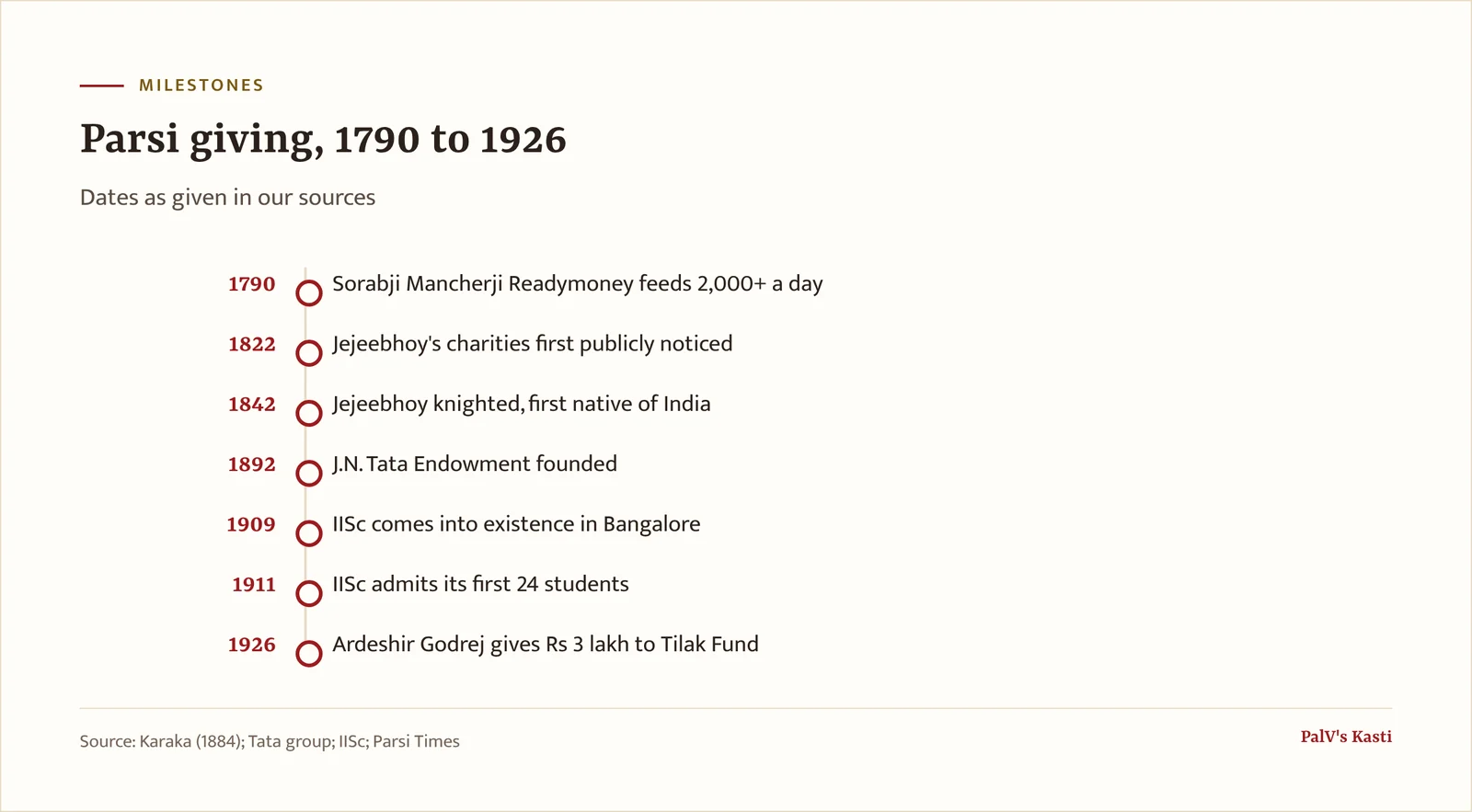
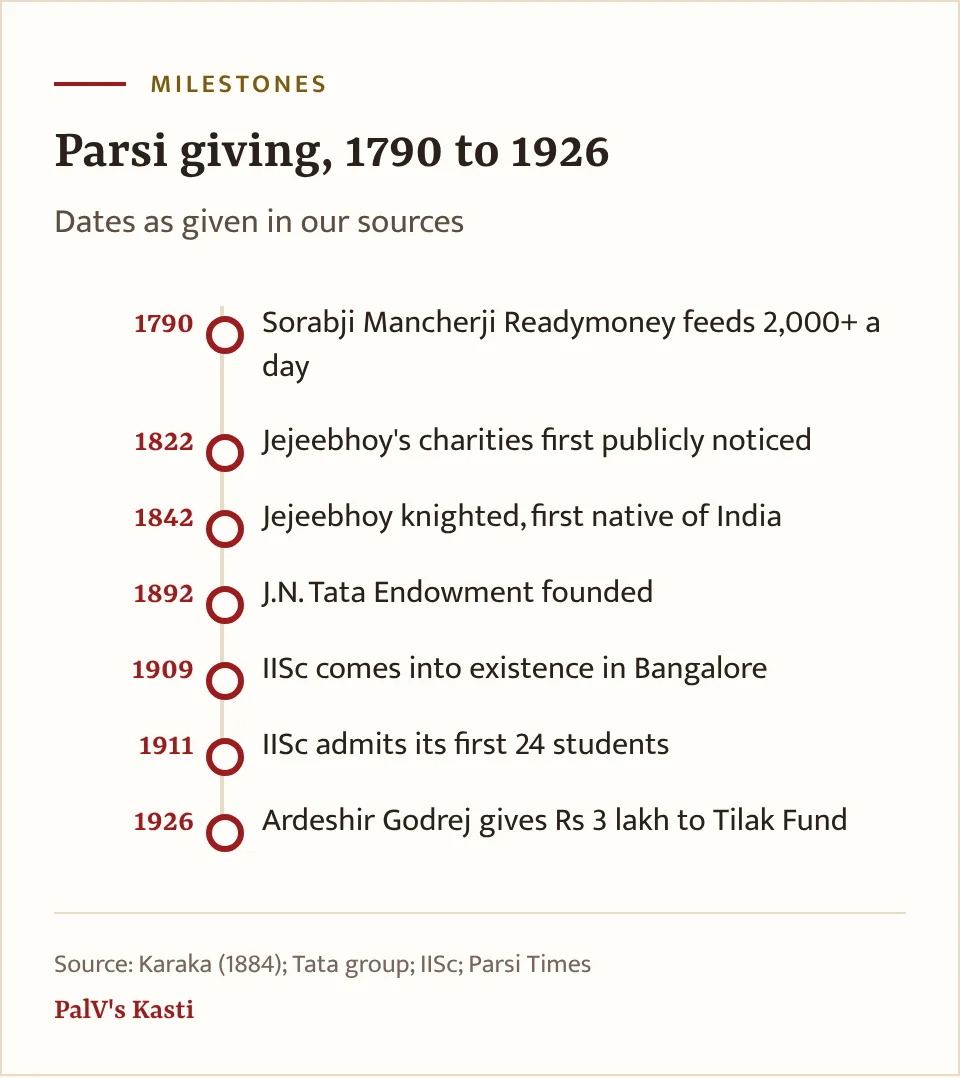
The historian Dosabhoy Framjee Karaka, writing in 1884, says the public began to notice his charities in 1822, and that hardly a year went by without a major gift from then until he died in 1859.
A January 2022 Parsi Times feature in Gujarati puts the total of his gifts to public works and charities over those years at Rs 24,59,736. The same feature says less than half of that money went to the Parsi community itself.
Karaka records his knighthood in 1842 as the first ever given to a native of India, and the Parsi Times feature also calls him the first Indian knight. On that occasion the community presented him with an address, which Karaka prints in full. It thanks him for a lakh and Rs 50,000 towards a hospital "for all classes of the community". It also mentions his offer of Rs 50,000 to the Government for a causeway at Mahim, and a large building at Khandala, on the road to the Deccan, where travellers could stay.
Karaka's summary of the man is short: he gave "without reference to caste, colour, or creed."
Who paid for the Mahim causeway?
Lady Jamsetjee Jejeebhoy did. Karaka says the causeway linking Bombay with Salsette cost Rs 1,57,000, and he credits it to her. Before it was built, people drowned every year crossing the channel between the two islands.
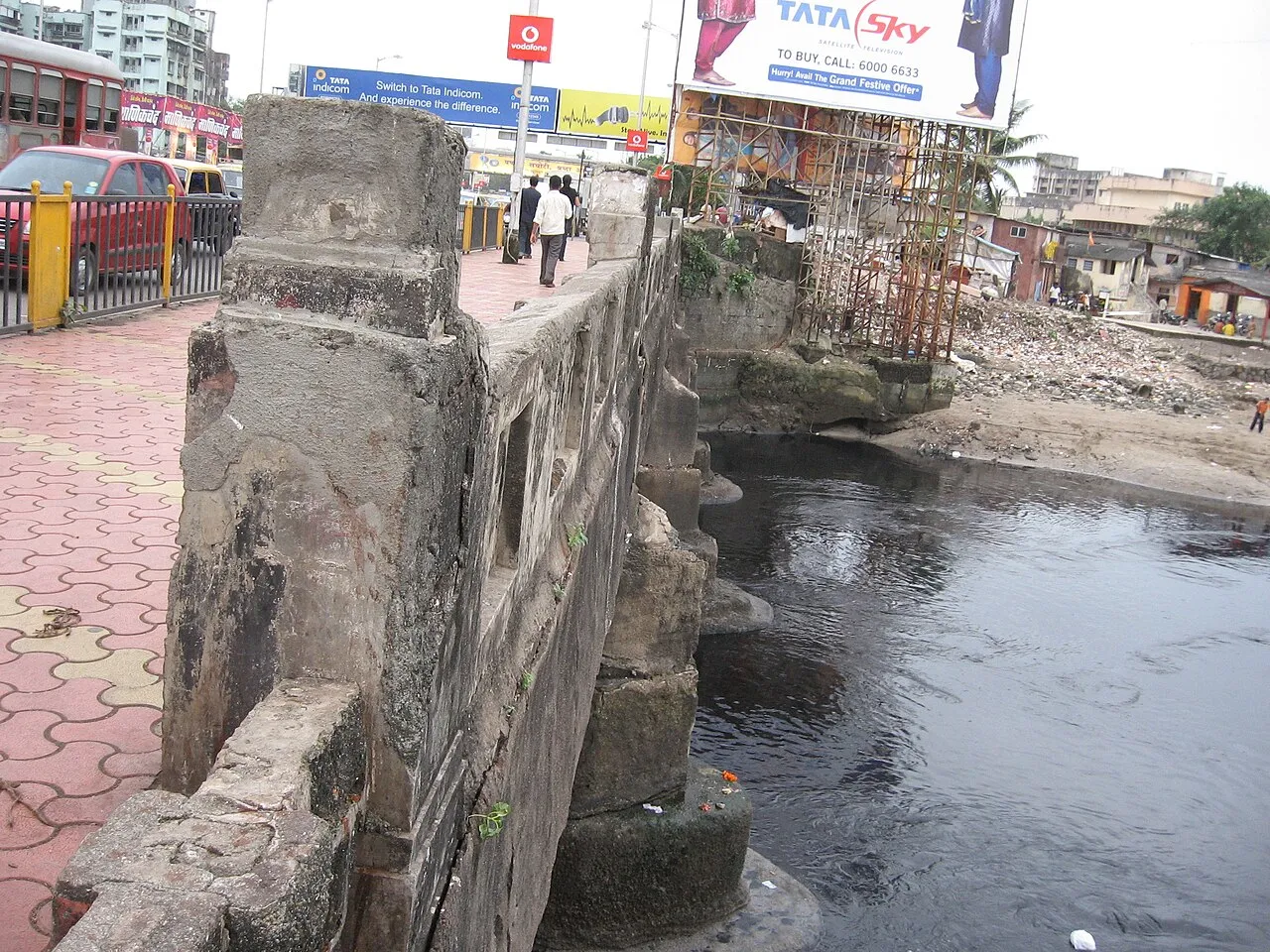
Karaka reproduces the speech that Sir George Arthur, Governor of Bombay, gave at the opening. In it, the Governor explains that the first estimate fell far short, so she raised her gift to a lakh of rupees, then kept adding smaller sums as new costs appeared. By the Governor's count, her donations for this one work came to Rs 1,57,000. He also reports her view that, since the poor would use the causeway most, the rich ought to pay for it.
What did Sir Cowasji Jehangir Readymoney fund?
Sir Cowasji Jehangir Readymoney (Karaka spells it Kavasji) started out as a godown-keeper for a European firm and rose to great wealth. Karaka writes that his giving ran for nearly a quarter of a century and lists these sums:
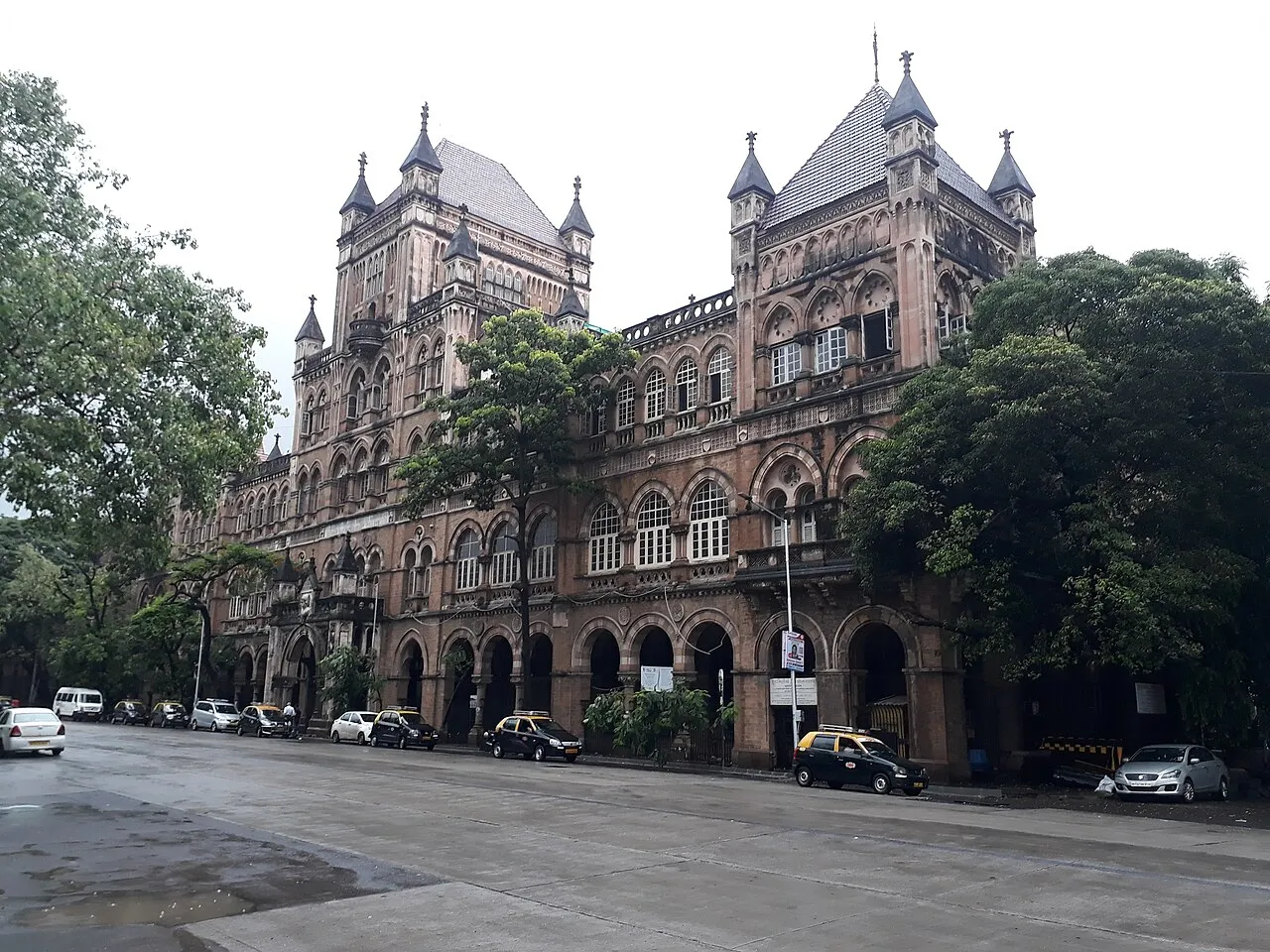
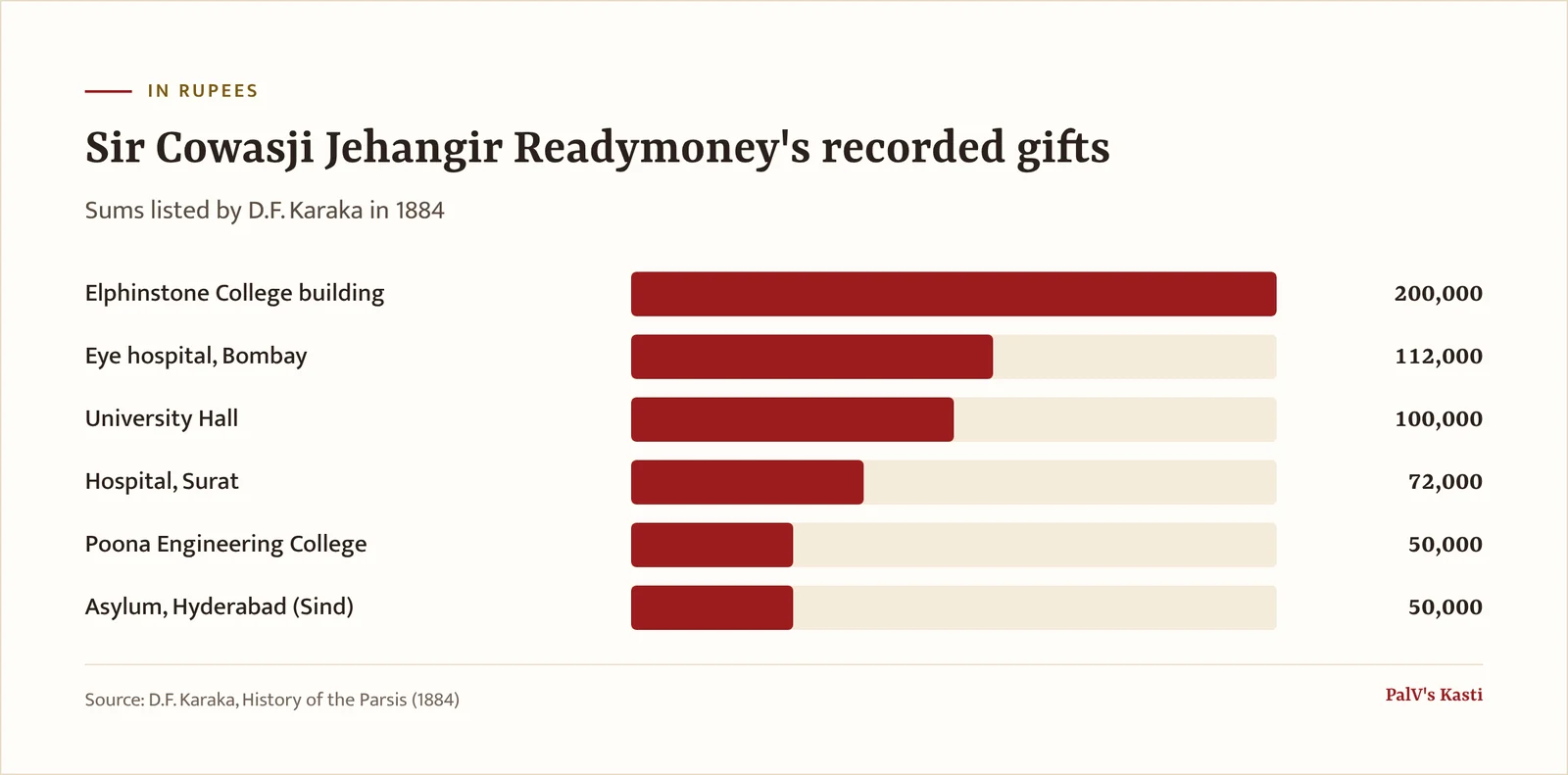
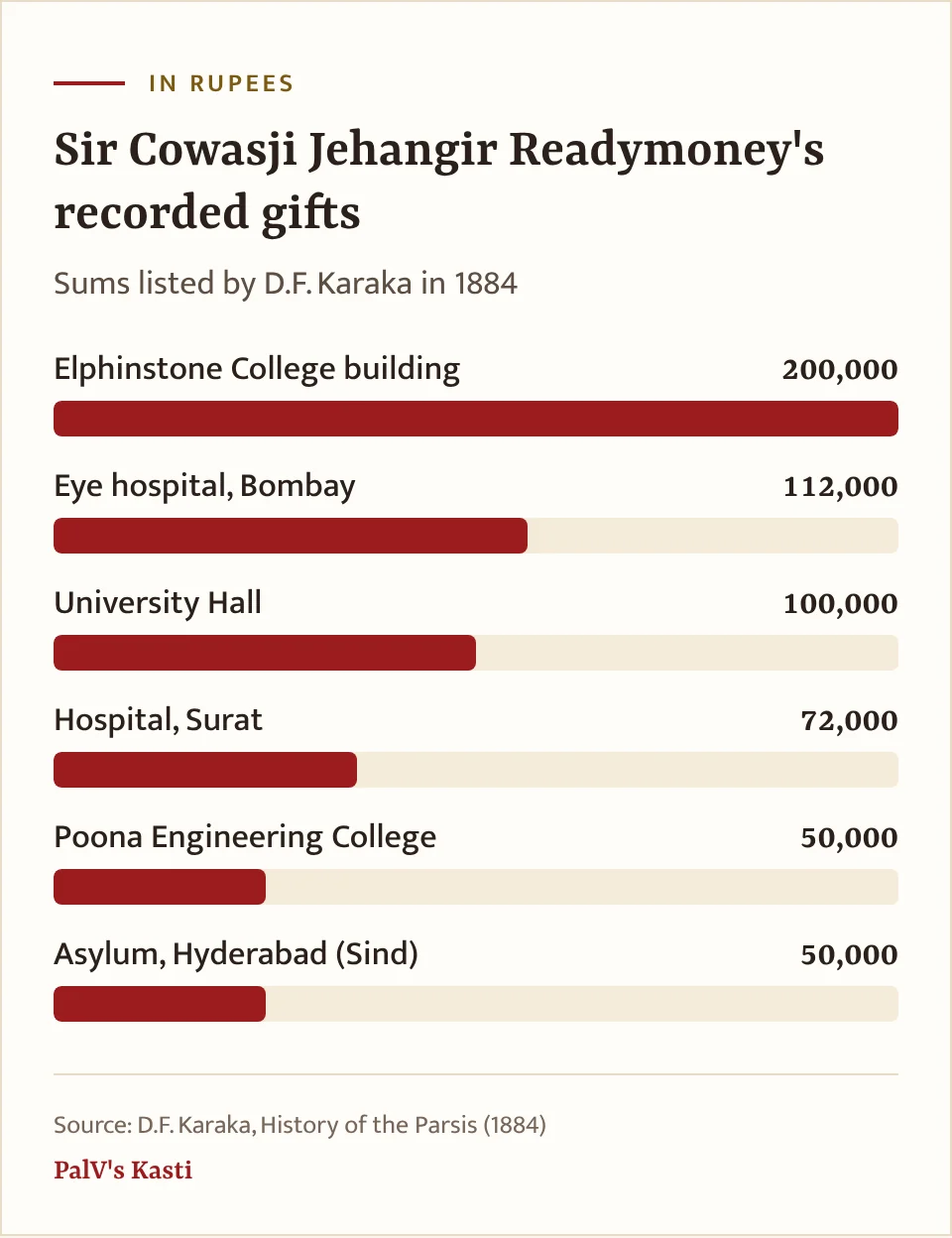
- Rs 2,00,000 for a permanent building for Elphinstone College
- Rs 1,00,000 for the University Hall
- Rs 50,000 for the Poona Engineering College
- Rs 72,000 to build a hospital at Surat, and Rs 1,12,000 for an eye hospital in Bombay
- Rs 50,000 towards a lunatic asylum at Hyderabad in Sind
Karaka adds that he gave to dispensaries in several towns of the Presidency and ran some of them at his own cost. He also founded scholarships linked to the colleges he supported. He is a different person from the Karachi family whose fund we cover in Cowasjee charity.
How did the earlier Readymoneys and the Petits give?
Parsi giving in Bombay is older than the famous 19th-century names. Karaka quotes a Bombay newspaper of 1790 praising Sorabji Mancherji Readymoney, who, during a shortage of food that year, was feeding more than 2,000 people of different castes every day at his own expense.
A century later, Dinshaw Manockjee Petit was the city's leading mill-owner. Karaka reports that he was said to be the richest Parsi in Bombay, adding that one might call him the richest Indian there too, and says his money kept many charitable institutions running, for Parsis and for every other community. In the year before Karaka's book appeared, Petit gave the Society for the Prevention of Cruelty to Animals Rs 45,000 to build a hospital for animals. Karaka also credits him with setting up charitable dispensaries.
How did Jamsetji Tata fund education and science?
According to the Tata group, Jamsetji Tata (1839 to 1904) did not believe in charity and handouts. Both the Tata group and the J.N. Tata Endowment date the Endowment to 1892. According to the Tata group's website, it let Indian students of any caste or creed go to England for higher studies, and its first scholar was Freany Cama, a woman doctor whom Jamsetji chose himself. The same page claims that by 1924, two in every five Indians joining the Indian Civil Service were Tata scholars.
The Endowment still runs. Its own website says it funds only higher studies overseas and has given loan scholarships to more than 5,700 Indian students.
What did Jamsetji Tata give for the Indian Institute of Science?
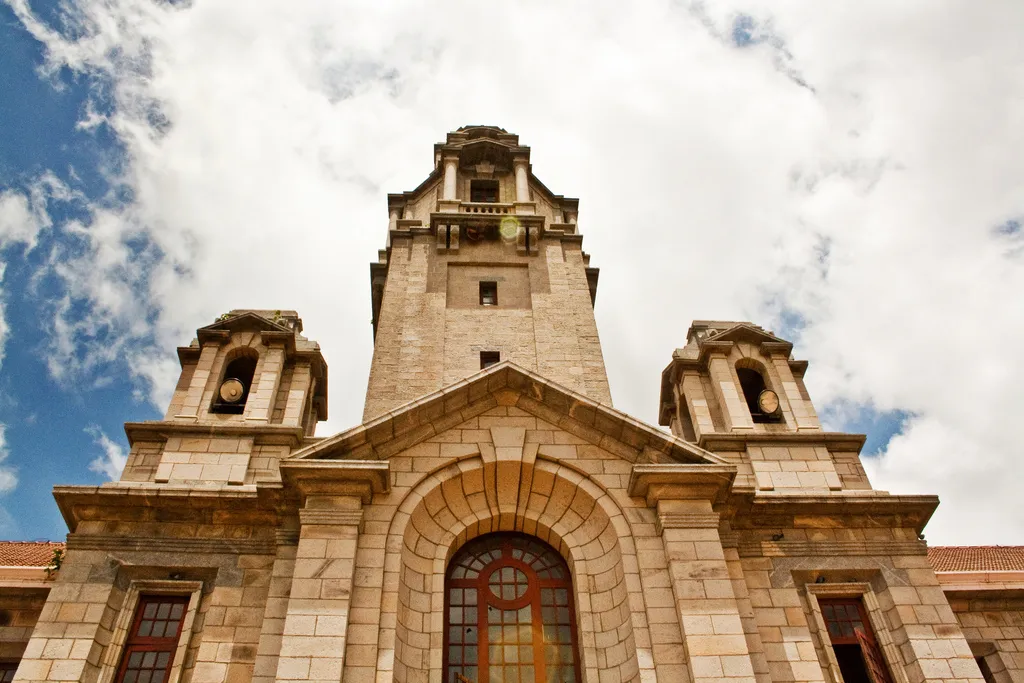
The Tata group says Jamsetji pledged Rs 30 lakh of his own money towards the institute. He did not live to see it. The Indian Institute of Science's own history page dates its formal founding to 27 May 1909 in Bangalore and says it took its first 24 students in 1911. That page also records that the Regent Maharani of Mysore gave about 371 acres of land.
What did Ardeshir Godrej and Bai Motlibai Wadia give?
Both examples come from the January 2022 Parsi Times feature. It says Ardeshir Godrej, founder of the Godrej company, gave Rs 3 lakh to the Tilak Fund in 1926, and that Mahatma Gandhi, who accepted it, called it the largest contribution he had received. The feature also credits Bai Motlibai Maneckji Wadia with founding dispensaries and the Bai Motlibai maternity hospital, and with giving land and money to orphanages.
Did Parsi philanthropists give only to Parsis?
No. The record we have points the other way. Karaka repeatedly notes that gifts went to all castes and creeds, and the Parsi Times figure for Jejeebhoy puts less than half his giving inside the community. Karaka also claims that, in the public subscriptions raised in Bombay in his day, the Parsi total was usually larger than the Hindu and Muslim totals put together, citing the Surat Relief Fund raised after the 1883 floods. That is his own assessment as a Parsi writer in 1884, and we have no second count to set beside it.
Whether this tradition of giving still serves the community well is a live question, and we lay out both sides in Parsi charity critique. For what the faith itself says about giving, see Charity in Zoroastrianism.
Frequently asked questions
Who was the first Indian to be knighted?
Sir Jamsetjee Jejeebhoy, a Parsi merchant of Bombay. The historian D.F. Karaka records that he was knighted in 1842 and that no native of India had received the honour before him. A 2022 Parsi Times feature also calls him the first Indian knight and baronet. He was made a baronet shortly before his death in 1859.
How much did Jamsetji Tata give for the Indian Institute of Science?
According to the Tata group's website, Jamsetji Tata pledged Rs 30 lakh from his personal fortune towards the institute. He died in 1904, before it opened. The Indian Institute of Science says it formally came into existence in Bangalore on 27 May 1909 and admitted its first 24 students in 1911.
What is the J.N. Tata Endowment?
The J.N. Tata Endowment is a fund set up by Jamsetji Tata in 1892 to help Indian students study abroad. The Tata group says it was open regardless of caste or creed. The Endowment's own website says it now supports only higher studies overseas and has given loan scholarships to more than 5,700 Indian students.
What did Sir Cowasji Jehangir Readymoney pay for?
According to D.F. Karaka's 1884 history, Sir Cowasji Jehangir Readymoney gave Rs 2 lakh for Elphinstone College's permanent building and Rs 1 lakh for the University Hall. He also gave Rs 50,000 to the Poona Engineering College, Rs 72,000 for a hospital in Surat and Rs 1,12,000 for an eye hospital in Bombay.
Who built the Mahim causeway?
Lady Jamsetjee Jejeebhoy, wife of Sir Jamsetjee Jejeebhoy, paid for it. D.F. Karaka says the causeway joining Bombay to Salsette cost Rs 1,57,000. He prints the Governor's speech at its opening, which explains that she kept raising her gift as the estimates grew, because she felt the rich should pay for a work the poor would use.