PalV's Kasti
On this page
- Is there a "Parsi rent control act"?
- Is the Bombay Rent Act, 1947 still in force?
- Does the Rent Act apply to Parsi baug and trust flats?
- What is the difference between a tenant and a leave-and-licence occupa…
- Can a relative inherit a tenancy in a Parsi colony flat?
- Why is the BPP debating tenancy versus leave and licence?
- Frequently asked questions
There is no separate rent control law for Parsis. The Bombay Rent Control Act of 1947, properly called the Bombay Rents, Hotel and Lodging House Rates Control Act, was a general law for landlords and tenants, Parsi or not. Section 58(1) of the Maharashtra Rent Control Act, 1999 repealed it, and the 1999 Act came into force on 31 March 2000. So today a Parsi tenant, and a flat let out by a community trust such as the Bombay Parsi Punchayet, falls under the same 1999 Act as everyone else in Maharashtra. The 1947 Act still decides cases that were already pending when it was repealed, which is why judges were applying it to a Parsi Colony flat as recently as June 2026.
શહેરેવર રોજ
Shehrevar Roj, Tir Mah · 1396 Y.Z.
Is there a "Parsi rent control act"?
No. The phrase is a misnomer: the rules come from the state's general rent law. The exemptions in section 3 of the 1999 Act name no community, and the 2026 High Court case discussed below applied the general Act to a flat owned by the Parsi Punchayet trust.
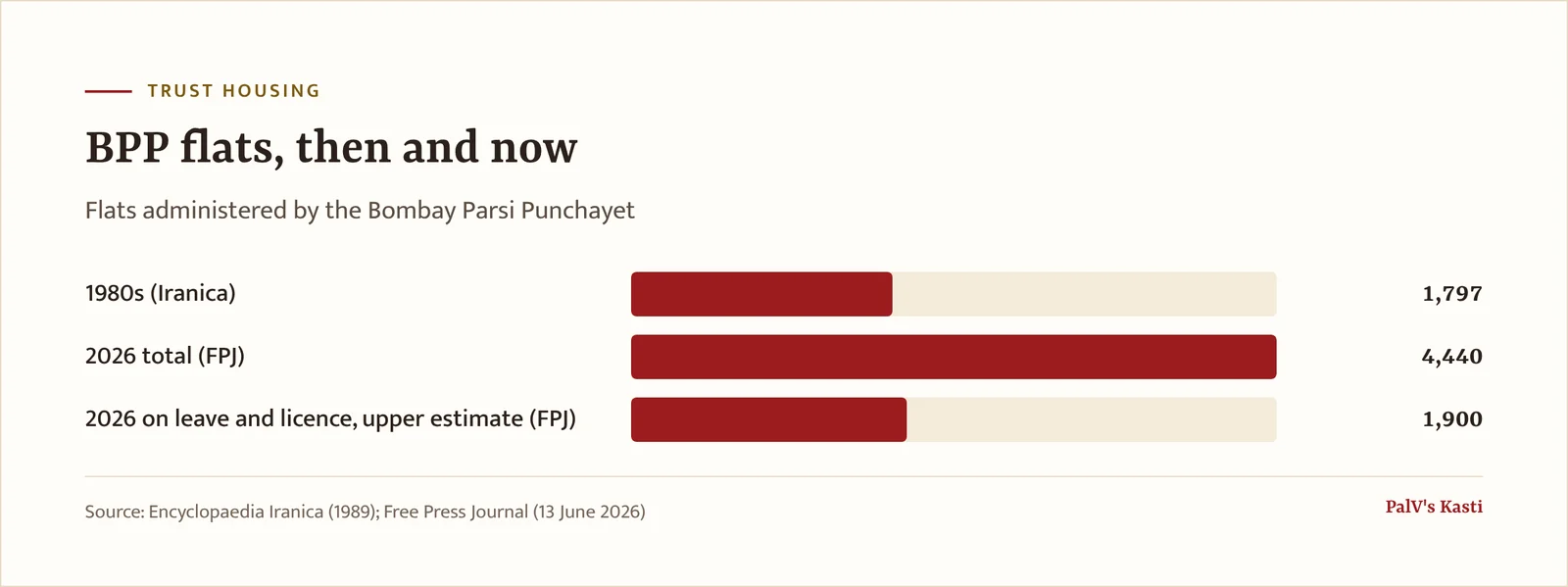
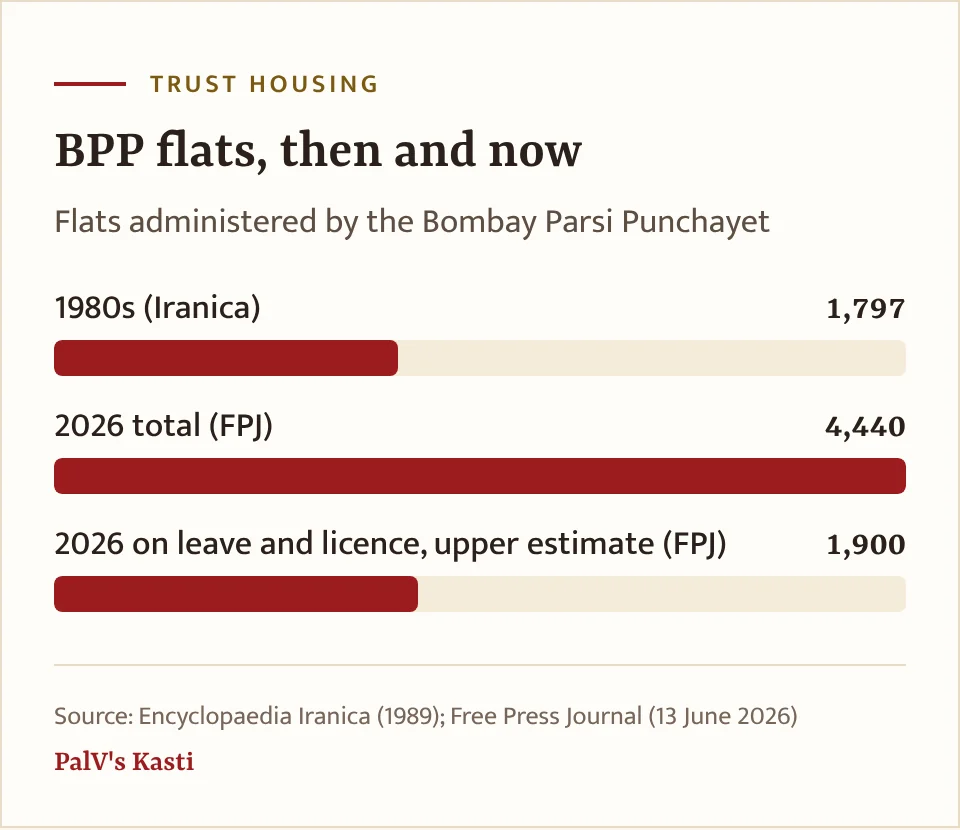
What makes Parsi housing different is the landlord, not the law. The Bombay Parsi Panchayat is a community trust that owns flats across the city's Parsi baugs. Encyclopaedia Iranica recorded that it administered 1,797 flats in the 1980s. In 2026 the Free Press Journal put the figure at 4,440 (13 June) and "nearly 4,500" (13 July).
Is the Bombay Rent Act, 1947 still in force?
Not for new matters. Section 58(1) of the Maharashtra Rent Control Act, 1999 (Maharashtra Act No. XVIII of 2000) lists the 1947 Act (Bom. LVII of 1947) among the laws that "shall stand repealed". The Act's footnote, as published on India Code, gives its commencement as 31 March 2000.
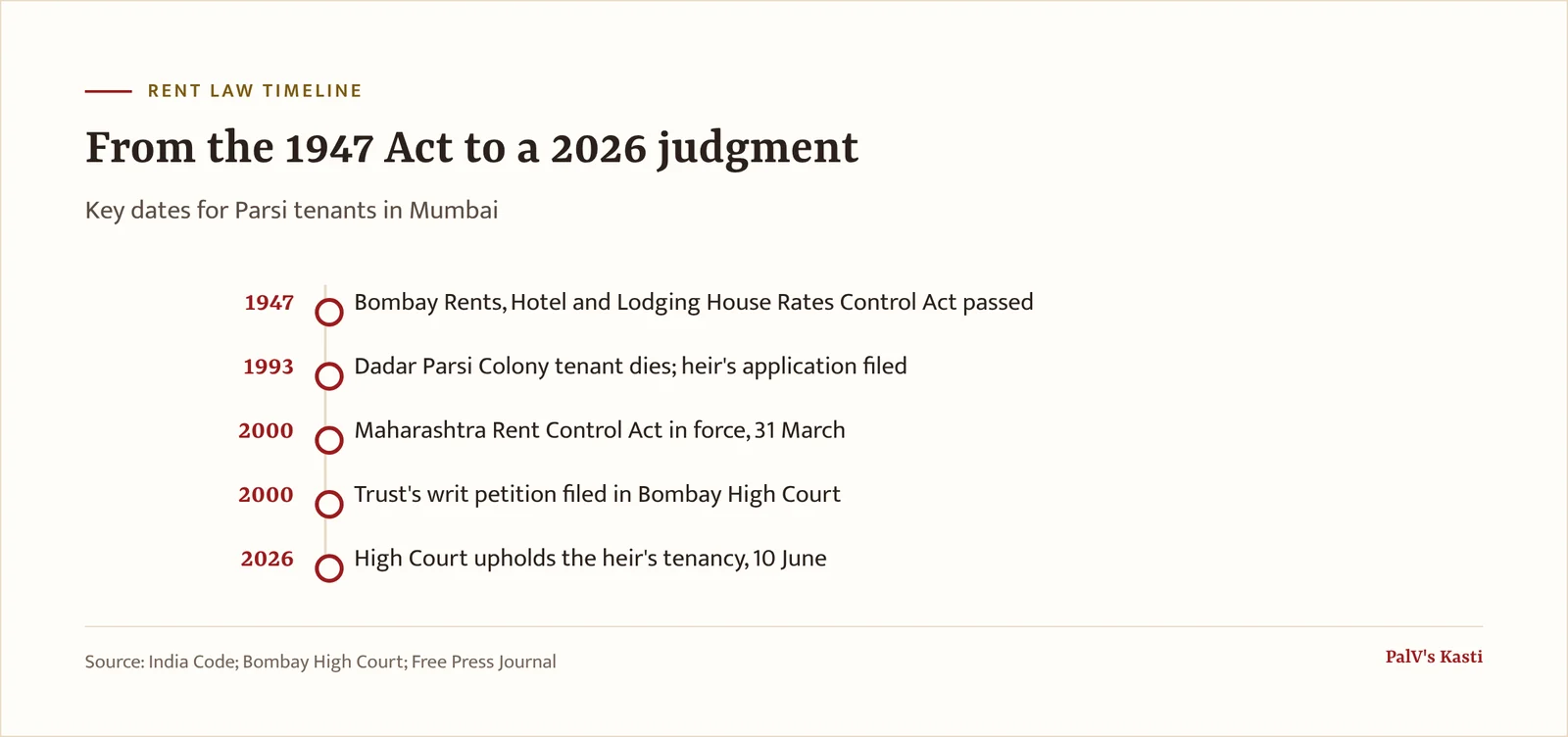

There is a catch that matters to older disputes. Section 58(2)(a) says applications, suits and proceedings that were pending on that date carry on under the repealed Acts, as if those Acts were still in force. A case filed in 1993 is therefore still decided under the 1947 Act, even if the final judgment comes decades later.
Does the Rent Act apply to Parsi baug and trust flats?
Yes, as far as we could find. Section 3(1) of the 1999 Act switches the Act off for a fixed list of premises: those belonging to the Government or a local authority, and premises let to banks, public sector undertakings and companies with a paid-up share capital of Rs 1 crore or more, among others. Religious or charitable trusts are not on that list.
Section 3(2) is the closer call. It gives the State Government a power to direct that the Act will not apply to certain premises, including premises a public trust holds for a religious or charitable purpose and lets "at a nominal or concessional rent". That is only a power. We could not find any Maharashtra government direction using it for Parsi trust flats. And its proviso requires the government, before any such direction, to make sure existing tenants' tenancy rights "are not adversely affected".
The courts have dealt with them that way. In the June 2026 Dadar case described below, the landlord was the trust named as the Parsi Punchayet Funds and Properties, Bombay, and the High Court decided the matter under the Bombay Rent Act.
What is the difference between a tenant and a leave-and-licence occupant?
Baug flats are held both ways. The Free Press Journal reported on 13 July 2026 that around 1,900 BPP flats were under leave-and-licence agreements. The 1999 Act treats the two very differently.
- Tenant. Section 7(15) defines a tenant as a person by whom or on whose account rent is payable. Under section 7(15)(d), a residential tenancy can pass to family members or heirs when the tenant dies.
- Licensee. Section 7(5) defines a licensee as someone occupying premises under a subsisting licence given for a licence fee or charge. Section 24(1) says a residential licensee must hand the flat back when the licence period ends. If the licensee does not, the landlord applies to the Competent Authority, which orders eviction once it is satisfied the licence has expired.
Paperwork matters too. Under section 55(1), every leave-and-licence or rental agreement made after the Act began must be in writing and registered under the Registration Act, 1908. Section 55(2) puts the job of registering it on the landlord. Where there is no written, registered agreement, the occupant's account of the terms prevails unless the landlord proves otherwise.
Can a relative inherit a tenancy in a Parsi colony flat?
Section 7(15)(d) of the 1999 Act has two limbs. First, a member of the tenant's family who was living with the tenant at the time of death becomes the tenant. Only if there is no such member does the second limb apply: any heir of the deceased tenant, as the court decides if the parties cannot agree. The old 1947 Act said much the same in section 5(11)(c)(i).
The 2026 Dadar Parsi Colony judgment
The second limb was tested in J. N. Guzder and others v Katty J. Mistry, brought by the trustees of the Parsi Punchayet Funds and Properties, Bombay, Writ Petition No. 3944 of 2000. Justice M. M. Sathaye of the Bombay High Court pronounced judgment on 10 June 2026; LiveLaw reports it as 2026 LiveLaw (Bom) 288. The flat was in Patel Building, Parsi Colony, Dadar. Its tenant died in April 1993, and a first cousin claimed the tenancy as his heir under the Indian Succession Act as it applies to Parsis.
The trust argued she had not lived with him. Justice Sathaye held that an heir is "not required to be residing with tenant" when the tenant dies, because the law attaches no residence condition to the heir limb. He dismissed the trust's petition. The dispute shows how slowly these cases move: the original application dates from 1993, and the Free Press Journal noted the petition had been "pending before the High Court since 2000".
Why is the BPP debating tenancy versus leave and licence?
In mid-2026 the BPP board passed a resolution to convert leave-and-licence flats into tenancies. Reports differ on the date: the Free Press Journal of 13 June 2026 says the board approved it at a meeting on 9 June, while its 13 July report says the resolution passed in May 2026 "through Chairman Viraf Mehta's casting vote". Chairman Mehta told the paper on 13 June that between 1,800 and 1,900 flats, out of 4,440, were held on leave and licence, and announced a five-year lock-in with a 20 per cent cap on encashment, which the paper said was meant to prevent misuse of tenancy rights.
Three trustees, Anahita Desai, Hoshang Jal and Adil Malia, opposed it. According to the Free Press Journal of 13 July, they warned that the move could undermine "a housing framework" that had protected the community for more than five decades, and they argued permanent tenancy could weaken the Parsi-only covenant on the baugs. Malia, according to the paper's 28 July report, warned that reclaiming possession from tenants under the Maharashtra Rent Control Act could become a long, costly and uncertain legal process. On 13 June he had also questioned whether the Charity Commissioner's approval would be needed.
Mehta's answer, quoted on 13 July, was that he had assured the three trustees a "'Parsi-only' covenant will be incorporated" into the new tenancy agreements. As of the Free Press Journal's 28 July 2026 report, the plan remained a proposal and the dispute was continuing.
Whether a community-only rule can bind a co-operative housing society is a separate question under different laws, decided by the Supreme Court in 2005 in the Zoroastrian Co-operative Housing Society case.
Frequently asked questions
Is there a separate rent control act for Parsis?
No. The Bombay Rent Act of 1947 and the Maharashtra Rent Control Act, 1999 that replaced it are general laws for all landlords and tenants. Parsi tenants, including those in flats owned by the Bombay Parsi Punchayet and other community trusts, are covered by the same provisions as any other tenant in Maharashtra.
Is the Bombay Rent Control Act 1947 still valid?
Section 58(1) of the Maharashtra Rent Control Act, 1999 repealed it, and the new Act took effect on 31 March 2000. Under section 58(2), cases pending on that date continue under the 1947 Act, so courts still apply it to old disputes, such as a Dadar Parsi Colony tenancy case decided in June 2026.
Are Parsi trust flats exempt from the Rent Act?
Not automatically. Section 3(2) lets the State Government exempt premises a public trust lets at a nominal or concessional rent, but only by a direction, and existing tenants' rights must be protected. We found no such direction for Parsi trust flats, and in 2026 the Bombay High Court decided a Parsi Punchayet tenancy dispute under the Rent Act.
Can a cousin inherit a tenancy if they did not live in the flat?
Possibly. The law first looks for a family member living with the tenant at death. If there is none, any heir may succeed, as a court decides. In June 2026 the Bombay High Court held that such an heir need not have lived with the tenant, and upheld a first cousin's tenancy of a Dadar Parsi Colony flat.
Must a leave-and-licence agreement be registered in Maharashtra?
Yes. Section 55(1) of the Maharashtra Rent Control Act, 1999 requires every leave-and-licence or rental agreement made after 31 March 2000 to be written and registered under the Registration Act, 1908. The landlord is responsible for registering it, and without a registered agreement the occupant's version of the terms prevails unless disproved.
This is general information, not legal advice; for a specific case, speak to a lawyer.