PalV's Kasti
On this page
- What kind of Parsi trust is the BPP?
- How many trustees run the Bombay Parsi Panchayat, and for how long?
- Who are the BPP trustees today?
- Who can vote in a BPP election?
- Who can stand for election as a BPP trustee?
- How is a Bombay Parsi Panchayat election run?
- How does BPP housing work?
- Frequently asked questions
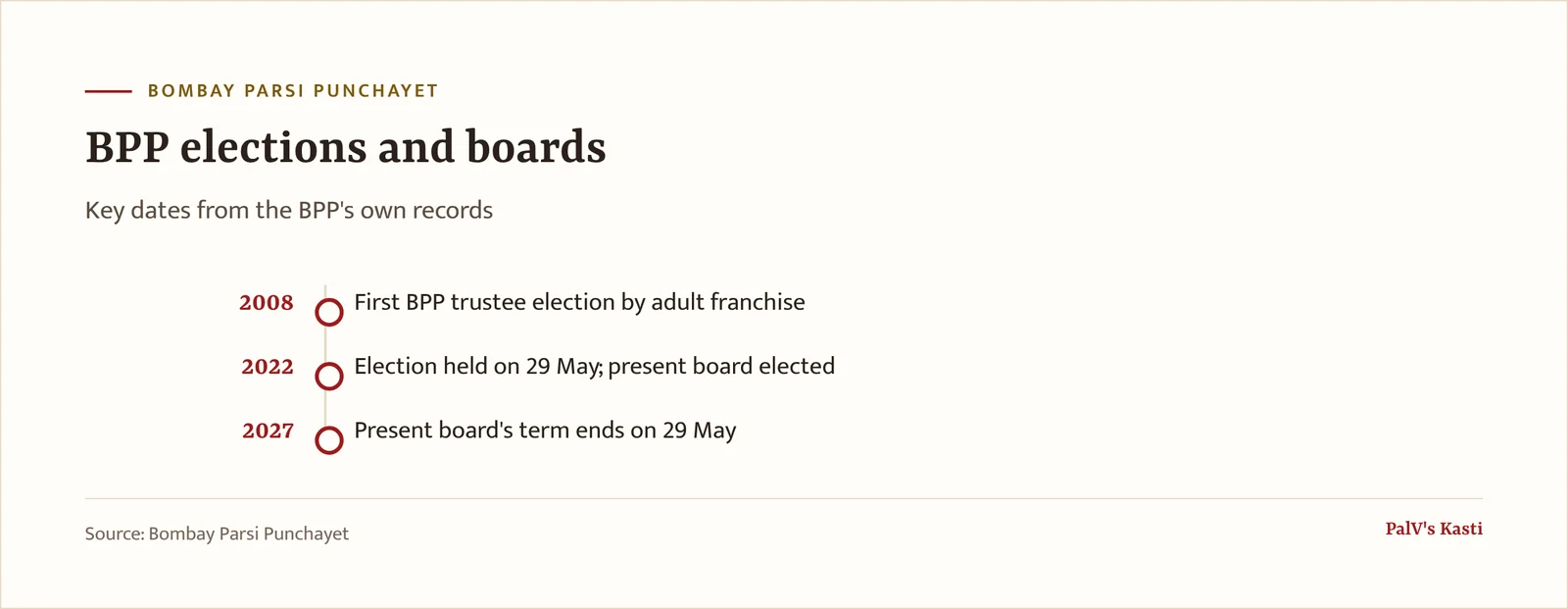
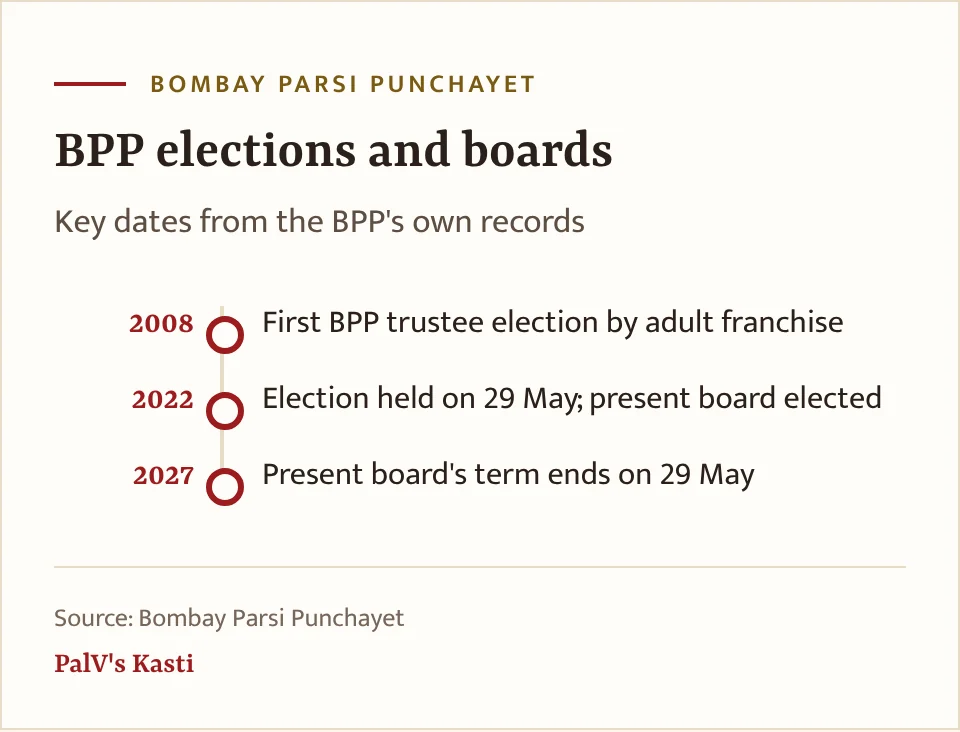
The Bombay Parsi Panchayat, which spells its own name Bombay Parsi Punchayet (BPP), is a Parsi trust registered as a public charitable trust and run by a board of seven trustees. Parsis on its voter registers elect those trustees for five-year terms, under an election scheme sanctioned by the Bombay High Court. Service is capped at ten years in a lifetime, with one exception. A General Register voter has one vote. A Donor Register voter, who has given Rs 10 lakh or more, has one vote that counts as two. The present board was elected on 29 May 2022 and its term runs to 29 May 2027. In 2026 the Free Press Journal put its housing stock at about 4,440 to 4,500 flats in Mumbai's Parsi baugs.
For what the BPP is and where it came from, start with our guide to the Bombay Parsi Panchayat. The older story of committees and court cases is in BPP history 1860–1960.
અસપંદામેદ રોજ
Asfandarmad Roj, Tir Mah · 1396 Y.Z.
What kind of Parsi trust is the BPP?
Legally, the BPP is the trust called the “Funds and Immoveable Properties of the Parsee Punchayet of Bombay”, which its election scheme describes as a registered public charitable trust. Clause 1.19 of the scheme lists the laws that bind its trustees: the Indian Trusts Act, 1882, the Maharashtra Public Trusts Act, 1950, the public-trust provisions of the Income Tax Act, 1961, and exchange control rules, including the Foreign Contribution Regulation Act.

The BPP publishes chartered accountants' audit reports on its website, one for each year from 2020-21 to 2025-26. How it compares with other community endowments is covered in our piece on Parsi charitable trusts.
How many trustees run the Bombay Parsi Panchayat, and for how long?
Seven, under clause 7.1 of the scheme. The tenure rules:
- Term: five years from the day a trustee takes office.
- Limit: two terms, back to back or with a gap. The scheme puts it as ten years in a lifetime.
- One exception: anyone first elected after 5 April 2007 and before 31 October 2015 gets one further five-year term, however long they have already served. This is a proviso to clause 1.16.
- Short vacancies: a trustee elected to fill a mid-term gap of twelve months or less does not have that stint counted against the limit.
The board decides by simple majority of trustees present and voting, and the result binds those who voted against it. On a tie, the chairman has a second, casting vote.
How is the BPP chairman chosen?
Clause 15 makes the trustee with the longest total service the chairman by default. The other six can resolve not to, and the board then elects a chairman by majority. Beyond presiding, preparing the agenda, signing minutes and the casting vote, the chairman has no extra powers over fellow trustees. The BPP's website and Free Press Journal reports from 2025 and 2026 name Viraf Mehta as chairman.
Who are the BPP trustees today?
As of 16 November 2026, the BPP's “Current Trustees” page lists seven people. The dates below come from its “Boards Over the Years” page. We name them only in their public role as trustees.
| Trustee | On the board since (BPP list) | Present term ends |
|---|---|---|
| Armaity R. Tirandaz | 21 April 2009 | 29 May 2027 |
| Viraf D. Mehta | 23 October 2015 | 29 May 2027 |
| Ervad Xerxes V. Dastur | 5 July 2018 | 29 May 2027 |
| Anahita Y. Desai | 29 May 2022 | 29 May 2027 |
| Hoshang J. B. Jal | 29 May 2022 | 29 May 2027 |
| Maharukh K. Noble | 29 May 2022 | 29 May 2027 |
| Adil J. Malia | 29 May 2022 | 29 May 2027 |
Who can vote in a BPP election?
A voter must be a Parsi aged 18 or above whose name has been on one of the two registers for at least 60 days before polling day. Clause 1.11 gives the scheme's own definition of “Parsi”, in three parts: a Parsi descended from the original Persian emigrants, born of two Zoroastrian parents and professing the religion; an Irani from Iran who professes the Zoroastrian religion; and the child of a Parsi father and a non-Parsi mother who has been duly admitted into the religion.
| General Register | Donor Register | |
|---|---|---|
| How you join | Apply on the BPP form and pay Rs 10 | Personally donate Rs 10,00,000 or more in one go, as a voluntary gift, then apply within 180 days |
| Weight of your vote | One vote | One vote, counted as two |
| Certificate | Certificate with your photo. A lost one is replaced on an affidavit and Rs 10 | Same rules. The BPP says a duplicate donor certificate also costs Rs 10 |
Nobody can be on both registers at once, and the BPP's Election Commission page adds that each beneficiary may be a General or a Donor member, not both, in a lifetime. The donation must not be payment for any benefit from the trust.
Who can stand for election as a BPP trustee?
Clause 6.1 lists the conditions. A candidate must be an Indian citizen, at least 30 years old on the day the election advertisement first appears in the Parsi press, and competent to contract. They must not be a non-resident under exchange control law, must never have committed an act of insolvency, and must not have been found “not fit and proper” by a regulator or court. A conviction anywhere in the world with a prison sentence of six months or more rules a person out.
Each candidate needs one proposer and one seconder from the voter lists, a signed copy of the code of conduct, and a Rs 20,000 security deposit. Poll under 5% of the valid votes and the deposit is forfeited. Withdraw at least 21 days before polling and half of it comes back.
How is a Bombay Parsi Panchayat election run?
On the trustees' application, a Judge in Chambers of the Bombay High Court appoints one Chief Election Commissioner and five Assistant Election Commissioners. For the 2022 election, the BPP says, that appointment was made by a court order of 1 March 2022. The commissioners are unpaid and must declare that they have no family or business link with any trustee. The scheme then sets the order of events:
- An advertisement appears in the Parsi press (the scheme names Parsiana, Jame Jamshed, The Parsi Times and The Mumbai Samachar), giving at least 15 days for nominations.
- The final list of candidates, with proposers and seconders, is published at least 14 days before the poll.
- Polling is ordinarily on a Sunday, at five baugs and colonies: Cusrow Baug, Kharegat Colony, Rustom Baug, Dadar Parsi Colony and Bharucha Baug.
- Voters show their certificate and a government photo ID, then vote by secret ballot on VVPAT electronic voting machines. Paper ballots are allowed only if all trustees agree for that election.
- Votes are counted the same day at each centre, and the result is declared that day. A tie is broken by drawing lots.
The code of conduct annexed to the scheme caps each candidate's campaign spending at Rs 5,00,000, paid through banks. No dinners, drinks or other inducements are allowed: candidates may offer only water at election meetings. Fire temples, the Towers of Silence and other places of worship are off limits for campaigning.
Direct voting is fairly new. According to the BPP, trustees were chosen every seven years for 97 years through an electoral college, and 2008 brought the first election by adult franchise.
How does BPP housing work?
The BPP's housing page carries forms for three things: applying for a flat on a leave and licence basis, exchanging a BPP flat already held, and buying an ownership flat in Buildings A and B at Panthaky Baug, Andheri. The page does not set out allotment rules or income limits, so ask the head office at 209, Dr D. N. Road, Fort, Mumbai 400001 (022-22617421/22/23).
BPP flats are held in one of two ways, on tenancy or on leave and licence. Leave and licence was brought in, trustee Anahita Desai told the Free Press Journal in July 2026, after rent control laws gave tenants statutory protection that made it hard for the trust to get flats back. In June 2026 the chairman told the same paper that the trust owns 4,440 flats, of which roughly 1,800 to 1,900 were on leave and licence. Only 300 to 400 of those carried security deposits.
Why are trustees divided over converting licences into tenancies?
In mid-2026 the board passed a resolution to convert leave and licence arrangements into tenancies. The Free Press Journal's reports differ on when: its 13 June report gives a board meeting on 9 June, while its 13 July report says May 2026 and that the chairman's casting vote carried it.
The case for: Viraf Mehta, Maharukh Noble and Armaity Tirandaz see the plan as a welfare measure, because licence holders stay open to eviction, the Free Press Journal reported on 28 July 2026. Mehta has announced a five-year lock-in and a 20% cap on encashing the new tenancy rights. In July he told the paper that a “Parsi-only” covenant would be written into the tenancy agreements, and that stamp duty is a statutory cost the beneficiaries must bear.
The case against: Anahita Desai, Hoshang Jal and Adil Malia said in June that they were not opposed to conversion as such, but wanted a written policy, independent legal and financial opinions, full disclosure, and clarity on whether the Charity Commissioner must approve. In a July open letter they argued that permanent tenancy could weaken the Parsi-only covenant. Malia told the paper that getting a flat back from a tenant under the Maharashtra Rent Control Act could be long, costly and uncertain, and asked why the push was coming now, months before the next elections.
By the Free Press Journal's 28 July report, deposit cases were on hold pending tax advice, and any decision on the Wadia Baugs awaited talks with the Wadia family. On 24 October 2026 Parsi Times reported that Desai, Malia and Jal had asked the Charity Commissioner to intervene and to stay further conversions, naming Mehta, Tirandaz, Noble and Ervad Xerxes Dastur as respondents. It said about 100 applications had been received and, citing news reports, that three tenancy agreements were registered on 5 October. It gave no hearing date or outcome, and the matter was pending as of that report.
What happened with the Godrej Baug allotment?
The casting vote has settled housing questions before. In November 2025 six trustees split three to three on allotting a subsidised rental flat in Godrej Baug, Nepean Sea Road, and the chairman's casting vote approved it, the Free Press Journal reported on 27 November. Two days later the paper reported that the allotment had been kept in abeyance and a public notice issued inviting objections. Mehta told the paper the board would look at the matter again in the light of new information. Malia said the voice of the community had to prevail.
This is general information, not legal advice; for a specific case, speak to a lawyer.
Frequently asked questions
How many trustees does the Bombay Parsi Punchayet have?
Seven. The BPP's court-sanctioned election scheme fixes the board at seven trustees. Each serves a five-year term, and the scheme limits a trustee to two terms, or ten years in a lifetime. Trustees first elected between 5 April 2007 and 31 October 2015 may serve one extra term.
Who can vote in BPP elections?
Any Parsi, as the scheme defines the word, who is 18 or older and has been on the General Register or the Donor Register for at least 60 days before polling day. Joining the General Register costs Rs 10. Voters must bring their BPP voter certificate and a government photo ID.
What is a donor vote in the BPP election?
A donor vote is a single vote that is counted as two. A Parsi earns it by personally giving the trust Rs 10 lakh or more in one voluntary donation, not in return for any benefit, and applying within 180 days. Nobody can be on the General and Donor Registers together.
When is the next BPP trustee election?
The board elected on 29 May 2022 serves until 29 May 2027, according to the BPP's own board list. The scheme says the election must be scheduled at least two Sundays before the term ends, so the next general election should fall before that date. It is announced by advertisement in the Parsi press.
How do I apply for a Bombay Parsi Panchayat flat?
The BPP's housing page offers downloadable forms: one to apply for accommodation on leave and licence, one to exchange an existing BPP flat, and one to buy an ownership flat in Buildings A and B at Panthaky Baug, Andheri. Queries go to the head office at 209, Dr D. N. Road, Fort, Mumbai.