PalV's Kasti

On this page
In Maharashtra, a Parsi or Zoroastrian public charitable trust is regulated like any other public trust, under the Maharashtra Public Trusts Act, 1950. The trustees register it, keep accounts, get them audited every year and need the Charity Commissioner's prior sanction before they sell or lease out trust property on a long lease. The Commissioner can issue directions, frame a scheme for a badly run trust and remove trustees. The best-known community trust, the Bombay Parsi Punchayet, also follows its own election scheme sanctioned through the Bombay High Court. The problems that reach the newspapers and the courts are mostly about housing: split boards, disputed flat allotments, a 2026 row over turning licences into tenancies, and landlord cases that run for decades.
This post is about how trusts are run. For what Parsi trusts are and how they came to fund hospitals, schools and baugs, start with our guide to Parsi charitable trusts.
શહેરેવર રોજ
Shehrevar Roj, Tir Mah · 1396 Y.Z.
Which law governs a Parsi or Zoroastrian trust in Maharashtra?
The Maharashtra Public Trusts Act, 1950 (Act XXIX of 1950). Section 18 makes it the trustee's duty to apply to register the public trust with the Deputy or Assistant Charity Commissioner of the region where the trust has its office or where most of its property lies. A trust that is not registered cannot have a suit on its behalf heard in any court (section 31).
The community once had its own registration law, the Parsi Public Trusts Registration Act, 1936. The 1950 Act transferred proceedings pending under it to the Charity Commissioner.
Section numbers here follow the state's official print of the Act as modified up to 19 December 2018. The Charity Commissioner's website also lists a Maharashtra Public Trusts (Amendment) Act, 2025, which we could not read, so check the current text before relying on a section.
What must trustees do every year?
The main duties, in the order the Act sets them out:
- Report changes. When an entry in the trust's register changes, such as trustees or property, the trustee must report it to the Deputy or Assistant Charity Commissioner within 90 days (section 22).
- Keep regular accounts in a form the Charity Commissioner approves (section 32).
- Close the books on 31 March, unless the Commissioner fixes another day, and have them audited every year by a chartered accountant or another person the State Government authorises. The auditor must not be connected with the trust (section 33).
- Face an auditor who must flag problems. The audit report has to list any irregular, illegal or improper spending, and any loss or waste of trust money or property, and say whether it came from a breach of trust or misconduct (section 34).
- Park idle money safely in a scheduled bank, the postal savings bank, an approved co-operative bank or public securities, unless the Commissioner permits otherwise (section 35).
- Ask before selling. No sale, exchange or gift of trust land or buildings, and no lease of a building or non-agricultural land for more than three years, is valid without the Charity Commissioner's previous sanction (section 36).
Who can step in when a trust is badly run?
The Charity Commissioner. Under section 41A the Commissioner may issue directions so that the trust is properly administered and its income is applied to its objects, including where trust property is in danger of being wasted or wrongly sold. Section 41D lets the Commissioner suspend, remove or dismiss a trustee who, among other grounds, persistently fails to file accounts, wilfully disobeys the Commissioner's lawful orders, misappropriates trust property or is convicted of an offence involving moral turpitude. Any person interested in the trust can apply for this, or the Commissioner can act on his own.
Under section 50A, the Assistant or Deputy Charity Commissioner can also frame a management scheme for a trust, after hearing its trustees.
How is the Bombay Parsi Punchayet run?
The Bombay Parsi Punchayet (BPP) shows what a large Zoroastrian trust looks like from the inside. Its election scheme names the trust as the "Funds and Immoveable Properties of the Parsee Punchayet of Bombay", calls it a public charitable trust that is registered, and lists the laws it answers to: the Indian Trusts Act, 1882, the Maharashtra Public Trusts Act, 1950, and the public-trust provisions of the Income Tax Act, 1961.
According to that scheme:
- there are seven trustees, each elected for a five-year term, and no Parsi may be a trustee for more than ten years in total over a lifetime (the scheme allows one further term for trustees first elected between April 2007 and October 2015);
- the trustee who has served longest is normally the chairman, unless all the others resolve otherwise;
- decisions are taken by a simple majority of trustees present and voting, and on a tie the chairman has "a second or casting vote". Beyond presiding, setting the agenda, signing minutes and that casting vote, the scheme says the chairman has no extra powers.
The board cannot change the scheme alone. Amendments go to a Judge in Chambers of the Bombay High Court, after four clear days' written notice to the Charity Commissioner, who may be heard. A written requisition from at least 1,000 Parsis on the trust's registers obliges the trustees to take a proposed change to the judge. The BPP's website lists a "CA Audit Report" for each year from 2020-21 to 2025-26.
What problems do Zoroastrian trusts face?
We could not find an official count of Zoroastrian trusts or their total assets, and almost all recent reporting concerns the BPP in Mumbai. So the examples below are from that one trust. They show the pressure points rather than a full picture.
Split boards and the casting vote
One absence on a seven-member board can mean a 3-3 tie. The Free Press Journal reported in November 2025 that this happened over a subsidised charity flat in Godrej Baug: six trustees were present, the vote tied, and chairman Viraf Mehta's casting vote approved the allotment. Two days later the paper reported the allotment had been "kept in abeyance" and a public notice issued inviting objections. Mehta told the paper the trust did want "to help the young couple", but that the board had to be taken along. Adil Malia, one of the dissenting trustees, said, "The righteous voice of the people has to prevail."
Housing policy: licences or tenancies?
In 2026 the BPP board backed a plan to convert some leave-and-licence occupants of its flats into tenants. The Free Press Journal put the trust's housing at 4,440 flats in a June report and nearly 4,500 in July, with about 1,800 to 1,900 of them on leave and licence. Its June report said the resolution was approved at a board meeting on June 9. Its July report said it passed in May 2026 on the chairman's casting vote.
Mehta told the paper in June that there would be a five-year lock-in, a 20 per cent encashment cap and tenancy clauses to enforce the trust's Parsi-only covenant. In a 28 July report, the majority trustees (Mehta, Maharukh Noble and Armaity Tirandaz) called the move a long-overdue welfare measure, arguing that "a licensee is far easier to remove" than a tenant. Trustees Anahita Desai, Hoshang Jal and Adil Malia objected to how it was being done. Malia said a proposal of this size needs "a clearly articulated written policy", asked whether the Charity Commissioner's approval would be needed if the trust's rights were diluted, and warned that taking back possession from tenants under the Maharashtra Rent Control Act could be slow and costly. Mehta called the charge that information was being withheld a distortion of facts. As of the paper's 28 July 2026 report, the dispute was unresolved and no court or Charity Commissioner proceeding was mentioned.
Landlord cases that outlast boards
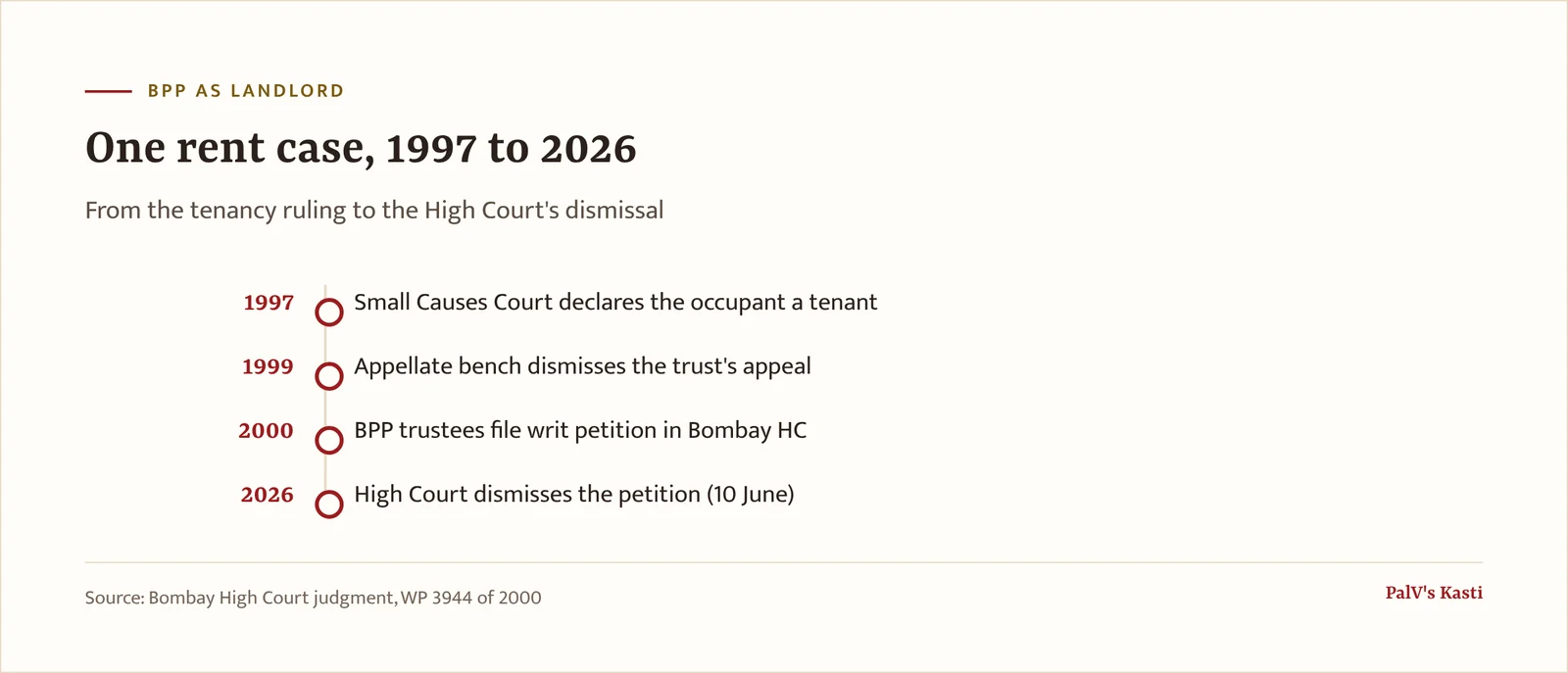
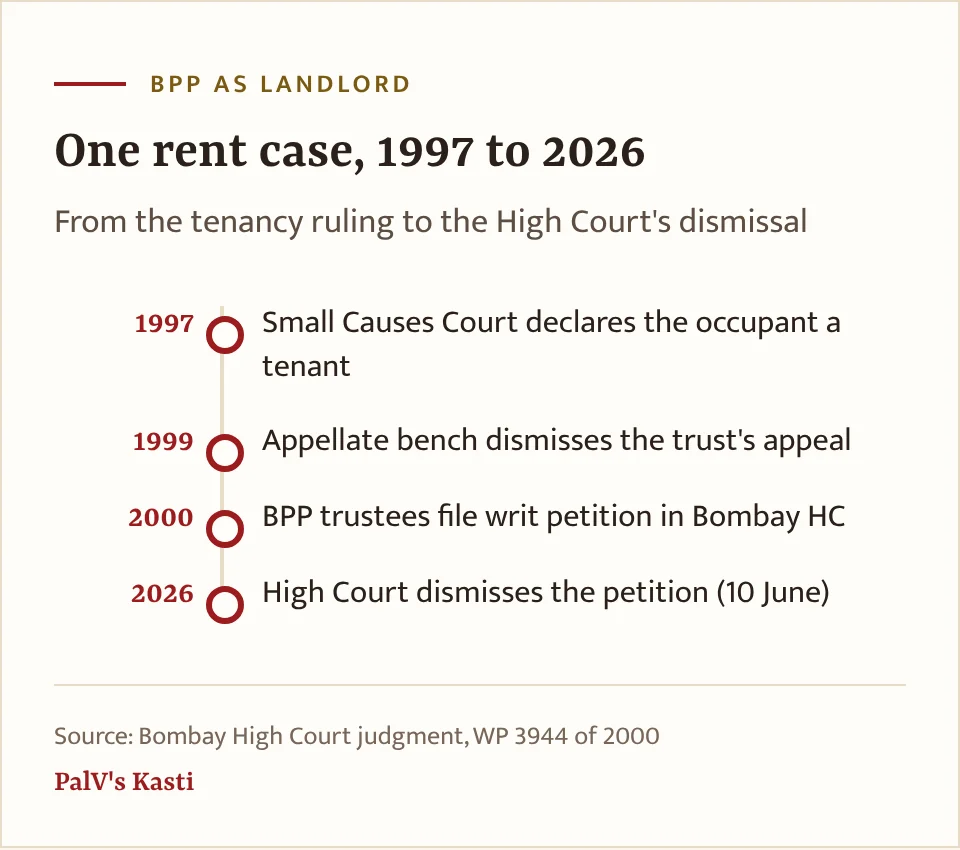
A trust that owns homes ends up in rent courts. In J. N. Guzder and Others (trustees of the Parsi Punchayet Funds and Properties) v. Katty J. Mistry, over a flat in Dadar Parsi Colony, the Small Causes Court declared the occupant a tenant in 1997 under the Bombay Rent Act, 1947, the appeal bench agreed in 1999, and the trust's writ petition (No. 3944 of 2000) was dismissed by Justice M. M. Sathaye of the Bombay High Court on 10 June 2026. The cause title lists the trustees who filed the case in 2000 and the entirely different board that saw it decided.
How far trustees' powers go
A trust deed sets limits on its trustees. In Jamsheed Kanga v. Parsi Panchayat Funds and Properties, decided on 11 March 2011, a Division Bench of the Bombay High Court (Chandrachud and Mohta JJ) set aside a single judge's ruling and held that, under the BPP's Deed of Trust of 1884, the trustees were not entitled to stop any duly ordained Parsi Zoroastrian priest from performing rites at Doongerwadi and the two Agiaries the case concerned. The trustees took it to the Supreme Court. The court sent the parties to mediation in May 2014, and its order of 27 April 2015 records that they signed a settlement, which was made part of the order, and that the petitions were disposed of on withdrawal.
Not every trust is a housing estate. For a much smaller kind of endowment, see our post on Parsi prize medals. The religious idea behind all this giving is covered in Charity in Zoroastrianism.
Frequently asked questions
Who supervises Parsi trusts in Maharashtra?
The Charity Commissioner, Maharashtra, under the Maharashtra Public Trusts Act, 1950. Parsi and Zoroastrian public trusts register with the Deputy or Assistant Charity Commissioner of their region, file changes within 90 days, and keep audited accounts. A separate Parsi Public Trusts Registration Act of 1936 once existed, but its proceedings passed to the Charity Commissioner.
Can trustees sell trust property?
Not on their own. Section 36 of the Maharashtra Public Trusts Act says no sale, exchange or gift of a public trust's immovable property is valid without the Charity Commissioner's previous sanction. The same applies to leasing a building or non-agricultural land for more than three years. The Commissioner may attach conditions to protect the trust when granting sanction.
How are Bombay Parsi Punchayet trustees chosen?
By election under a scheme approved through the Bombay High Court. The scheme provides for seven trustees serving five-year terms, with a lifetime limit of ten years, subject to a narrow exception. Decisions go by simple majority, and the chairman, normally the longest-serving trustee, has a casting vote on a tie but no other additional powers under the scheme.
What disputes have Parsi trusts faced recently?
The most reported ones involve the Bombay Parsi Punchayet's housing. In November 2025 a charity-flat allotment passed on the chairman's casting vote was put on hold, with a public notice inviting objections. In 2026 trustees split over converting leave-and-licence flats into tenancies. And in June 2026 the High Court dismissed a rent case the trust had pursued since 2000.
This is general information, not legal advice; for a specific case, speak to a lawyer.