 PalV's Kasti
On this page
- Is there a Parsi personal law of adoption?
- Which law do Parsis use to adopt a child in India?
- Who can adopt, and can a single Parsi adopt?
- What rights does an adopted Parsi child have?
- Is adoption under the JJ Act valid for Parsis?
- How is guardianship different from adoption?
- Will an adopted child be accepted for Navjote?
- Frequently asked questions
Yes. Parsis in India can legally adopt a child under the Juvenile Justice (Care and Protection of Children) Act, 2015, which is open to Indian prospective adoptive parents living in India "irrespective of their religion". Parsis have no adoption law of their own, and the Hindu Adoptions and Maintenance Act, 1956 expressly leaves them out. Under Section 63 of the 2015 Act, a child adopted by an adoption order becomes the adoptive parents' child as if born to them, for all purposes, including intestacy. Not everyone in the community reads the law this way. A 2024 Parsi Times article by Noshir H. Dadrawala says adoption "is not legal among Parsis in India", and the Supreme Court has held that personal beliefs cannot block an enabling statute. Both positions are set out below.
શહેરેવર રોજ
Shehrevar Roj, Tir Mah · 1396 Y.Z.
Is there a Parsi personal law of adoption?
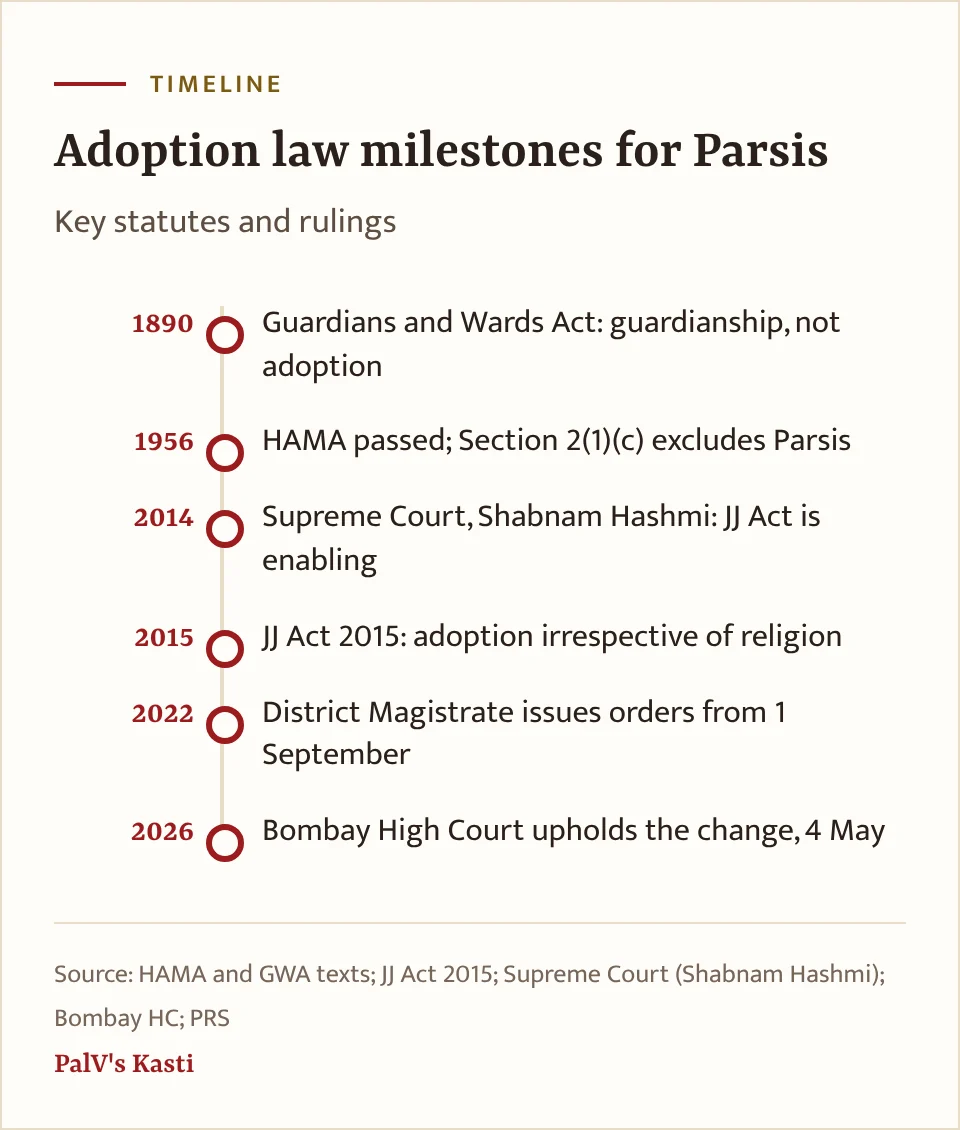
No. Writing in Parsi Times in 2024, Noshir H. Dadrawala notes that the personal law of Parsis, like that of Muslims, Christians and Jews, does not recognise complete adoption. The Hindu Adoptions and Maintenance Act, 1956 cannot fill the gap either. Section 2(1)(c) of that Act extends it to any person not "a Muslim, Christian, Parsi or Jew by religion", so a Parsi is outside it by name. Dadrawala's article makes the same point in plain words: "HAMA is NOT Applicable to Parsis."
The wider story of how Parsi personal law took shape in India is told in our page on Parsi law history.
Which law do Parsis use to adopt a child in India?
The secular route is Chapter VIII of the Juvenile Justice Act, 2015 (the JJ Act). Section 56(1) says adoption is to be used to secure a "right to family" for orphan, abandoned and surrendered children. Section 56(2) allows a child to be adopted from one relative by another relative, irrespective of their religion. Section 58(1) lets Indian prospective adoptive parents living in India, again irrespective of religion, apply to a Specialised Adoption Agency.


What are the steps under the JJ Act?
- The parents apply to a Specialised Adoption Agency.
- The agency prepares a home study report and, if it finds them eligible, refers a child who has been declared legally free for adoption, with the child's study report and medical report.
- Once the parents accept the child, the agency places the child with them in pre-adoption foster care and applies for the adoption order.
- After the order, the agency follows up on the child's progress in the new family, as the adoption regulations require.
Who issues the adoption order now?
When the 2015 Act was passed, a court issued the order. The Juvenile Justice (Care and Protection of Children) Amendment Act, 2021 (Act 23 of 2021), in force from 1 September 2022, moved that power to the District Magistrate, including an Additional District Magistrate. A person aggrieved by the District Magistrate's order can appeal to the Divisional Commissioner. PRS Legislative Research, in its summary of the 2021 Bill, gives the time limit for that appeal as 30 days. On 4 May 2026 a Division Bench of the Bombay High Court (Bharati Dangre and Manjusha Deshpande JJ) upheld the transfer in Nisha Pradeep Pandya v. Union of India, Writ Petition No. 1085 of 2023, and dismissed the petitions challenging it.
Who can adopt, and can a single Parsi adopt?
Section 57 of the JJ Act sets the eligibility rules, and none of them depends on religion:
- Prospective parents must be physically fit, financially sound, mentally alert and highly motivated to give the child a good upbringing.
- A married couple needs the consent of both spouses.
- A single or divorced person can adopt, subject to the same criteria and the adoption regulations.
- A single man cannot adopt a girl.
Further criteria are set by the adoption regulations of the Central Adoption Resource Authority (CARA), which the Act constitutes under Section 68. So a single Parsi woman or man can adopt, within those limits.
What rights does an adopted Parsi child have?
Under Section 63 of the JJ Act, once the adoption order takes effect the child becomes the adoptive parents' child, and they become the child's parents, "for all purposes, including intestacy". From that date the child's ties with the birth family are severed and replaced by ties to the adoptive family. One exception: property already vested in the child before the order stays with the child, along with any duties attached to it. Section 2(2) puts it the same way, defining adoption as making the child the "lawful child" of the adoptive parents with the rights and responsibilities of a biological child.
Inheritance is where the open question sits. A Parsi who dies without a will is governed by Sections 50 to 56 of the Indian Succession Act, 1925, the "Special Rules for Parsi Intestates". Those sections speak of children and lineal descendants and, on our reading of the text, do not mention adoption at all. We found no reported judgment that applies Section 63 of the JJ Act to a Parsi estate, so how a court would read the two together is untested. A will removes the doubt: Section 59 of the Succession Act lets any person of sound mind who is not a minor dispose of property by will. Dadrawala gives the same practical advice, writing that Parsi adoptive parents "are advised to execute testamentary and other documents" to secure the child's inheritance.
Is adoption under the JJ Act valid for Parsis?
Two positions are on record, and we give each in its own words.

The view that adoption is not legal for Parsis
Noshir H. Dadrawala, writing in Parsi Times on 2 November 2024, opens with: "Adoption is not legal among Parsis in India." He argues that the JJ Act "fails to override the provisions of other personal laws" and that it is not a full adoption law but one way of rehabilitating abandoned and destitute children. His article discusses the JJ Act 2000 and its 2006 amendment. It does not discuss the 2015 Act or its Section 63.
He also recounts the failed attempts at a general adoption law. According to Dadrawala, the Adoption of Children Bill, 1972 was not approved because Muslims opposed it, and the Adoption of Children Bill, 1980 met opposition from the Bombay Zoroastrian Jashan Committee, which he says set up its own committee to seek an exemption for Parsis.
What the Supreme Court said in Shabnam Hashmi (2014)
In Shabnam Hashmi v. Union of India (Writ Petition (Civil) No. 470 of 2005), decided on 19 February 2014 by Chief Justice P. Sathasivam and Justices Ranjan Gogoi and Shiva Kirti Singh, the Supreme Court called the JJ Act "an enabling legislation", one a prospective parent may choose to use. Nobody is forced to use it. In the Court's words, "Personal beliefs and faiths, though must be honoured, cannot dictate" how such a statute works. The case was decided under the JJ Act 2000 as amended, the law in force at the time. The same bench declined to declare adoption a fundamental right, saying that step "will have to await a dissipation of the conflicting thought processes".
How is guardianship different from adoption?
Guardianship under the Guardians and Wards Act, 1890 does not make a child yours. Section 4 of that Act defines a guardian as someone with care of a minor's person, property or both, and a ward as the minor in that care. The relationship is guardian and ward, not parent and child, a point Dadrawala also makes: "The GWA confers only a guardian-ward relationship."
He gives an example from the Tata family. According to his article, Naval Tata, father of Ratan Tata, was at the J.N. Petit Parsi Orphanage when Lady Navajbai Tata, wife of Sir Ratanji Tata, chose to take him in. Dadrawala writes that the couple became Naval's guardians under the 1890 Act and that he remained Naval Hormusji Tata, not Naval Ratanji Tata.
Will an adopted child be accepted for Navjote?
The law of adoption does not settle religious standing. The only written view we found is Dadrawala's 2024 article, which argues that a Navjote alone does not make a child of unknown parentage a Parsi Zoroastrian and points to the Parsi Punchayet case decided over a century ago. We report that as his view, from a single source. He also stresses that naming a paalak to perform a deceased person's obsequies is a different custom from adoption. Our page on Palak (adoption) covers that custom.
Practice varies between families and Agiaries; your family priest's guidance comes first.
Frequently asked questions
Can Parsis adopt a child in India?
Yes, through the Juvenile Justice Act, 2015. Section 58(1) lets Indian prospective adoptive parents living in India apply to a Specialised Adoption Agency irrespective of religion, and Section 56(2) allows relative adoption irrespective of religion. Parsis have no separate adoption law, and the Hindu Adoptions and Maintenance Act, 1956 excludes them by name.
Does the Hindu Adoptions and Maintenance Act apply to Parsis?
No. Section 2(1)(c) of the Hindu Adoptions and Maintenance Act, 1956 applies it to persons who are not Muslim, Christian, Parsi or Jew by religion, so Parsis fall outside it. A Parsi family that wants a legal adoption, with the child treated as their own, has to use the Juvenile Justice Act, 2015 instead.
Can a single Parsi adopt a child?
Yes. Section 57(3) of the Juvenile Justice Act, 2015 allows a single or divorced person to adopt, if they meet the fitness, financial and motivation criteria and the CARA adoption regulations. Section 57(4) adds one bar: a single man is not eligible to adopt a girl. Religion is not one of the eligibility tests.
Is guardianship the same as adoption?
No. Guardianship under the Guardians and Wards Act, 1890 creates a guardian and a ward, someone who has care of a minor or the minor's property. Adoption under Section 63 of the Juvenile Justice Act, 2015 makes the child the adoptive parents' own for all purposes, including intestacy, and severs ties with the birth family.
Can an adopted child inherit from Parsi parents?
Section 63 of the Juvenile Justice Act, 2015 treats an adopted child as born to the adoptive parents, including for intestacy. The Parsi intestacy rules in Sections 50 to 56 of the Indian Succession Act, 1925 do not mention adoption, and we found no judgment joining the two. A will under Section 59 avoids the question.
This is general information, not legal advice; for a specific case, speak to a lawyer.


