PalV's Kasti
On this page
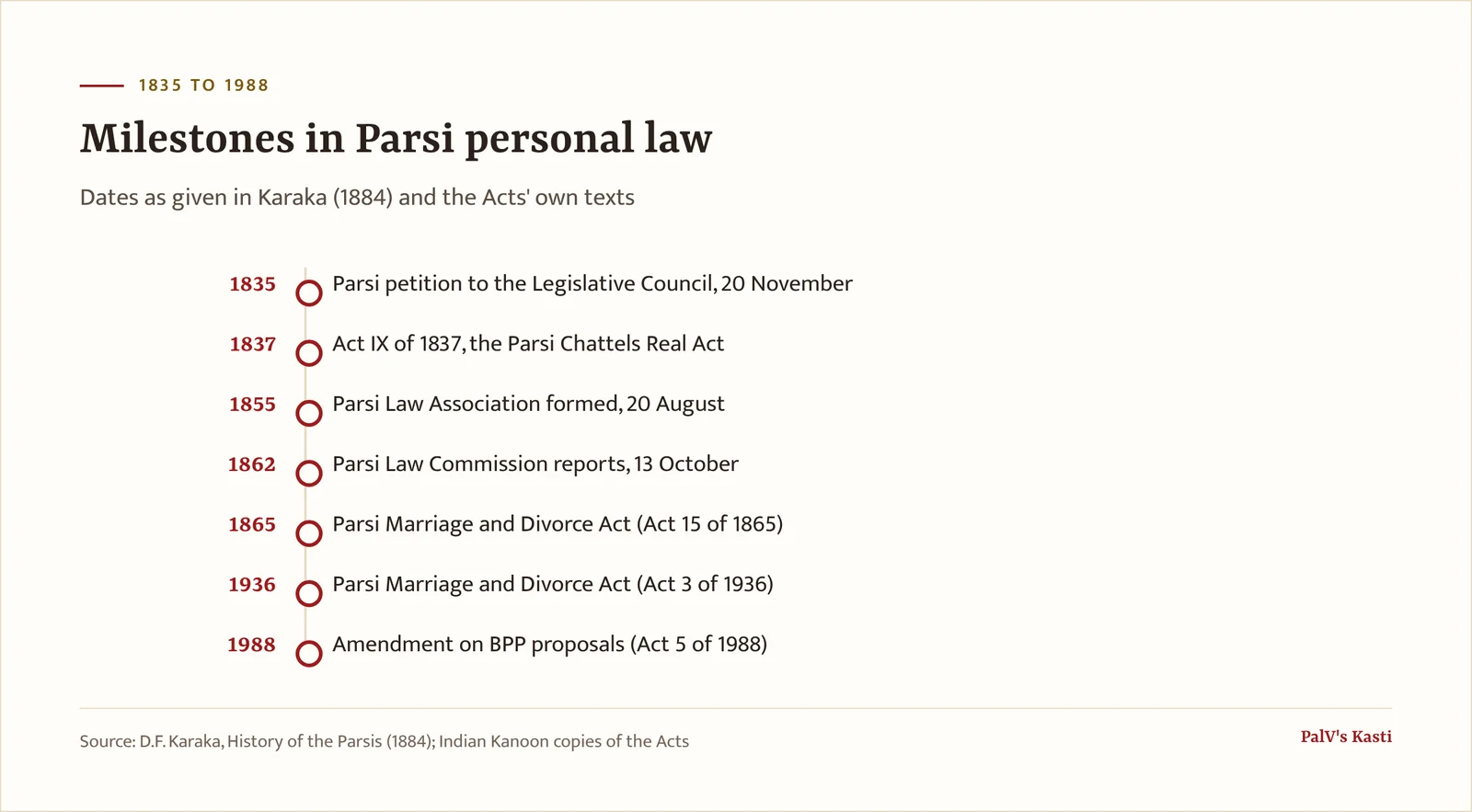
Separate Parsi laws in India came about because the community asked for them. Under British rule, Parsis in Bombay were placed under English civil law for inheritance and succession, and before 1865 they had practically no law on marriage. D.F. Karaka's History of the Parsis (1884) traces the steps: a petition against English inheritance rules in 1835, which led to Act IX of 1837; the Parsi Law Association, formed in 1855 to press for a code; and a government commission that reported in 1862. Its work led to a Parsi Marriage and Divorce Act and a Parsi Succession Act in 1865. The marriage Act was replaced by the Parsi Marriage and Divorce Act, 1936, and Parsi intestacy today falls under special rules in the Indian Succession Act, 1925.
Here is that history of Parsi personal law, step by step, with the dates as the records give them.
શહેરેવર રોજ
Shehrevar Roj, Tir Mah · 1396 Y.Z.
Why do Parsis have separate personal laws in India?
The colonial courts would not fit Parsis into the Hindu or Muslim categories, and English law suited them badly. Karaka quotes a clause in the Charter of 1823: contract, inheritance and succession were to be decided by Mahomedan law for Mahomedans, and by the laws and usages of the "Gentoos" (Hindus) for Hindus. The judges of the Supreme Court at Bombay, he writes, declined to treat Parsis as Gentoos. From then on, Parsis living within that court's limits came under English civil law for contract, inheritance and succession.
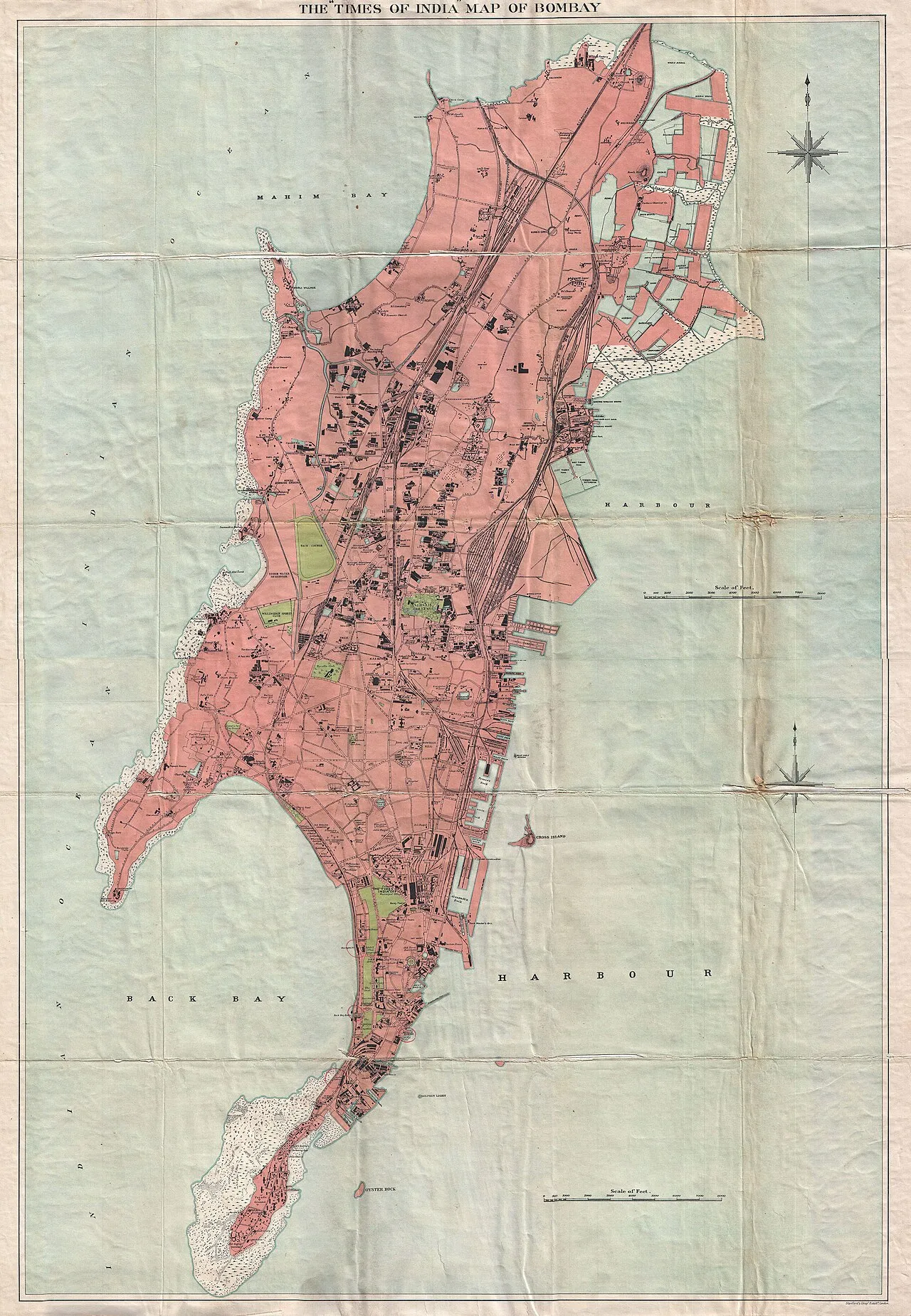
Outside Bombay, in the Mofussil, courts went by proof of unwritten usage instead. Karaka calls it an anomalous position, with two groups of Parsis exposed to two different kinds of trouble: uncertain rulings in the Mofussil, and in the Presidency towns, laws that did not suit their customs. On marriage he is blunt. Before 1865, he says, Parsis were practically without any law in matrimonial matters.
The historian Mitra Sharafi's book Law and Identity in Colonial South Asia (Cambridge University Press, 2014) looks at what came next. Its publisher's description says that from the late eighteenth century until 1947 Parsis "became heavy users of colonial law", taking part in it as lawyers, judges, litigants, lobbyists and legislators.
What was the Parsi Chattels Real Act of 1837?
The Parsi Chattels Real Act (Act IX of 1837) shielded Parsi land in Bombay from the English rule of primogeniture. According to Karaka, the trigger was a suit in the Supreme Court. The eldest son of a Parsi who had died without a will claimed, under the English rule of primogeniture, to be sole heir to his father's immovable estate. The community took alarm. On 20 November 1835 Parsis sent the Legislative Council a petition, signed by large numbers, asking to be protected from that rule.
A resolution of the Legislative Department followed on 13 January 1837. The Act then provided that a Parsi's immovable property within the Supreme Courts' jurisdiction would be treated as "chattels real" when it passed by will or on intestacy. Put simply, land would no longer go to the eldest son alone under the English rule. Karaka notes that the Act covered only Parsis living in Bombay, and only their immovable property. So the gap between town and Mofussil Parsis grew wider.
What was the Parsi Law Association?
The Parsi Law Association was the community body that drafted and lobbied for a Parsi code. Karaka records that it was formed at a public meeting in Bombay on 20 August 1855, held in the hall of a fire temple, with upwards of 3,000 people present. The meeting appointed a managing committee of 150. That committee picked 20 of its members by ballot as a sub-committee, which was to prepare a draft code and petition the Legislative Council of India.
Manakji Nasarvanji Petit was the first chairman, and Framji Nasarvanji Patel followed him. Naorozji Fardunji and Sorabji Shapurji Bengali served as joint honorary secretaries.
A court ruling then made marriage law urgent. Karaka writes that on 17 July 1856, the year after the Association was formed, the Privy Council decided in Ardeshir Kharshedji v. Pirozbai that the Supreme Court of Bombay, on its ecclesiastical side, could not hear a Parsi wife's suit against her husband for restitution of conjugal rights and maintenance. The Association answered with a separate draft code on betrothal, marriage and divorce. A paper by its secretaries, he adds, listed no fewer than 26 well-known cases of bigamy within two years.
When was the first Parsi marriage law passed?
The first Parsi marriage law was the Parsi Marriage and Divorce Act, 1865 (Act 15 of 1865). The 1936 Act refers to it by that number, and Karaka gives the same. It came out of the Parsi Law Commission set up by the Bombay Government. Karaka's dates for the Commission: appointed on 26 December 1861, first meeting on 15 February 1862, report on 13 October 1862.

He lists the members as Justice (Sir Joseph) Arnould, Henry Newton, Framji Nasarvanji Patel for the Bombay Parsis, and Rastamji Kharshedji Modi of Surat for the Mofussil Parsis. On whether Parsi women could inherit from a man who died without a will, the Commission reached the conclusion Mr. Borradaile had reached decades earlier: the Parsis had no law of their own, since the books they had in Persia were lost. The Commission went on to recommend a Parsi Succession Act and a Parsi Marriage and Divorce Act, and Karaka records both as Acts of 1865.
How did the 1865 laws become today's Parsi personal law?
Marriage and divorce: the 1936 Act and the 1988 amendment
The Parsi Marriage and Divorce Act, 1936 (Act 3 of 1936), replaced the 1865 Act. Its Statement of Objects and Reasons says the Parsi Central Association took up reform in 1923 and appointed a sub-committee. The Trustees of the Bombay Parsi Panchayat made suggestions, the Association adopted them, and leading Parsis such as Sir Dinshaw E. Wacha and the late Sir Dinshaw F. Mulla approved the draft. Section 2 of the Act defines a Parsi as "a Parsi Zoroastrian" and says a priest includes a Dastur and a Mobed.
The same pattern held in 1988. The Statement of Objects of the amending Act, Act 5 of 1988, says the government's policy was not to change any minority's personal law "unless the initiative comes from such community", and that the Board of Trustees of the Bombay Parsi Panchayat had sent the proposals. The amendment set the minimum age for a valid marriage at 21 for men and 18 for women, and added cruelty as a ground for divorce.
Divorce cases under the Act are still not heard by a judge alone. Sections 19 and 20 say the judge of a Parsi Matrimonial Court is aided by five delegates at the regular hearing of a case. Under section 24, the State Government appoints these delegates after giving local Parsis a chance to give their views, and they must be Parsis.
Inheritance: the Indian Succession Act, 1925
Parsi intestate succession now sits in the Indian Succession Act, 1925, Part V, Chapter III, "Special Rules for Parsi Intestates" (sections 50 to 56). Section 31 says the general rules of Chapter II do not apply to Parsis. Under section 51, a widow or widower and each child take equal shares, and each surviving parent takes half a child's share. Our page on Parsi succession law explains these rules in full. Adoption is a separate question, covered in our page on Parsi adoption law.
Is Parsi personal law still debated?
Yes. Whether Parsis should keep laws of their own, and what reformers and defenders each say, is set out in our piece on separate Parsi family laws. How the law treats a Parsi who marries outside the community is covered in Parsi law on inter-faith marriage.
This is general information, not legal advice; for a specific case, speak to a lawyer.
Frequently asked questions
Why do Parsis have separate personal laws?
According to D.F. Karaka, Bombay's Supreme Court judges would not treat Parsis as Hindus, so Parsis there came under English civil law for inheritance. Before 1865 they had practically no marriage law. The community petitioned in 1835 and formed the Parsi Law Association in 1855. That pressure led to Act IX of 1837 and the Parsi Acts of 1865.
When was the first Parsi marriage law passed?
The first was the Parsi Marriage and Divorce Act, 1865 (Act 15 of 1865). Karaka records that it followed the Parsi Law Commission, which reported on 13 October 1862. The Parsi Marriage and Divorce Act, 1936 (Act 3 of 1936) later replaced it. That 1936 Act was amended in 1988 on proposals from the Bombay Parsi Panchayat's trustees.
What was the Parsi Law Association?
It was a community body formed at a public meeting in Bombay on 20 August 1855, attended by upwards of 3,000 people, according to D.F. Karaka. Its committee drafted a code of inheritance and succession, later a marriage and divorce code, and petitioned the Legislative Council. Framji Nasarvanji Patel, its second chairman, sat on the 1861 Parsi Law Commission.
Which law governs Parsi inheritance today?
When a Parsi dies without a will, the Indian Succession Act, 1925, applies, through Part V, Chapter III, "Special Rules for Parsi Intestates", sections 50 to 56. Under section 51, the widow or widower and each child receive equal shares, and each living parent receives half of one child's share.
Does the Parsi Marriage and Divorce Act still use a jury?
The Act does not use the word jury. Under sections 19 and 20, the judge of a Parsi Matrimonial Court is aided by five delegates at the regular hearing of a divorce or matrimonial case. Section 24 says the State Government appoints the delegates after hearing local Parsis' views, and that every delegate must be a Parsi.