PalV's Kasti
On this page
- Can a Parsi marry a non-Parsi under the Parsi Marriage and Divorce Act…
- Which law do inter-faith Parsi couples marry under?
- What inheritance law applies after a Special Marriage Act wedding?
- Does a Parsi woman who marries outside stop being a Parsi in law?
- Where does the Goolrokh Gupta case stand in 2026?
- Are men and women who marry out treated the same?
- Has anyone proposed changing Parsi personal law on this?
- Frequently asked questions
Parsi marriage law does not provide for inter-faith marriages. The Parsi Marriage and Divorce Act, 1936 defines "marriage" as a marriage between Parsis, and a valid Parsi marriage needs the Ashirvad ceremony performed by a priest before two Parsi witnesses. For a Parsi marrying someone of another faith in India, the civil route is the Special Marriage Act, 1954, which is open to any two persons who meet its conditions. That choice has two effects. The special Parsi inheritance rules stop applying to the couple's property. And for women, it has raised the question of whether a Parsi woman stays a Parsi at all. That second question has been before the Supreme Court since 2012, and the case was pending as of 16 November 2026, the date we last checked.
શહેરેવર રોજ
Shehrevar Roj, Tir Mah · 1396 Y.Z.
Can a Parsi marry a non-Parsi under the Parsi Marriage and Divorce Act?
No. The Parsi Marriage and Divorce Act is written only for marriages between Parsis. Section 2(6) says "marriage" means a marriage between Parsis, and section 2(7) says a Parsi means a Parsi Zoroastrian. Chapter II of the Act carries the heading "Marriages between Parsis".
Section 3(1)(b) adds the ceremonial test. A marriage is not valid under the Act unless it is solemnised by the Parsi form of ceremony called Ashirvad, by a priest, with two Parsi witnesses besides the priest. Section 2(8) defines a priest as a Parsi priest, including a Dastur and a Mobed.
One provision does reach beyond the community. Section 5, on bigamy, bars a Parsi from marrying again, under this Act or any other law, while a husband or wife is alive, "whether a Parsi or not", unless that earlier marriage has been lawfully ended. So a Parsi who is already married to a non-Parsi cannot marry again without a divorce or annulment.
Which law do inter-faith Parsi couples marry under?
The Special Marriage Act, 1954 (SMA). Section 4 allows a marriage between any two persons if the conditions in that section are met at the time of marriage, and none of those conditions is about religion. Neither party may have a living spouse. Both must be able to give valid consent. The man must be at least 21 and the woman at least 18, and they must not fall within the prohibited degrees of relationship, unless a custom governing at least one of them permits it.
In December 2017, a five-judge bench of the Supreme Court spoke to this during the Goolrokh Gupta hearing, as LiveLaw reported. The purpose of the 1954 Act, the bench observed, is for each spouse to keep their own religious identity after marriage, and unless a wife expressly renounces her religion there is a presumption that she continues to practise it. That was an observation during the hearing, not a final ruling.
What inheritance law applies after a Special Marriage Act wedding?
Parsis who die without a will normally inherit under a separate chapter of the Indian Succession Act, 1925: Part V, Chapter III, "Special Rules for Parsi Intestates", sections 50 to 56. Section 51, for example, gives the widow or widower and each child equal shares.
Section 21 of the SMA changes this for couples married under it. Succession to the property of a person married under the SMA, and to the property of their children, is governed by the Indian Succession Act as though the Parsi chapter had been left out of it. In plain terms, the special Parsi rules for those who die without a will do not apply to that couple's estates or to their children's. How Parsi succession law came to have its own chapter is covered on our page on Parsi law history.
Does a Parsi woman who marries outside stop being a Parsi in law?
The only binding answer on record comes from the Gujarat High Court, and it is under challenge. Goolrokh Gupta, born a Parsi, married a Hindu man under the SMA and kept practising her religion. The Parsi trust in her hometown of Valsad barred her from its Parsi institutions, which would have kept her from performing her parents' last rites.
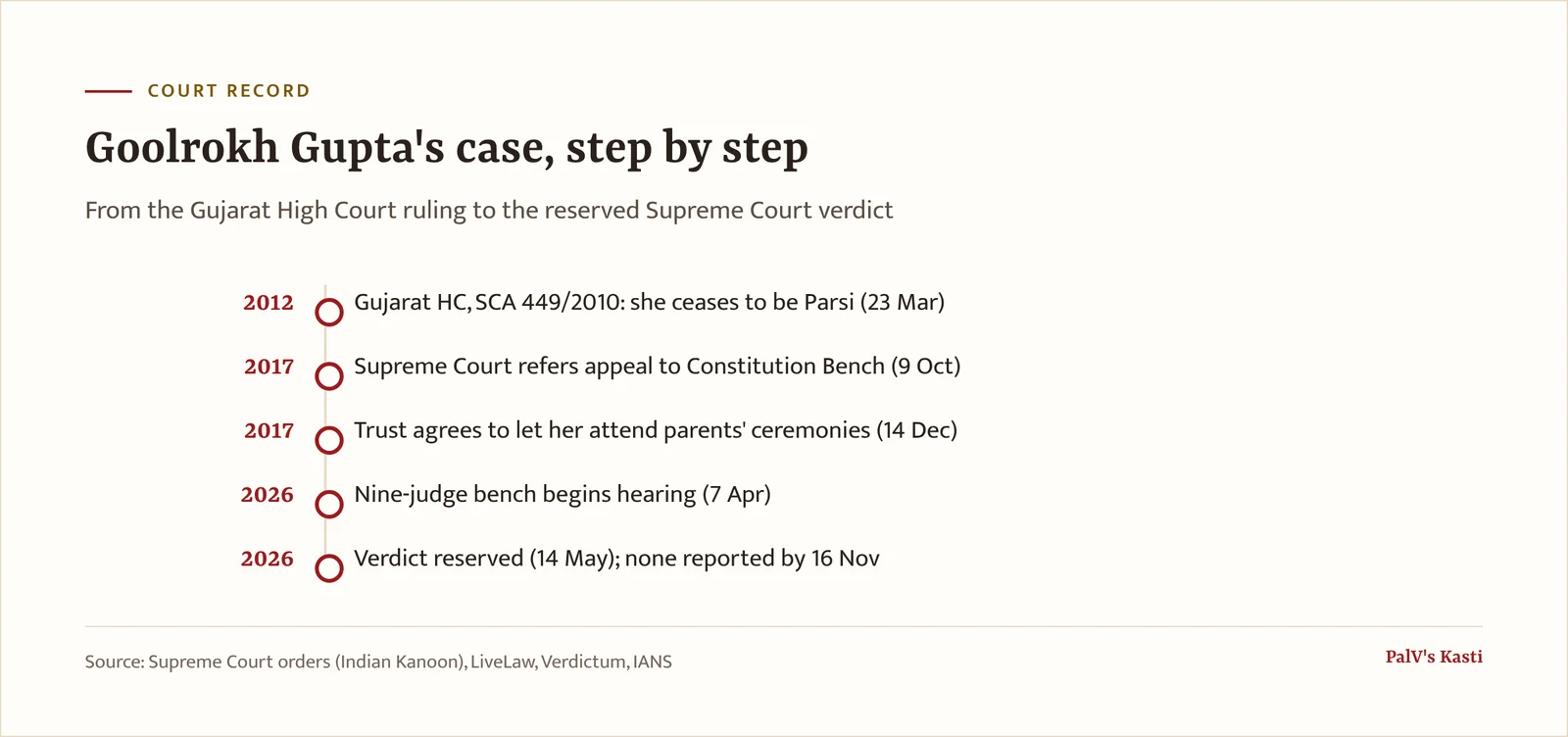

On 23 March 2012, in Special Civil Application 449 of 2010, the Gujarat High Court dismissed her petition. The Supreme Court Observer describes the split as 2:1 and records the main ground: a Parsi woman who marries a non-Parsi under the SMA ceases to be a Parsi unless a competent court declares that she still follows the Zoroastrian religion. LiveLaw's reports describe the High Court as relying on the common law doctrine of merger (its 2026 report calls it coverture), under which a wife's identity merges with her husband's on marriage.
Her appeal, SLP (C) 18889 of 2012, then moved slowly:
- 9 October 2017: a three-judge bench referred the matter to a Constitution Bench "regard being had to the importance of the matter".
- 7 December 2017: hearing before five judges. Indira Jaising, for Ms Gupta, argued that "religion is a matter of choice" and that the treatment was sex-based, since a Parsi man marrying a non-Parsi woman would not face it.
- 14 December 2017: without prejudice to either side, the Valsad Parsi Anjuman Trust agreed "on compassionate grounds" to let her attend her parents' Paidust ceremony and the four-day ceremonies in the prayer hall of the Bungli at Valsad. Her children could sit in the pavilion opposite. The order says this met her immediate need and that her other rights would be decided later.
Where does the Goolrokh Gupta case stand in 2026?
The case was tagged with the Sabarimala reference and heard by a nine-judge Constitution Bench led by Chief Justice Surya Kant. Verdictum reports that hearings began on 7 April 2026.
For the respondents, Verdictum's report of 22 April 2026 says Senior Advocate Gopal Subramanium argued that courts can inquire into the basic tenets of a faith, and that a person free to choose a creed cannot, once inside a denomination, try to change its core doctrine from within.
For Ms Gupta, Senior Advocate Darius Khambata argued on 5 May 2026 that the bar was a man-made practice, hard to support from any religious text, and that practice differs between trusts. He told the court that the Bombay Parsi Trust passed a resolution in 1991 allowing entry, and that several Anjumans across India permit it. LiveLaw reports that Justice B.V. Nagarathna remarked that the right to conscience under Article 25(1) comes by birth and "can't be taken away by marriage", calling it "virtually ex-communication". The Chief Justice remarked that the High Court majority's view ran contrary to the scheme of sections 19, 21 and 21A of the SMA. These were oral remarks during argument.
IANS and LiveLaw both reported that the bench reserved its verdict on 14 May 2026, and IANS listed Parsi women's access to fire temples after marrying outside the faith among the allied questions it examined. Kerala Kaumudi reported on 2 October 2026 that the verdict was expected that month. When we checked LiveLaw's Sabarimala pages on 16 November 2026, we found no report of a verdict, so the case was pending as of that date.
The Nagpur Parsi Panchayat petition
A separate case, W.P.(C) 381 of 2026, challenges Rule 5(2) of the Nagpur Parsi Panchayat's constitution. As LiveLaw describes the rule, a Parsi or Irani Zoroastrian woman who takes a non-Parsi husband and has children with him is not accepted as a Parsi Zoroastrian, and nor are those children. On 25 May 2026, a bench of the Chief Justice and Justices Joymalya Bagchi and Vipul Pancholi explored limited interim permission for the petitioner to pray at Nagpur's only Agiary. Her counsel, Shyam Divan, said similar arrangements already exist for such women in Mumbai, Delhi, Kolkata and Pune. The case was pending at the time of that report.
Are men and women who marry out treated the same?
None of the sections quoted above draws a line between a Parsi man and a Parsi woman who marries out. The difference people talk about comes from community and trust practice, and the court record gives it only as the parties' accounts. In 2017 Indira Jaising told the Supreme Court that a Parsi man who marries a non-Parsi woman is not treated the same way. In 2026 Darius Khambata said such a man and his family keep their rights, including entry to the fire temple. In the Nagpur case, Shyam Divan gave a narrower account: under the Panchayat's rules the man's own religious status is unaffected, although his wife and children may be denied benefits from Panchayat funds and properties.
Older cases dealt with people born outside the community. In Petit v Jijibhai (Bombay High Court, 1908), Justices Davar and Beaman held, in historian Mitra Sharafi's summary, that juddins (non-Parsis) could not benefit from Parsi trusts. Sharafi notes that the case was about a convert, not about children of mixed parentage. In Saklat v Bella (Privy Council, 22 October 1925), the girl Bella was born in Rangoon to a Goan Christian father and a mother who said she was a Parsi. Her Navjote was performed by a visiting priest after the local Head Priest refused. The Privy Council said that, as regards the racial claim, "maternity is of no importance", and declared that she was not entitled, as of right, to use the fire temple there or take part in its ceremonies.
Practice varies between families and Agiaries; your family priest's guidance comes first.
Has anyone proposed changing Parsi personal law on this?
Yes. In its consultation paper on family law reform, released on 31 August 2018, the Law Commission of India suggested, as LiveLaw summarised it, that a Parsi woman should keep her Parsi status after marrying outside the community, and that her children should be able to inherit if they choose to profess the Zoroastrian religion. A consultation paper is a set of suggestions, not a law. The wider argument over whether Parsis should keep their own personal laws is on our page on Separate Parsi family laws.
Frequently asked questions
Can a Parsi marry a non-Parsi under the Parsi Marriage and Divorce Act?
No. Section 2(6) of the Parsi Marriage and Divorce Act, 1936 defines marriage as a marriage between Parsis, and section 3(1)(b) requires the Ashirvad ceremony by a Parsi priest before two Parsi witnesses. A Parsi marrying someone of another faith in India can marry under the civil Special Marriage Act, 1954 instead.
Does a Parsi woman who marries outside stop being a Parsi in law?
The Gujarat High Court said yes in 2012, unless a court declares she still follows Zoroastrianism. That ruling is under appeal in the Supreme Court in Goolrokh Gupta's case. A nine-judge bench reserved its verdict on 14 May 2026, and the case was pending as of 16 November 2026, when we last checked for a verdict.
What inheritance law applies after a Special Marriage Act wedding?
Section 21 of the Special Marriage Act says the Indian Succession Act, 1925 governs succession to the couple's property and their children's property, as though its Parsi chapter were left out. So the special Parsi rules for those who die without a will, sections 50 to 56, do not apply to them.
What is the Goolrokh Gupta case?
Goolrokh Gupta, born a Parsi, married a Hindu man under the Special Marriage Act and was barred by the Parsi trust in Valsad from its institutions. The Gujarat High Court ruled against her in 2012. Her Supreme Court appeal, SLP (C) 18889 of 2012, was later heard by the nine-judge bench in the Sabarimala reference.
Are children of a Parsi father and non-Parsi mother Parsi?
No Act settles this. Accounts in court differ: in 2026 Darius Khambata said a Parsi man who marries out and his family keep their rights, while Shyam Divan said Nagpur's Panchayat rules may deny the wife and children Panchayat benefits. Practice varies between families and Agiaries; your family priest's guidance comes first.
This is general information, not legal advice; for a specific case, speak to a lawyer.