PalV's Kasti

On this page
- Who does the Parsi Marriage Act 1936 apply to?
- Why was the 1936 Act passed, and what did it replace?
- What makes a Parsi marriage valid under section 3?
- Can a Parsi marry again while a spouse is alive?
- How is a Parsi marriage certified and registered?
- What cases can be filed under the Act?
- Which court hears a Parsi matrimonial case?
- When was the PMDA last amended?
- Frequently asked questions
The Parsi Marriage and Divorce Act, 1936 (Act 3 of 1936) is the law that governs marriage, nullity, divorce, maintenance and the custody of children for Parsi Zoroastrians in India. It is dated 23 April 1936 and came into force on 22 June 1936. For a Parsi marriage to be valid, section 3 asks for three things: the couple must not be related within the degrees listed in Schedule I, the marriage must be solemnised by the Ashirvad ceremony performed by a priest with two Parsi witnesses besides the priest, and the groom must have completed 21 years and the bride 18. The Act also asks the priest to certify each marriage for registration, makes a second marriage during a spouse's lifetime void, and sends every suit under it to special Parsi Matrimonial Courts.
શહેરેવર રોજ
Shehrevar Roj, Tir Mah · 1396 Y.Z.
Who does the Parsi Marriage Act 1936 apply to?
The Act uses a narrow definition. Section 2(7) says "a Parsi means a Parsi Zoroastrian", and section 2(6) defines marriage as a marriage between Parsis, whether it took place before or after the Act began. A "priest", under section 2(8), is a Parsi priest and includes a Dastur and a Mobed.
Changing faith or domicile does not take a married Parsi out of the Act. Under section 52(2), a Parsi married under this Act or the 1865 Act remains bound by it for as long as the spouse is alive and the marriage has not been ended or annulled by a competent court, even if he or she changes religion or domicile.
Inheritance is not part of this Act. That sits under a different statute, covered in our guide to Parsi succession law.
Why was the 1936 Act passed, and what did it replace?
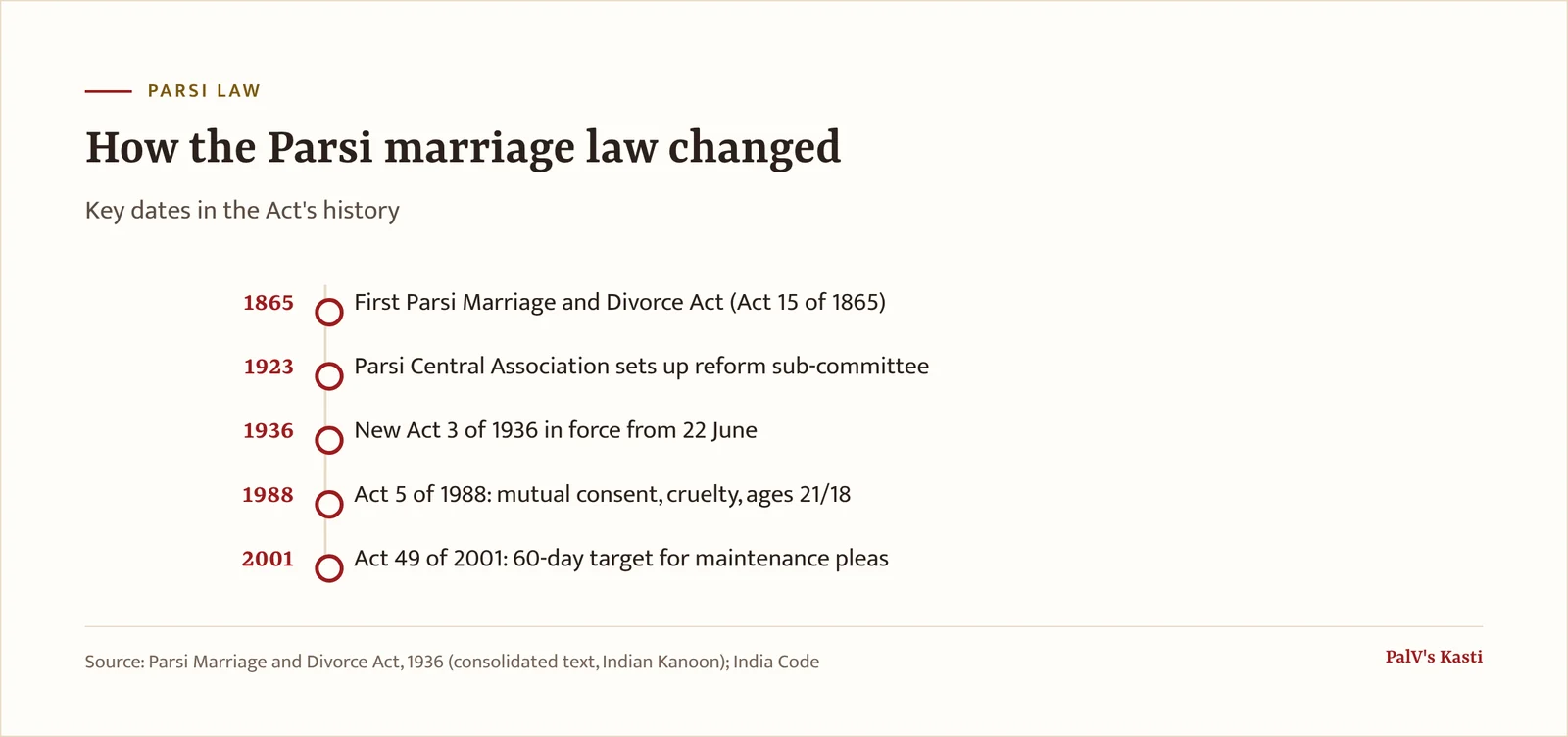
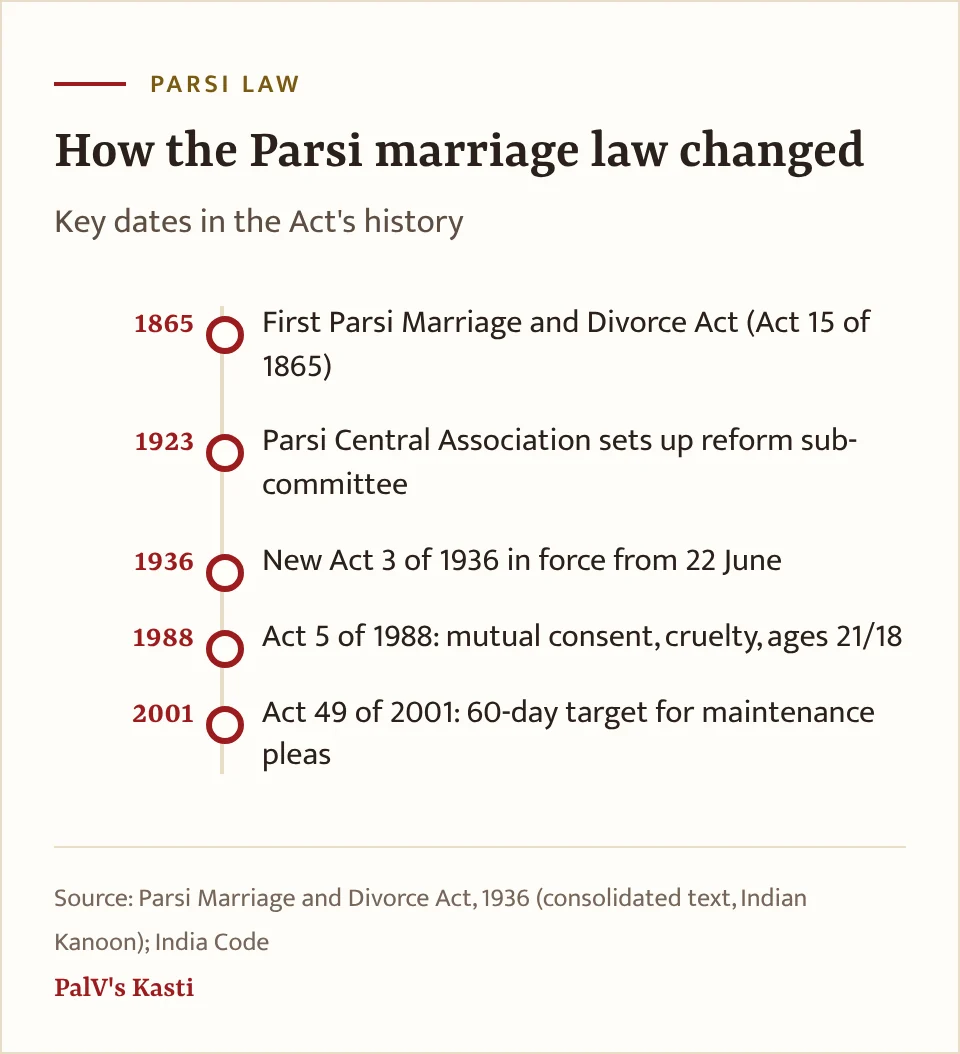
It replaced the Parsi Marriage and Divorce Act of 1865 (Act 15 of 1865), which the 1936 text marks as repealed. The Statement of Objects and Reasons printed with the Act gives the reason plainly: circumstances had changed a great deal since 1865, and so had the views of the community.

The draft came from within the community. That same Statement records that the Parsi Central Association took up reform in 1923 and set up a sub-committee, whose report was printed and sent to Parsi associations and prominent community members in Bombay and beyond. The Association then adopted the suggestions of the Trustees of the Bombay Parsi Panchayat, circulated the revised draft again, and weighed further comments from the press, public meetings, associations and individuals. The Statement says the result had the backing of most of the community and names Sir Dinshaw E. Wacha and the late Sir Dinshaw F. Mulla among the leading Parsis who approved it.
What makes a Parsi marriage valid under section 3?
Section 3(1) is written in the negative. A marriage is not valid if any one of these is missing:
| Requirement | What the Act says | Section |
|---|---|---|
| No prohibited relationship | The couple must not be related within the degrees of consanguinity or affinity in Schedule I | 3(1)(a) |
| Ashirvad | Solemnised by the Parsi ceremony called Ashirvad, by a priest, with two Parsi witnesses other than the priest | 3(1)(b) |
| Minimum age | A man must have completed 21 years and a woman 18, whether or not either has changed religion or domicile | 3(1)(c) |
The age clause in its present form dates from Act 5 of 1988, in force from 15 April 1988. The same amendment added section 3(2), which protects children: a child of a marriage that fails section 3(1) is still legitimate if he or she would have been legitimate had the marriage been valid.
Is a Tandoorasti the same as an Ashirvad?
Not in the eyes of the Bombay High Court. In H v. S (2026:BHC-OS:20904), Justice Somasekhar Sundaresan dealt with a couple who had a civil wedding in Perth in August 2010 and a ceremony in Mumbai that November. As reported by Verdictum on 27 September 2026, five delegates watched a video of the Mumbai event and unanimously found it was a Tandoorasti, a blessing, and not an Ashirvad. They noted that the marriage document was not signed by the couple and witnesses. Since that ceremony was the only link to Mumbai, the court held it had no jurisdiction and dismissed the suit.
The ceremony itself, and how your own wedding should be arranged, is a matter for the family and the officiating priest. We describe the day in our Parsi wedding guide. Practice varies between families and Agiaries; your family priest's guidance comes first.
Can a Parsi marry again while a spouse is alive?
No. Section 4 bars a Parsi from marrying, under this Act or any other law, during the lifetime of a husband or wife, Parsi or not, unless there has been a lawful divorce or the earlier marriage has been declared null or dissolved. A change of religion or domicile makes no difference, and a marriage made in breach of the rule is void.
Section 5 makes it a punishable offence, applying the penalties of sections 494 and 495 of the Indian Penal Code as the Act's text puts it. A priest who knowingly solemnises such a marriage faces up to six months' simple imprisonment, a fine of up to 200 rupees, or both, under section 11.
How is a Parsi marriage certified and registered?
The paperwork starts with the priest. Right after the ceremony, section 6 requires the officiating priest to certify the marriage in the Schedule II form, signed by the priest, the couple and two witnesses. He sends it to the Registrar of the place where the wedding was held, along with a two-rupee fee that the husband pays, and the Registrar enters it in a register.
- Within the original civil jurisdiction of a High Court, the Chief Justice appoints the Registrar; elsewhere the State Government does (section 7).
- The register is open to inspection, extracts cost two rupees each, and the register counts as evidence of what it records (section 8).
- Decrees of divorce, nullity or dissolution are sent by the court to the Registrar to be entered too (section 10).
- A missing or faulty certificate does not invalidate the marriage. Section 17 says a marriage is not invalid only because it was not certified, the certificate never reached the Registrar, or it was defective.
What cases can be filed under the Act?
Chapter IV sets out the suits a Parsi spouse may bring:
- nullity, where consummation is impossible from natural causes (section 30);
- dissolution, where a spouse has been absent and unheard of for seven years (section 31);
- divorce on the grounds in section 32, after no resumption of cohabitation (section 32A), or by mutual consent (section 32B);
- judicial separation on any ground available for divorce (section 34);
- restitution of conjugal rights (section 36).
The court can also order interim maintenance and costs during the suit (section 39), permanent alimony (section 40), and arrangements for the custody, maintenance and education of children under 18 (section 49). Every ground, with its time limit, and how maintenance is fixed, is in our explainer on Parsi divorce grounds.
Which court hears a Parsi matrimonial case?
The Act has its own courts. Section 18 sets up a Parsi Chief Matrimonial Court in each of the old Presidency-towns of Calcutta, Madras and Bombay, and Parsi District Matrimonial Courts in other places a State Government chooses. A suit is filed where the defendant lives, or, since 1988, where the marriage was solemnised (section 29). That second option is exactly what failed in the Tandoorasti case above.

The unusual part is the delegates. The judge sits with five Parsi delegates, and under section 46 the judge decides questions of law and procedure while the majority of delegates decides the facts. If they split evenly, the judge decides. How delegates are appointed, and how they work in practice, is the subject of our piece on Parsi matrimonial courts.
Two more rules apply to every case. Suits are heard in camera, and publishing anything about one, other than a judgment released with the court's permission, can draw a fine of up to 1,000 rupees (section 43). Appeals go to a two-judge bench of the High Court and must be filed within three calendar months (section 47).
When was the PMDA last amended?
The big rewrite came in 1988. Its Statement of Objects and Reasons explains that the Act had not been touched for years because the Government's policy was not to change a minority's personal law unless the community asked. The Board of Trustees of the Bombay Parsi Panchayat sent proposals, the Minorities Commission recommended them, and the stated aim was to bring parts of the Act in line with the Hindu Marriage Act, 1955.
| Change | Section | Amending Act |
|---|---|---|
| Marriage age set at 21 for men and 18 for women | 3(1)(c) | Act 5 of 1988 |
| Children of invalid marriages made legitimate | 3(2) | Act 5 of 1988 |
| Desertion period cut from three years to two | 32(g) | Act 5 of 1988 |
| Divorce after no resumption of cohabitation, and by mutual consent | 32A, 32B | Act 5 of 1988 |
| Delegates aiding the judge reduced from seven to five | 19 | Act 5 of 1988 |
| All suits to be tried in camera | 43 | Act 5 of 1988 |
| Custody orders to cover children up to 18 years | 49 | Act 5 of 1988 |
| Interim maintenance and child maintenance applications to be decided within 60 days of notice "as far as possible" | 39, 49 | Marriage Laws (Amendment) Act, 2001 (Act 49 of 2001) |
We have not found a later amendment in the consolidated text we used, but we could not open the official India Code copy of the full Act to confirm that, so treat the 2001 change as the latest we can vouch for.
Frequently asked questions
What is the Parsi Marriage and Divorce Act 1936?
It is Act 3 of 1936, the law on marriage, nullity, divorce, judicial separation, maintenance and child custody for Parsi Zoroastrians. It replaced the 1865 Act and came into force on 22 June 1936. According to its Statement of Objects and Reasons, the draft was worked out by the Parsi Central Association with the Trustees of the Bombay Parsi Panchayat.
Which ceremony makes a Parsi marriage valid?
Section 3(1)(b) requires the Ashirvad, performed by a priest with two Parsi witnesses other than the priest. In a 2026 ruling reported by Verdictum, the Bombay High Court accepted the delegates' finding that a Tandoorasti blessing was not an Ashirvad, so it did not count as solemnising a marriage in Mumbai.
What is the minimum marriage age under Parsi law?
Section 3(1)(c) makes a marriage invalid if the man has not completed 21 years or the woman has not completed 18. This wording came in with Act 5 of 1988 from 15 April 1988, and it applies whether or not the person has changed religion or domicile. Children of such a marriage are still legitimate under section 3(2).
Is a Parsi marriage valid if it is not registered?
Yes, if section 3 is met. Section 17 says a marriage is not invalid only because the priest did not certify it, the certificate never reached the Registrar, or the certificate was defective. The priest who fails to certify can still be penalised, and under section 8 the register entry is evidence of what it records.
Can a Parsi who converts escape the Act?
Not while the marriage stands. Sections 4 and 52(2) keep a Parsi married under the Act bound by it, including the bar on a second marriage, after a change of religion or domicile, until the marriage is dissolved or annulled by a court. Separately, section 32(j) lets the other spouse seek divorce if one partner converts.
When was the Parsi Marriage and Divorce Act last amended?
The latest change we can confirm is the Marriage Laws (Amendment) Act, 2001 (Act 49 of 2001), which asks courts to decide interim maintenance and child maintenance applications within 60 days of notice where possible. The larger overhaul came earlier, through Act 5 of 1988, at the request of the Bombay Parsi Panchayat Trustees.
This is general information, not legal advice; for a specific case, speak to a lawyer.