 PalV's Kasti
On this page
- What is a Parsi matrimonial court?
- Who are the Parsi jury, and who appoints them?
- How are delegates chosen for a particular case?
- What do the delegates decide, and what does the judge decide?
- Are Parsi matrimonial court hearings public?
- Why do Parsi courts still use a jury when the rest of India stopped?
- How have the courts adapted the delegate system?
- Has the Parsi jury system been challenged in court?
- Frequently asked questions
Parsi matrimonial courts are special courts created by Chapter III of the Parsi Marriage and Divorce Act, 1936, to hear suits under that Act, such as divorce, nullity and judicial separation. A judge presides, but at the regular hearing of a contested case the judge sits with five delegates, who are Parsis appointed by the State Government. Under section 46, the judge rules on law and procedure while the majority of the delegates decides the facts. That is why the BBC called them India's only surviving jury trials in 2015. They still use delegates for one plain reason. The 1936 Act requires them, and when Parliament amended the Act in 1988, it trimmed the delegate system without removing it.
શહેરેવર રોજ
Shehrevar Roj, Tir Mah · 1396 Y.Z.
What is a Parsi matrimonial court?
Section 18 of the Act sets up a special court in each of the three old Presidency towns, Calcutta, Madras and Bombay, and in any other place a State Government chooses. That gives two kinds of court:
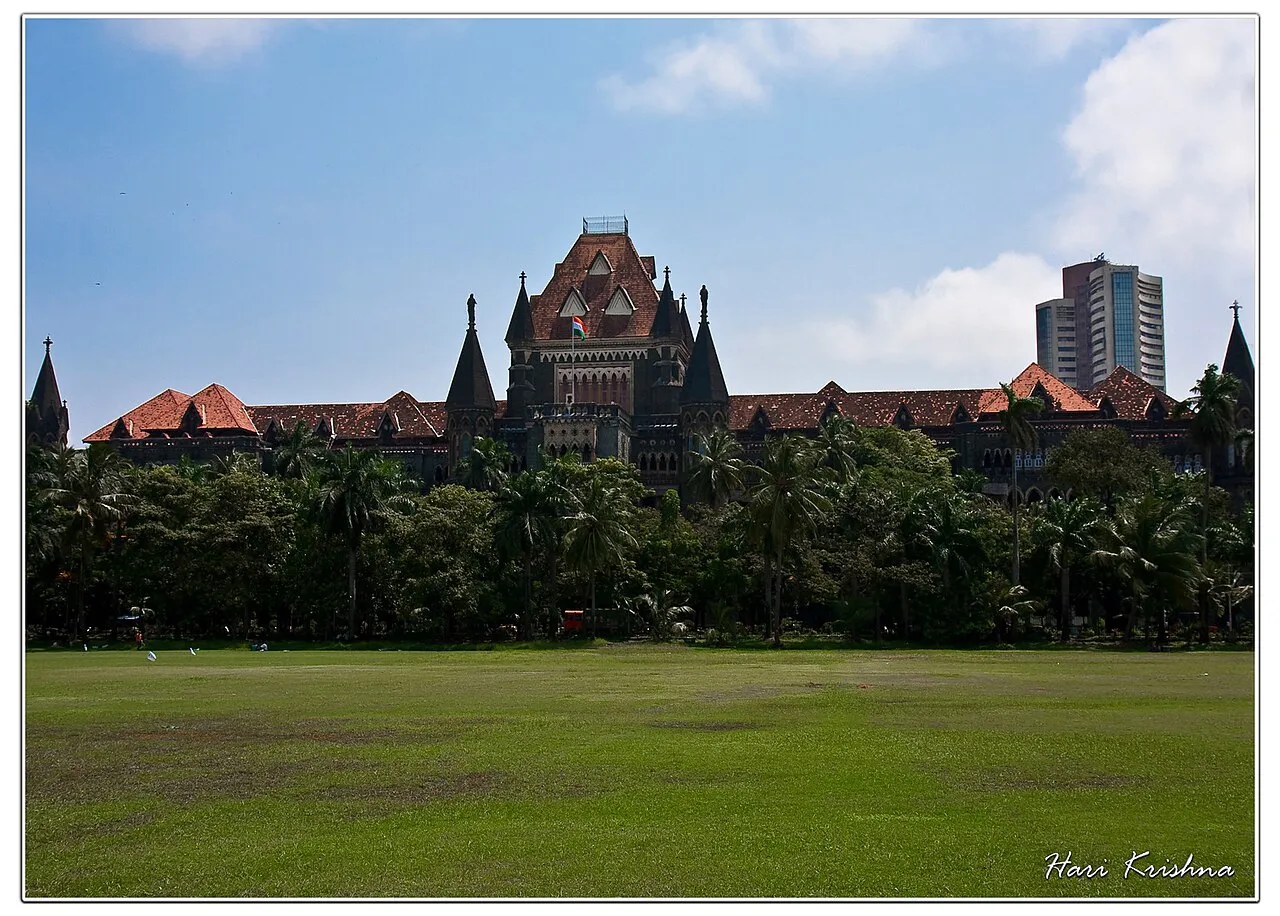
- Parsi Chief Matrimonial Court (section 19): one each in Kolkata, Chennai and Mumbai. Its area matches the High Court's ordinary original civil jurisdiction, and the judge is the Chief Justice or a High Court judge the Chief Justice appoints.
- Parsi District Matrimonial Court (section 20): in other places the State picks. The judge of the principal civil court of the place presides, and the court covers the district, though the State can redraw those limits under section 21.
If a district has too few Parsis to justify a court of its own, section 22 puts it under the Chief Matrimonial Court of that State, where one exists. We could not find an official list of the District Matrimonial Courts working today. A May 2025 LiveLaw article mentions one at Surat, where a suit discussed below was being heard.
Who are the Parsi jury, and who appoints them?
The Act calls the jurors delegates. Section 24 tells the State Government to appoint them after giving local Parsis a chance to express an opinion, in whatever manner the Government thinks fit. The main rules:
- Every delegate must be a Parsi, and their names are published in the Official Gazette.
- The State may appoint up to thirty delegates within a High Court's original civil limits, and up to twenty in districts outside them.
- An appointment runs for ten years and can be renewed (section 25). A delegate is replaced on death, resignation or unfitness, on ceasing to be a Parsi, on insolvency, or on conviction for an offence involving moral turpitude. The words about moral turpitude were added in 1988.
- Delegates count as public servants under the Indian Penal Code (section 26).
How this looked in practice is reported, not legislated. In September 2015 the BBC described the Mumbai court drawing on a pool of 20 jurors whom the community council had put forward for ten years. The council paid each juror ₹500 a day for travel and lunch.
How are delegates chosen for a particular case?
Under section 27, the delegates for a suit are taken in rotation from the appointed list, on the presiding judge's orders. Before the selection, each side may challenge any two of the delegates present without giving a reason, and a challenged delegate cannot sit. The 1988 amendment cut this from three challenges to two. The BBC's 2015 report says the Mumbai judge picked the five by drawing lots, and that lawyers could object to a juror who knew their client.

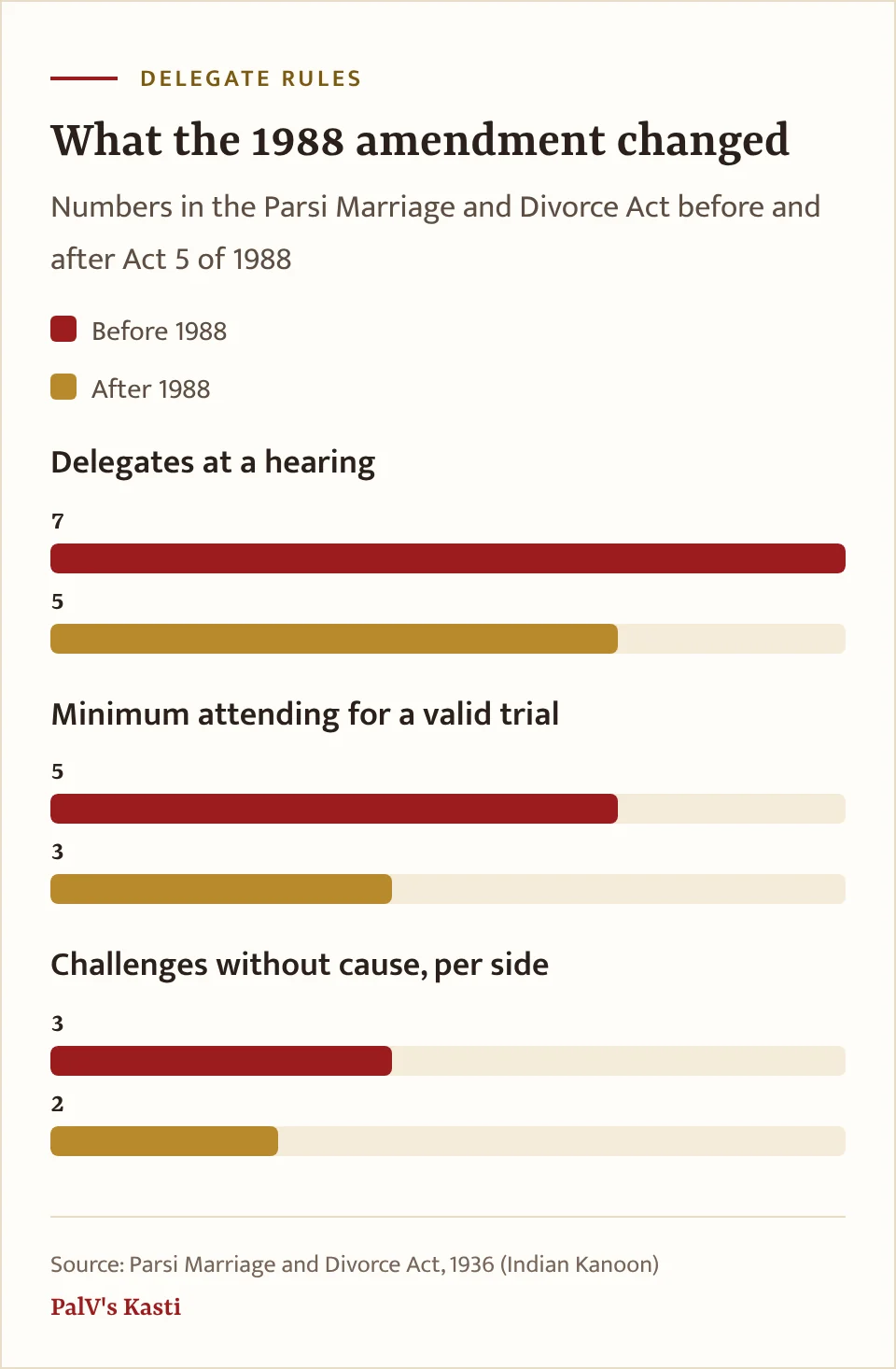
A trial survives if a delegate drops out. Section 44 keeps it valid as long as at least three delegates attended throughout. Before 1988 the figure was five, because the court then sat with seven delegates rather than five.
What do the delegates decide, and what does the judge decide?
Section 46 splits the work. The judge decides every question of law and procedure. The facts are decided by the majority of the delegates who heard the case, and if they are evenly divided, the judge decides the facts. Since 1988, section 45 also requires the judge to read the relevant sections of the Act to the delegates, explain them if needed, and keep a word-for-word record of what was read or explained.
The delegates do not sit on everything. Sections 19 and 20 leave these to the judge alone:
- interlocutory applications and proceedings
- alimony and maintenance, whether interim (pendente lite) or permanent
- custody, maintenance and education of children
- anything other than the regular hearing of a case
So the delegates decide whether a ground for divorce is proved, and the judge decides money and children. Our guide to Parsi divorce grounds covers what those grounds are and how maintenance is fixed.
Can a matrimonial court's decision be appealed?
Yes, but only on narrow grounds. Section 47 allows an appeal to the High Court if the decision is contrary to law or to a usage with the force of law, or if a substantial error or defect in procedure or investigation may have affected the result, and on no other ground. The appeal must be filed within three calendar months, and since 1988 it goes to a bench of two High Court judges. The 2017 petition described below argues that no appeal lies against the delegates' verdict on facts.
Are Parsi matrimonial court hearings public?
No. Section 43, as recast in 1988, says every suit under the Act is tried in camera. Nobody may print or publish anything about a case except a judgment the court has permitted to be published, and breaking this rule carries a fine of up to ₹1,000.
Why do Parsi courts still use a jury when the rest of India stopped?
Jury trials in Indian criminal courts ended after the Nanavati murder case of 1959. The sources word this differently. The BBC (2015) says India abolished jury trials in 1959. A 2025 LiveLaw article says they were abolished by amending the Code of Criminal Procedure, and the 2017 petition quoted by Bar & Bench places the abolition in the 1960s. That petition also notes that the delegate system was kept for suits under the Parsi Act even after the procedure codes were amended.
The community itself has steered the Act. Its 1936 Statement of Objects and Reasons says the draft came from the Parsi Central Association and the Trustees of the Bombay Parsi Panchayat. The 1988 Statement says the Government changes minority personal laws only when the community takes the initiative, and that the amendments followed proposals from the Bombay Parsi Panchayat's trustees, which the Minorities Commission also recommended.
The BBC's 2015 report gave two views from inside the field. US-based legal historian Mitra Sharafi said the courts are unique in India because no other body of personal law uses a jury. She said the early juries had nine members, almost all senior Parsi men from Bombay's elite, while women plaintiffs outnumbered men in divorce suits by two or three to one. The same report named the main criticism: couples wait longer than others because the courts meet only a few times a year. Parsi lawyer Armaity Khushrushahi told the BBC that on the whole the system serves the community well and that the jurors are pragmatic.
How have the courts adapted the delegate system?
Three Bombay High Court decisions show how the rules work today.
- 2005, mutual consent: in Minoo Rustomji Shroff v. Union of India (10 March 2005, 2005(4) BomCR 147), the trustees of the Parsi Panchayat Funds and Properties asked the court to declare that mutual-consent divorces could not be granted without delegates. The court dismissed the petition, so a joint petition under section 32B is decided by the judge alone.
- 2014, evidence on commission: in an order of 3 April 2014 in Parsi Suit No. 20 of 2013, Justice G.S. Patel, sitting as the Parsi Chief Matrimonial Court, held that evidence in a contested suit may be recorded before a court commissioner, and that the court need not sit with the delegates at all times. He closed with the line “delay denies justice; despatch defines it.”
- 2026, a fact at the early stage: Verdictum reported on 27 September 2026 that Justice Somasekhar Sundaresan held the court may seek the delegates' help on a crucial question of fact even at the interlocutory stage. With the parties' consent, five delegates watched a video of a 2010 Mumbai ceremony and unanimously found it was a Tandoorasti blessing, not an Ashirvad ceremony. With no Mumbai solemnisation, the court held it had no jurisdiction and dismissed the suit.
The 2026 ruling shows the delegates being trusted with a question of community ritual. For what happens at an Ashirvad, see our Parsi wedding guide. Practice varies between families and Agiaries; your family priest's guidance comes first.
Has the Parsi jury system been challenged in court?
Yes. On 1 December 2017, Bar & Bench reported that a Supreme Court bench of Justices Kurian Joseph and R. Banumathi issued notice to the Central Government on a petition by Naomi Sam Irani (LiveLaw gives its number as W.P.(C) 1125 of 2017). It challenges sections 18 to 21, 24, 30, 32(a), 46, 47(b) and 50 under Articles 14 and 21 of the Constitution. The petition argues that the five delegates are a jury in all but name because their verdict on facts is final, that a jury judges by social norms rather than legal principle, and that Parsis lose the quicker Family Courts available to everyone else.
LiveLaw's May 2025 article still refers to the challenge, with the petitioner's suit before the Parsi District Matrimonial Court at Surat, and reports no decision. That is the latest report we could find, so the challenge should be read as pending as of May 2025.
Frequently asked questions
Do Parsi divorces still have a jury?
Yes, for contested cases. Sections 19 and 20 of the Parsi Marriage and Divorce Act, 1936, require the judge to sit with five Parsi delegates at the regular hearing, and the delegates' majority decides the facts. Maintenance and child custody are for the judge alone, and the Bombay High Court held in 2005 that mutual-consent divorces need no delegates.
How many delegates sit in a Parsi matrimonial court?
Five delegates aid the judge at the hearing of a contested suit. Before the 1988 amendment it was seven. The trial stays valid if at least three delegates attend throughout. Each side may also strike out two delegates without giving a reason before the five are chosen in rotation from the list.
Who appoints the delegates?
The State Government appoints them under section 24, after giving local Parsis a chance to give their opinion. They must be Parsis, their names appear in the Official Gazette, and each term is ten years. In 2015 the BBC reported that the Mumbai pool of 20 had been nominated by the community council.
Where are the Parsi matrimonial courts?
The Act sets up a Parsi Chief Matrimonial Court in Mumbai, Kolkata and Chennai, each presided over by a High Court judge. States may also set up Parsi District Matrimonial Courts elsewhere, and a 2025 LiveLaw article mentions one at Surat. Districts with very few Parsis fall under their State's Chief Matrimonial Court where one exists.
Has the Parsi jury system been challenged in court?
Yes. In December 2017 the Supreme Court issued notice on Naomi Sam Irani's petition, which says the delegates act as a jury whose findings on facts are final and that Parsis are kept out of Family Courts. A May 2025 LiveLaw article, the latest report we found, shows the challenge still pending.
This is general information, not legal advice; for a specific case, speak to a lawyer.


