PalV's Kasti
On this page
- What are the grounds for divorce under Parsi law?
- Can a Parsi couple divorce by mutual consent?
- What if a separation or restitution decree changes nothing?
- When can a court refuse a divorce even if the ground is proved?
- How is interim maintenance decided while the case runs?
- How is permanent alimony decided under the Parsi Act?
- What happens to the children and to remarriage after a decree?
- Frequently asked questions
Under the Parsi Marriage and Divorce Act, 1936, a Parsi marriage can be ended in three ways. A court can declare it null where consummation is impossible from natural causes (section 30). It can dissolve it where one spouse has been missing, unheard of, for seven years (section 31). Or it can grant a divorce on one of the grounds in sections 32, 32A and 32B, which include adultery, cruelty, desertion for two years, conversion to another religion and mutual consent. Maintenance is set by the court case by case. Section 39 deals with support and legal costs during the suit. Section 40 deals with permanent alimony, where the judge looks at what each side earns and owns, how each has behaved, and anything else relevant. No percentage or formula appears anywhere in the Act.
શહેરેવર રોજ
Shehrevar Roj, Tir Mah · 1396 Y.Z.
What are the grounds for divorce under Parsi law?
Section 32 opens with the words "any married person may sue for divorce", so husband and wife have the same grounds. Most grounds carry a condition, and several carry a deadline. Miss the deadline and that ground is closed, even if the facts are true.
| Clause of s.32 | Ground | Condition or time limit |
|---|---|---|
| (a) | Wilful refusal to consummate, leaving the marriage unconsummated a year on | None stated |
| (b) | Unsound mind when married, and habitually so ever since | Plaintiff unaware of it at the wedding; file within three years of marrying |
| (bb) | Incurable unsound mind for the two years just before filing, or a mental disorder that makes living together unreasonable to expect (added 1988) | None stated |
| (c) | At the wedding, the wife was carrying another person's child | Husband unaware at the wedding; file within two years; no intercourse once he knew |
| (d) | Adultery, fornication, bigamy, rape or an unnatural offence after the wedding | File within two years of finding out |
| (dd) | Cruelty, or conduct that makes it improper, in the court's view, to compel the spouses to live together (added 1988) | Court may grant judicial separation instead of divorce |
| (e) | Grievous hurt caused on purpose; passing on venereal disease; or a husband forcing his wife into prostitution | File within two years: of the hurt, of discovering the infection, or of the last such act |
| (f) | Imprisonment for seven years or longer (the Act still refers to the Indian Penal Code) | At least one year of the sentence already served before filing |
| (g) | Defendant has deserted the plaintiff | At least two years of desertion |
| (h) | A magistrate has ordered the defendant to pay the plaintiff separate maintenance | No marital intercourse for one year or more since the order |
| (j) | Defendant is no longer a Parsi, having converted to another religion | File within two years of finding out |
How do desertion, cruelty and grievous hurt work as grounds?
The Act defines three of these words for itself in section 2. Desertion, in the Act's sense, means walking away with no reasonable cause, where the other spouse has not agreed or is unwilling. "Grievous hurt" is a closed list: emasculation, permanent loss of sight in an eye or hearing in an ear, loss or lasting impairment of a limb or joint, permanent disfigurement of the head or face, or any hurt that endangers life. The mental disorder ground in clause (bb) comes with its own explanation, which names schizophrenia and psychopathic disorder.
For cruelty, the proviso to clause (dd) gives the court a choice. It may grant a divorce, or only a judicial separation.
What changed in 1988?
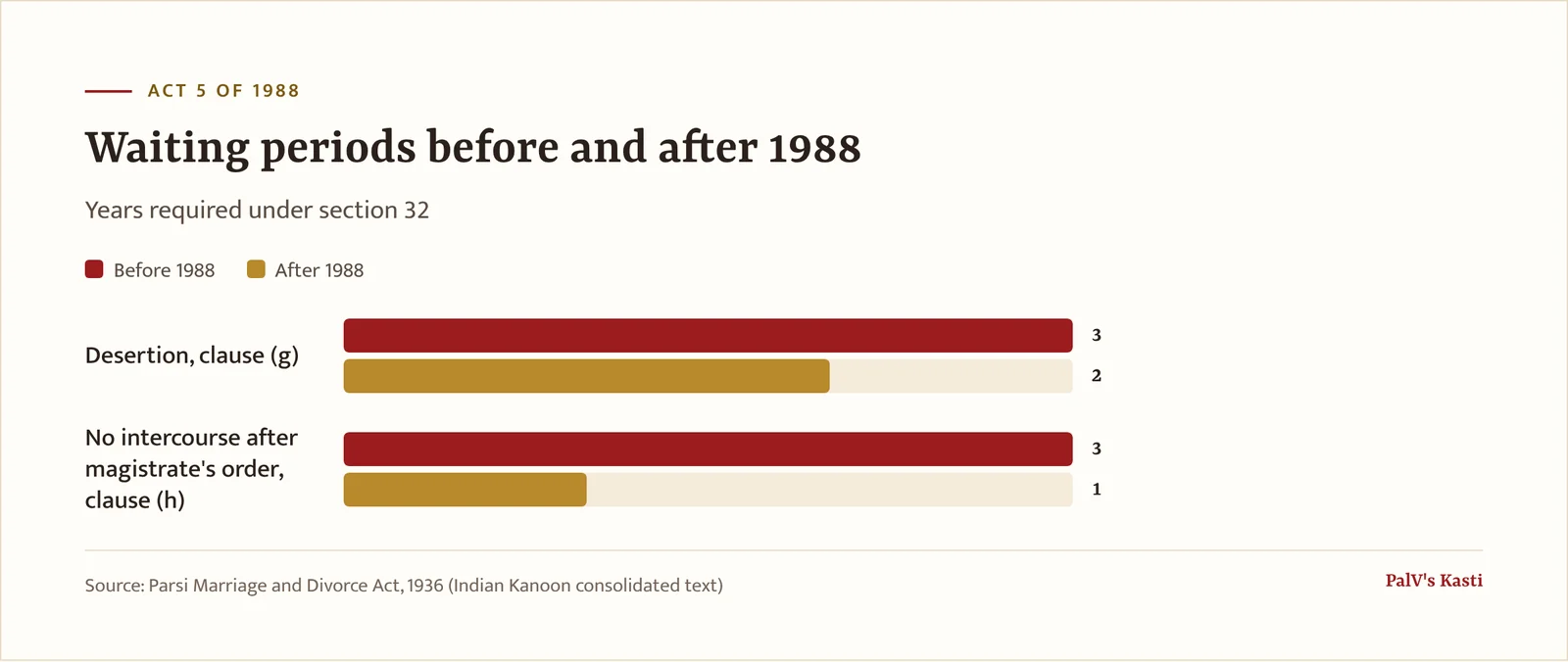
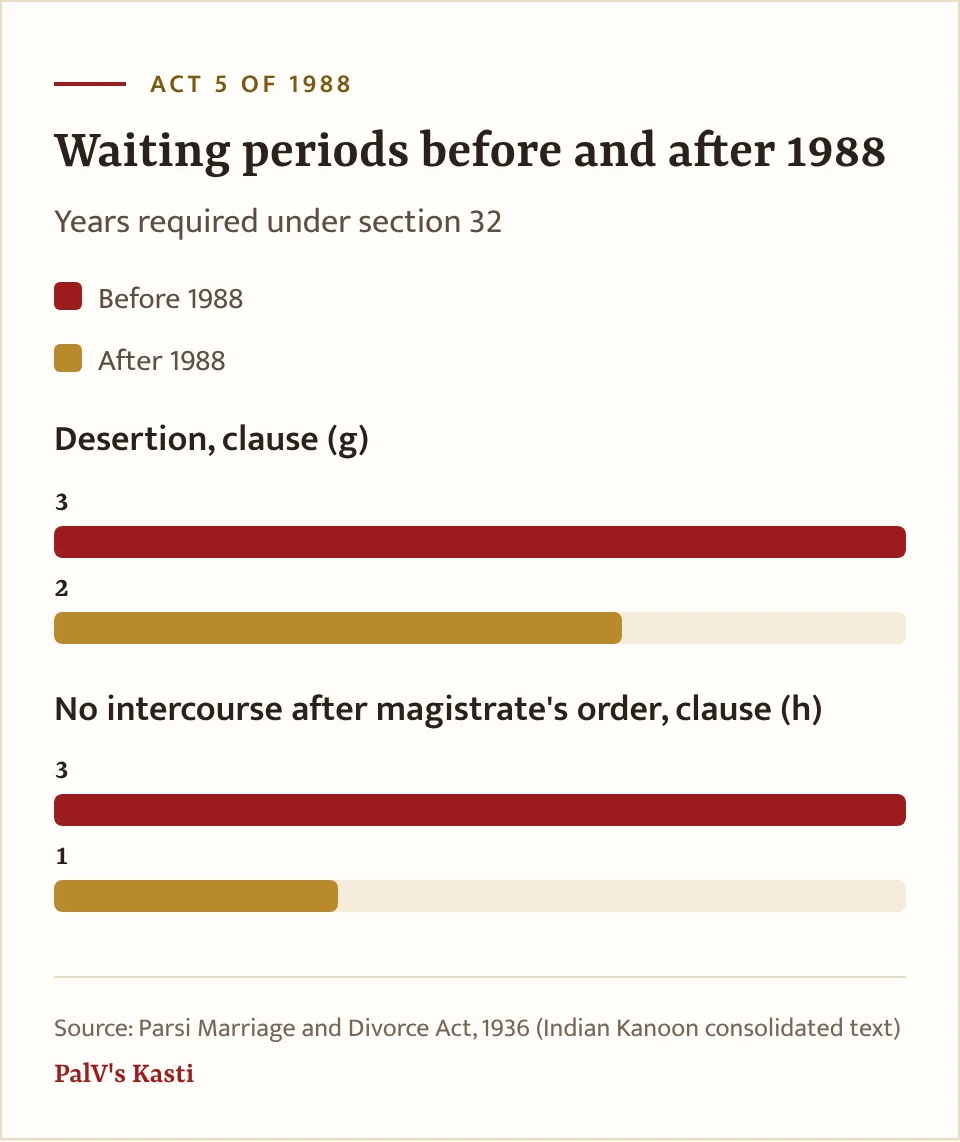
The Parsi Marriage and Divorce (Amendment) Act, 1988 (Act 5 of 1988) reshaped this section; the consolidated text of the 1936 Act dates these changes to 15 April 1988. It added cruelty and the wider mental disorder ground. It cut desertion from three years to two, and the no-intercourse period after a magistrate's maintenance order from three years to one. It deleted clause (i) altogether and added the words "by conversion to another religion" to clause (j). The same amendment created sections 32A and 32B, explained below.
Can a Parsi couple divorce by mutual consent?
Yes. Section 32B, added in 1988, lets both spouses file one suit together. They must say three things: they have lived separately for one year or more, they have not been able to live together, and they have agreed that the marriage should be dissolved. No such suit can be filed until a year has passed since the wedding.

The court then hears both sides, makes whatever inquiry it thinks fit, and checks that the marriage was solemnised under the Act, that the plaint is true, and that neither consent was obtained by force or fraud. If satisfied, it dissolves the marriage from the date of the decree.
Mutual-consent cases also go ahead without the delegates, the lay Parsi jurors whose majority decides questions of fact under section 46. In Minoo Rustomji Shroff v. Union of India, decided on 10 March 2005, the Bombay High Court dismissed a challenge to mutual-consent decrees passed by the presiding judge without delegates, reading section 32B's own words on how the court satisfies itself. How the delegate system works in contested cases is covered in our piece on Parsi matrimonial courts.
What if a separation or restitution decree changes nothing?
Section 32A gives either spouse one more ground. If a court has passed a decree for judicial separation and the couple have not resumed living together for a year or more, either may sue for divorce. The same applies a year after a decree for restitution of conjugal rights that was never followed.
There is a condition. A spouse who has failed or neglected to obey a maintenance order against them, under section 40 of this Act or under section 125 of the Code of Criminal Procedure, 1973 (or section 488 of the 1898 Code), cannot get a divorce under section 32A.
Both of those earlier decrees have their own sections. Any ground good enough for divorce is also good enough for judicial separation under section 34. Restitution of conjugal rights (section 36) is open to a spouse whose partner has deserted them or stopped living with them without lawful cause.
When can a court refuse a divorce even if the ground is proved?
Proving a ground is only half the case. Section 35 says that in suits under sections 30, 31, 32, 32A and 34, whether defended or not, the court grants relief only if it is also satisfied of the following:
- the act complained of has not been condoned (forgiven)
- the spouses are not colluding
- the plaintiff did not connive at or take part in the act
- there was no unnecessary or improper delay in filing, except where the Act already sets a fixed time limit
- there is no other legal reason to refuse relief.
How is interim maintenance decided while the case runs?
Section 39 deals with alimony pendente lite, which is support during the suit. It is open to the wife or the husband. If the court finds that one of them has no independent income sufficient for their support and the necessary expenses of the suit, it may order the other to cover the suit expenses and pay a weekly or monthly amount until the case ends.
The measure is what seems "reasonable" given the applicant's own income and the other spouse's income; the section sets no figure.
Speed was a later addition. The Marriage Laws (Amendment) Act, 2001 (Act 49 of 2001) added a proviso asking courts to dispose of this application within sixty days from service of notice, "as far as possible".
How is permanent alimony decided under the Parsi Act?
Under section 40(1), the court can make this order with the decree itself or on a later application. It may be a single gross sum, or a monthly or other periodic payment. Either the wife or the husband can apply. The payment cannot run beyond the lifetime of the spouse receiving it.
The Act names the factors the court must weigh:
- the paying spouse's own income and other property
- the income and other property of the spouse applying
- the conduct of both parties
- the other circumstances of the case.
Within those factors, the amount is whatever "may seem to the Court to be just". If needed, the court can secure the payment with a charge on the paying spouse's movable or immovable property.
Can maintenance be changed later?
Yes. Section 40(2) lets either party come back to court if circumstances change after the order, and the court may vary, modify or rescind it. Section 40(3) gives the other party a specific route as well: the order may be varied or cancelled if the person receiving it has remarried, or on the conduct grounds that sub-section lists for a wife and for a husband.
What happens to the children and to remarriage after a decree?
Section 49 covers children under eighteen. While the suit is pending the court can make interim orders on their custody, upkeep and schooling, and it can deal with the same matters in the final decree. The age was sixteen until the 1988 amendment. These orders can be made, suspended or varied after the decree on a fresh petition. The Act does not say which parent gets custody; it leaves that to what the court "may deem just and proper". Since 2001, a request for a child's upkeep and schooling during the suit carries the same sixty-day target as interim maintenance.
Remarriage has to wait. Section 47 allows an appeal to the High Court within three calendar months, heard by two judges. Section 48 says the parties may marry again only once that time has run out with no appeal, or once any appeal is decided. The section ends with the words "but not sooner". So for anyone planning a second Parsi wedding, the date that counts is the end of the appeal window, not the date of the decree.
Frequently asked questions
Can Parsis get a divorce by mutual consent?
Yes. Under section 32B, added in 1988, both spouses file one suit stating that they have lived apart for at least a year, cannot live together and have agreed to end the marriage. The suit can only be filed a year after the wedding. The court checks that neither consent came through force or fraud before granting the decree.
How long must you wait for desertion?
Desertion must have lasted at least two years before the suit is filed. The period was three years until the 1988 amendment cut it. Because the Act's definition requires the leaving to be without reasonable cause and without the other spouse's agreement, a separation both spouses agreed to does not fit it.
How is alimony decided under the Parsi Act?
There is no formula. Under section 40 the court weighs the paying spouse's income and property, the other spouse's income and property, both parties' conduct and the other circumstances, then orders what seems just. It may be a lump sum or periodic payments, for no longer than the recipient's lifetime, and can be secured on the payer's property.
Who gets custody of children in a Parsi divorce?
The Act names no preferred parent. Section 49 lets the court make whatever orders it deems just and proper on the custody, maintenance and education of children under eighteen, both while the suit runs and in the final decree. Those orders can be revisited later on a fresh petition if circumstances change.
This is general information, not legal advice; for a specific case, speak to a lawyer.