 PalV's Kasti

On this page
- What does "half-Parsi" mean?
- Is the child of a Parsi father and a non-Parsi mother a Parsi?
- Can the child of a Parsi mother and a non-Parsi father have a navjote?
- Can half-Parsis enter fire temples and Towers of Silence?
- What are the courts deciding about children of Parsi women?
- Would accepting half-Parsis stop the population decline?
- Frequently asked questions
"Half-Parsi" is an informal name for a child with one Parsi parent and one non-Parsi parent. How such a child is treated depends on which parent is the Parsi. Children of a Parsi father and a non-Parsi mother have long been accepted once their navjote is done: the Bombay High Court counted them in its 1908 definition of the Parsi community, and the Privy Council said in 1925 that for the racial claim "maternity is of no importance". Children of a Parsi mother and a non-Parsi father are, by custom, not accepted by most Parsi bodies in India, though some priests have performed their navjotes. Several cases on this question were still pending in the Supreme Court as of October 2026.
શહેરેવર રોજ
Shehrevar Roj, Tir Mah · 1396 Y.Z.
What does "half-Parsi" mean?
It isn't a legal category, and none of the court judgments below uses it. The label also hides the detail that decides things in India: which parent is Parsi. A 2011 demographic study by Zubin Shroff and Marcia Castro puts it plainly. They write that the community requires a Parsi father for a newborn to be considered Parsi, so the children of a Parsi woman who marries out are not counted, while a Parsi man's children are, though his wife is not.
Is the child of a Parsi father and a non-Parsi mother a Parsi?
Yes, by long usage, provided the child has had a navjote. The key text is the Bombay High Court judgment in Petit v. Jeejeebhoy (27 November 1908), the case that began after R. D. Tata married a French woman in Paris and had her navjote performed. Justice Davar defined the Parsi community as Parsis descended from the Persian emigrants who are born of two Zoroastrian parents and profess the faith, Zoroastrian Iranis from Persia who come to India, and "the children of Parsi fathers by alien mothers" who had been properly admitted into the faith.

The acceptance came with reservations. The trustees, who were the defendants, said in their written statement that this exception dated from "ancient times" but was "not viewed with favour". The judgment also records two moments that pull in opposite directions:
- In 1882 Dastur Jamaspji Minocherji, a Shenshai high priest, invested nine people from Mazagon with Sudra and Kusti in public, after satisfying himself that every one of them had a Parsi father. The other Shenshai high priest, Dastur Peshotan, handed out notices saying he would not allow them into his Atash Behram, and treated them as Juddins.
- The judgment also records that at a public meeting on 16 April 1905, the Parsi community of Bombay resolved not to admit even the children of Parsi fathers by non-Parsi mothers in future.
Twenty years after that meeting, in Saklat v. Bella (22 October 1925), the Privy Council wrote that it was "settled" that maternity is of no importance to the racial claim.
Can the child of a Parsi mother and a non-Parsi father have a navjote?
Some priests will perform it, but most Indian Parsi bodies won't treat the child as Parsi afterwards. The leading case is about exactly this. Bella, a girl in Rangoon, was the daughter of a Goanese Christian father and a mother who said she was Parsi. The local head priest refused her navjote, and a visiting priest performed it instead. After she attended the fire temple on 21 March 1915, three members of the Rangoon Parsi community sued.
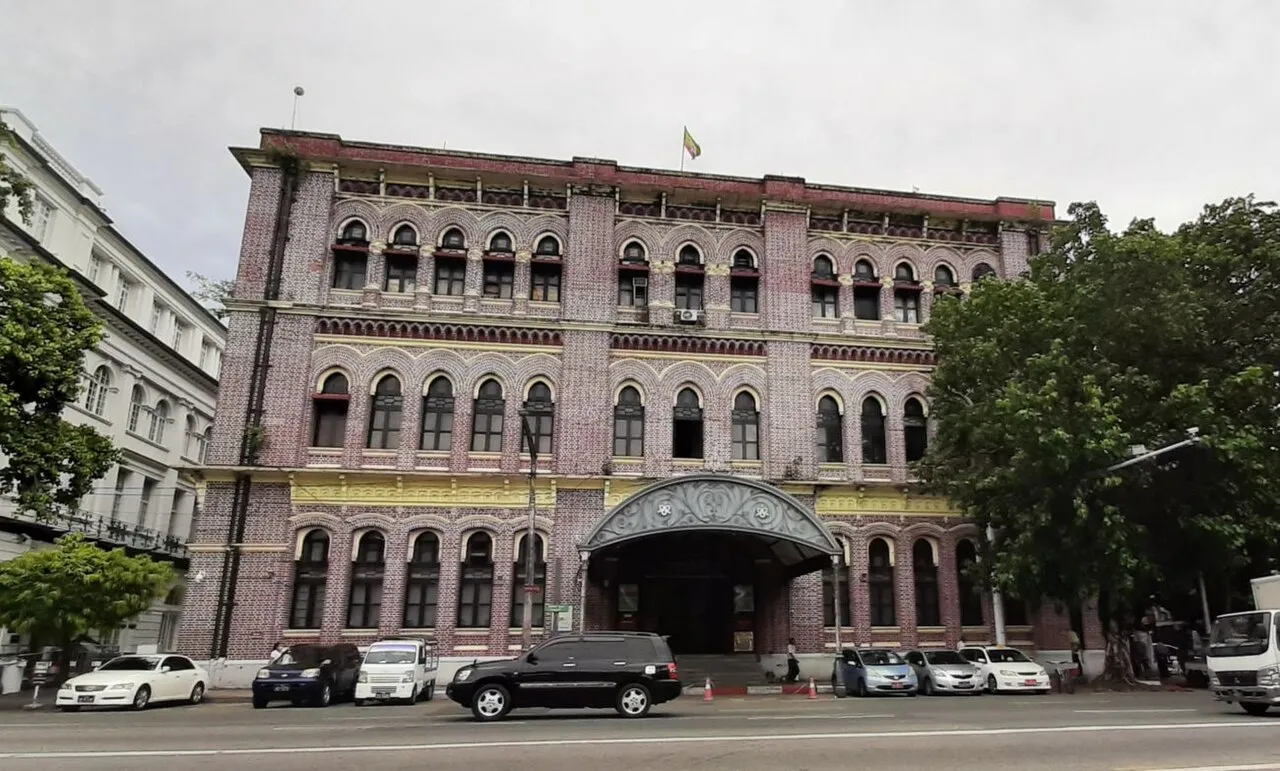
The Privy Council accepted that Bella's initiation into the Zoroastrian religion was real and valid. It still held that the temple trust's benefits were confined to people with "the double qualification of Zoroastrians and racial Parsis", and declared that she was not entitled, as of right, to use the temple. The court said her mother's being Parsi did not matter to the racial claim.
What the traditionalist and reformist sides say
Encyclopaedia Iranica summarises the traditionalist position: only a child of Zoroastrian parents is "mazdāyasna by birth". It adds that from the 18th century, Parsi councils in India have generally declined to recognise as Zoroastrian anyone who isn't the child of Parsi parents. National Geographic reported in 2024 that among the most orthodox Parsis, only children of Zoroastrian parents can take part in religious rituals. A Bombay Parsi Punchayet trustee, unnamed in ThePrint's 2023 report, put the community view this way: "Everyone may embrace the faith, but everyone cannot become a Parsi."
The same Iranica entry notes that some moderates accept the spouses and children of mixed marriages. ThePrint reported in August 2023 that families from Gujarat, Kolkata and Bengaluru were travelling to the Asha Vahishta Agiary in Pune, which it described as established in 2017, for their children's navjotes, among them women who had married outside the community. Posters there credit Dastur Jamaspji with navjotes of "children of intermarriage" in 1882, ThePrint says, though the 1908 judgment records that all nine people he invested that year had Parsi fathers. Our post on Navjote of children of intermarried women goes into the ceremony question in more detail.
Practice varies between families and Agiaries; your family priest's guidance comes first.
Can half-Parsis enter fire temples and Towers of Silence?
Describing community practice to the Supreme Court in February 2026, Senior Advocate Percival Billimoria said a Parsi man's children by a non-Parsi wife are treated as Parsis, while a Parsi woman's children by a non-Parsi husband are not. For the children of Parsi mothers, entry is decided Agiary by Agiary and Anjuman by Anjuman, and refusals have reached the courts.
- Author Prochy N. Mehta went to the Calcutta High Court in 2017 after her grandchildren, whose father is not Parsi, were refused entry to the city's only fire temple. The Federation of Parsi Zoroastrian Anjumans of India later intervened to keep non-Parsis out, ThePrint reported.
- According to LiveLaw's report of the 25 May 2026 hearing, Rule 5(2) of the Nagpur Parsi Panchayat's constitution excludes a Parsi or Irani Zoroastrian woman who marries outside and has children, "along with her children".
- Vispy Wadia, president of the Association of Intermarried Parsis, told ThePrint that it is "an open secret" that such women and their children enter agyaris, "but officially it's not allowed".
For funerals, the Bombay Parsi Punchayet's own Doongerwadi page says one Modi Dokhma is used specially for Parsi women married to non-Parsis who kept professing the Zoroastrian religion until death and wished to be consigned to the Towers of Silence. The page says nothing about their children. Our page on Funeral rites of inter-married Parsis covers this further.
Practice varies between families and Agiaries; your family priest's guidance comes first.
What are the courts deciding about children of Parsi women?
Three strands were pending in the Supreme Court as of 2 October 2026, the date of the latest report we could check.
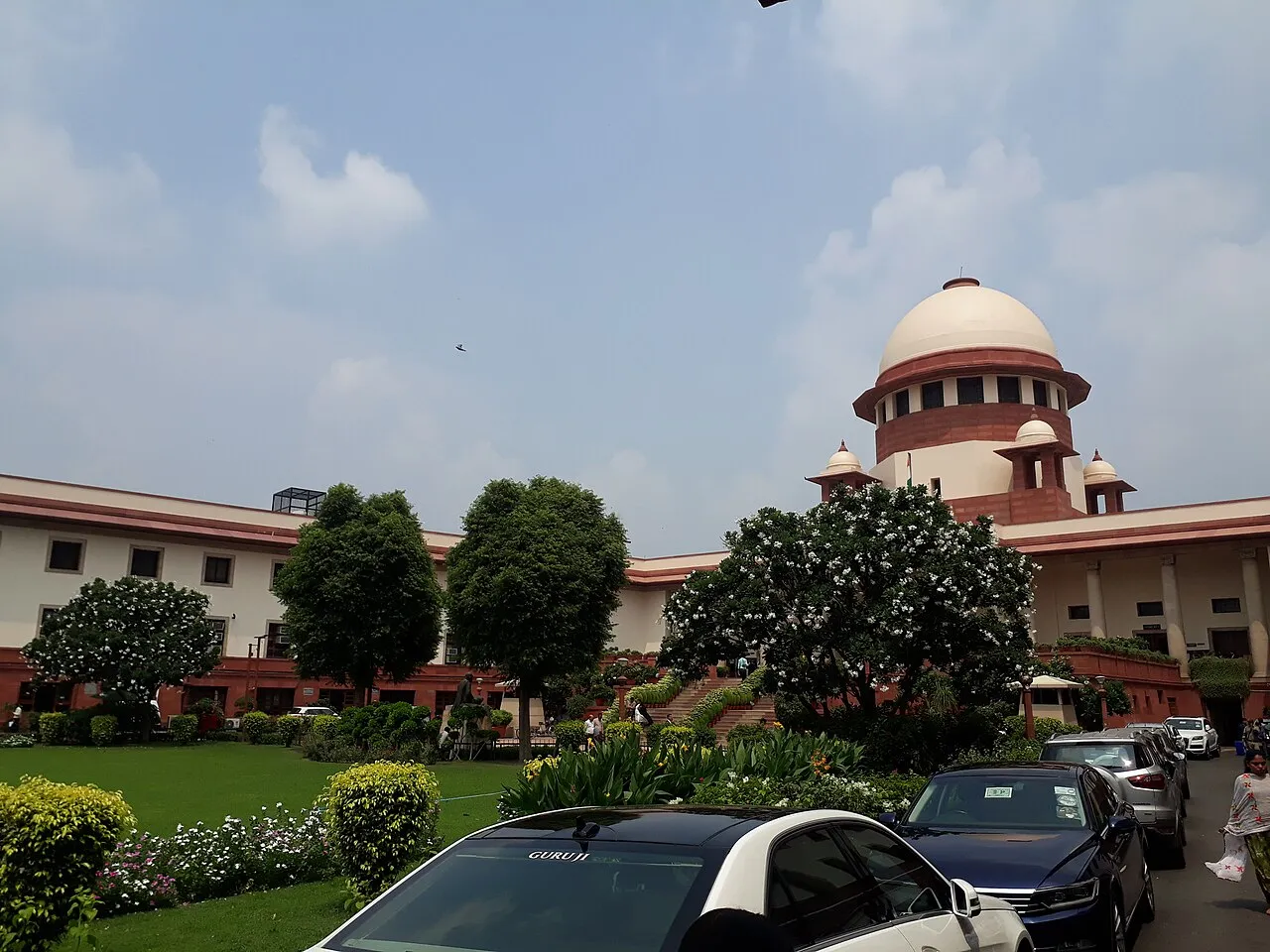
- The Goolrokh Gupta case. Goolrokh Gupta married a Hindu man under the Special Marriage Act, LiveLaw reported, and Scroll reported in 2017 that her community had barred her from offering prayers for her dead parents. Kerala Kaumudi reported that the nine-judge bench hearing the Sabarimala reference heard arguments on the denial of temple entry to a Parsi woman who married outside her community, reserved its verdict on 14 May 2026, and was expected to deliver it in October 2026.
- A writ by a minor child. Filed through the child's Parsi mother and heard on 10 February 2026, this petition, LawBeat reported, asks the court to declare the 1908 ruling bad law and to declare that children of Parsi women brought up in the faith must not face discrimination only because their father isn't considered Parsi.
- The Nagpur challenge to Rule 5(2). On 25 May 2026 a bench led by Chief Justice Surya Kant explored limited interim permission for the petitioner to pray at Nagpur's only Agiary, noting, LiveLaw reported, that the wider question was already before the nine-judge bench.
This is general information, not legal advice; for a specific case, speak to a lawyer.
Would accepting half-Parsis stop the population decline?
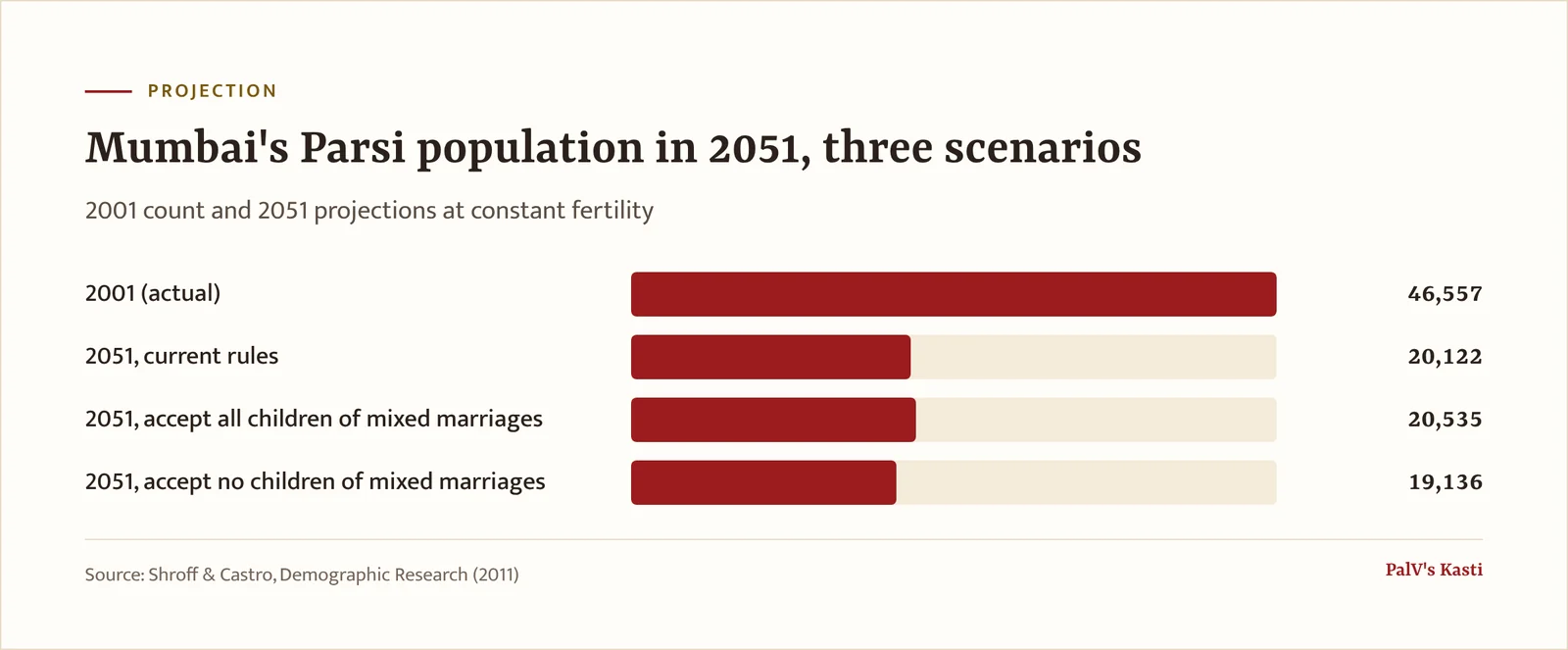
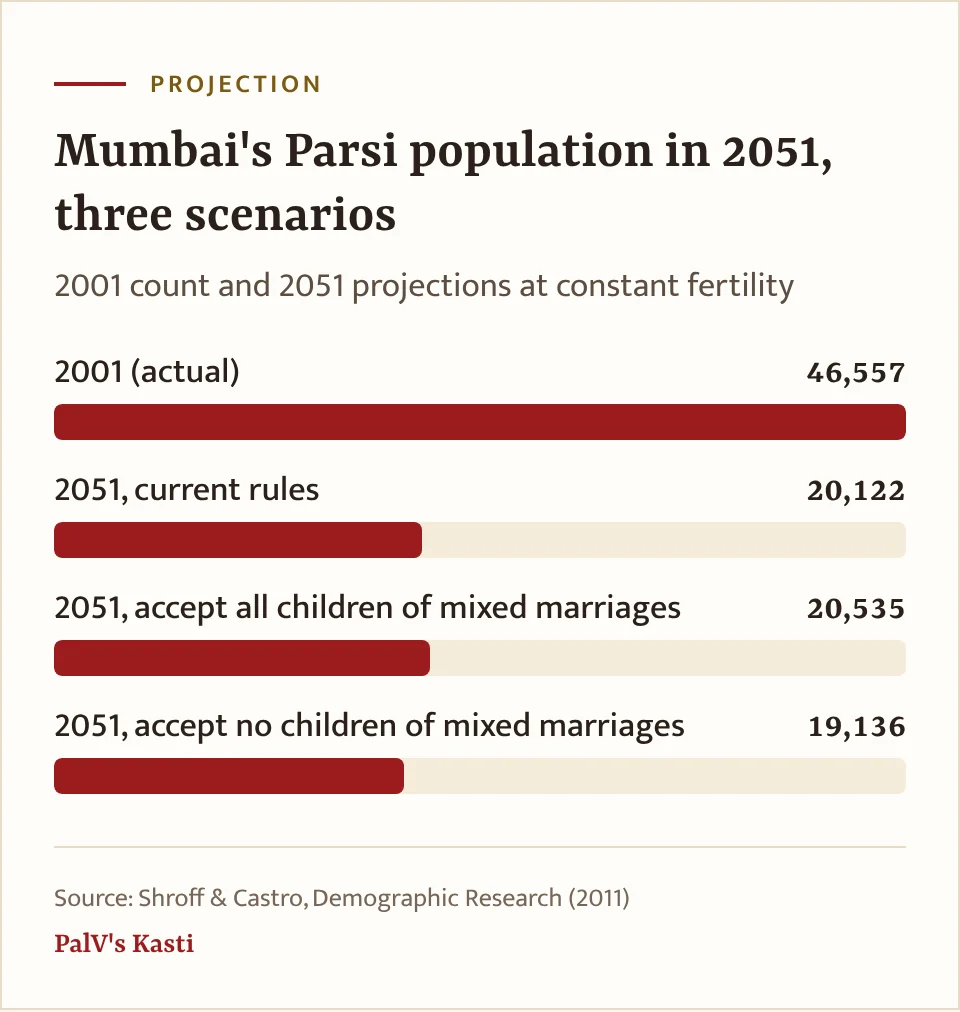
Not on its own, according to the one projection study we found. Shroff and Castro modelled Mumbai's Parsi population, 46,557 in 2001, out to 2051 at the fertility levels of the time. If current rules held, it fell to 20,122. If every child of a mixed marriage were accepted, it fell to 20,535. If no children of mixed marriages were accepted at all, it fell to 19,136. The authors conclude that the decline is driven chiefly by very low fertility, and that accepting children of intermarried women would have a "negligible impact".

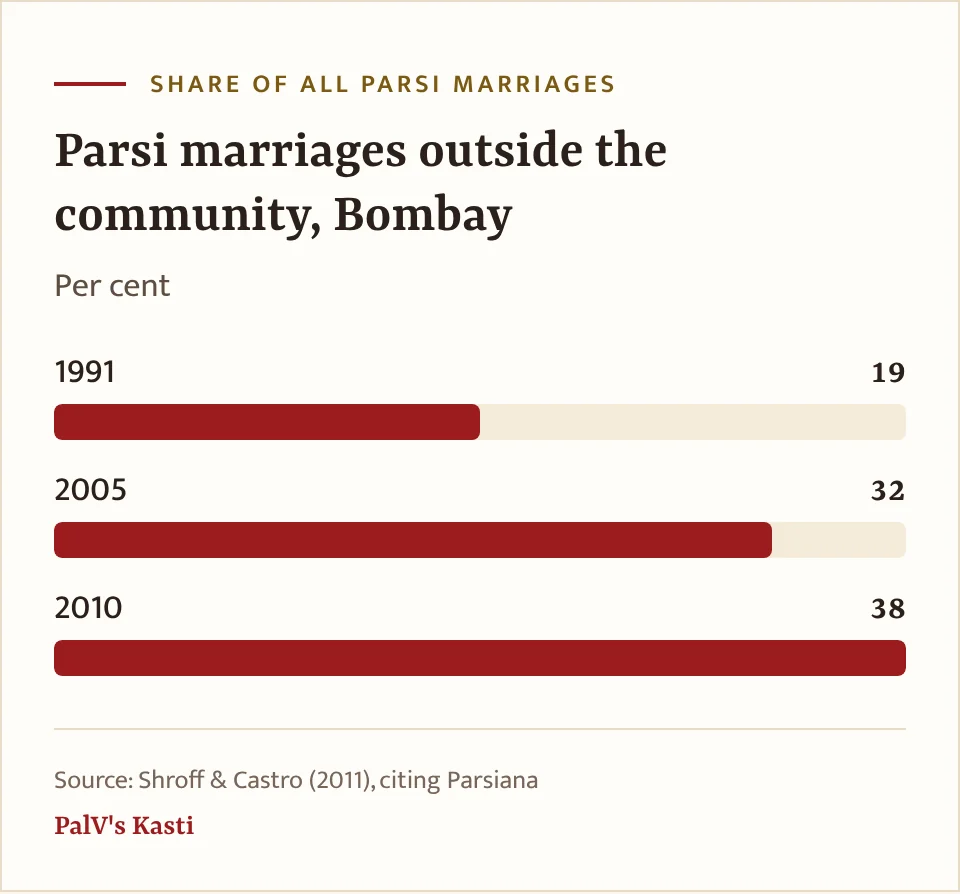
Mixed marriages themselves have become more common. The same paper, citing Parsiana, gives marriages outside the community as 19% of Parsi marriages in Bombay in 1991, 32% in 2005 and 38% in 2010. ThePrint reported in 2023 that Parsiana's figures put the share close to 50%.
Views inside the community differ. ThePrint read a 2017 TISS study by Dr Lata Narayan, with 761 respondents across India, in which only 4.4% said children of Parsi women who have had their navjote should count as community members. On the other side, Rohinton Nariman, a mobed and former Supreme Court judge, told National Geographic in 2024 that North America is now the only place "accepting both the spouses as well as the children".
Frequently asked questions
What is a half-Parsi?
It's an informal term for a child with one Parsi parent and one non-Parsi parent. It isn't a legal category. In India what matters is which parent is Parsi: the children of Parsi fathers have long been accepted after navjote, while the children of Parsi mothers who married out are, by custom, generally not counted as Parsi.
Is the child of a Parsi father and a non-Parsi mother a Parsi?
Yes, if the child has been admitted into the religion through navjote. The Bombay High Court's 1908 Petit judgment included "children of Parsi fathers by alien mothers" in the Parsi community, and the Privy Council said in 1925 that maternity is of no importance to the racial claim.
Can the child of a Parsi mother and a non-Parsi father have a navjote?
Some priests have performed it. ThePrint reported in 2023 that families were travelling to Pune's Asha Vahishta Agiary for these navjotes. But a navjote alone has not made such children Parsi under community practice. In 1925 the Privy Council accepted a Rangoon girl's initiation yet declared she was not entitled, as of right, to use the fire temple.
Can half-Parsis enter fire temples?
It depends on the parent and the Agiary. A senior advocate told the Supreme Court in 2026 that children of Parsi fathers are treated as Parsis. Children of Parsi mothers have been refused at some temples, in Kolkata (a case filed in 2017) and under Nagpur's Panchayat rules, and both disputes reached the courts.
Would accepting children of mixed marriages save the Parsi population?
A 2011 study by Shroff and Castro says no, not by itself. Their projection for Mumbai to 2051 found that accepting every child of a mixed marriage left the population at 20,535, against 20,122 under current rules. The authors put the decline down chiefly to extremely low fertility, not to the rules on intermarriage.


