PalV's Kasti
On this page
Parsi succession law in India is part of the Indian Succession Act, 1925. When a Parsi dies without a will, sections 50 to 56, a chapter titled "Special Rules for Parsi Intestates", decide who inherits. Under section 51, a surviving widow or widower and each child take equal shares, sons and daughters alike, and each surviving parent takes half of one child's share. When a Parsi leaves a will, Part VI of the same Act governs how it is made, witnessed and revoked, and section 213 decides when it must be proved through probate. Probate is needed for wills made within the original civil jurisdiction of the High Courts at Bombay, Calcutta and Madras, and for wills made elsewhere only as far as they deal with immovable property inside those limits.
શહેરેવર રોજ
Shehrevar Roj, Tir Mah · 1396 Y.Z.
Which law governs Parsi inheritance in India?
There is no separate "Parsi Succession Act", although the name is often used. Parsi inheritance law sits inside the Indian Succession Act, 1925 (Act 39 of 1925). Part V of that Act deals with succession without a will. Its general chapter does not touch Parsis at all: section 31 says, in so many words, that nothing in that chapter applies to Parsis. Parsis have their own chapter instead, Chapter III of Part V.
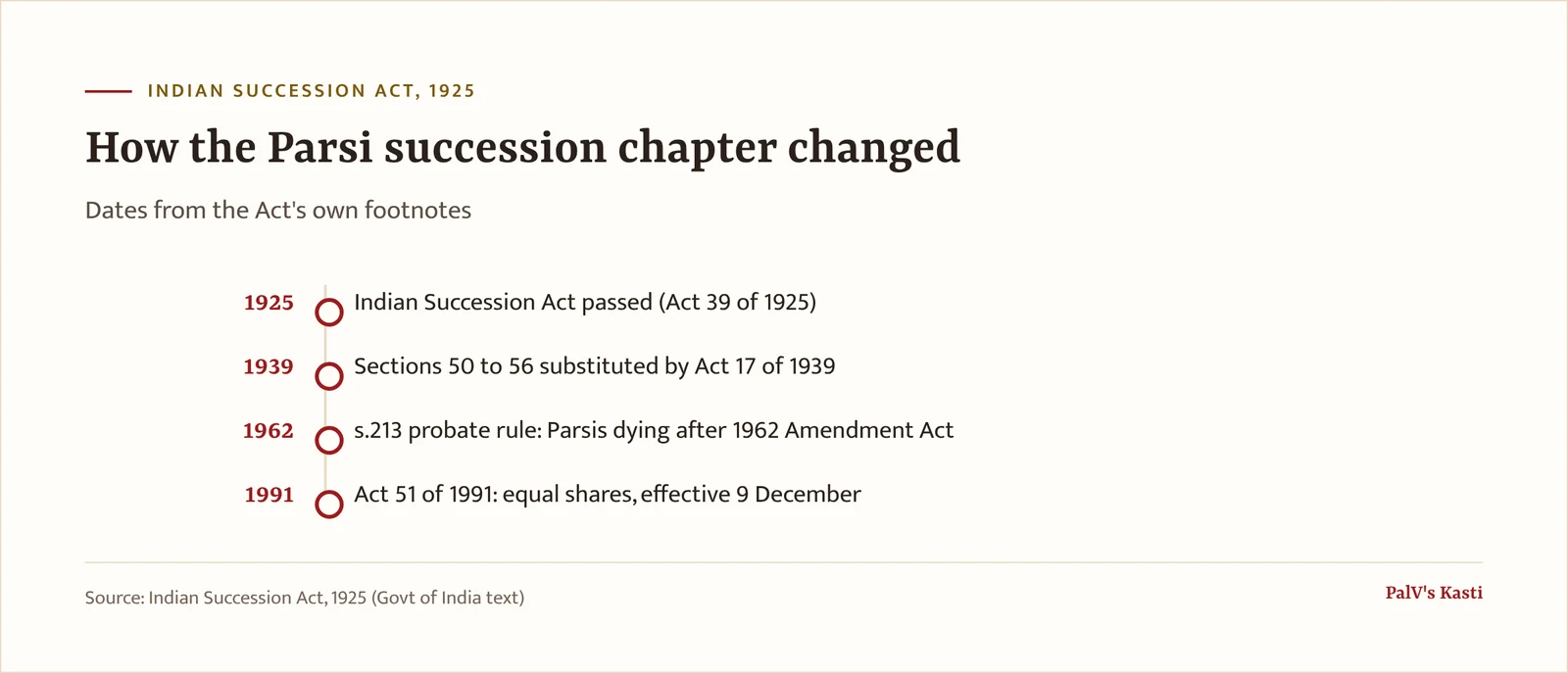
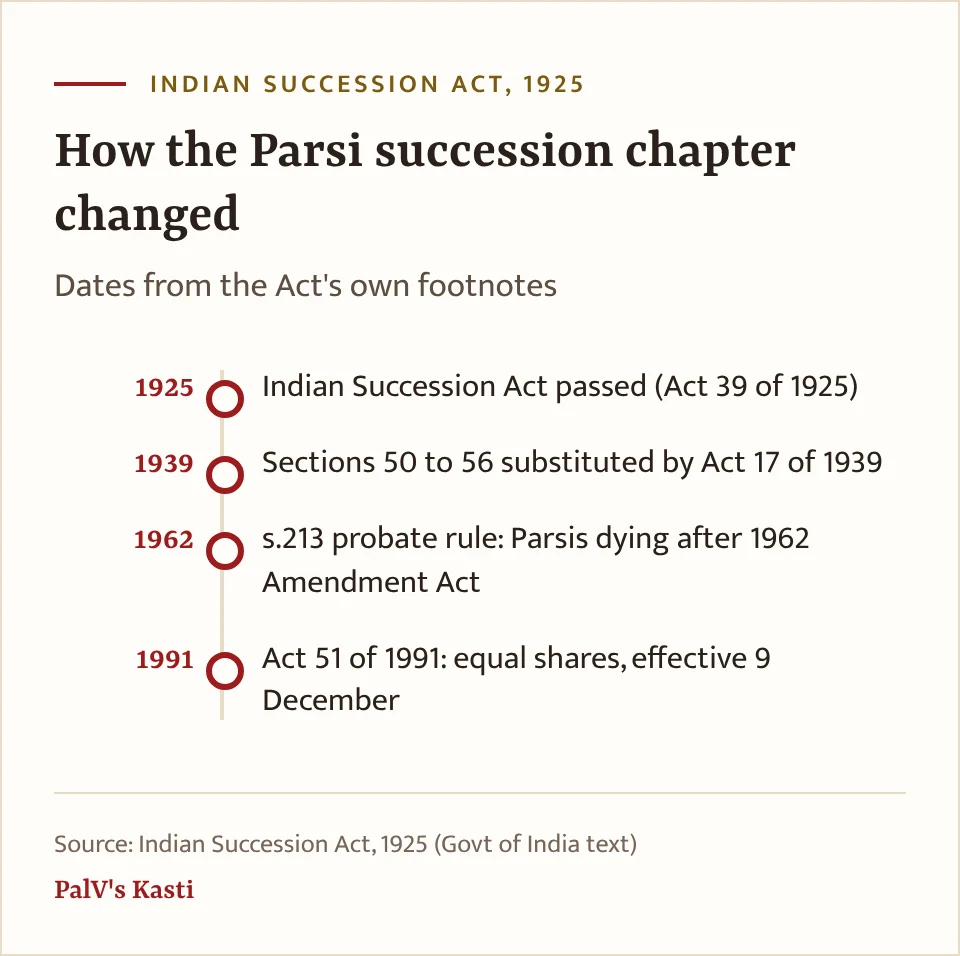
The Parsi chapter has been rewritten twice. According to the footnotes in the Government of India text of the Act, sections 50 to 56 were substituted by Act 17 of 1939 with effect from 12 June 1939, and Act 51 of 1991 substituted sections 51, 52 and 54 with effect from 9 December 1991. That is why the current text jumps from section 51 to section 53. How Parsi personal law came to be written into these Acts is the subject of our page on Parsi law history.
How is a Parsi's property divided without a will?
A Parsi who dies without a valid will is an "intestate". Section 30 adds a further point: a person is treated as intestate for any property that their will does not effectively dispose of. So a will that covers only the flat leaves the bank deposits to the intestacy rules below.


| Who survives the deceased | How the property is divided | Section |
|---|---|---|
| Widow or widower and children | The spouse and each child take equal shares | 51(1)(a) |
| Children, no widow or widower | The children share equally | 51(1)(b) |
| One or both parents, as well as children | Each parent takes half the share of each child | 51(2) |
| Widow or widower, no lineal descendant and no widow or widower of a descendant | The spouse takes half. The rest goes to relatives in Part I of Schedule II | 54(a), 54(d) |
| Widow or widower, and the widow or widower of a lineal descendant | One-third each (the second third shared if there are several). The rest goes to Part I relatives | 54(b), 54(d) |
| No widow or widower, but widows or widowers of lineal descendants | One such person takes one-third; several share two-thirds equally. The rest goes to Part I relatives | 54(c), 54(d) |
| No lineal descendant, no spouse, no widow or widower of a descendant | The whole estate goes to the next-of-kin in Part II of Schedule II, in order | 55 |
| No relative entitled under any of the above | Shared equally by the relatives in the nearest degree of kindred | 56 |
A worked example under section 51
Say a Parsi dies without a will and is survived by his wife, a son, a daughter and both his parents. The wife, the son and the daughter each count as one share, and each parent counts as half a share, which makes four shares in all. By our calculation, the wife, the son and the daughter receive 25% each, and each parent receives 12.5%. The percentages are our arithmetic on section 51, not figures printed in the Act.
Do Parsi daughters and widows get equal shares?
Yes. Under section 51 as it has stood since 9 December 1991, each child takes an equal share whether son or daughter, and a widow takes the same share as each child. The chapter is written in neutral terms, "widow or widower", so a husband who survives his wife is treated in the same way. For the wider circle of relatives in sections 54 and 55, the Act now says that males and females of the same degree of kinship receive equal shares.
Before 1991 some of these rules differed by gender. The footnote to section 55 records the old wording it replaced: each male was to "take double the share of each female" of the same degree. The Supreme Court, in Gaiv Dinshaw Irani v Tehmtan Irani (25 April 2014, AIR 2014 SC 2326), described the earlier section 52, which dealt with a Parsi woman's estate, as dividing her property equally among her children, without separating stepchildren from children.
One difference remains in the text of section 53, which deals with a child who died before the parent. If that child was a son, his widow and children take his share under the chapter's rules as if he had died just after the parent. If that child was a daughter, the Act says her share goes equally to her children. We set out what the section says and leave its interpretation to the courts.
Who inherits if a Parsi has no children?
If there is a surviving spouse, section 54 applies. A widow or widower alone takes half the estate, and the other half passes to the relatives in Part I of Schedule II. If no Part I relative is entitled, the residue is spread among those who already took shares under section 54, in proportion to their shares.
If there is no spouse either, section 55 hands the whole estate to the Part II list. Whoever stands higher on the list is preferred to those lower down. Part I has the first six classes below, and Part II adds the last four.
- Father and mother.
- Full brothers and sisters, and the descendants of any who died before the intestate.
- Paternal and maternal grandparents.
- Children of those grandparents (uncles and aunts), and descendants of any who died earlier.
- The grandparents' parents.
- The grandparents' parents' children, and descendants of any who died earlier.
- Half brothers and sisters, and descendants of any who died earlier.
- The widow of a brother or half brother, and the widower of a sister or half sister.
- Widows or widowers of the grandparents' children.
- Widows or widowers of the intestate's deceased lineal descendants who had not remarried before the intestate's death.
Who is left out under section 50?
Section 50 sets three ground rules for every Parsi intestacy. A child conceived before the death and born alive afterwards counts the same as a child already born. A descendant who died before the intestate, leaving no spouse, no descendant and no widowed spouse of a descendant, is not counted at all. And the widow or widower of a relative who remarried during the intestate's lifetime takes nothing and is treated as not existing at the death.
Sections 50 to 56 speak of children and lineal descendants and do not mention adoption. Where an adopted child stands is covered in our explainer on adopted child inheritance.
How does a Parsi make a valid will?
Part VI of the Act applies to Parsi wills in full, because section 58 excludes only Muslims and, apart from section 57, Hindus, Buddhists, Sikhs and Jains. Section 59 allows any person of sound mind who is not a minor to dispose of property by will. Section 63 sets the formalities for an ordinary will:
- The testator signs or puts a mark on it, or another person signs in the testator's presence and on the testator's direction.
- The signature or mark is placed so that it is clearly meant to give effect to the document as a will.
- At least two witnesses attest it. Each must have seen the signing, or had the testator personally acknowledge the signature, and each signs in the testator's presence.
A will can be revoked or changed at any time while its maker is competent to make one (section 62). Marriage matters here. Section 69 says every will is revoked by the marriage of its maker, apart from a narrow exception for wills made under a power of appointment. The proviso that marriage does not revoke a will is in section 57, which covers certain wills of Hindus, Buddhists, Sikhs and Jains, not Parsis. So a will a Parsi made before marrying is revoked by that marriage, unless the power-of-appointment exception applies. The rules for the marriage itself are in our guide to the Parsi Marriage and Divorce Act.
One older limit does not bind Parsis. Section 118 restricts a person who has a nephew, niece or nearer relative from leaving property to religious or charitable uses unless the will meets set conditions of timing and deposit. A proviso added in 1991 says nothing in that section applies to a Parsi.
Is probate compulsory for a Parsi will?
It depends on where the will was made and where the property lies. Section 213(1) says no right as executor or legatee can be established in court without probate, or letters of administration with the will annexed. Section 213(2)(ii) applies that rule to wills of Parsis who died after the Indian Succession (Amendment) Act, 1962 came into force, where the will was made within the ordinary original civil jurisdiction of the Bombay, Calcutta or Madras High Courts. A will made outside those limits needs probate only so far as it concerns immovable property inside them.

The Supreme Court applied the rule in the Gaiv Dinshaw Irani case, a dispute over a family property at Mazgaon in Mumbai. The mother's will had never been probated. The court held that under section 213 no legatee could claim a right through an unprobated Parsi will, and that she was treated as having died intestate, so the florist and nursery business she had left by will passed jointly to her heirs.
Where there is no will, the position is different. Section 212(1) says no right to an intestate's property can be established in court without letters of administration, but section 212(2) says that rule does not apply to the intestacy of a Parsi.
Frequently asked questions
Which law governs Parsi inheritance?
The Indian Succession Act, 1925 governs Parsi inheritance in India. Sections 50 to 56, the special chapter for Parsi intestates, apply when there is no will, and Part VI of the same Act applies to wills. There is no separate Parsi Succession Act, even though that name is often used for these rules.
Do Parsi daughters get equal shares?
Yes. Since 9 December 1991, section 51 of the Indian Succession Act gives every child of a Parsi who dies without a will an equal share, and a widow or widower takes the same share as each child. For more distant relatives, sections 54 and 55 now give males and females of the same degree equal shares.
What does a Parsi widow inherit?
If her husband dies without a will and leaves children, the widow takes a share equal to each child's share under section 51. If he leaves no lineal descendant and no widowed spouse of a descendant, section 54 gives her half the estate, and the rest goes to his relatives in Part I of Schedule II.
Who inherits if there are no children?
With a surviving spouse, section 54 gives the spouse half and sends the rest to relatives in Part I of Schedule II, starting with the parents. With no spouse and no widowed spouse of a descendant, section 55 passes the whole estate to the Part II list in order: parents first, then full brothers and sisters, and so on.
Is probate compulsory for a Parsi will?
Only in some cases. Section 213 requires probate for a Parsi will made within the ordinary original civil jurisdiction of the High Courts at Bombay, Calcutta or Madras. A will made elsewhere needs probate only for immovable property within those limits. The Supreme Court held in 2014 that an unprobated Parsi will of that kind gave the legatee no right.
Does marriage cancel a Parsi's will?
As a rule, yes. Section 69 of the Indian Succession Act says every will is revoked by the marriage of its maker, with a narrow exception for wills made under a power of appointment. The saving proviso in section 57, under which marriage does not revoke a will, covers certain Hindu, Buddhist, Sikh and Jain wills, not Parsi ones.
This is general information, not legal advice; for a specific case, speak to a lawyer.