PalV's Kasti
On this page
- What does the Parsi Succession Act say about adopted children?
- Does the Hindu Adoptions and Maintenance Act apply to Parsis?
- What does Section 63 of the Juvenile Justice Act say about inheritance…
- Why do some say adoption is not legal for Parsis?
- Is guardianship the same as adoption for inheritance?
- Does an adopted child keep inheritance rights in the birth family?
- How can Parsi adoptive parents make sure the child inherits?
- Frequently asked questions
Possibly, but no court has settled it for Parsis. The special rules for Parsis who die without a will, sections 50 to 56 of the Indian Succession Act, 1925, never mention adoption. They speak only of "children" and other relatives. A separate, religion-neutral law, the Juvenile Justice (Care and Protection of Children) Act, 2015, says a child adopted under an adoption order becomes the adoptive parents' child "for all purposes, including intestacy". We found no reported judgment that applies that rule to a Parsi estate. And one Parsi commentator, Noshir H. Dadrawala, wrote in Parsi Times in November 2024 that adoption is not legal among Parsis in India. So the route that works whichever reading wins is a will.
અસપંદામેદ રોજ
Asfandarmad Roj, Tir Mah · 1396 Y.Z.
What does the Parsi Succession Act say about adopted children?
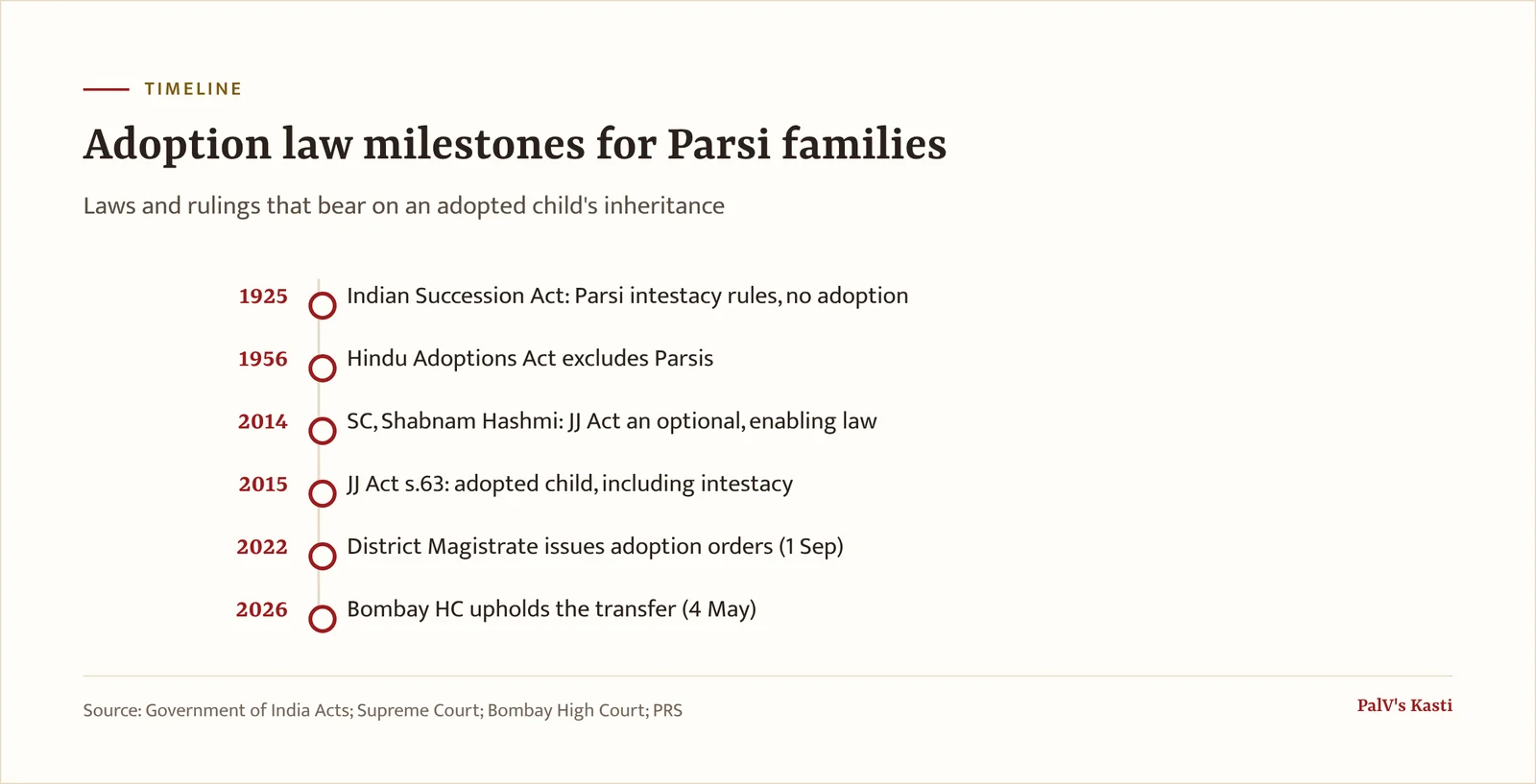
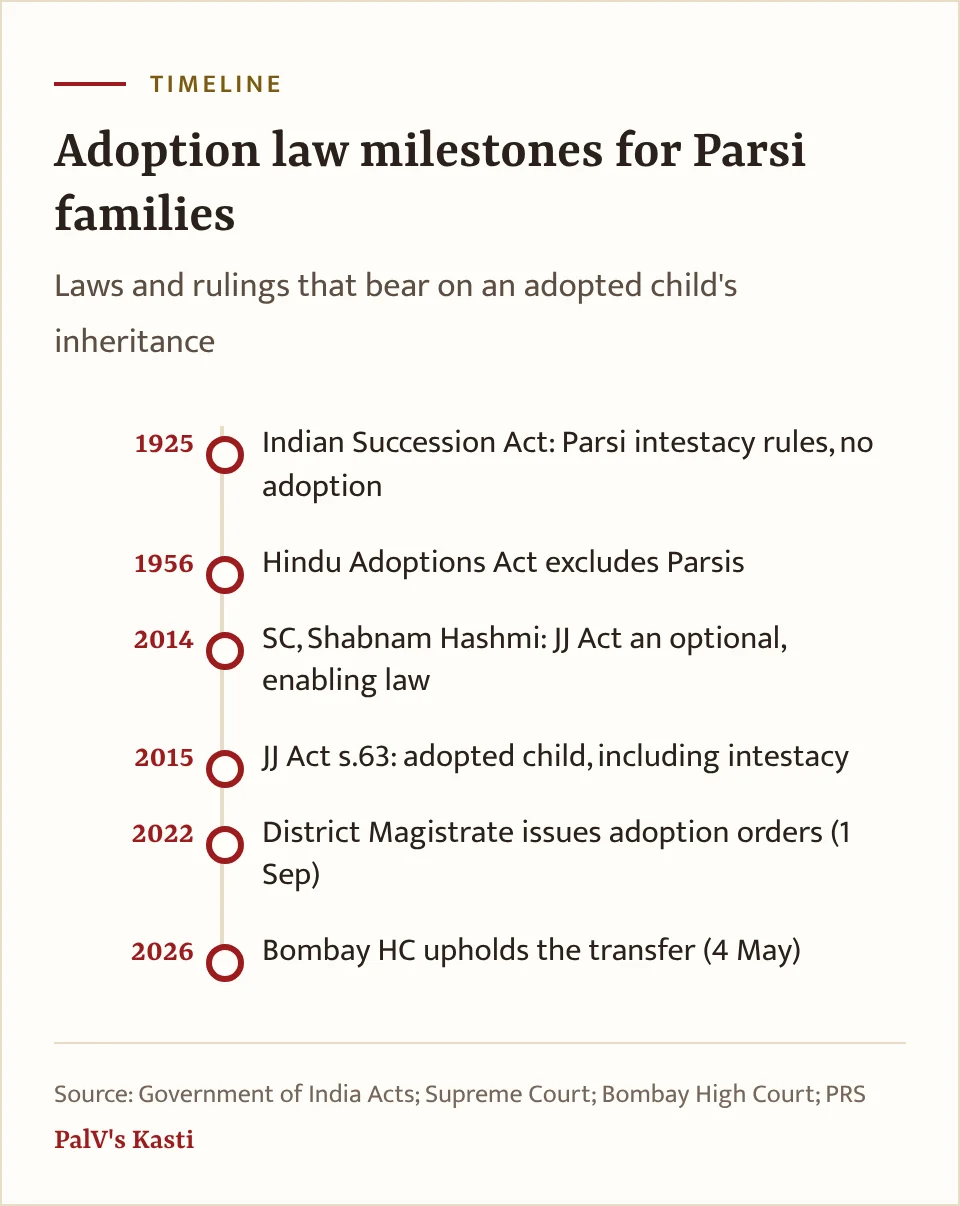
Nothing, in so many words. There is no separate "Parsi Succession Act". The Parsi rules sit inside the Indian Succession Act, 1925, as Chapter III of Part V, headed "Special Rules for Parsi Intestates". We searched sections 50 to 56 of the Government of India text for the word "adopt" and it does not appear. Section 51 shares the estate among the widow or widower and the children of the person who died, each taking an equal share, with parents taking half a child's share each. The full order of heirs is in our guide to Parsi succession law.

The 1925 Act does treat "child" as including an adopted child in one place, Schedule III, paragraph 5. That schedule is tied to section 57, which covers wills made by Hindus, Buddhists, Sikhs and Jainas, and paragraph 5 applies only to a short list of will sections (75, 76, 105, 109 and 111 to 116). It does not reach the Parsi intestacy chapter.
So the Act is silent on the point. Whether "child" in section 51 includes a child adopted under another law is a question of interpretation that, as far as we could find, has not been decided. Why Parsis have their own chapter at all is covered in our piece on Parsi law history.
Does the Hindu Adoptions and Maintenance Act apply to Parsis?
No. Section 2(1)(c) of the Hindu Adoptions and Maintenance Act, 1956 extends that Act to everyone else "not a Muslim, Christian, Parsi or Jew by religion". Parsis are named among those it leaves out. Parsis have no equivalent personal law of adoption, and the 2015 Juvenile Justice Act, in its section 56(3), keeps itself apart from adoptions made under the Hindu Act.
What does Section 63 of the Juvenile Justice Act say about inheritance?
Section 63 is the provision that speaks directly to inheritance. Once an adoption order is issued, the child "shall become the child of the adoptive parents", treated "as if the child had been born to" them, "for all purposes, including intestacy", from the date the order takes effect. Intestacy means dying without a will, which is exactly the situation the Parsi chapter governs.
The Act is open to Parsi families on its face. Section 58(1) lets Indian prospective adoptive parents living in India, "irrespective of their religion", apply to a Specialised Adoption Agency to adopt an orphan, abandoned or surrendered child. Section 56(2) allows a relative to adopt a relative's child on the same religion-neutral basis.
Who issues the adoption order now?
The District Magistrate. The Juvenile Justice (Care and Protection of Children) Amendment Act, 2021 (Act 23 of 2021) moved the power from the court to the District Magistrate, including an Additional District Magistrate, as PRS Legislative Research summarised the Bill. The Bombay High Court recorded that the change took effect from 1 September 2022, and on 4 May 2026, in Nisha Pradeep Pandya v. Union of India (Writ Petition 1085 of 2023), it dismissed a challenge to the transfer. In Maharashtra, an interim order of the High Court dated 10 January 2023 had kept pending adoption cases in the courts. That ruling vacated the order and let the District Magistrate take them up. Section 63 only covers a child "in respect of whom an adoption order is issued", so a family that simply brings up a child, without an order, is outside it.
What did the Supreme Court say about personal law and this Act?
In Shabnam Hashmi v. Union of India, decided on 19 February 2014 by a bench of Chief Justice P. Sathasivam with Justices Ranjan Gogoi and Shiva Kirti Singh, the Supreme Court called the Juvenile Justice Act "an enabling legislation" that gives a would-be parent "the option of adopting an eligible child". It added that "personal beliefs and faiths, though must be honoured, cannot dictate" how such a statute operates. The court was looking at the older 2000 Act as amended in 2006, not the 2015 Act.
Why do some say adoption is not legal for Parsis?
The clearest statement of that view is Noshir H. Dadrawala's article "Is Adoption Legal Among Parsis In India?", published in Parsi Times on 2 November 2024. He opens: "Adoption is not legal among Parsis in India." He argues that the "JJA fails to override the provisions of other personal laws", and he writes that Parsi adoptive parents are "advised to execute testamentary and other documents" so that the child's inheritance is secured.
His article discusses the Juvenile Justice Act, 2000 and its 2006 amendment. It does not discuss the 2015 Act or its section 63. We put the two positions side by side and give no verdict of our own, because no court ruling we found has tested section 63 against a Parsi estate.
Is guardianship the same as adoption for inheritance?
No. Under section 4 of the Guardians and Wards Act, 1890, a guardian is someone with "the care of the person of a minor", or of the minor's property, or both, and a ward is the minor in that guardian's care. Nothing in those definitions makes the ward the guardian's child. Dadrawala puts it the same way in Parsi Times: "The GWA confers only a guardian-ward relationship." A ward therefore has no claim as a "child" under section 51 of the Succession Act. Only a will can leave the guardian's property to a ward.
Does an adopted child keep inheritance rights in the birth family?
Mostly not, under the 2015 Act. Section 63 says that once the adoption order takes effect, the child's ties with the birth family "stand severed" and are replaced by those in the adoptive family. There's one exception in the proviso. Property that had already vested in the child before the order continues to vest in the child, together with any obligations attached to it, including any duty to maintain relatives in the biological family.
How can Parsi adoptive parents make sure the child inherits?
By making a will. Section 59 of the Indian Succession Act lets any person "of sound mind not being a minor" leave property by will. Section 30 confirms that the intestacy rules only apply to property a valid will doesn't dispose of. So a will naming the adopted child sidesteps the whole debate over sections 51 and 63.
Under the Succession Act a will needs two or more attesting witnesses (its own section 63, not to be confused with the Juvenile Justice section). For Parsi wills in Mumbai, Kolkata and Chennai, probate can be required before anyone can claim under the will. Our Parsi succession law guide explains when.
Frequently asked questions
Can an adopted child inherit from Parsi parents who die without a will?
The texts point both ways and no court has decided it. The Parsi intestacy rules in the Indian Succession Act, 1925 never mention adoption. The Juvenile Justice Act, 2015 says a child adopted under an adoption order is the parents' child "for all purposes, including intestacy". Commentator Noshir Dadrawala holds that adoption is not legal for Parsis.
Does the Hindu Adoptions Act apply to Parsis?
No. Section 2(1)(c) of the Hindu Adoptions and Maintenance Act, 1956 covers people "not a Muslim, Christian, Parsi or Jew by religion", so Parsis are expressly outside it. Parsis have no personal law of adoption of their own, which is why the religion-neutral Juvenile Justice Act, 2015 is the route discussed for Parsi families.
What does JJ Act Section 63 say?
Section 63 of the Juvenile Justice Act, 2015 makes a child adopted under an adoption order the adoptive parents' child, "for all purposes, including intestacy". Ties with the birth family are severed, though property already vested in the child stays. Since the 2021 amendment took effect on 1 September 2022, the District Magistrate issues these orders.
Is guardianship the same as adoption?
No. The Guardians and Wards Act, 1890 makes a person the guardian of a minor's person or property, or both, and the minor a ward. It does not make the ward the guardian's child. A ward cannot claim as a child under the Parsi intestacy rules, so property passes to a ward only through a will.
Should Parsi adoptive parents make a will?
A will is the one route that doesn't depend on how the adoption question is settled. Under section 59 of the Indian Succession Act, any adult of sound mind can leave property by will, and the Parsi intestacy rules apply only to property the will doesn't cover. Writing in Parsi Times in 2024, Noshir Dadrawala also advises testamentary documents.
This is general information, not legal advice; for a specific case, speak to a lawyer.