PalV's Kasti
On this page
Parsis in India marry and divorce under the Parsi Marriage and Divorce Act, 1936, and an intestate Parsi's property passes under a separate chapter of the Indian Succession Act, 1925. Whether that separate Parsi personal law should stay is argued both ways. Those who want it kept, including the Bombay Parsi Panchayat (BPP) trustees in their 2023 meeting with the Law Commission, say the community must keep its religious identity, and the Acts' own records show past changes came at the community's request. Those who want change, including the 2018 Law Commission and Parsi women who have gone to the Supreme Court, say parts of it treat women who marry out unequally. We set out each side in its own words and leave the verdict to you.
શહેરેવર રોજ
Shehrevar Roj, Tir Mah · 1396 Y.Z.
What are the separate Parsi family laws?
There are two. The Parsi Marriage and Divorce Act, dated 23 April 1936, defines "a Parsi" as "a Parsi Zoroastrian" and sends divorce cases to special Parsi Matrimonial Courts. Under section 19, the judge of the Parsi Chief Matrimonial Court at Calcutta, Madras or Bombay is aided by five delegates, a panel Bar & Bench described in 2018 as a jury system of a kind otherwise abolished in India.
The other is Chapter III of Part V of the Indian Succession Act, 1925, headed "Special Rules for Parsi Intestates" (sections 50 to 56). Section 31 keeps Parsis out of the general intestacy rules in Chapter II. How these laws came about is told in our post on Parsi law history.
Who has driven changes to Parsi law so far?
The community, according to the Acts' own Statements of Objects and Reasons. For the 1936 Act, the Parsi Central Association took the question up in 1923 and appointed a sub-committee. The Association later adopted the BPP trustees' suggestions. The Statement says the draft represented the views of the great majority of the community and had the approval of Sir Dinshaw E. Wacha and the late Sir Dinshaw F. Mulla.
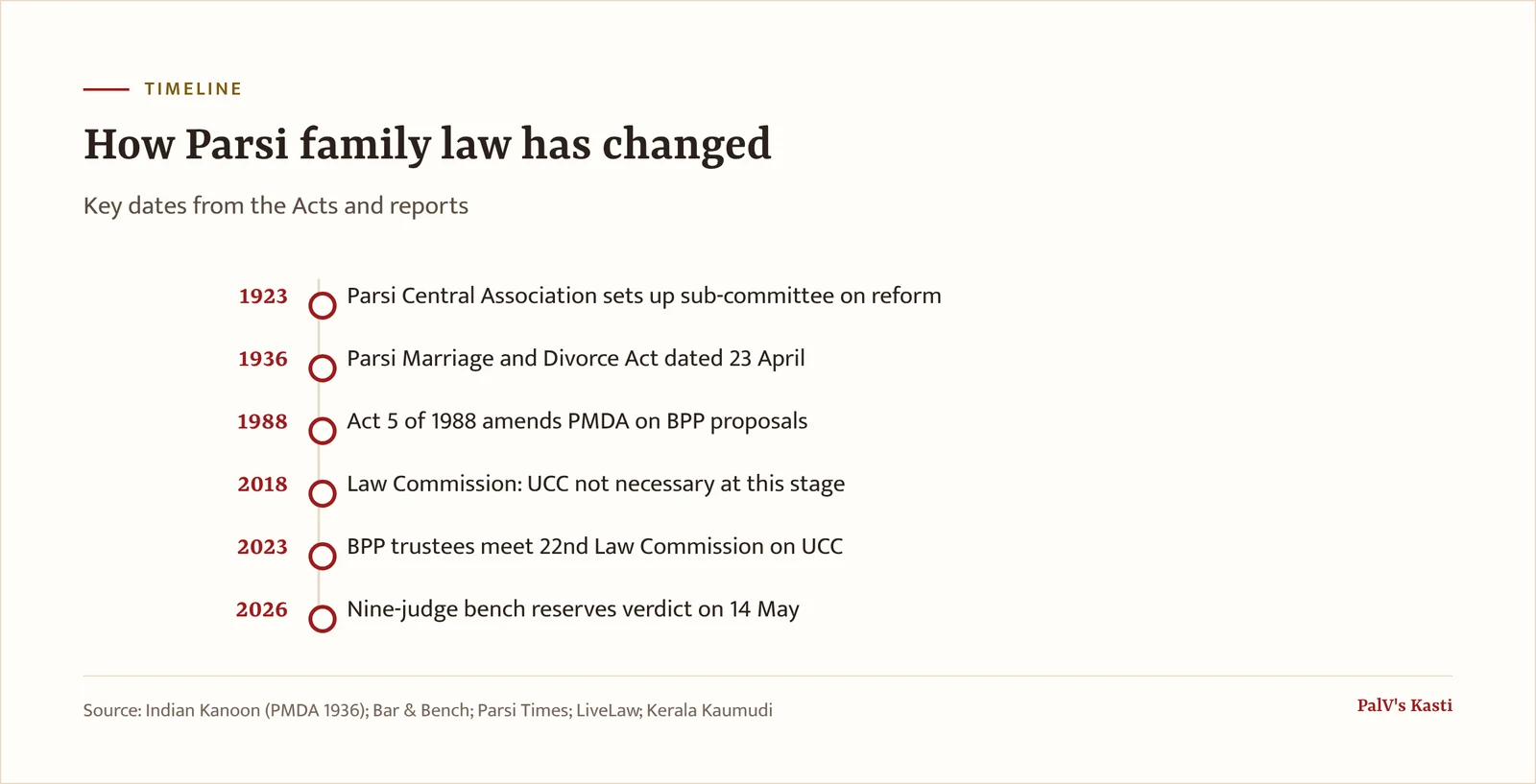
The 1988 amendment (Act 5 of 1988) took the same road. Its Statement explains that the government did not change a minority's personal law "unless the initiative comes from such community". The BPP trustees sent proposals, the Minorities Commission backed them, and Parliament amended the Act.
What is the case for keeping separate Parsi family laws?
The clearest recent statement came on 21 August 2023, when BPP trustees met the 22nd Law Commission, chaired by Justice Ritu Raj Awasthi (retd.), about a possible Uniform Civil Code (UCC). Parsi Times reported that Adv. Zerick Dastur spoke for the trustees with Hanosh Mistry, and that Vada Dasturji Dr. Firoze M. Kotwal also took part by video. As Parsi Times summed up their concerns:
- the community must keep its ethno-centric religious identity;
- Parsi social life cannot be separated from religion, belief and tradition;
- past governments protected Parsi and Irani Zoroastrian identity through special legislation;
- no actual draft of the UCC had been published, which itself caused apprehension.
Justice Awasthi, the report says, assured them the Commission was conscious of the community's "ethno-centric religious existence".
A related argument about religious autonomy was put to the Supreme Court in April 2026 by Senior Advocate Gopal Subramanium, for the respondents in Goolrokh Gupta's case. Verdictum reported on 22 April 2026 that he read Article 26 as giving every religious denomination equal institutional autonomy, whatever its size. A person may choose a creed, he said in Verdictum's summary, but an adherent may not "seek to alter its core doctrine from within".
What is the case for changing them?
It centres on Parsi women who marry outside the community. In its Consultation Paper on Reform of Family Law of 31 August 2018, the 21st Law Commission said, as Bar & Bench quoted it, that expecting a woman to "discard her religious or social identity" on marriage "goes against the idea of equal partnership in marriage". LiveLaw's summary adds that the Commission wanted such a woman to keep her Parsi status, and her children to be able to inherit if they choose to profess the Zoroastrian religion. The paper also suggested adding irretrievable breakdown as a ground for divorce and simplifying the delegate procedure.
In court on 7 December 2017, Senior Advocate Indira Jaising argued for Goolrokh Gupta that "religion is a matter of choice". LiveLaw quoted her: "The treatment meted out to the woman is sex-based." She went on to say that a Parsi man who married a non-Parsi woman would face no such discrimination. Shiraz Patodia, a lawyer who has appeared in the case, told ThePrint in October 2017 that this showed "deep-rooted gender discrimination". And at the nine-judge hearing reported by The Leaflet on 6 May 2026, Senior Advocate Darius Khambata argued that a religion cannot "strip a believing woman of her faith" for marrying out. He appeared for a Parsi woman refused entry to an Agiary after her marriage to a Hindu man.
These are arguments made in court and in the press, not rulings on what the faith requires. Practice varies between families and Agiaries; your family priest's guidance comes first.
Would a Uniform Civil Code replace Parsi personal law?
No one can say yet, because we found no published draft. In 2018 the 21st Law Commission, as Bar & Bench reported, called a uniform civil code "neither necessary nor desirable at this stage" and chose to tackle discriminatory laws instead. In 2023 the 22nd Commission reopened the question, and Parsi Times reported that it planned to draft a code after its consultations.
Not every Parsi voice expects a code to wipe out Parsi law. At a FEZANA online session on 30 May 2026, reported by Parsi Times, the lawyer and author Berjis Desai called fears that a UCC would erode the community's distinct identity a misconception. By the report's account, he said a code could give Parsis legal adoption rights while keeping their existing marriage and succession laws.
Where do the court cases stand?
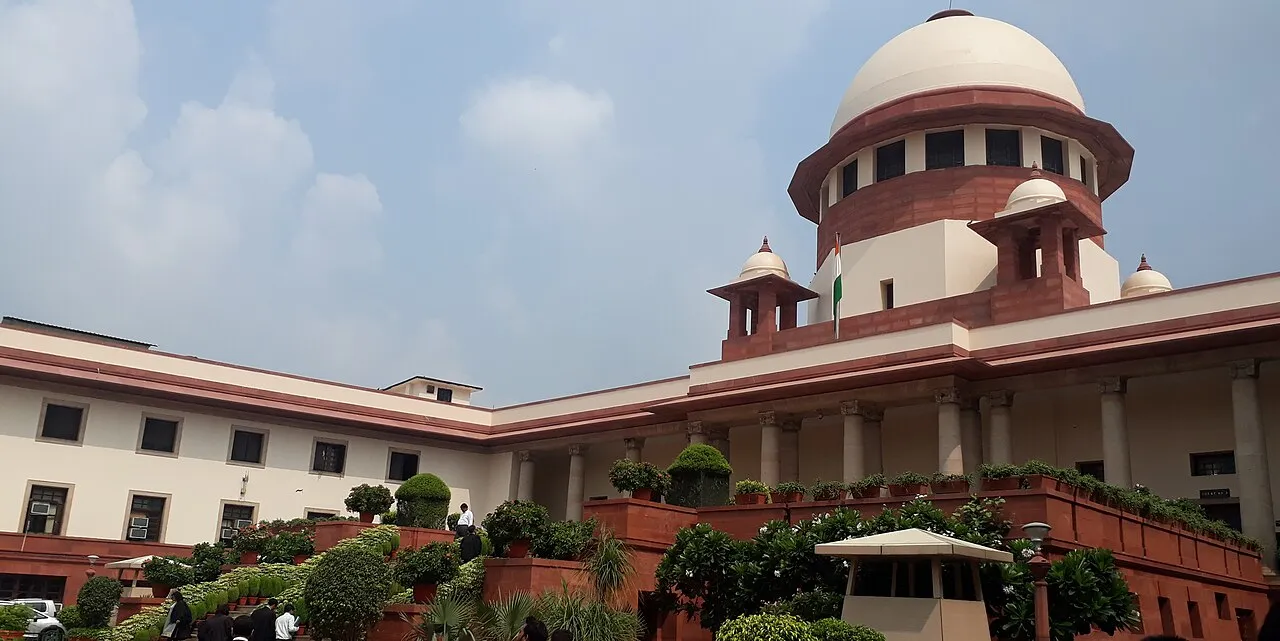
Goolrokh Gupta's challenge to the Gujarat High Court's 2012 ruling is being heard with the nine-judge Sabarimala reference. LiveLaw and Kerala Kaumudi both reported that the bench reserved its verdict on 14 May 2026, and Kerala Kaumudi said on 2 October 2026 that a verdict was expected that month. We found no report of a verdict, so as of that 2 October 2026 report the matter was pending. The law on marrying out, and these cases in detail, are in our post on Parsi law on inter-faith marriage.
Frequently asked questions
Which laws make up Parsi personal law in India?
Marriage and divorce among Parsis come under the Parsi Marriage and Divorce Act, 1936, which defines a Parsi as a Parsi Zoroastrian. When a Parsi dies without a will, the estate passes under the Special Rules for Parsi Intestates, sections 50 to 56 of the Indian Succession Act, 1925, not that Act's general intestacy rules.
What did the Law Commission say about Parsi law in 2018?
Its Consultation Paper of 31 August 2018 said a uniform civil code was neither necessary nor desirable at that stage. For Parsis, it suggested that women who marry outside keep their Parsi status, that their children may inherit if they profess Zoroastrianism, and that divorce procedure be simplified, with irretrievable breakdown added as a ground.
Who started the changes to Parsi law in 1936 and 1988?
The community did, according to the official Statements of Objects and Reasons. The 1936 Act grew from a Parsi Central Association sub-committee set up in 1923 and from Bombay Parsi Panchayat trustees' suggestions. The 1988 amendment came from BPP proposals, under a government policy of changing minority personal laws only at the community's initiative.
Why do some Parsis want Parsi personal law reformed?
Their main complaint is how women who marry outside the community are treated. Arguing for Goolrokh Gupta in the Supreme Court in 2017, Indira Jaising called the treatment sex-based, since a Parsi man marrying a non-Parsi woman faces no such consequence. Shiraz Patodia called it deep-rooted gender discrimination. The case was pending as of October 2026.
Would a Uniform Civil Code end separate Parsi laws?
We found no published draft, so its effect is unknown. The BPP trustees told the Law Commission in August 2023 that they had apprehensions for exactly that reason. Lawyer Berjis Desai, reported by Parsi Times in June 2026, said a code could add adoption rights while keeping Parsi marriage and succession laws.
This is general information, not legal advice; for a specific case, speak to a lawyer.