PalV's Kasti

On this page
- What exactly is a Parsi gara saree?
- How is a gara different from a kor?
- Where did the Parsi gara come from?
- What does a traditional Parsi gara look like?
- What is the 'forbidden stitch' in gara work?
- Why is a Parsi gara saree so expensive?
- When do Parsi women wear a gara?
- Is gara embroidery still made today?
- Where can you see historic Parsi garas?
- What else should you read about Parsi embroidery?
- Frequently asked questions
A Parsi gara saree is a silk sari embroidered across its body, worn by Parsi women and born out of the community's trade with China. Garo began as a Gujarati word for a sari, and over time it came to mean the Chinese embroidered sari in particular, as both the CSMVS museum in Mumbai and the RISD Museum record. The early pieces were embroidered in China for Parsi families, on a coloured silk ground that was often purple, red or black. Parsi women then learnt the stitches and made their own. The cost comes from skilled handwork on silk. Designer Ashdeen Lilaowala told Outlook Traveller that one gara can take three weeks to two months, with six to eight artisans working on it together.
શહેરેવર રોજ
Shehrevar Roj, Tir Mah · 1396 Y.Z.
What exactly is a Parsi gara saree?
A Parsi gara is a silk sari whose body, and not only its edge, is embroidered. The Chhatrapati Shivaji Maharaj Vastu Sangrahalaya (CSMVS) in Mumbai puts its place in the community plainly: "Garo has become an identity for Parsi women", and it's worn on special occasions and at weddings.
You'll see the word spelt two ways. Gara is the common spelling today. Garo is the spelling CSMVS and the RISD Museum use in their catalogue records. Both mean the same garment.
The Parzor Foundation (UNESCO Parzor) describes the Parsi gara sari as a length of cloth "bound in a frame" by a kor, or border, running along all four sides. When the whole surface is worked, the piece is called an akho garo. CSMVS glosses akho garo as "fully embroidered", and RISD catalogues its own piece under the same name.
How is a gara different from a kor?
A kor is a border, not a sari. The Textile Research Centre (TRC) in Leiden defines kor as embroidered "bands (kor) used for sewing on garments, especially saris". A gara carries embroidery across the body of the sari itself.
According to Parzor, the first pieces that came from China were embroidered on satin and had "no borders or 'pallavs'". Following Indian tradition, Parsi women then started designing kors "to match the inner embroidery". The two still get mixed up. Lilaowala told Outlook Traveller that even today "the odd customer" assumes a gara is a border sari. Our article on the kor, the embroidered sari border covers the kor in detail.
Where did the Parsi gara come from?
The short version runs through Gujarat and Canton. Parzor records that Zoroastrians who left Iran "came to adopt Indian costumes, including the sari". RISD's 2005 label says the same of the community in Gujarat, which took up local dress and "made fortunes in trade with China and Europe".
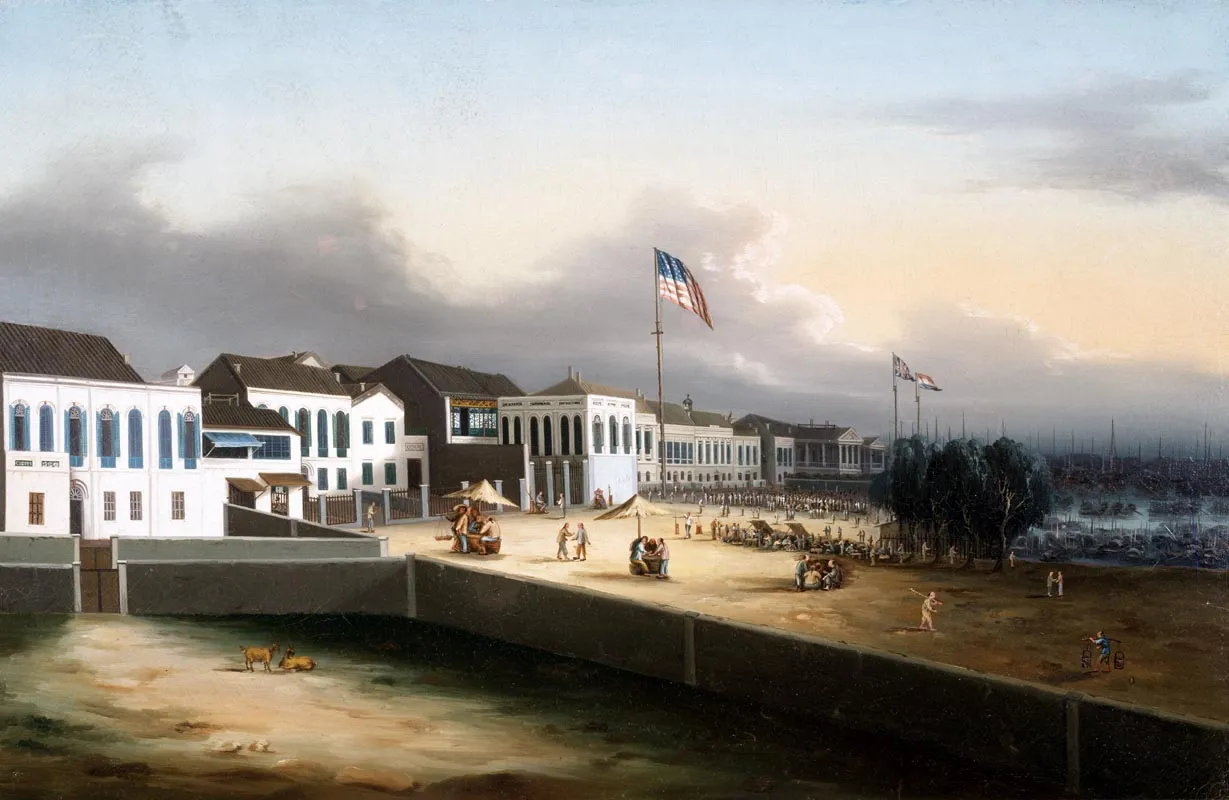
Parsi traders sold goods, cotton above all, in Canton (Guangzhou), as TRC notes. John R. Hinnells' entry on Parsi communities in Encyclopaedia Iranica records that sea trade from western India reached China and that Parsis took part in its growth. According to CSMVS, "Parsi traders bought embroidered silks for their families". RISD describes these as Chinese silk satins "made for the Indian market". Two saris at the Victoria and Albert Museum (V&A) in London are catalogued as made in China for the Parsi community.
Then the craft moved home. Parzor says Parsi women used their "newly acquired skill" to create their own garas, jhablas and kors. TRC also notes that Parsi women started to imitate the Chinese embroideries. Parzor adds that Parsi women learnt the aari and mochi stitches from Gujarati women friends.
The dated story is in our history of the Parsi gara, and the trade link is covered in the Chinese roots of Parsi embroidery.
What does a traditional Parsi gara look like?
Museum records give a clear picture of the traditional gara. The table below sets out what each source records.
| Feature | What the records say | Source |
|---|---|---|
| Ground fabric | Silk satin ("Sali ghaj") at RISD, silk gauze at the V&A; TRC lists chiffon, gauze or satin | RISD, V&A, TRC |
| Ground colour | Purple, red or black; both V&A saris are black | V&A, TRC |
| Colour history | Imperial purple from Persian taste, then Indian kunku red (vermilion) | Parzor |
| Embroidery thread | White silk on a coloured ground; V&A T.24-1967 also has magenta and yellow silk | TRC |
| Stitches | Satin stitch, stem stitch, Peking stitch, knots, and the khakha | TRC |
| Motifs on dated pieces | Birds and flowering stems (V&A); songbirds, trees, lotus flowers and peacocks (RISD) | V&A, RISD |
| Dates of the pieces cited | RISD 55.286: about 1875 to 1900; V&A T.271-1922: early 20th century; V&A T.24-1967: 1900 to 1950; CSMVS akho garo: 20th century | RISD, V&A, CSMVS |
| Length of surviving pieces | 170 in (V&A T.271-1922); 569 cm (RISD 55.286) | V&A, RISD |
Motifs carry a long story of their own. Parzor notes that Parsi women showed a liking for the rooster and the fish. What these and other designs mean is covered in Parsi gara embroidery, our guide to the motifs.
What is the 'forbidden stitch' in gara work?
The forbidden stitch is the khakha (also spelt khakho), a knot stitch used in Parsi embroidery. TRC calls it the "(in)famous 'forbidden stitch'" and says it's more widely known as the Peking knot. Parzor calls the khakho a "seed pearl stitch" and says that its intricacy led to women losing their eyesight, which is how it came to be called the forbidden stitch.

The two sources describe it slightly differently, a Peking knot for TRC and a seed pearl stitch for Parzor, but both tie the khakha to the forbidden-stitch name. For how the stitches are actually worked, see how Parsi embroidery is done.
Why is a Parsi gara saree so expensive?
A hand-embroidered gara is expensive because it's weeks of skilled handwork laid over silk. Here's what the sources actually show.
- Time and hands. Ashdeen Lilaowala, who launched his label in 2012, told Outlook Traveller that a gara can take "anywhere from three weeks to two months", with "six to eight artisans working on one Gara together".
- Intricate stitches. The khakha knot was intricate enough that Parzor links it to embroiderers losing their eyesight.
- Silk on silk. Museum records describe silk satin or gauze grounds embroidered with silk thread.
- A luxury from the start. RISD's 2005 label says the dense embroidery on its gara "immediately indicates that a wealthy Parsee woman wore this sari", possibly for her wedding.
- Kept for generations. RISD notes that these garments "are treasured as family heirlooms". The CSMVS akho garo came from the family of the poet Ardeshir Khabardaar. More on this in the Parsi gara as a family heirloom.
Writing in Harper's Bazaar India in January 2026, Anwesh Banerjee reported that Lilaowala sees gara as "inherently niche, defined by time, labour, and cost".
We haven't quoted price ranges here. We couldn't find a named, dated source for what a gara costs today, and we'd rather leave a number out than guess. If you're weighing a purchase, our guide to spotting a hand-embroidered gara is the place to start. Woven versions are a separate subject, covered in woven garas.
When do Parsi women wear a gara?
CSMVS records that the garo is worn on special occasions and at marriages. RISD's label suggests its own piece was possibly worn for a wedding, and its 2024 label adds that Parsi women wear the gara in the traditional Gujarati manner, with the pallu brought from the back over the right shoulder. Our page on the Parsi saree drape shows how it's done.
The occasions are covered in when to wear a Parsi gara. The gara's place among a bride's clothes is in the gara in a Parsi bride's trousseau, and its role in changing styles is in gara saris and Parsi women's fashion in the 19th and 20th centuries.
Is gara embroidery still made today?
Yes. In January 2026, Harper's Bazaar India reported that young brides still commission garas for their weddings at Lilaowala's Mumbai store, and that he has worked with Ekaya Banaras and Kanakavalli on Banarasi and kanjeevaram silks. The same report describes a gara sari he made with the artist Bhasha Chakrabarti for an exhibition at the Rhode Island School of Design, titled The Flower, The Labour And The Sea.
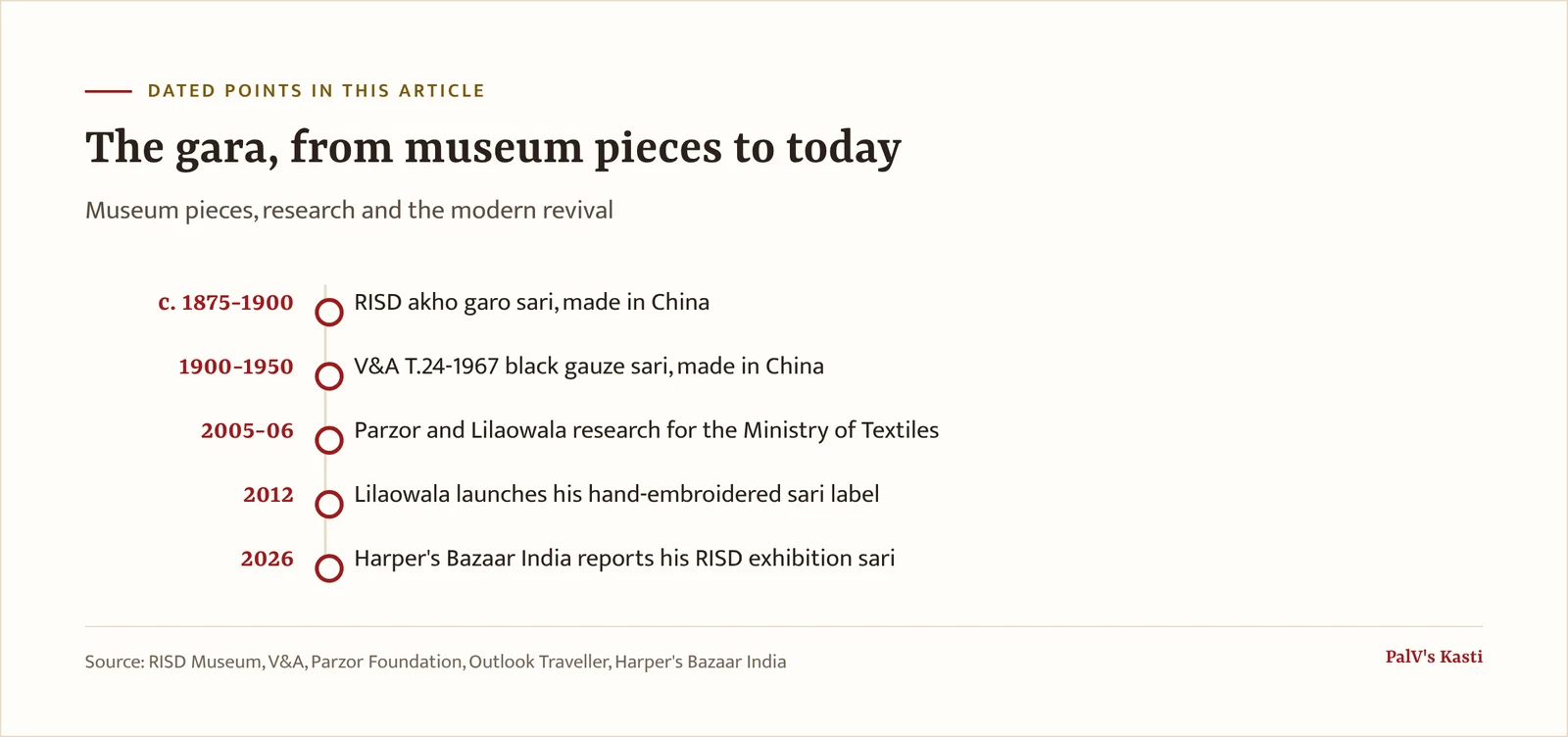

Parzor's own site says a revival of Parsi kor embroidery has spread across India, with Parzor at its origins. In 2005 and 2006, Parzor and Lilaowala carried out a research project on Zoroastrian embroidery for the Ministry of Textiles.
Who is behind the revival is the subject of Parsi gara work today. Why the craft declined in the first place is in why gara embroidery is disappearing.
Where can you see historic Parsi garas?
The historic garas cited in this article are in the collections of CSMVS in Mumbai, the V&A in London and the RISD Museum of the Rhode Island School of Design. The V&A lists both of its saris at its V&A East Storehouse. Our piece on the global gara follows garas abroad, in the diaspora and in museum collections.
What else should you read about Parsi embroidery?
- Parsi embroidery, its main forms: gara, kor, jhabla and ijar
- Jhabla and ijar, the embroidered garments beyond the sari
- Caring for and storing a Parsi gara saree
Frequently asked questions
What is a Parsi gara saree?
A Parsi gara saree is a silk sari embroidered across its body, worn by Parsi women on special occasions and at weddings, according to CSMVS in Mumbai. The word garo began as a Gujarati word for a sari. Over time it came to mean the Chinese embroidered sari that Parsi traders brought home for their families.
Why is Parsi gara so expensive?
A hand-embroidered gara takes a great deal of skilled labour. Designer Ashdeen Lilaowala told Outlook Traveller that one gara can take three weeks to two months, with six to eight artisans working on it together. The embroidery is silk on a silk ground, and fine stitches such as the khakha knot are intricate.
How long does it take to embroider a Parsi gara?
Designer Ashdeen Lilaowala told Outlook Traveller that a gara can take anywhere from three weeks to two months to complete, with six to eight artisans working on one piece together. He gave this figure for how a gara is made today. We found no source with a figure for the early Chinese workshops.
What is the difference between a gara and a kor?
A gara is a whole sari embroidered across its body. A kor is an embroidered band sewn onto a garment, usually as a sari border, as the Textile Research Centre in Leiden defines it. Parzor records that early Chinese garas had no borders, and Parsi women later designed kors to match the inner embroidery.
Is gara embroidery Chinese or Parsi?
It's both. Museum records at the V&A and RISD describe early garas as embroidered in China for the Parsi community. Parzor and the Textile Research Centre in Leiden record that Parsi women then learnt the embroidery and made their own garas, and Parzor says they also used aari and mochi stitches learnt from Gujarati women.
What does akho gara mean?
Akho gara, or akho garo, is a sari embroidered over its whole surface rather than only at the border. CSMVS in Mumbai glosses the term as "fully embroidered" in its record of a twentieth-century silk sari from Surat. The RISD Museum catalogues its own Chinese-made piece, dated about 1875 to 1900, as an Akho Garo Sari.