PalV's Kasti

On this page
- Are machine-made garas actually sold?
- What should the back of a hand-embroidered gara look like?
- What gives machine embroidery away on the front?
- Which stitches and threads does a genuine gara show?
- What do the fabric and construction tell you?
- Can the time and price tell you anything?
- Is a sari with only an embroidered border still a hand-embroidered gar…
- Where can you see genuine hand-embroidered garas to compare?
- Frequently asked questions
Turn the sari over first. The Textile Research Centre (TRC) in Leiden notes that in hand work the yarn is normally hidden "on the back of the cloth". Machine embroidery tends to give itself away through motifs that match exactly in stitch size, position and colour, threads crossing between motifs on the front, a bobbin yarn showing on the back, or a facing fabric stitched behind the work. Writing about Parsi gara work in Garland magazine, Priyanka Kochar said "it looks the same on the reverse side too", with knots "hardly seen". Then compare what you see with museum-recorded garas: satin and stem stitch in twisted silk on a dark satin or gauze ground, sometimes with the knot stitch. None of these sources offers a single deciding test, so use the checks together.
શહેરેવર રોજ
Shehrevar Roj, Tir Mah · 1396 Y.Z.
Are machine-made garas actually sold?
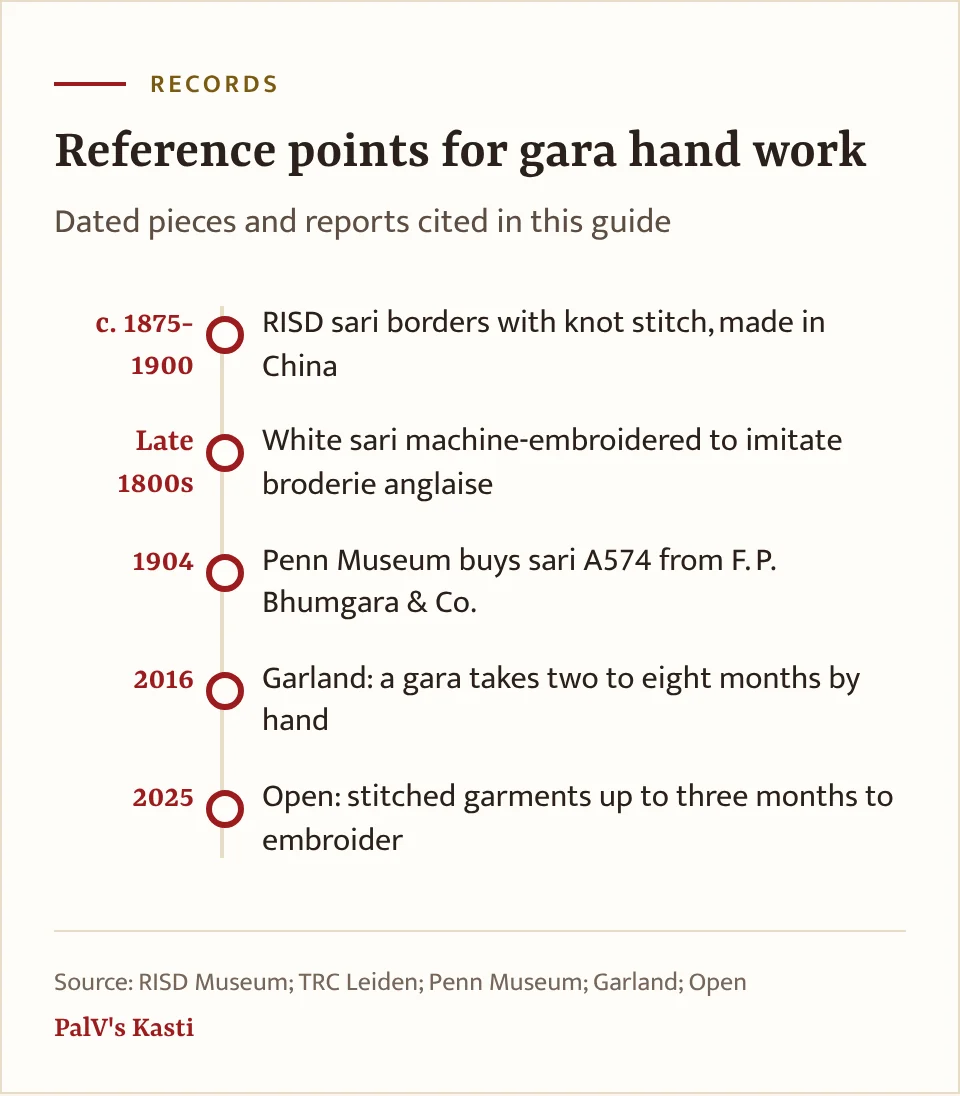
Yes, and they are not new. The TRC's page on Parsi embroidery mentions a white sari, popular with late nineteenth-century Parsis, that was "machine embroidered in imitation of broderie anglaise". Today the gara look also reaches buyers as machine embroidery and as prints. The designer Ashdeen Lilaowala, interviewed by Sohini Dey for Open magazine (last updated 14 February 2025), said he doesn't "object to machine-made or prints", because in those forms too the craft lives on and finds a new audience.
So a machine-made gara isn't necessarily a fake. It becomes a problem only when it's sold as hand work. Woven versions of gara designs are a third category, covered in our piece on woven garas and Benarasi versions.
What should the back of a hand-embroidered gara look like?
On a hand-embroidered piece, the back is where the embroiderer hides the yarn. That is the TRC's general rule for hand work. For Parsi gara specifically, Priyanka Kochar wrote in Garland (5 December 2016) that the back of the work is identical to the front and that the knots of the stitches are "hardly seen".
A neat back on its own doesn't settle the question, though. What matters is what's on it. The TRC points out that on some machine work the bobbin yarn shows "on the back as well as the front", and that machine pieces may carry a facing material behind the work to strengthen the ground cloth. A second thread colour running under every motif, or a stiff backing fabric, is a reason to ask the seller more questions.
What gives machine embroidery away on the front?
Regularity. Gillian Vogelsang of the TRC describes industrial embroidery whose motifs look as if they were laid out with a ruler, where "the form and size of the stitches are also very regular". Repeats are another tell: on multi-needle machine work, stitch size, stitch position and colour are the same on every motif. She also advises looking for threads that cross from one part of the design to another on the front of the cloth, since a hand embroiderer would normally carry them on the back.
| Where to look | Sign of machine work | What the sources say about hand work |
|---|---|---|
| Back of the cloth | Bobbin yarn showing on the back as well as the front | Yarn hidden on the back; in gara work, a back identical to the front with knots hardly seen |
| Repeated motifs | Identical stitch size, position and colour on every motif | Not described as identical |
| Lines and spacing | Motifs set out as if with a ruler, very regular stitch size | Not described as ruler-straight |
| Front of the cloth | Threads crossing between areas of the design | Hand embroiderers normally carry the yarn on the back |
| Backing | A facing material stitched behind to strengthen the ground | No facing mentioned |
The TRC's tests were written for embroidery in general, not for garas alone. Read them alongside the gara-specific museum records below.
Which stitches and threads does a genuine gara show?
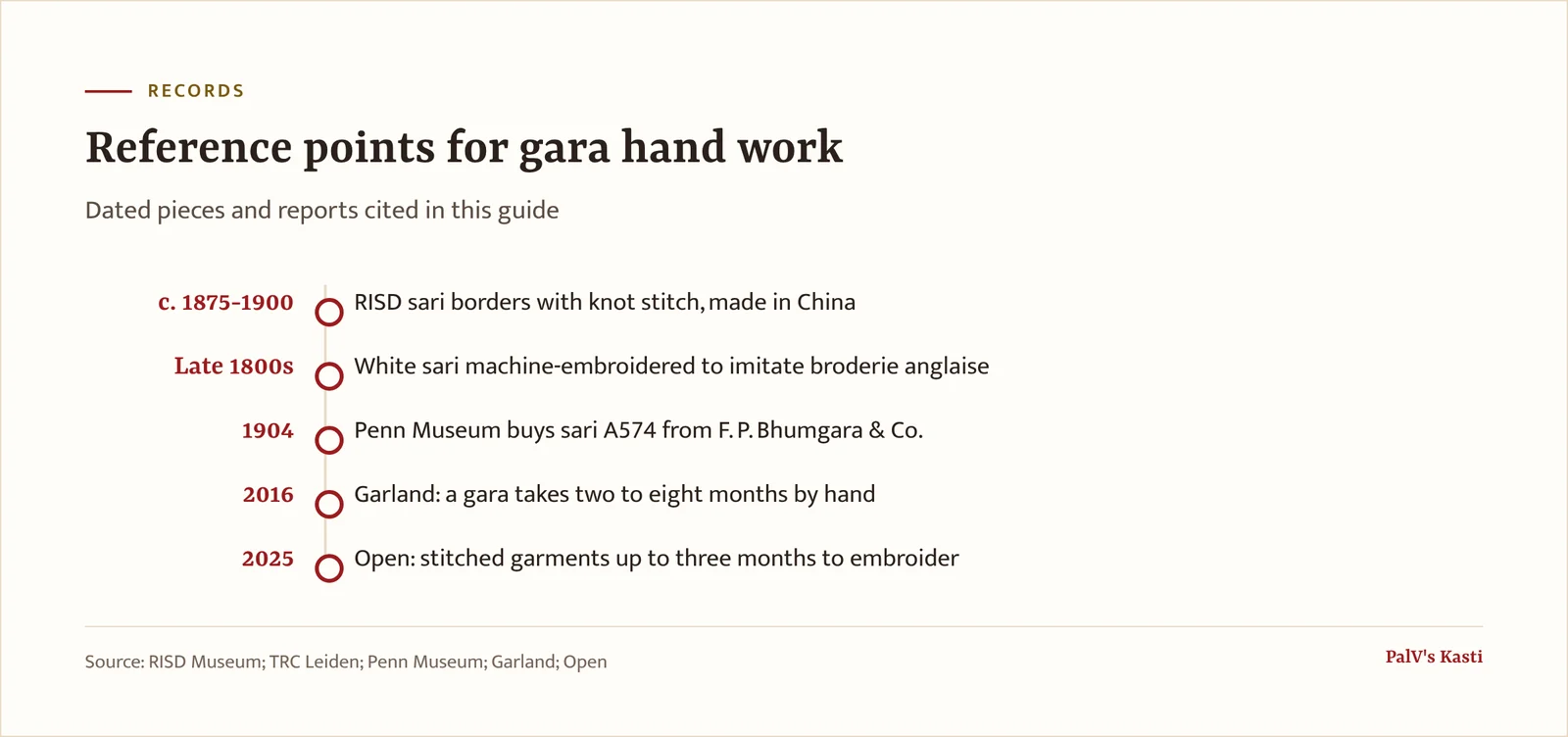
Museum records give a useful reference set. The Penn Museum describes its fully embroidered sari (object A574) as worked mainly in satin stitch, with some stem stitch, in twisted two-ply silk thread. A Singapore collection record for a garo (accession 2009-01458) says the embroidery is usually in twined silk of several shades, set against the darker ground, and that combining silk with jari (metallic) thread was rare.
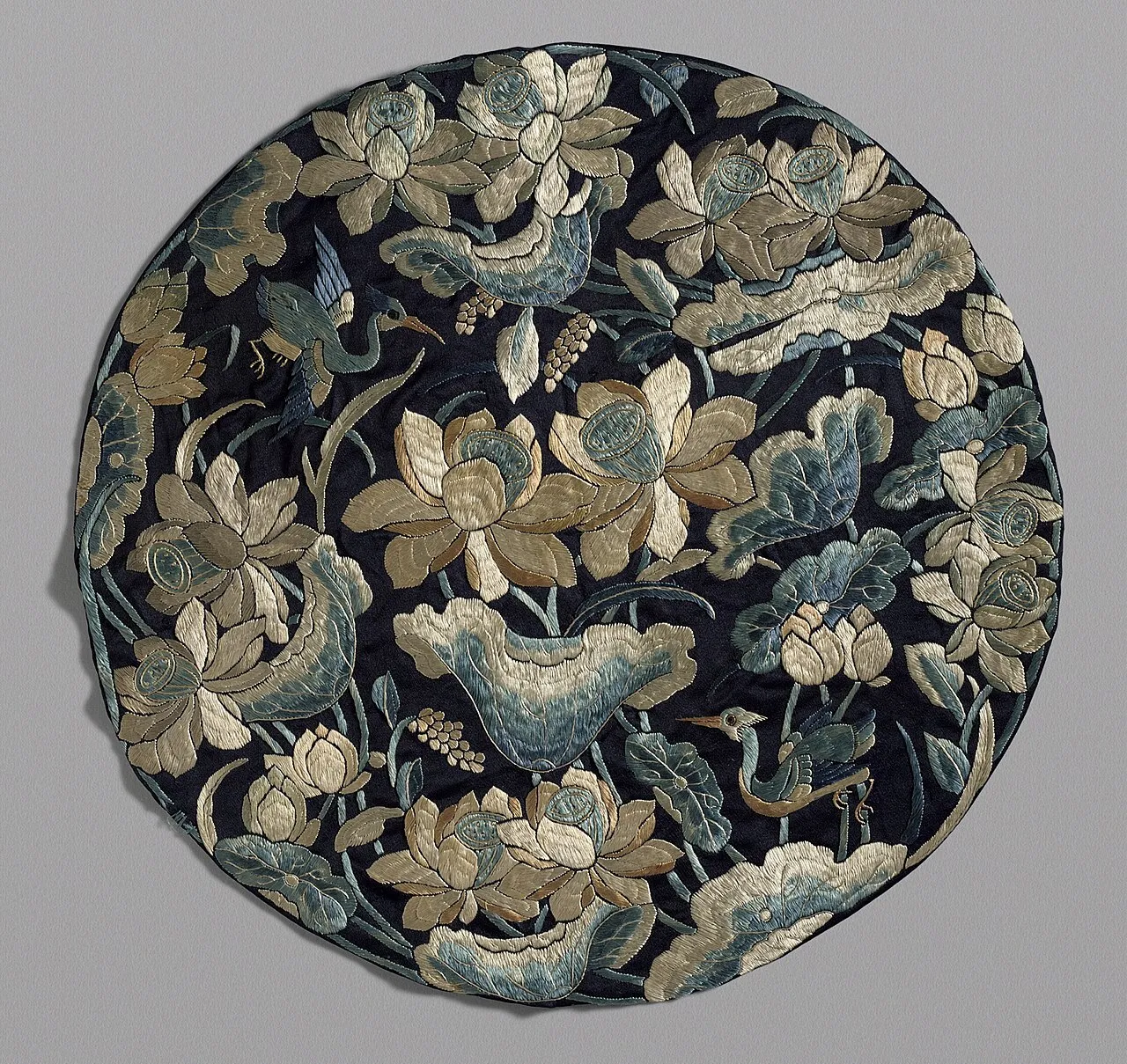
Knot stitches point back to the Chinese workshops. The RISD Museum's label for a sari border of about 1875 to 1900 calls tuan chen, or knot stitch, "a specialty of workshops in China". The TRC names the khakha stitch, "more universally known as the Peking knot", as the "forbidden stitch". Parzor's online exhibition calls the khakho a "seed pearl stitch", and Kochar described it as "a French knot with a comma by its side". The descriptions differ, but all three point to a very fine knot. Shernaz Cama, writing in Global Textile Encounters (2014) and cited in a 2022 Leiden University thesis, counts at least six types of stitch in gara silk embroidery. For how those stitches are worked, see how Parsi embroidery is done, and for the wider tradition, our guide to Parsi embroidery.
What do the fabric and construction tell you?
Garas were usually embroidered on dark grounds. The Singapore record says the garo "is usually done on dark coloured satins", and calls a light lilac example uncommon. The TRC lists chiffon, gauze and satin as gara grounds, often purple, red or black, embroidered "using white silk thread". Black silk gauze appears in both the Penn Museum sari and the V&A sari T.271-1922, which the V&A records as made in China for the Indian Parsi community in the early 20th century.
Older China-made saris can also carry a seam. According to the TRC, these saris normally have a lengthwise seam where an extra half-width of cloth was added, because Chinese hand looms were narrower. The type is called a do-patti (two-strip) sari. A seam like this doesn't prove hand embroidery, but it does fit the older China trade.
Can the time and price tell you anything?
Hand work is slow, and the sources say so plainly. Kochar wrote in 2016 that each gara takes two to eight months to complete, depending on how much embroidery it carries. Writing about Lilaowala's studio for Open in 2025, Sohini Dey reported that even stitched garments can need up to three months of embroidery each, depending on how complex the design is. The Singapore record adds that a garo "was equally expensive to acquire" as it was demanding to make.
We couldn't find a named, dated source for current gara prices, so we haven't quoted one. A very low price on a fully covered sari is still worth questioning, given the months of work these sources describe.
Is a sari with only an embroidered border still a hand-embroidered gara?
It can be. The RISD Museum explains that kor ni sarees pair a plain body with an embroidered border, or kor, and that they became the more common, more affordable alternative to the classic akha garas, which carried embroidery all over. Apply the same back-of-cloth checks to the border band. Our article on the Parsi kor border covers how kor saris differ from full garas.
Where can you see genuine hand-embroidered garas to compare?
Catalogued pieces give you something real to compare against. Records you can open online include:
- CSMVS, Mumbai: an akho garo (fully embroidered) sari from Surat, 20th century, gift of Manek Khabardar, from the family of the poet Ardeshir Khabardaar.
- Penn Museum, Philadelphia: sari A574, black silk gauze, purchased from F. P. Bhumgara & Company in 1904.
- V&A, London: saris T.271-1922 and T.24-1967. The TRC describes T.24-1967 as worked "using satin stitch and stem stitch".
- RISD Museum, Providence: Chinese-made sari borders of about 1875 to 1900. They were shown in the exhibition The Flower, The Labor, and The Sea, which ran from 27 September 2025 to 28 June 2026, and the collection records remain online.
For what a gara is and why it costs what it does, start with our guide to the Parsi gara saree. Once you've confirmed a piece is hand-embroidered, our guide to gara saree care covers how to store it.
Frequently asked questions
Is a Parsi gara always hand-embroidered?
Not everything sold as one is. The Textile Research Centre in Leiden mentions a machine-embroidered white sari from the late nineteenth century in its Parsi embroidery notes, and designer Ashdeen Lilaowala told Open magazine in 2025 that he doesn't object to machine-made or printed versions. A gara sold as hand-embroidered should pass the back-of-cloth and repeat-motif checks above.
What is an akho gara?
An akho (or akha) gara is a sari embroidered all over, not just at the border. The RISD Museum contrasts it with the kor ni sari, which has a plain body and an embroidered border. CSMVS in Mumbai and the Penn Museum both hold fully embroidered examples, catalogued as akho garo, that you can view online.
What is the forbidden stitch in Parsi embroidery?
It is the khakha or khakho stitch. The Textile Research Centre calls it the Peking knot. Parzor's online exhibition calls the khakho a seed pearl stitch, and Garland magazine described it as a French knot with a comma beside it. Sources describe it differently, but all link it to very fine, hand-worked knots.
Should the back of a hand-embroidered gara be neat?
Yes. Priyanka Kochar, writing in Garland magazine in 2016, said the back of gara work is identical to the front, with knots hardly seen. Neatness alone isn't proof, though. The Textile Research Centre warns that machine work can show bobbin yarn on both sides or carry a facing fabric behind it.
How long does it take to hand-embroider a gara?
Garland magazine's 2016 article put it at two to eight months for each piece, depending on how much embroidery it carries. Open magazine reported in 2025 that, at Ashdeen Lilaowala's studio, even stitched garments can take up to three months, depending on the complexity of the design. Neither source gives current prices.
Are printed garas fake?
Not if they're sold as prints. Ashdeen Lilaowala, interviewed by Open magazine (last updated February 2025), said he doesn't object to machine-made or printed versions because the craft still reaches a new audience. The problem arises only when a print or machine piece is presented as hand embroidery, so ask the seller directly.