PalV's Kasti
On this page
- What exactly is a kor?
- How is a kor sari different from a full gara?
- Was the kor embroidered separately from the sari?
- Where does the kor sit on a sari?
- Why could a kor be moved from one sari to another?
- What stitches, colours and fabrics do kors use?
- Are kors still being made today?
- Frequently asked questions
A kor is an embroidered band made to be sewn onto a garment, most often a sari. The Textile Research Centre (TRC) in Leiden describes kor as bands used for sewing on garments, especially saris. A sari that carries only this border is a kor ni sari. The RISD Museum explains that kor ni sarees have a plain body and an embroidered border, and that they became "the more common and affordable alternative" to akha garas, the saris embroidered all over. So the difference is coverage. A full gara (akho or akha gara) is embroidered across its whole body. A kor sari keeps the embroidery to its edges, often on a band that was made separately and stitched on.
શહેરેવર રોજ
Shehrevar Roj, Tir Mah · 1396 Y.Z.
What exactly is a kor?
The word kor means the border itself. Garland magazine's December 2016 feature on Mumbai's Parsi embroiderers describes "embroidered borders called 'kor'", and one of its photo captions lists the materials of a kor as silk base fabric, silk skeins and satin stitch. You'll also see the plural kors and the phrase kor ni saree, meaning a sari with a kor.
Kors weren't only for saris. The TRC's definition covers garments in general, with saris as the main use. The RISD Museum's label for one Chinese-made border adds that the embroidery used on gara borders was also applied to "Parsi blouses, loose pants, hats, and children's tunics". The wider craft is covered in our hub on Parsi embroidery.
How is a kor sari different from a full gara?
The two are built differently and were priced differently.
| Feature | Kor ni sari | Akho (full) gara |
|---|---|---|
| Body of the sari | Plain (RISD Museum) | "Fully covered with embroidery" (Asian Civilisations Museum, Singapore) |
| Where the embroidery sits | On an embroidered border band | Across the whole field, often with an embroidered border as well (Parzor, Penn Museum) |
| How the border is added | Often made as a separate piece and stitched on later (RISD Museum) | The whole sari length is embroidered |
| Cost | "The more common and affordable alternative" (RISD Museum) | Expensive to acquire (Asian Civilisations Museum) |
| Museum examples | RISD Museum sari borders 56.075.1, 56.075.4 and 56.075.8 | CSMVS "Akho Garo (fully embroidered) Sari" and Penn Museum A574 |
Singapore's Asian Civilisations Museum, in its record for an early 20th-century garo, says making a garo demanded a great deal of ingenuity and patience, and that a garo was equally expensive to acquire. A kor ni sari puts that labour into one band instead of the whole length.
A full gara usually has a kor too. Parzor's online exhibition with Google Arts & Culture describes how Chinese yardage developed into the Parsi gara sari, bound in a frame by a kor on four sides. The earliest pieces, embroidered on satin, had no borders or pallavs. Then, Parzor says, Parsi women followed Indian tradition and began designing kors to match the embroidery inside them. How the gara reached that form is told in our history of Parsi garas.
Was the kor embroidered separately from the sari?
Often, yes. The RISD Museum says borders were sometimes embroidered straight onto the sari fabric, but were more likely made as separate pieces to be stitched on later. Another RISD label notes that, later on, Chinese workshops made "uncut embroidered panels" for tailoring once they reached India.
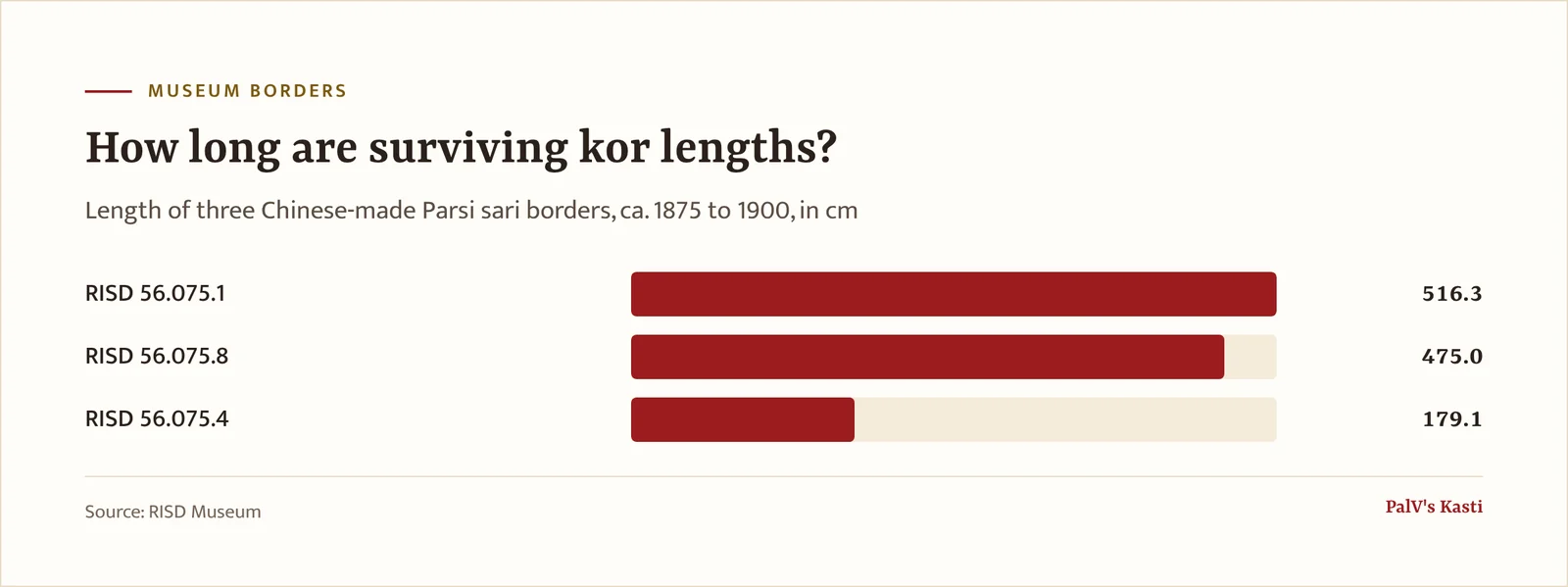
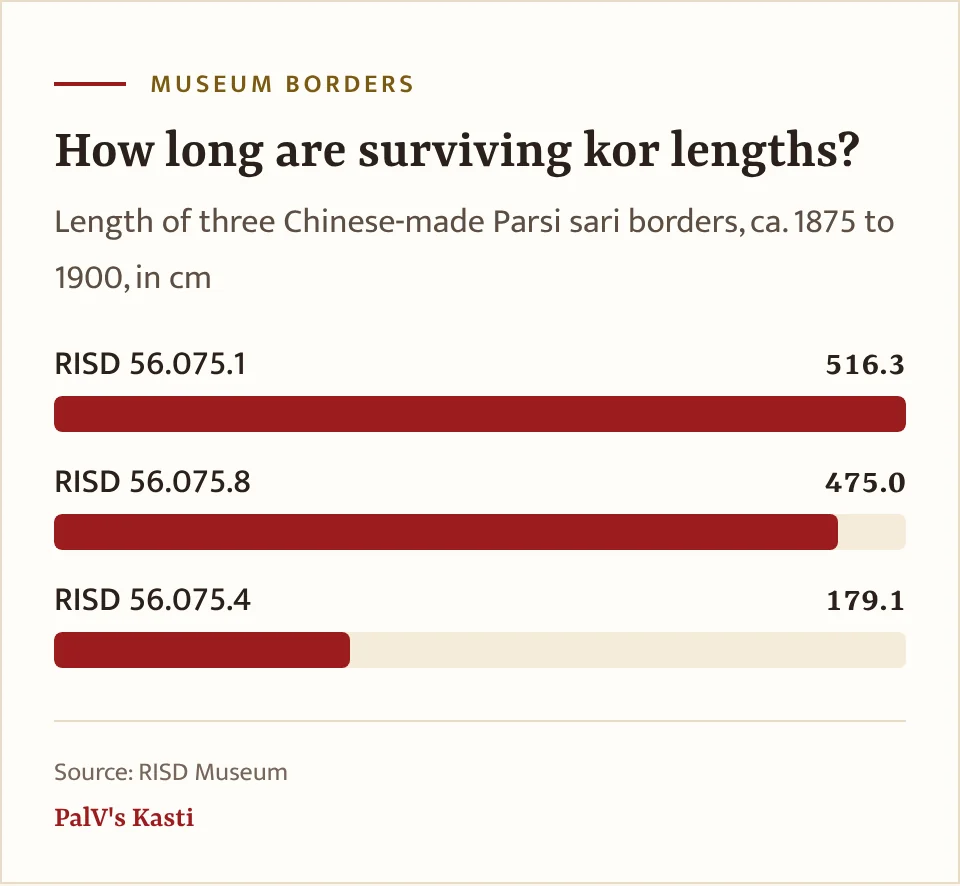
Surviving lengths show what these bands looked like before they met a sari:
| Collection and number | Date | Length | Embroidery |
|---|---|---|---|
| RISD Museum 56.075.8 | ca. 1875 to 1900 | 475 cm | Silk knot-stitch embroidery on silk compound weave |
| RISD Museum 56.075.1 | ca. 1875 to 1900 | 516.3 cm | Silk satin-stitch embroidery on silk plain weave |
| RISD Museum 56.075.4 | ca. 1875 to 1900 | 179.1 cm | Silk satin stitch, chakla-chakli (paired birds) pattern |
| Museum of Archaeology and Anthropology, Cambridge, 1988.443.1-3 | Collected 1900 | 2,620 mm long, 40 mm wide | Floral and geometric motifs on dark blue to black silk |
The Cambridge record states that its edging was "embroidered by Chinese in Bombay for Parsee clothing decoration". All three RISD borders are catalogued as the work of unknown Chinese makers.
Where does the kor sit on a sari?
Placement varies from piece to piece. Parzor's exhibition describes the gara as framed by a kor on four sides. A 20th-century Parsi sari at the Museum of Art & Photography (MAP), Bengaluru, has a more densely embroidered border band that runs along three sides of the pallu and along the whole fall, the bottom-facing end, of the sari. Parzor adds that "the frontage or the pallav was designed to highlight the design".
Why could a kor be moved from one sari to another?
A separate band is easy to unpick. The RISD Museum puts it practically: if the body of a sari was stained or damaged, the border could be taken off and moved onto a different plain textile to make a new sari. Kor lengths also survive on their own in collections, as the RISD and Cambridge pieces show. Re-using inherited garas is covered in the gara as a family heirloom.
What stitches, colours and fabrics do kors use?
The museum records name two main stitches. RISD's borders include satin stitch and tuan chen, "or knot stitch, a specialty of workshops in China". Garland's caption lists a silk base with satin stitch.
Grounds were often dark. The Cambridge edging is dark blue to black silk. The TRC adds that in the early to mid-20th century, gold-coloured badla work on navy and other plain fabrics became popular, finished with applied borders of Chinese embroidery on satin bands. Parzor also shows richer grounds: its exhibition features Lady Bachubai Vakil of Ahmedabad (1888) in "an embroidered Parsi velvet kor gara".
Patterns repeat across kors. According to Parzor, some kor patterns turn up again and again, worked in different colours to suit the wearer. One of the most common patterns, chakla-chakli, takes its name from the Gujarati word for sparrow, the RISD label says. For what the motifs show, see gara embroidery designs and motifs.
Are kors still being made today?
Yes. Parzor writes that "along with full garas, stand alone 'kors' became popular", and says the current revival of Parsi embroidery began with Parzor workshops held across the country. Who is doing that work now is the subject of reviving gara embroidery, and why fewer full garas are made is covered in why gara embroidery is disappearing. For the gara as a whole, start at our guide to the Parsi gara saree. If you're buying a kor sari, our guide on how to tell a hand-embroidered gara from a machine-made one applies to the border band too.
Frequently asked questions
What is a kor in Parsi embroidery?
A kor is an embroidered band sewn onto a garment, especially a sari. The Textile Research Centre in Leiden describes kor as bands used for sewing on garments. A sari with a plain body and a kor is called a kor ni sari, according to the RISD Museum's catalogue label for a Chinese-made border.
What is the difference between a kor sari and a gara?
A kor ni sari has a plain body with an embroidered border, while an akho (full) gara is embroidered all over. The RISD Museum describes kor saris as the more common and affordable alternative. Most full garas also carry a kor, which Parzor describes as framing the sari on four sides.
Why is a kor sari cheaper than a full gara?
Only the border band is embroidered. The RISD Museum calls kor ni saris the more common and affordable alternative to akha garas, the saris embroidered all over. Singapore's Asian Civilisations Museum says a fully embroidered garo demanded great ingenuity and patience and was expensive to acquire.
Can a kor be moved to a new sari?
Yes. The RISD Museum explains that kors were often made as separate pieces and stitched on. If a sari's body was stained or damaged, the border could be removed and transferred to a different plain fabric to make a new sari. Old kor lengths survive on their own in museum collections.
Who made the kor borders?
Many surviving borders were made by Chinese embroiderers. The RISD Museum catalogues its 1875 to 1900 sari borders as Chinese work, and Cambridge's Museum of Archaeology and Anthropology records an edging embroidered by Chinese in Bombay for Parsee clothing. Parzor notes that Parsi women went on to design kors to match the embroidery of the sari.