PalV's Kasti
On this page
- Is gara embroidery really disappearing?
- What are the main reasons for the decline?
- How did the end of the China trade affect gara embroidery?
- Why did Parsi women turn away from the gara?
- Why are the old gara stitches so hard to pass on?
- Do gara artisans earn enough to stay in the craft?
- Has machine embroidery replaced the hand-made gara?
- Does a smaller Parsi community mean fewer gara buyers?
- Frequently asked questions
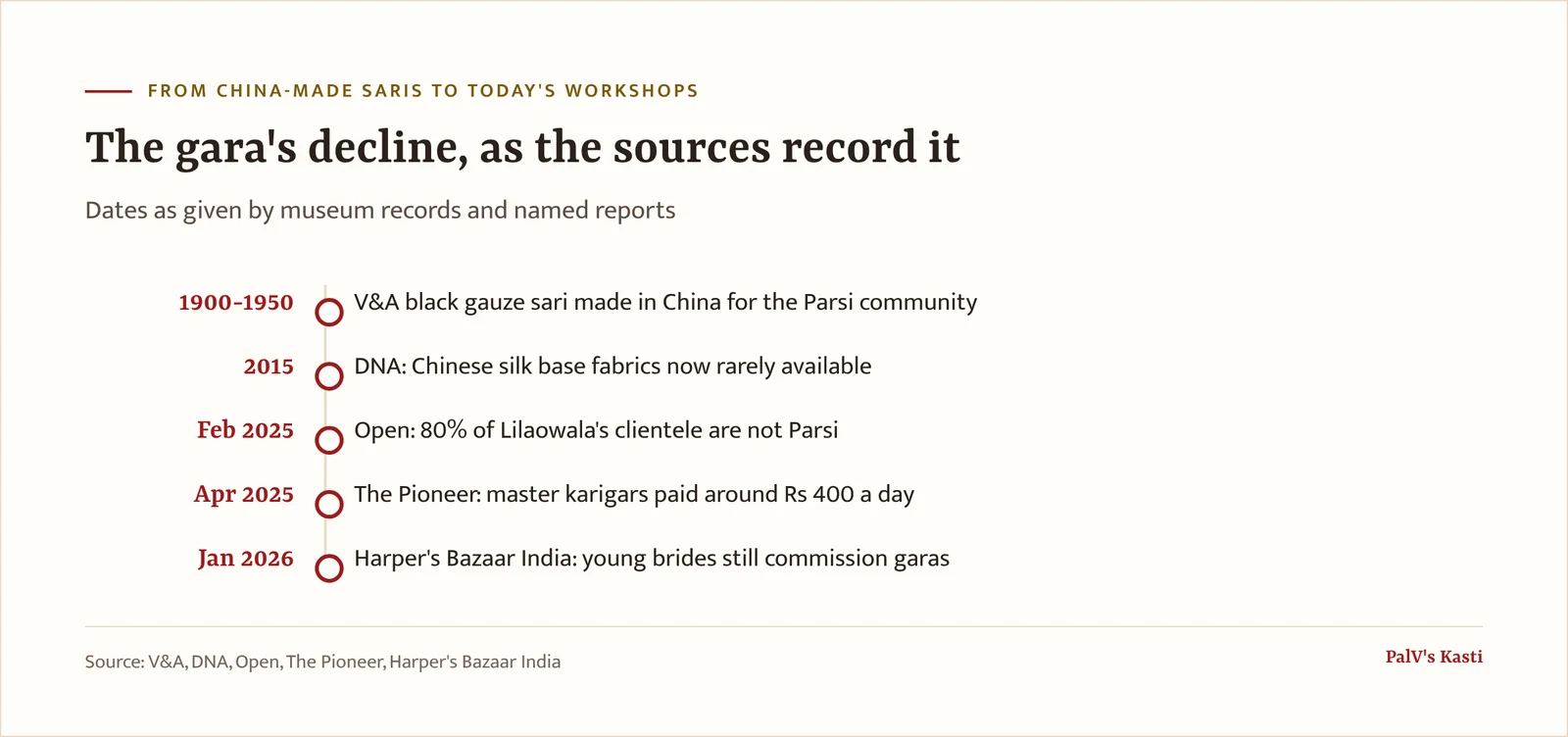
Gara embroidery didn't fade for one reason. Several pressures stacked up. The UNESCO Parzor Foundation says the craft's link to China went when Parsi trading in China ended, and DNA reported in 2015 that the Chinese silk base fabrics are now rarely available. Dr Shernaz Cama, director of the UNESCO Parzor Foundation, told DNA that Parsi women moved to European chiffons and georgettes, took up khadi during the Swadeshi movement, and dressed differently once they went out to work. Parzor says the rare stitches now survive with a few elderly women. Today the pressure is money. A gara takes months, and The Pioneer reported in April 2025 that master karigars earn around Rs 400 a day. Our view: the craft is shrinking, not dead. The V&A says the gara is still in production, and Harper's Bazaar India reported in January 2026 that young brides still commission garas at Ashdeen Lilaowala's Mumbai store.
અસપંદામેદ રોજ
Asfandarmad Roj, Tir Mah · 1396 Y.Z.
Is gara embroidery really disappearing?
Partly. The sources describe a craft that contracted sharply but never stopped.
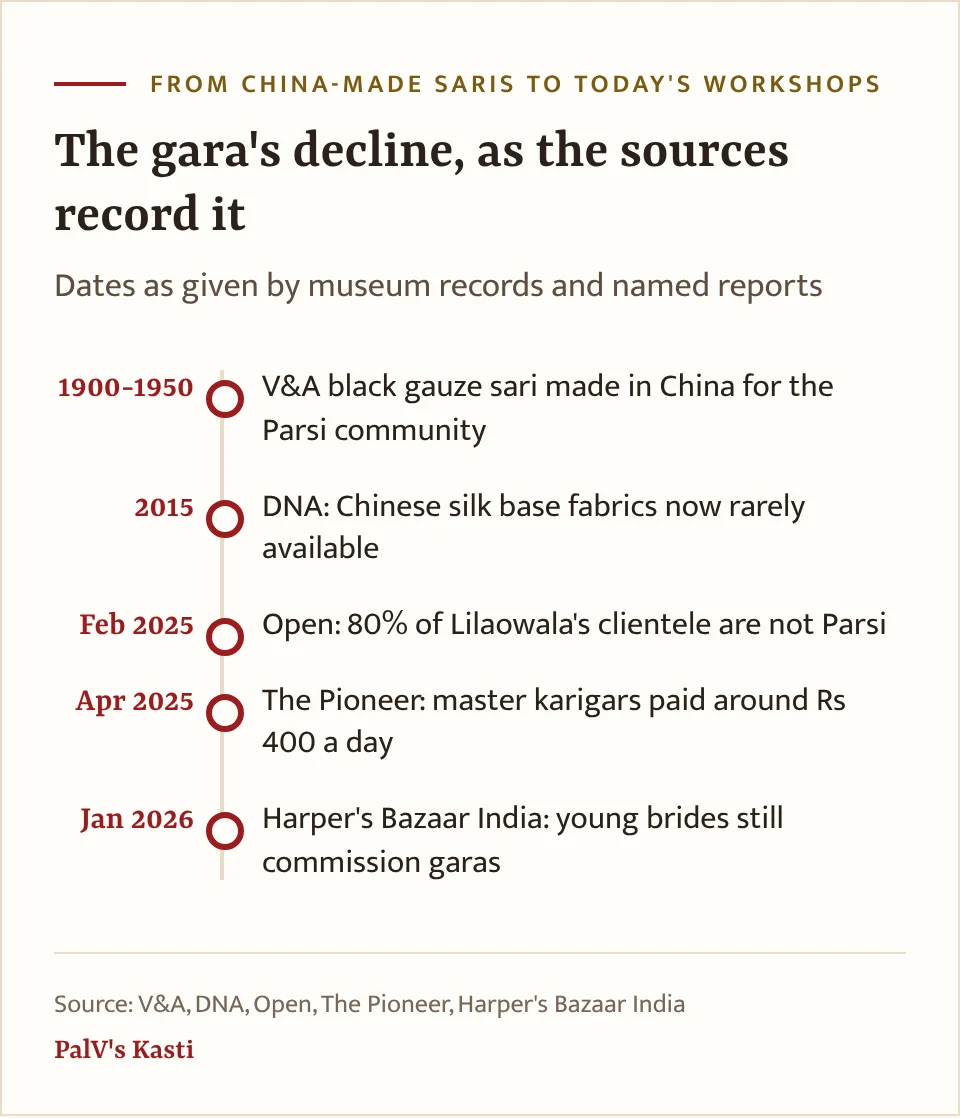
The Textile Research Centre in Leiden calls Parsi embroidery "now a disappearing craft". DNA's report on the gara said its decline was so steep that it "passed into near oblivion". Against that, the Victoria and Albert Museum's catalogue says the gara is "still in production today", and the UNESCO Parzor Foundation says a revival of Parsi kor embroidery, one it says it began, is sweeping across India.
Our reading: hand gara work became rare, and what survives depends on a small pool of skilled hands. The people now rebuilding it are covered in who is reviving gara embroidery.
What are the main reasons for the decline?
| Reason | Who says so |
|---|---|
| Parsi trading in China ended, cutting the craft's link to China | UNESCO Parzor Foundation |
| Women switched to chiffons and georgettes brought by Europeans | Dr Shernaz Cama, in DNA (2015) |
| Parsis took up khadi during the Swadeshi movement | Dr Shernaz Cama, in DNA (2015) |
| Women entering employment changed what they wore | Dr Shernaz Cama, in DNA (2015) |
| Chinese silk base fabrics became rarely available | DNA (2015) |
| Only a few elderly Parsi women still know the rare stitches | UNESCO Parzor Foundation |
| Low daily pay pushes artisans to think about leaving | The Pioneer (April 2025) |
| Falling demand, partly put down to the community's low birth rate | The Pioneer (April 2025) |
How did the end of the China trade affect gara embroidery?
Some garas were embroidered in China for Parsi buyers. The V&A holds a black silk gauze sari made in China between 1900 and 1950, which it describes as made "for the Parsi community". Its record for an unfinished jubla (girl's shirt), probably made for the Parsis of Bombay, adds that traders brought back prized Chinese embroidery and that Chinese embroiderers also settled in Surat.
That supply line is what broke. When Parsi trading in China ended, the UNESCO Parzor Foundation's textiles page says, "this link is now gone". DNA reported in 2015 that the Chinese silk fabrics which served as the gara's canvas are now rarely available. The full story of the China connection is in the Chinese roots of Parsi embroidery.
Why did Parsi women turn away from the gara?
Dr Shernaz Cama, director of the UNESCO Parzor Foundation, gave DNA three reasons in 2015:
- New fabrics. Women took to chiffons and georgettes, "brought here by the Europeans", she said.
- Politics. Parsis, prominent in India's freedom struggle, gave up their usual garments for khadi in the Swadeshi movement.
- Work. By the time India won independence, women were starting to take jobs, and that changed what they wore.
Today, The Pioneer notes, garas are costly and kept for special occasions. How Parsi women's dress changed across those decades is covered in gara saris and Parsi women's fashion.
Why are the old gara stitches so hard to pass on?
Because so few people still hold them. The UNESCO Parzor Foundation says the intricate, rare stitches are known to only a few elderly Parsi women, and that Parsis "today seem to forget a great tradition of creativity".

The work is also slow. The Pioneer puts part of the fall in demand down to the craft's time-intensive nature. Outlook Traveller reported in 2023 that one Parsi gara sari takes three weeks to two months, with six to eight artisans on the same piece. The Pioneer's figure is longer: two to eight months. The stitches themselves are explained in how Parsi embroidery is done.
Do gara artisans earn enough to stay in the craft?
Not according to The Pioneer. Its April 2025 report by Manisha Gawade said master karigars are paid "merely around Rs. 400 per day". Of the five artisans it interviewed, three said they were seriously considering a change of profession. It named Sheikh Khadim Ali, Sheikh Raju and Sohan Bimal among those affected.
One designer reports the opposite in his own workshops. Ashdeen Lilaowala told Open in February 2025 that his label has brought younger generations into the work "because we have made the work lucrative". Neither report gives a figure for the craft as a whole.
Has machine embroidery replaced the hand-made gara?
Not replaced. It now sits alongside it. DNA noted in 2015 that the gara is often machine-embroidered these days, on lighter fabrics such as georgette.
Not everyone in the craft sees that as a loss. "I don't object to machine-made or prints," Lilaowala told Open, because the craft still finds a new audience in those forms. If you want to know which kind you're looking at, see how to tell a hand-embroidered gara from a machine-made one.
Does a smaller Parsi community mean fewer gara buyers?
The Pioneer thinks so. It wrote that demand for Parsi gara embroidery "has declined over the years", partly because of the community's low birth rate, and that the garments are costly and kept for special occasions.
The buyers have changed as well as shrunk. Lilaowala told Open that 80 per cent of his clientele are not Parsi. He doesn't expect the gara to go mass-market either. "It will have moments in the spotlight," he told Harper's Bazaar India in January 2026, "but it will never be mainstream." For what a gara is and why it costs what it does, see our guide to the Parsi gara saree.
Frequently asked questions
Why did Parsi gara embroidery decline?
Several reasons combined. The UNESCO Parzor Foundation points to the end of Parsi trading in China, which cut the craft's link to China. Dr Shernaz Cama told DNA in 2015 that Parsi women moved to European chiffons and georgettes, took up khadi in the Swadeshi movement, and dressed differently once they began working.
Is Parsi gara embroidery a dying art?
It is rare but still alive. The Textile Research Centre in Leiden calls Parsi embroidery a disappearing craft, and Parzor says only a few elderly Parsi women know the rare stitches. But the V&A says the gara is still in production, and Open reported in 2025 that around 300 to 350 artisans work across Ashdeen Lilaowala's units.
How much do gara embroidery artisans earn?
The Pioneer reported in April 2025 that master karigars doing Parsi gara embroidery are paid around Rs 400 a day. Three of the five artisans it interviewed said they were seriously considering another profession. Designer Ashdeen Lilaowala, by contrast, told Open that his label has made the work lucrative enough to attract younger embroiderers.
Did machine embroidery kill the hand-made gara?
No. DNA reported in 2015 that garas are now often machine-embroidered on lighter fabrics such as georgette, but hand embroidery continues alongside it. Designer Ashdeen Lilaowala told Open he doesn't object to machine-made or printed versions, because the craft still reaches a new audience through them.
How long does it take to embroider a gara?
Reports differ. Outlook Traveller reported in 2023 that one Parsi gara sari takes three weeks to two months, with six to eight artisans working together on the piece. The Pioneer, in April 2025, put it at two to eight months, and it links that slow, labour-heavy pace to falling demand for the craft.