PalV's Kasti

On this page
In the 19th and early 20th centuries, the gara was the sari worn by wealthy Parsi women: Chinese silk in black, purple or red, covered in Chinese-style flowers and birds. Parsi women kept the sari, but Tulsi Vatsal, writing in the Indian Journal of Gender Studies, says they gave it a modern, sophisticated look by adding elements of Western fashion. And the gara itself kept changing. White saris machine-embroidered to imitate broderie anglaise were popular in the late 19th century. Gold badla work, applied satin borders and sequins on net came in during the early to mid-20th century, according to the Textile Research Centre in Leiden. Portraits dated 1888 and 1923, shown by the UNESCO Parzor project, record Parsi women in their garas, one of them wearing her Navjote.">Sadra in lace.
શહેરેવર રોજ
Shehrevar Roj, Tir Mah · 1396 Y.Z.
Why did the gara become fashionable among Parsi women?
Clothing signalled status. Vatsal calls clothing "that very visible marker of social status" and places it within the wider process by which Parsis came to identify themselves with the ruling elite under foreign rule. She suggests, as a conjecture, that the appeal of Chinese embroidery reflected fashion trends in Britain. Parsi clients, she writes, chose gara designs from the same generic pattern books used for other Chinese export embroidery, including pieces sent to Europe and America.
The gara also marked the community. Firoza Punthakey Mistree writes that its white embroidery on jewel-toned silk "delighted the community", and that it was worn only by Parsis. The CSMVS museum in Mumbai puts it more briefly: "Garo has become an identity for Parsi women". Describing one of its own saris, the V&A says the black ground together with the Chinese embroidery mark it as specifically Parsi.
That exclusivity has since loosened. Designer Ashdeen Lilaowala told Open magazine in February 2025 that 80 per cent of his clientele are non-Parsis. Why the hand-made craft shrank in between is covered in why gara embroidery is disappearing.
What did a fashionable gara look like?
The museum and research records agree on a dark or jewel-toned ground with lighter embroidery, though they differ on detail.
| Feature | What the sources record | Source |
|---|---|---|
| Ground colour | Black and purple were common | V&A |
| Ground colour | Purple, red or black, often with white silk thread; black and violet common; wedding-related garas in brilliant red or orange-red | Textile Research Centre, Leiden |
| Colour over time | Imperial purple, favoured in the Persian tradition; Indian kunku (vermilion) red became a favourite as Indian influence grew | UNESCO Parzor project |
| Cloth | Silk gauze was a favoured material | V&A |
| Cloth | Chiffon, gauze or satin | Textile Research Centre, Leiden |
| Cloth | Sali ghaj silk satin (akho garo, ca. 1875-1900) | RISD Museum |
| Embroidery subjects | Flowers, leaves, birds, animals, people in Chinese dress, bridges over water | Textile Research Centre, Leiden |
| Edging | Often applied separately: satin ribbon embroidered by Chinese artisans for the purpose | V&A |
For what makes a sari a gara in the first place, see what is a Parsi gara saree. A fully embroidered gara is called an akho garo, the name both the CSMVS and the RISD Museum use for their pieces. Others were framed on all four sides by a kor, or border, and Parzor notes that stand-alone kors became popular alongside full garas. The difference between the two is explained in our article on the Parsi kor border.
How did Parsi women drape the gara?
The UNESCO Parzor project says Parsi women, to keep their sari distinct, wore the pleats on the right and let the pallav fall almost to the feet. The RISD Museum describes Parsi women draping gara saris the traditional Gujarati way, with the sari wrapped around the waist and the pallu taken from the back over the right shoulder.
That drape travelled. The RISD Museum's 2025 essay repeats the account that the Bengali social reformer Jnanadanandini Tagore created the nivi drape, inspired by the way Parsi women in her social circle in Bombay wore their Chinese-embroidered silks. That story is told in full in how the Parsi sari drape reached Bengal.
Which European touches appeared on Parsi garas?
European trimmings sat on top of Chinese embroidery. Parzor writes that Europe's imperial presence added scallops, bows and ribbons, bringing four cultures together in the Parsi sari. The Textile Research Centre in Leiden notes that gara designs often mixed Chinese patterns with older European export ones.
The clearest picture is a portrait. Parzor shows Lady Bachubai Vakil of Ahmedabad, in a portrait dated 1888, wearing an embroidered velvet kor gara with her Sadra in lace, which Parzor calls a European influence.
Some fashions left Chinese embroidery out altogether. The Textile Research Centre, citing Linda Lynton's The Sari (1995), records that a white sari machine-embroidered in imitation of broderie anglaise was popular among Parsis in the late 19th century.
How did gara fashion change in the early 20th century?
Parsi sari fashion kept moving. The Textile Research Centre says gold-coloured badla decoration on navy and other plain fabrics became popular in the early to mid-20th century, along with applied borders of Chinese embroidery on satin bands and sequins sewn onto net.
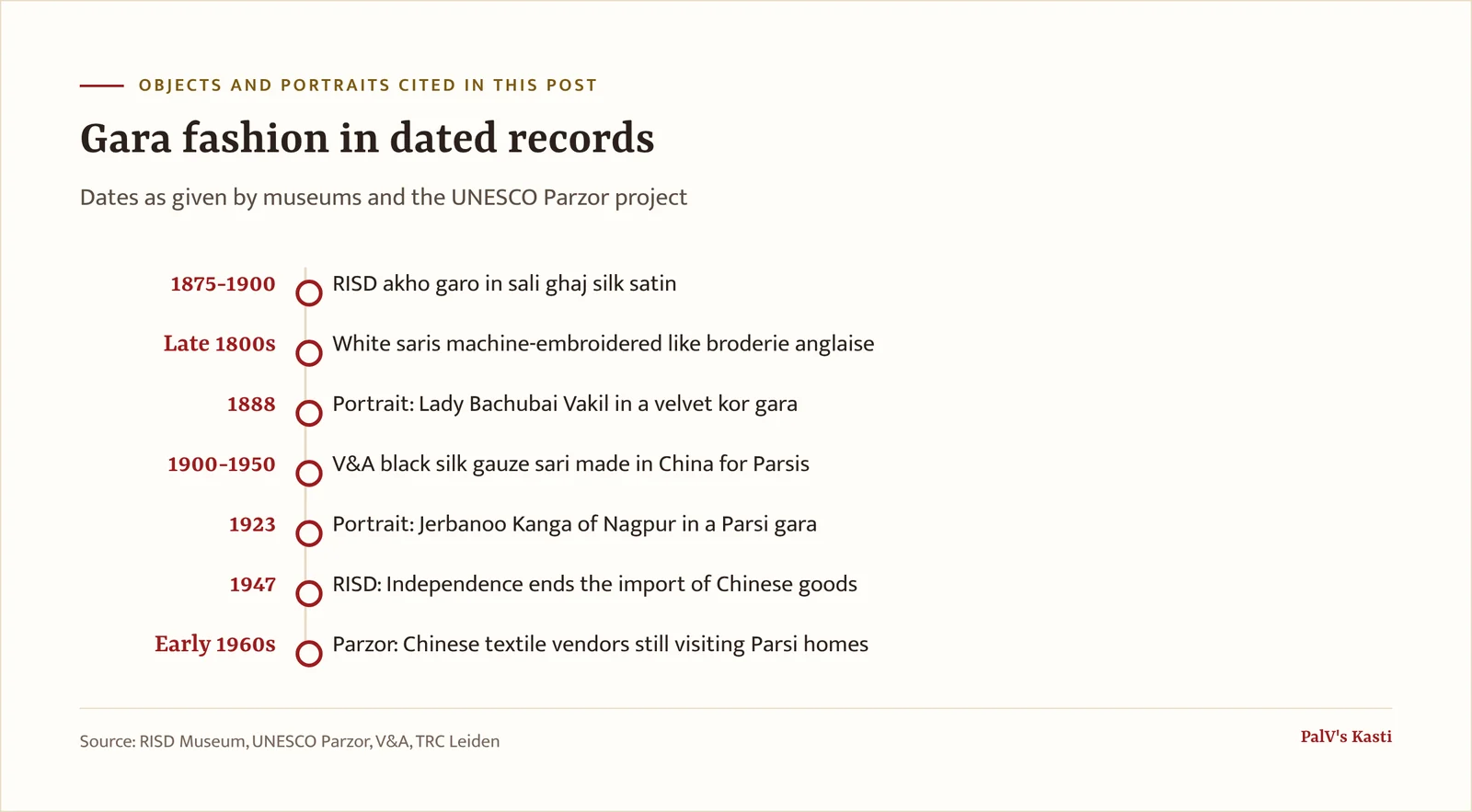

Chinese-made garas were still being produced. The V&A's black silk gauze sari T.24-1967, dated 1900-1950, was made in China for the Parsi community. Its centre is covered with rows of floral rosettes, and its long borders carry a dense design of birds and flowers. Unusually, the V&A notes, its edging is embroidered straight onto the sari silk rather than applied as a ribbon. Parzor shows a 1923 portrait of Jerbanoo Kanga of Nagpur wearing a Parsi gara. Garas like these now sit in collections from the V&A to the RISD Museum, which is the subject of the global gara.
Kors gave women room to choose. Parzor notes that certain kor patterns appear repeated in different colours according to individual preference. It also records a rare gara from Japan with fine chrysanthemums embroidered on black, in the collection of the late Khorshed Sethna (née Vakil) of Ahmedabad.
The gara was not the only China-trade sari in a Parsi wardrobe. Mistree writes that the woven Tanchoi sari was "an integral part of every festive occasion" in Parsi homes. The supply of Chinese garas ended around the middle of the century. The RISD Museum ties the end of Chinese imports to 1947, the Textile Research Centre dates the end of the pedlar trade to the late 1940s and early 1950s, and Parzor says Chinese textile vendors kept visiting Parsi homes until the early 1960s. The full timeline is in our history of Parsi garas.
When did Parsi women wear their garas?
The surviving evidence links the gara to celebrations. The CSMVS museum says the garo is "worn on special occasions as well as at marriages". The RISD Museum says its akho garo would have been worn by a wealthy Parsi woman, possibly for her wedding. Parzor shows garas made for engagements, including a 19th-century fish gara ordered from China as an engagement sari and a gara made for an engagement in the family of Bhicoo Manekshaw of Delhi in the late 19th century. The Textile Research Centre records that red silk saris with white Chinese embroidery were worn by Parsi brides during their wedding festivities, though apparently not for the wedding ceremony itself. The gara's place in a bride's trousseau has its own article: the gara in a Parsi bride's trousseau.
Girls dressed differently. The Textile Research Centre says Parsi girls tended to wear a loose tunic (jubla, also spelt jhabla), wide trousers (ijor, or ijar) and a round cap, all of which could be embroidered, while married women wore that outfit or saris. They belong to the wider tradition of Parsi embroidery.
Frequently asked questions
What colours were Parsi garas in the 19th century?
Dark and jewel-toned grounds dominated. The V&A says black and purple were common, and the Textile Research Centre in Leiden lists purple, red and black grounds, often with white silk embroidery. The UNESCO Parzor project links imperial purple to Persian taste and says kunku (vermilion) red became a favourite as Indian influence grew.
How did Parsi women drape the gara differently?
According to the UNESCO Parzor project, Parsi women wore the sari's pleats on the right and let the pallav fall almost to the feet, which kept their sari distinct. The RISD Museum describes them draping the gara the traditional Gujarati way, wrapped around the waist with the pallu over the right shoulder.
What Western influences can be seen on Parsi garas?
Parzor records European scallops, bows and ribbons on Parsi saris, and an 1888 portrait of Lady Bachubai Vakil wearing a velvet kor gara with her Sadra in lace. The Textile Research Centre notes designs mixing Chinese and older European export patterns, and white saris machine-embroidered to imitate broderie anglaise in the late 19th century.
Were garas worn only by Parsi women?
Historically, yes. Firoza Punthakey Mistree writes that the gara was worn only by members of the Parsi community and became a recognisable marker of it. The CSMVS museum calls the garo an identity for Parsi women. That has changed: Ashdeen Lilaowala told Open magazine in February 2025 that 80 per cent of his clientele are non-Parsis.
Why did Parsi women add Western fashion to the sari?
Tulsi Vatsal, in the Indian Journal of Gender Studies, links it to status. She calls clothing a very visible marker of social status in the Parsis' identification with the ruling elite. Parsi women kept wearing saris, she writes, but achieved a modern, sophisticated look by adding elements of Western fashion to their clothing.