PalV's Kasti
On this page
- What is Parsi embroidery?
- Where did Parsi embroidery come from?
- What are the main forms of Parsi embroidery?
- What is a Parsi gara?
- What is a kor?
- What is a jhabla?
- What is an ijar?
- What motifs does Parsi embroidery use?
- Who made Parsi embroidery?
- Is Parsi embroidery still made today?
- Frequently asked questions
Parsi embroidery is the hand embroidery of the Parsi Zoroastrians of western India: silk thread worked on silk, showing flowers, birds and small scenes. The Parzor Foundation describes it as a blend of "Iranian, Indian, Chinese and European" design traditions. It turns up in four main forms found in Parsi homes: the gara (an embroidered sari), the kor (an embroidered border), the jhabla (a child's tunic) and the ijar (loose trousers). The earliest pieces were embroidered in China for Parsi families who traded there. Indian embroiderers later copied them, and the RISD Museum says that by the mid-1900s garas were "exclusively made in India". You may also see the craft called Parsi gara embroidery.
શહેરેવર રોજ
Shehrevar Roj, Tir Mah · 1396 Y.Z.
What is Parsi embroidery?
Parsi embroidery is a style of needlework, not one garment. The Textile Research Centre (TRC) in Leiden notes that most Parsis adopted Indian dress and language but kept their own religious and ethnic identity, and that many items of Parsi clothing, especially for women and girls, were embroidered.
The classic look is pale silk on a dark or rich ground. The Victoria and Albert Museum (V&A) describes this Chinese-made work, called chinai, as "usually done with white silks on a coloured silk ground". TRC lists purple, red and black as the usual ground colours. Writing about a black silk gauze sari in its collection, the V&A says the black ground and the Chinese embroidery together mark it "specifically as a Parsi sari".
Designer Ashdeen Lilaowala, who worked with Parzor on reviving the craft, told Deccan Chronicle in 2014 that its motifs are "a mixture of four cultures, Persian, Chinese, Indian, and European". How those strands meet is the subject of our article on Parsi embroidery as an intercultural mix.
Where did Parsi embroidery come from?
It came to the Parsis through their trade with China. Parzor names Hirji Jivanji as "the first Parsi to sail for China", in 1756, and the RISD Museum gives the same year for his voyage to Guangzhou.
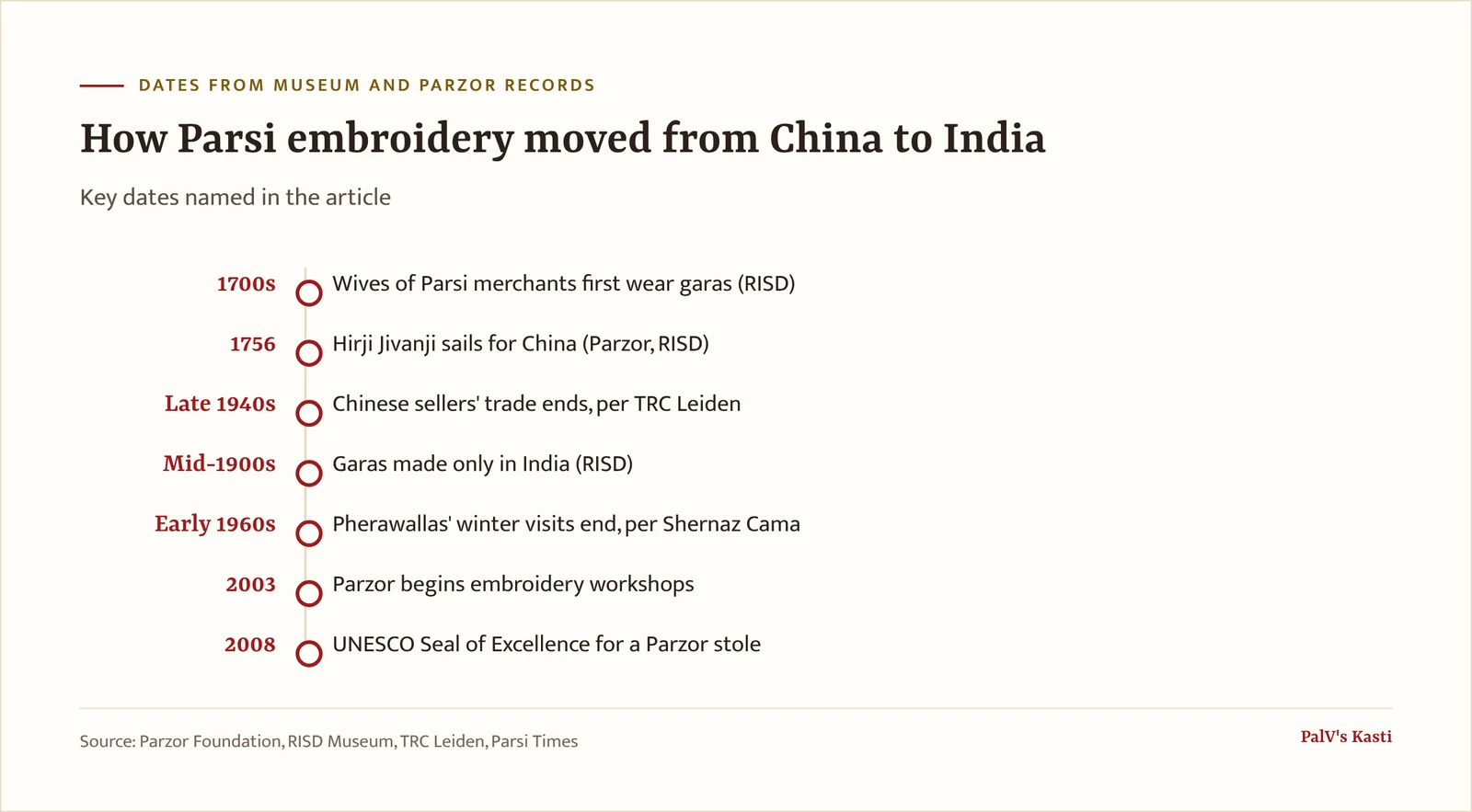
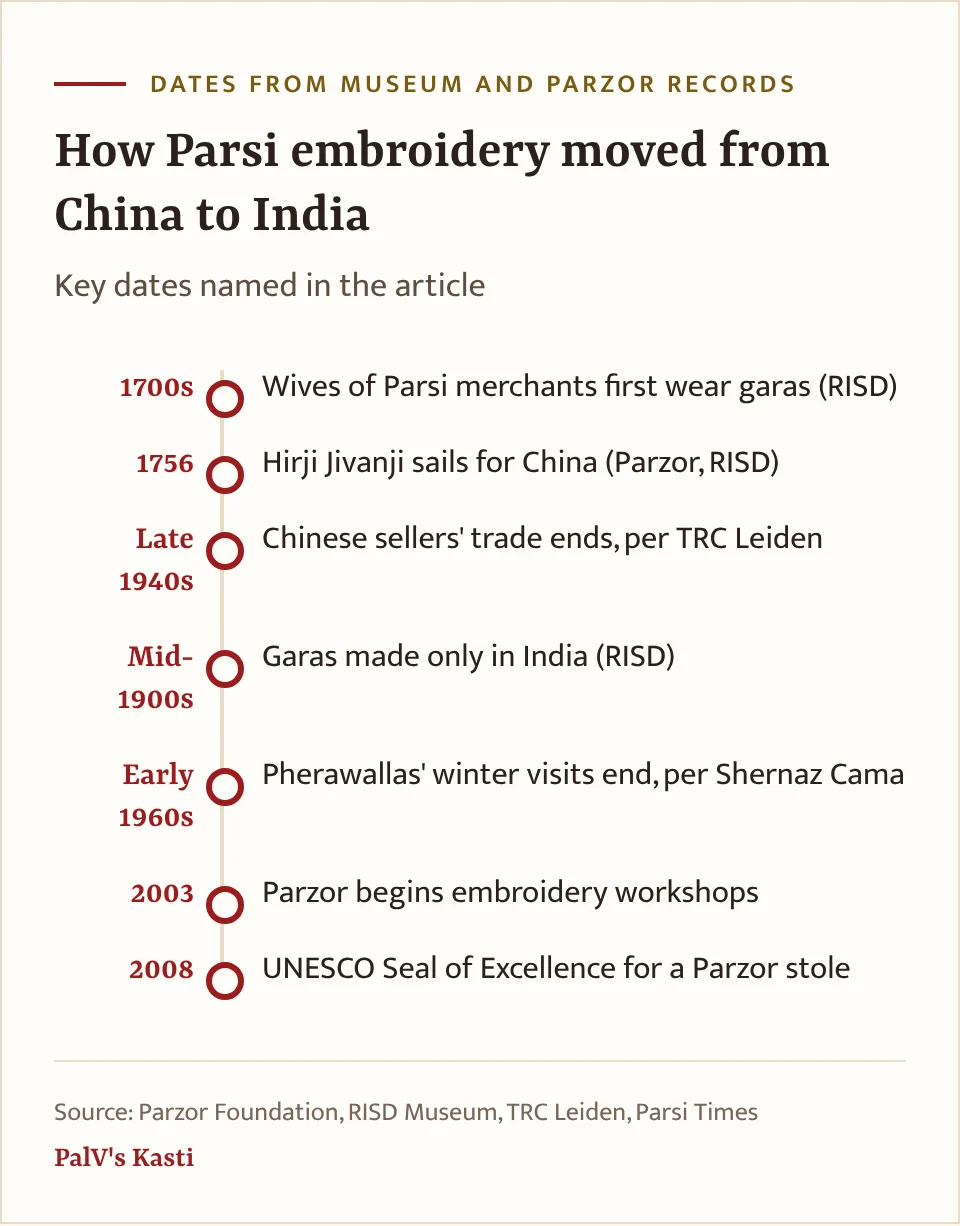
According to RISD, early garas were embroidered in China. Parsi women then began "commissioning local Indian embroiderers" to copy the Chinese silks their husbands brought home, and by the mid-1900s garas were made only in India, still with Chinese motifs. The V&A adds that Chinese embroiderers also settled in Surat, and calls Surat "an important source of embroidery for the Parsi community". RISD dates the first garas, worn by the wives of Parsi merchants, to "starting in the 1700s".
The sources don't agree on when the Chinese sellers stopped coming. TRC says the trade ended in the late 1940s and early 1950s, when China closed its borders. Shernaz Cama of Parzor, writing in Parsi Times in 2020, says Chinese "Pherawallas" kept visiting Parsi homes each winter until the early 1960s. The full story is in the Chinese roots of Parsi embroidery.
What are the main forms of Parsi embroidery?
Parzor names four: kors, garas, jhablas and ijars. Children's caps (topis) were embroidered too.
| Form | What it is | Usually worn by |
|---|---|---|
| Gara | A sari embroidered across its body, framed by borders | Women |
| Kor | An embroidered border, often made separately and sewn on | Sewn onto women's saris |
| Jhabla | A loose tunic, sometimes embroidered before it was cut and sewn | Children |
| Ijar | Loose trousers with an embroidered border at the hem | Children, and women under gara saris |
| Topi | A round cap, sometimes with zari work | Children |
What is a Parsi gara?
A gara is a sari embroidered across its body, not only at the edges. The RISD Museum explains that the word "originates from the Gujarati word garo, meaning a width of cloth". In the gara's early form, Cama writes, the embroidered yardage was edged on all four sides "as if bordered within a frame". Parzor likewise describes the gara as yardage "bound in a frame" by a kor on four sides.
TRC records that complete chiffon, gauze or satin saris embroidered in China were called gara. Writing in Harper's Bazaar India in June 2025, Ashdeen Lilaowala points out that the name Parsi Gara became "associated exclusively with the sari", even though the same embroidery decorated ijars, jhablas, flat sapat shoes, potlis and home furnishings. For the gara's features, see what a Parsi gara saree is.
What is a kor?
A kor is an embroidered border. TRC describes kor as bands "used for sewing on garments, especially saris". On a purple chiffon sari of the 1930s, the V&A identifies the finely embroidered border with birds as the "core".
Kors were often made on their own. Describing Parsi saris, the V&A notes that the edging was frequently applied separately, with "yards of satin ribbon being embroidered by Chinese artisans" for the purpose. Parzor adds: "Along with full garas, stand alone 'kors' became popular."
Because a kor was separate, it could be moved. A sari border in the V&A's Feroza Jamsheed Marker collection was cut from a red damask sari, and its owner used part of it to make the pallu (decorative end) of another sari. Borders get their own article: kor, the embroidered sari border.
What is a jhabla?
A jhabla (also written jubla or jhabalu) is a loose embroidered tunic for children. The V&A says jublas "were worn by Parsi children", and that young girls wore them with loose trousers and a round embroidered cap.
Many jhablas were embroidered before anyone cut or sewed them. The V&A holds a magenta child's jubla from about 1867 that is still "untailored (not sewn along sides and collar not cut out)". The RISD Museum notes that Chinese workshops later made "uncut embroidered panels" that could be tailored once they reached home. In the Deccan, according to Parzor, zari work "began appearing on Parsi Jhablas and childrens' prayer caps or topis".
What is an ijar?
An ijar is a pair of "loose trousers or pyjamas", which a record in Singapore's national collection calls "a basic element of traditional Parsi clothing". The same record says young Parsi boys and girls usually wore ijar with a tunic or jhabla, and that women could also wear them under gara saris.
The embroidery sits at the hem. A companion record describes "loose trousers with embroidery at the bottom". One unstitched ijar cloth in that collection, dated to the late 19th century, carries an embroidered border and "a Chinese stamp for export". The V&A has a Parsi child's pair from Surat, about 1855, in red silk with silver-wrapped thread. Jhablas and ijars are covered in depth in jhablas and ijars.
What motifs does Parsi embroidery use?
TRC lists flowers, leaves, birds, animals, people in Chinese dress and bridges spanning water among the common designs. Parzor says Parsi women preferred roosters and fish to the "dragons and snakes popular in Chinese tradition". And the RISD Museum notes that the Chinese phoenix "was embraced by Parsis as Simurgh, the auspicious Persian mythical creature". What each design means is covered in gara embroidery designs and motifs.
Who made Parsi embroidery?
Chinese embroiderers made the early pieces, in China and also in Surat. Indian embroiderers took over when Parsi women commissioned copies.
Parsi women embroidered as well. Parzor credits Chinese pedlars (pherias) with a role "in familiarizing Parsi women with Chinese embroidery". Ashdeen Lilaowala's earliest memory of the craft is his mother's black gara, "a family heirloom embroidered by my father's grandmother". The stitches and tools are explained in how Parsi embroidery is done, and the families, merchants and museums behind the surviving pieces in patrons and collectors of Parsi embroidery.
Is Parsi embroidery still made today?
Yes. Parzor says it has held workshops "at Ahmedabad, Mumbai, Navsari and Delhi", beginning in 2003, and that UNESCO chose one of its hand-embroidered stoles for the Seal of Excellence Award for 2008. Lilaowala, a graduate of the National Institute of Design, Ahmedabad, wrote in June 2025 that his label's mission is to "push the Parsi Gara in new directions".
Frequently asked questions
What is Parsi embroidery?
Parsi embroidery is the hand embroidery of the Parsi Zoroastrians of western India, usually silk thread on silk, showing flowers, birds and small scenes. The Parzor Foundation describes it as a blend of Iranian, Indian, Chinese and European design. It is worked on garas (saris), kors (borders), jhablas (children's tunics) and ijars (loose trousers).
Which Indian state is Parsi gara embroidery from?
The craft began in China, where the earliest garas were embroidered for Parsi merchant families. In India, the V&A records Surat in Gujarat as an important source of embroidery for the Parsi community, and notes that Chinese embroiderers settled there. By the mid-1900s, garas were made only in India.
What is the difference between a gara and a kor?
A gara is a whole sari embroidered across its body and framed by borders on all four sides. A kor is only the embroidered border. Kors were often made separately, sometimes as yards of embroidered satin ribbon, and sewn onto a sari. Parzor notes that stand-alone kors became popular alongside full garas.
What is a jhabla worn with?
A jhabla is a loose embroidered tunic for Parsi children. The V&A says young girls wore it with loose trousers and a round embroidered cap. A record in Singapore's national collection names those trousers as the ijar, which young Parsi boys and girls usually wore with a jhabla, with embroidery at the hem.
Is Parsi embroidery Chinese or Indian?
It is both, in sequence. Parsi traders brought embroidered silks from China, where the early garas were made. Parsi women then had Indian embroiderers copy them, and by the mid-1900s garas were made only in India. Parzor describes the result as a blend of Iranian, Indian, Chinese and European design traditions.