PalV's Kasti
On this page
- Who commissioned the first Parsi embroideries?
- Who set the fashion for the gara?
- Who wore Parsi embroidery, and for what?
- How did Parsi families keep their embroidery?
- Who gave Parsi embroidery to museums?
- Who collects and documents Parsi embroidery today?
- Who are the new patrons of Parsi embroidery?
- Frequently asked questions
Parsi embroidery was first commissioned by Parsi merchants in the China trade, who had pieces made to order in China for their families in India. Their wives wore the first garas and set the fashion, and Parsi women went on to commission Indian embroiderers to copy the Chinese silks, according to the RISD Museum. Children wore embroidered jhablas with ijars. Families kept the pieces as heirlooms. Outside the community, museum buyers and donors preserved what survived: a child's tunic bought for the Great Exhibition of 1851, a tunic given by Queen Mary and the Feroza Jamsheed Marker collection of Parsi clothing are all at the V&A in London. Today the Parzor Foundation documents family collections, and the designer Ashdeen Lilaowala both collects old garas and makes new ones.
શહેરેવર રોજ
Shehrevar Roj, Tir Mah · 1396 Y.Z.
Who commissioned the first Parsi embroideries?
Parsi merchants trading with China. Parzor names Hirji Jivanji as "the first Parsi to sail for China", in 1756. The V&A records that Parsi-owned shipping companies traded with China and that merchants brought back prized embroidered textiles (chinai) "and would take out orders from India".
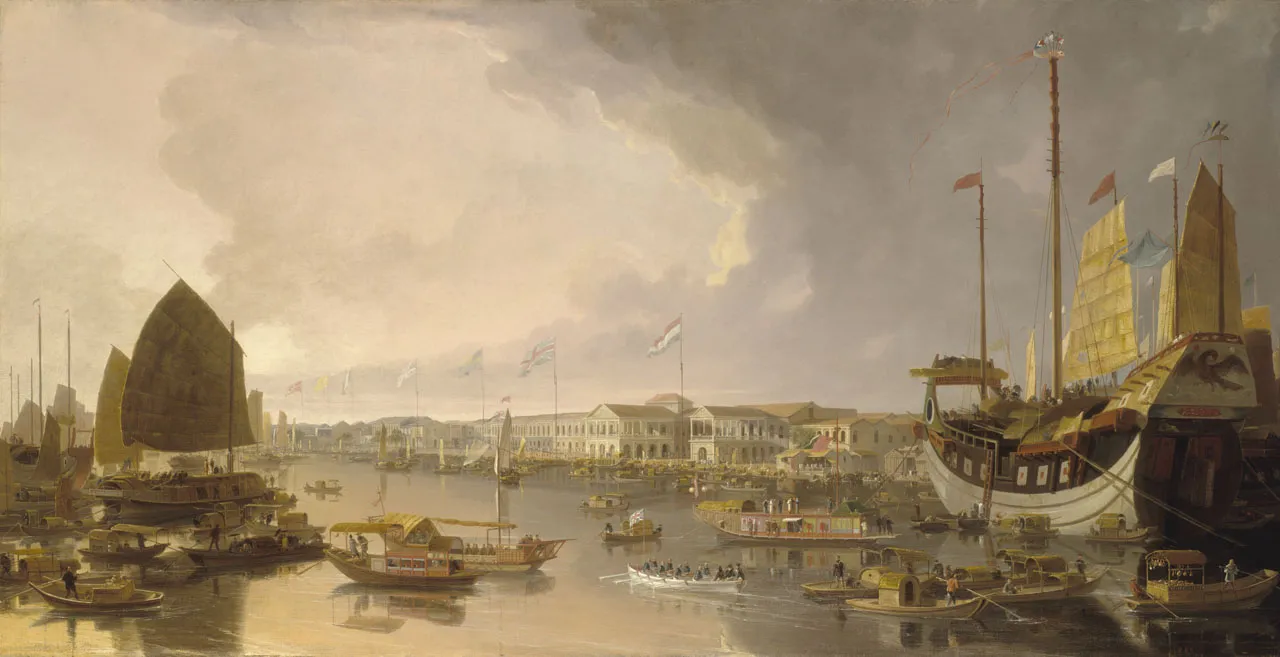
Parzor shows one such order: the 19th-century Fish Gara, "an engagement sari made to order in China by Parsi merchants" who dealt in opium, tea and textiles. Parzor also repeats a legend of a Canton trader who asked craftsmen to embroider six yards of silk as a sari for his wife in India. It's told as a legend, and we pass it on as one.
Chinese sellers also came to the customer. The Textile Research Centre in Leiden records that tunics, saris and sari borders made in China were brought to Bombay by itinerant Chinese traders and sold to Parsi women in their homes. Writing in Parsi Times in 2020, Shernaz Cama of Parzor said elders across Gujarat remember Chinese men on bicycles who "sold garas by the weight". How this trade began is covered in the Chinese roots of Parsi embroidery.
Who set the fashion for the gara?
The wives of Parsi merchants. The RISD Museum says gara refers to the saris that the wives of Parsi merchants first wore, "starting in the 1700s", and that the wives of wealthy Parsi opium merchants "were respected as tastemakers".
These women became patrons in their own right. According to RISD, Parsi women began "commissioning local Indian embroiderers" to copy the Chinese silks their husbands brought back. The work those embroiderers did is explained in how Parsi embroidery is done, and the Persian, Indian and Chinese strands that met in it are traced in Parsi embroidery as an intercultural mix.
Parzor's archive puts names and faces to the wearers. It shows a portrait of Lady Bachubai Vakil of Ahmedabad, captioned 1888, in an embroidered velvet kor gara, and a portrait of Jerbanoo Kanga of Nagpur, captioned 1923, in a Parsi gara. It also records that Mrs Bhicoo Manekshaw of Delhi owned a late 19th-century gara, made for a family engagement.
Who wore Parsi embroidery, and for what?
Women, girls and boys all wore it. The occasions differ by source and by garment.
| Wearer | What they wore | Occasion or note | Recorded by |
|---|---|---|---|
| Brides | Red silk saris with white Chinese embroidery | The wedding festival, but apparently not the wedding ceremony itself | Textile Research Centre, Leiden |
| Families at an engagement | Garas such as the Fish Gara and the Manekshaw gara | Engagements | Parzor Foundation |
| Children | A richly embroidered jhabla (tunic) with ijar (trousers) | The Navjote | Indian Heritage Centre, Singapore |
| Young girls | Jubla with loose trousers and a round embroidered cap | Occasion not stated | V&A |
| Women | Ijar under the gara sari | Occasion not stated | Indian Heritage Centre, Singapore |
| Widows | Tie-dyed lahi silk sari with an embroidered border | Widowhood | V&A |
On the widow's sari, the V&A notes that saris of tie-dyed lahi silk "were worn by Parsi widows", and that the border on its example recalls embroidery made for the Parsi market by Chinese craftsmen in Surat in the 19th century.
Wearers also reworked what they owned. A border in the Feroza Jamsheed Marker collection was cut from a red damask silk sari, and its owner used part of it to make the pallu (decorative end) of another sari. The V&A also holds a chakla (hanging or cover) from Gujarat, dated 1850 to 1900, made of embroidered Parsi sari borders stitched together.
Practice varies between families and Agiaries; your family priest's guidance comes first.
How did Parsi families keep their embroidery?
As heirlooms. The RISD Museum calls garas "the most precious of heirlooms" in Parsi families, handed down through generations of women. Ashdeen Lilaowala, writing in Harper's Bazaar India in June 2025, said his earliest memory of the craft is his mother's black gara, "a family heirloom embroidered by my father's grandmother".
Much was lost all the same. Cama wrote that the large embroidery cupboards neither fitted into Bombay flats nor could be carried when Parsis migrated abroad, and that what remained were "the garas, jhablas, ijars". Looking after inherited pieces is covered in the gara as a family heirloom.
Who gave Parsi embroidery to museums?
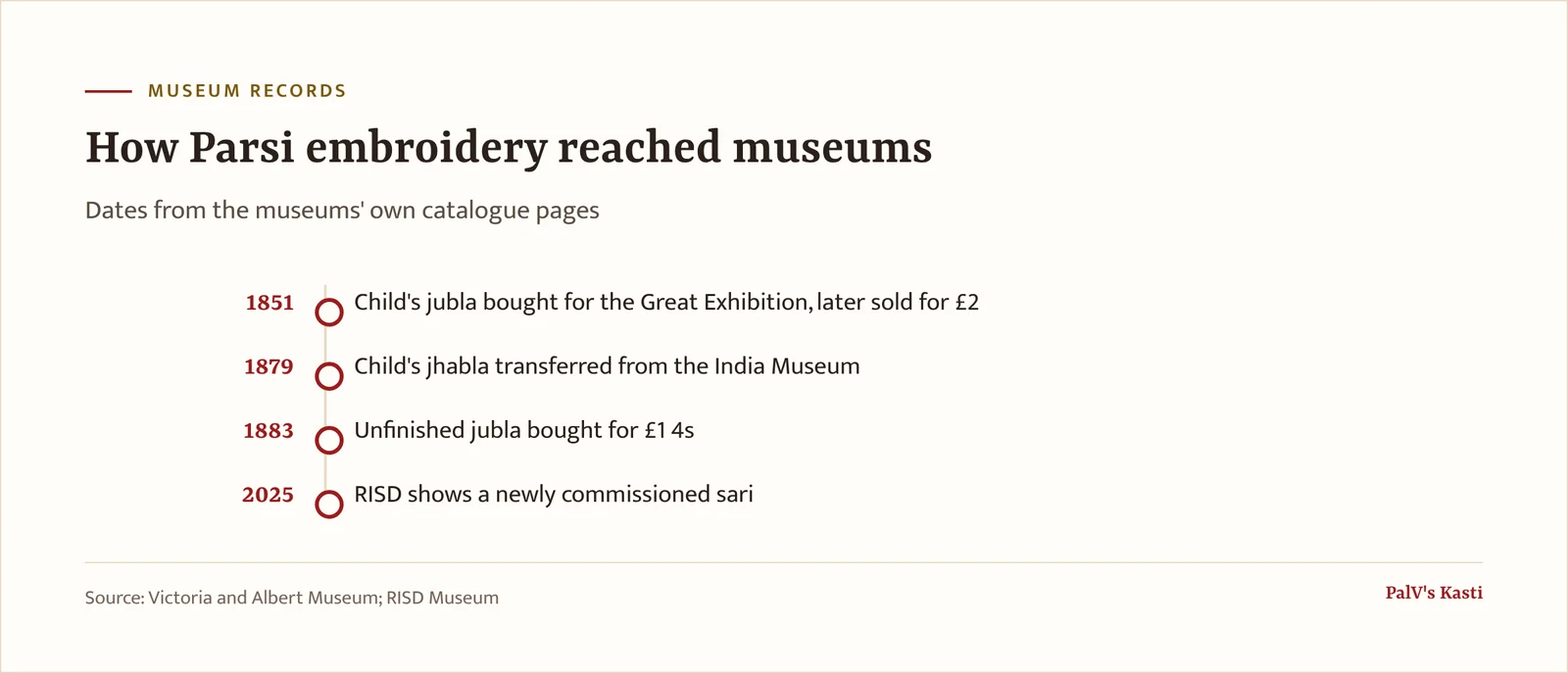
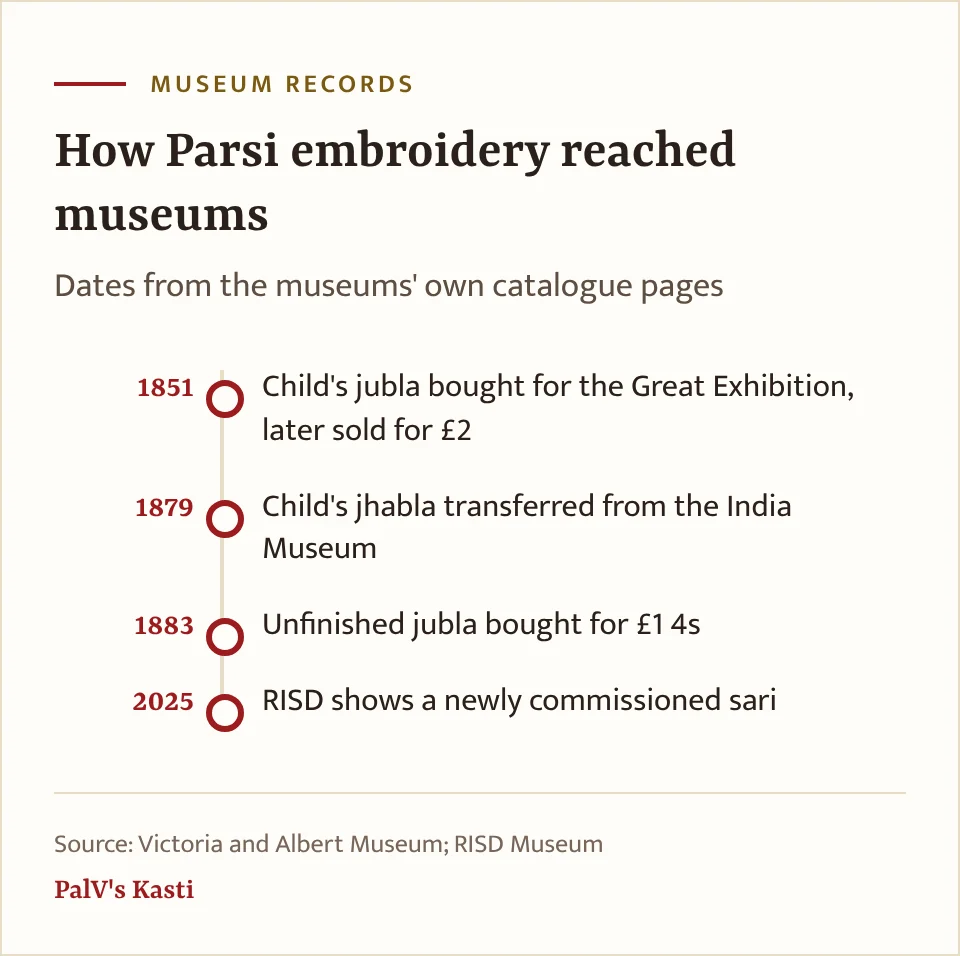
Museum records name the people and routes that carried Parsi pieces into public collections. The table lists the donors and routes we confirmed on the museums' own catalogue pages.
| Donor or route | Object | Museum and number |
|---|---|---|
| Bought by the East India Company for the Great Exhibition of 1851, then sold to the Museum of Manufactures for £2 | Child's jubla, Surat | V&A 800-1852 |
| Transferred from the India Museum in 1879 | Child's jhabla, Surat | V&A 9645(IS) |
| Bought in 1883 for £1 4s | Unfinished jubla, "Used by the Parsees of Bombay" | V&A IS.2050-1883 |
| Bequeathed by Miss M. B. Hudson | Black silk gauze sari made in China for the Parsi community | V&A T.271-1922 |
| Given by Queen Mary | Lady's tunic made in China | V&A T.87-1925 |
| Given by Mrs M. Mylne | Black silk sari with embroidered borders, Surat | V&A IS.261-1953 |
| Given by Sir Harold E. Satow | Black silk gauze sari made in China, 1900 to 1950 | V&A T.24-1967 |
| The Feroza Jamsheed Marker collection of Parsi clothing | A jubla, a topi, saris, a sari border, trousers | V&A, numbers we checked run from IS.11-2004 to IS.31-2004 |
| Bequest of Isaac C. Bates | Jhabla made in China, about 1875 to 1910 | RISD Museum 13.2311 |
| Gift from the Estate of Miss Lucy T. Aldrich | Sari border, about 1875 to 1900 | RISD Museum 56.075.1 |
Queen Mary's tunic shows how stories attach to such pieces. The V&A records that Imre Schwaiger gave it to her, saying it came from "the Summer Palace" near Beijing and that he had found it in India in 1923. Another archive note says it was made for the "Parsees of Bombay", and the V&A calls the Summer Palace story "certainly very unlikely".
The Marker collection reads like one family's wardrobe across decades. It runs from a late 19th-century black silk jubla with Chinese scenes and a purple silk ghara length, probably made in China about 1900, to a 1960s sari made from silk printed by Ascher Ltd of London. For where Parsi pieces can be seen today, see the global gara.
Who collects and documents Parsi embroidery today?
The Parzor Foundation leads the documentation. Its own site says its craft documentation programme "has also continued across India for two decades now". Lilaowala wrote in 2025 that he documented the gara with UNESCO Parzor, travelling through India, China and Iran. In her 2020 Parsi Times article, Cama asked families to tell Parzor about embroidered pieces they no longer wanted to keep, so they could go to its resource centre and archive.
Private owners appear in Parzor's credits too. Parzor records a rare gara from Japan, with chrysanthemums on black, "in the collection of late Khorshed Sethna, nee Vakil of Ahmedabad", and credits the Fish Gara image to Zenobia Pestonjamasp. Parzor's story is based on an essay, "The Embroidery Cupboard", published in 2010 in Peonies & Pagodas, a book on embroidered Parsi textiles in the TAPI Collection.
Lilaowala collects as well as designs. The Nod Mag reported on 30 September 2026 that the Parsi garas in "Coming Home", an exhibition on the Chettiar, Parsi and Peranakan communities at MS House, Karaikudi, curated by Aayushi Jain of The Registry of Sarees, "came from the personal collection of designer Ashdeen Lilaowala". One was a burgundy gara with five Chinese soldiers and, in a corner, the Chinese manufacturer's stamp.
Who are the new patrons of Parsi embroidery?
Museums now commission it. The RISD Museum commissioned a new sari from Lilaowala's studio and the artist Bhasha Chakrabarti, made between 2023 and 2025. It was shown in the exhibition The Flower, The Labor, and The Sea, which ran from 27 September 2025 to 28 June 2026. Chakrabarti told Harper's Bazaar India that once the sari entered a museum, "it would never be worn again".
Wearers have changed too. Cama wrote in 2020 that Lilaowala's design house "has introduced this genre to celebrities like Oprah Winfrey". Lilaowala also names Priyanka Chopra Jonas and Madhuri Dixit Nene among those who have worn it, and notes that Natasha Poonawalla wore a Manish Malhotra ensemble at the 2025 Met Gala "crafted from two vintage Parsi Gara saris". The people keeping the craft alive are profiled in reviving gara embroidery. The craft itself is introduced in our guide to Parsi embroidery, and the sari it decorates in our guide to the Parsi gara saree.
Frequently asked questions
Who commissioned the first Parsi garas?
Parsi merchants trading with China. The V&A records that they brought back embroidered textiles and placed orders from India, and Parzor describes a 19th-century engagement sari made to order in China by Parsi merchants. Their wives, who first wore garas from the 1700s according to the RISD Museum, later commissioned Indian embroiderers to copy them.
Which museums hold Parsi embroidery?
The Victoria and Albert Museum in London holds children's tunics, saris and borders, including a piece bought for the 1851 Great Exhibition and the Feroza Jamsheed Marker collection. The RISD Museum in Providence holds a jhabla and a sari border. The Indian Heritage Centre in Singapore holds a jhabla and an ijar cloth.
What is the Feroza Jamsheed Marker collection?
It is a group of Parsi clothing at the Victoria and Albert Museum, catalogued under that credit line with numbers from IS.11-2004 to IS.31-2004. It includes a girl's jubla, a topi, embroidered saris and a border, red silk trousers with cockerels, and a 1960s sari made from silk printed by Ascher Ltd of London.
Did Queen Mary own Parsi embroidery?
Yes. The V&A holds a lady's tunic, made in China and embroidered with a Chinese landscape, that Queen Mary gave to the museum. Imre Schwaiger had given it to her, saying it came from the Summer Palace near Beijing. The V&A calls that story very unlikely, and an archive note says it was made for Bombay Parsis.
Who wears Parsi garas today?
Parsi families still hand down garas as heirlooms, the RISD Museum notes. New wearers have come through designers. Shernaz Cama wrote in 2020 that Ashdeen Lilaowala's design house introduced the craft to Oprah Winfrey, and Lilaowala notes that Natasha Poonawalla wore a Met Gala ensemble by Manish Malhotra made from two vintage Parsi garas.
Can I share my family's old Parsi embroidery with researchers?
The Parzor Foundation has asked for this. In 2020 Shernaz Cama invited families to tell Parzor about embroidered pieces they no longer wished to keep, for its resource centre and archive. Parzor says its craft documentation has run across India for two decades, and its researchers have recorded Parsi crafts from China to India.