PalV's Kasti

On this page
- What are the named units of the Parsi calendar?
- What are the 30 Roj names?
- What are the 12 Mah names in the Parsi calendar?
- What happens when a Roj and a Mah share a name?
- What are the five Gatha days called?
- What are the five Gehs of the day?
- What are the six Gahambars called?
- Where can I read about each set of names?
- Frequently asked questions
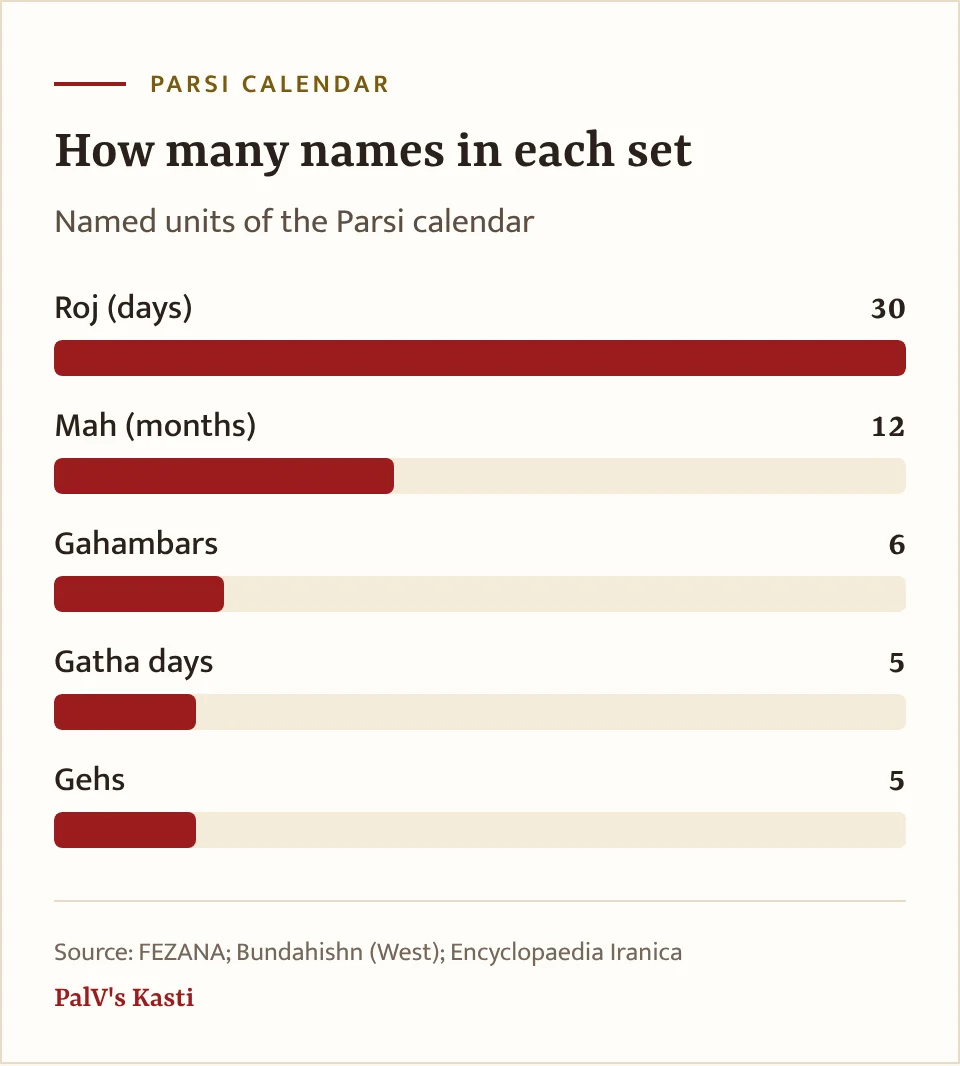
Every Parsi calendar name stands for a divinity, a hymn, a time of day or a season. Each of the 30 days of a month, the Roj, carries the name of a yazata, and FEZANA's calendar lesson plan puts it simply: the 30 days or Roj represent 30 Yazatas. The 12 months, the Mah, are named after twelve of those same thirty. Twelve months of thirty days make 360 days, and five Gatha days, named after Zarathushtra's five Gathas, bring the year to 365. Inside each day sit five Gehs, the watches of prayer. Across the year fall six seasonal feasts, the Gahambars. That's five sets of names, and this page puts all of them in one place, each with the text it comes from and a link to the article in this series that goes deeper.
શહેરેવર રોજ
Shehrevar Roj, Tir Mah · 1396 Y.Z.
What are the named units of the Parsi calendar?
There are five sets of names in the Parsi calendar. FEZANA's lesson plan uses "Roj" for the 30 days and "Mah" for the 12 months, and writes a matching pair as, for example, "Adar roj, Adar mah".

| Unit | How many | Named after | Where the names are recorded |
|---|---|---|---|
| Roj (day) | 30 in every month | A divinity (yazata) for each day | The Sirozah, in two versions |
| Mah (month) | 12 in a year | Twelve of the same thirty divinities | Bundahishn, chapter 25, lists them by season |
| Gatha days | 5 at the end of the year | The five Gathas of Zarathushtra | Rapithwin Gah, verse 5, names the five Gathas |
| Geh (watch of the day) | 5 in a day | Times of the day | The five Gah prayers of the Khordeh Avesta |
| Gahambar | 6 in a year | Seasons of the pastoral and farming year | The Āfrīnagān ī Gāhānbār, recited at the six festivals |
The day names are older than the month names. Mary Boyce writes in the Encyclopaedia Iranica that a specifically Zoroastrian calendar came about when each of the month's thirty days was given to a yazata. The month dedications, she adds, "were probably made later in the Achaemenid period". Antonio Panaino, writing in the same encyclopaedia, gives the evidence: Avestan sources name all thirty days, but only seven of the twelve months.
What are the 30 Roj names?
The 30 Roj names, in order, follow the thirty sections of the Sirozah, the prayer that invokes the divinity of each day in turn. The middle column below follows James Darmesteter's translation of Sirozah 1 (Sacred Books of the East, American edition, 1898), as published on avesta.org. The Parsi spellings in the second column are the ones FEZANA's lesson plan uses.
| Roj | Name | Divinity invoked in Sirozah 1 |
|---|---|---|
| 1 | Hormazd | Ahura Mazda |
| 2 | Bahman | Vohu-Mano |
| 3 | Ardibehsht | Asha-Vahishta |
| 4 | Shehrevar | Khshathra-vairya |
| 5 | Asfandarmad | Spenta-Armaiti |
| 6 | Khordad | Haurvatat |
| 7 | Amardad | Ameretat |
| 8 | Dae pa Adar | The Maker, Ahura Mazda, with the Amesha-Spentas |
| 9 | Adar | Atar |
| 10 | Ava | The good Waters and Ardvi Anahita |
| 11 | Khorshed | The Sun |
| 12 | Mohor | The Moon and the Bull |
| 13 | Tir | Tistrya |
| 14 | Gosh | The Cow, body and soul, and Drvaspa |
| 15 | Dae pa Mehr | The Maker, Ahura Mazda, with the Amesha-Spentas |
| 16 | Mehr | Mithra |
| 17 | Sarosh | Sraosha |
| 18 | Rashne | Rashnu Razishta and Arstat |
| 19 | Fravadin | The Fravashis of the holy ones |
| 20 | Behram | Strength and Verethraghna |
| 21 | Ram | Rama Hvastra and Vayu |
| 22 | Govad | The Wind |
| 23 | Dae pa Din | The Maker, Ahura Mazda, with the Amesha-Spentas |
| 24 | Din | Chista and the good Law |
| 25 | Ashishvangh | Ashi Vanguhi |
| 26 | Ashtad | Arstat |
| 27 | Asman | The Heavens |
| 28 | Zamyad | The Earth |
| 29 | Mahrespand | Mathra Spenta |
| 30 | Aneran | The eternal and sovereign luminous space |
Ahura Mazda is named four times. Roj 1 is his. Sections 8, 15 and 23 of the Sirozah, headed Dai-pa-Adar, Dai-pa-Mihr and Dai-pa-Den on avesta.org, each open with "To the Maker". Boyce explains that these three days were rededicated to the Creator (Dadvah) Ahura Mazda. Look down the table and you'll notice that every Dae pa day borrows the name of the day after it: Adar on Roj 9, Mehr on Roj 16, Din on Roj 24.
There are two Sirozahs, and avesta.org carries both in Darmesteter's translation. Sirozah 1 addresses each divinity in a short formula ("To Ahura Mazda, bright and glorious"). Sirozah 2 opens each section with "We sacrifice unto" and gives longer epithets.
What each name means is covered in the thirty Roj names and their meanings. How the days fall into groups under Ahura Mazda and the Amesha Spentas is explained in how the 30 Roj names are grouped, and the Avestan, Pahlavi and Gujarati forms are compared in Roj names in Avestan, Pahlavi and Gujarati.
What are the 12 Mah names in the Parsi calendar?
The 12 Mah names, in FEZANA's spelling, run from Fravadin to Aspandarmad. The Pahlavi Bundahishn, in E. W. West's translation, lists the same months in the same order, three to a season.
| Mah | Name (FEZANA) | Name in the Bundahishn (West) |
|---|---|---|
| 1 | Fravadin | Frawardin |
| 2 | Ardibehesht | Ardwahisht |
| 3 | Khordad | Hordad |
| 4 | Tir | Tishtar |
| 5 | Amardad | Amurdad |
| 6 | Shehrevar | Shahrewar |
| 7 | Meher | Mihr |
| 8 | Avan | Aban |
| 9 | Adar | Adar |
| 10 | Dae | Din |
| 11 | Bahman | Vohuman |
| 12 | Aspandarmad | Spandarmad |
One difference is worth flagging. West's translation, as printed on avesta.org, gives the tenth month as "Din", where FEZANA and Parsi calendars write Dae. Boyce calls the same month Dadvah, Middle Persian Dai.
For month-by-month detail, including what each name means, which divinity presides over it and which season it falls in, see the twelve Parsi months (Mah).
What happens when a Roj and a Mah share a name?
When the day's name and the month's name match, the day becomes a feast of that divinity. Boyce puts the rule this way: "whenever a day- and month-name had the same dedication", that day was celebrated as a festival for the yazata. FEZANA's lesson plan gives the Parsi word: when the day and month coincide, it is known as a Parabh. Its examples include Tirgan (Tir Roj in Tir Mah) and Mehergan (Meher Roj in Meher Mah).
Ahura Mazda's month gets more than one. Four days of every month are his, so Boyce writes that there were "four festivals for Ahura Mazdā" in the month Dadvah, which she glosses as Middle Persian Dai.
Practice varies between families and Agiaries; your family priest's guidance comes first.
How the Roj and Mah are written together as a date is explained in what a Roj date is. To see today's Roj and Mah, use our Parsi Roj calendar.
What are the five Gatha days called?
The five Gatha days come after the twelfth month, at the very end of the year. FEZANA describes 5 additional days "known as the Gathas", added to the 12th month to make a 365-day year. The Bundahishn calls this season the five supplementary days at the end of the month Spandarmad.
Each day is named after one of the five Gathas, the hymns of Zarathushtra. Panaino writes that the five epact days were named after the five Gathas, and Boyce says priestly authorities gave each of these days to one of Zoroaster's Gathas.
The Rapithwin Gah, verse 5, in Darmesteter's Khordeh Avesta translation, worships the five Gathas by name: the Ahunawad, the Ushtawad, the Spentomad, the Wohukhshathra and the Wahishtoisht. The first of them, the Ahunavaiti, fills Yasna chapters 28 to 34. Those are Darmesteter's spellings. Parsi calendars print their own forms, and we haven't been able to check those against a source, so we've left them out.
The Gatha days have their own article: the five Gatha days.
What are the five Gehs of the day?
The five Gehs are Hawan, Rapithwin, Uzerin, Aiwisruthrem and Ushahin, each with its own Gah prayer in the Khordeh Avesta. The word itself is simple. Boyce defines gāh as a word in Middle Persian, Parthian and New Persian that means "place" or "time". It came to be used for each of the day's five divisions, which have no recorded Avestan name.

Each Geh is bounded by the sun and the sky, not by the clock. Boyce traces the older pattern of prayers at sunrise, noon and sunset, to which Zoroaster added midnight and dawn. The Bundahishn marks the periods by daybreak, midday, afternoon, the appearance of the stars and midnight. Because sunrise and sunset move through the year and from one city to another, the clock time of each Geh moves too. That's why we don't print fixed times on this page.
Even the number of Gehs changes. The Bundahishn says there are five periods in the seven months of summer, "since one celebrates the Rapithwin", but that in winter there are only four, because from daybreak till Uzerin is all Hawan.
Practice varies between families and Agiaries; your family priest's guidance comes first.
The Rapithwin season is the subject of Rapithwin Geh, and each watch is laid out in the five Gehs.
What are the six Gahambars called?
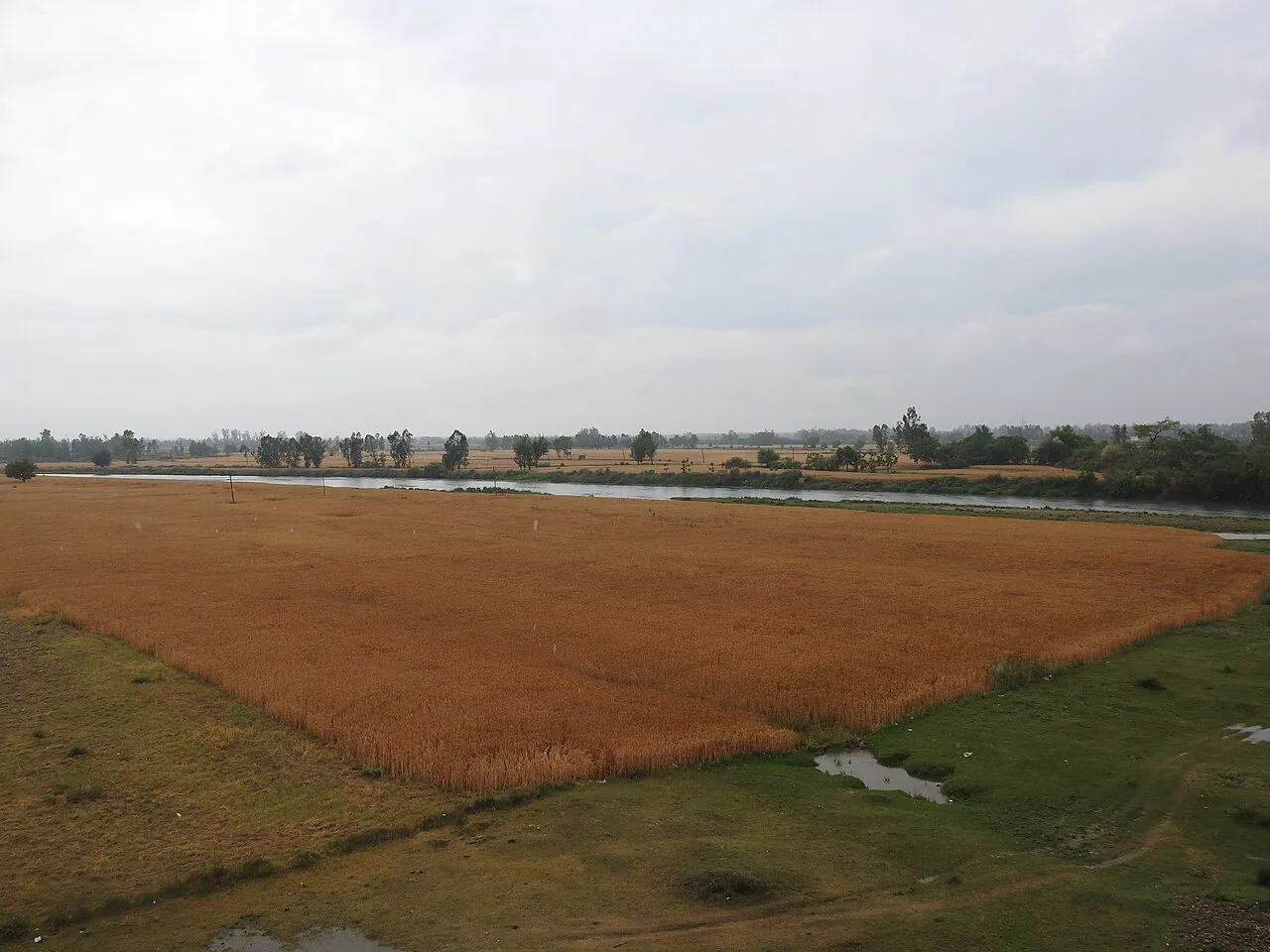
The six Gahambars are the seasonal feasts of the Zoroastrian year. Boyce defines the gāhānbār as the Middle Persian term for the feasts that close each of the year's six seasons, and says their Young Avestan names mark them as "pastoral and farming festivals" in origin. The table gives Boyce's Avestan names and literal senses, FEZANA's spellings (FEZANA prints each with a "-gah" ending) and the creation each feast came to honour.
| No. | Avestan name (Boyce) | Literal sense (Boyce) | FEZANA spelling | Creation honoured |
|---|---|---|---|---|
| 1 | Maiδyōi.zarəmaya | Midspring, "midgreening" | Maidyozarem | Sky |
| 2 | Maiδyōi.šam | Midsummer | Maidyoshahem | Water |
| 3 | Paitiš.hahya | Bringing in the corn | Paitishahem | Earth |
| 4 | Ayāθrima | Homecoming | Ayathrem | Plants |
| 5 | Maiδyāirya | Midyear | Maidyarem | Animals |
| 6 | Hamaspaθmaēδaya | No generally accepted meaning (Boyce) | Hamaspathmaidyem | Humans |
The link with creation is old. The Bundahishn opens its chapter on the religious calendar with a line from revelation, that the creatures of the world were made complete in 365 days, and reads it as the six periods of the Gahambars completed in a year. Boyce gives the same sequence, from the sky in the first feast to mankind in the sixth.
How long each lasts has changed. Boyce writes that "originally all the seven feasts were evidently one-day observances" (she counts Navroz with the six), and that the later Sad dar-e Bondaheš gives them as lasting five days. FEZANA's lesson plan also says each Gahambar traditionally spans five days. On the word itself, FEZANA notes that some derive Gahanbar from gah-anbar, meaning "time-gathering".
Practice varies between families and Agiaries; your family priest's guidance comes first.
The feasts themselves, and how they're kept, are covered in our article on the Gahambar.
Where can I read about each set of names?
Each set of names has its own page in this series:
- The twelve Parsi months (Mah): names, meanings and presiding divinities.
- The thirty Roj names and their meanings.
- How the 30 Roj names are grouped, with the Ahura Mazda days and the Amesha Spenta days.
- Roj names in Avestan, Pahlavi and Gujarati: how the names changed form.
- What a Roj date is, and how the Parsi day and month are written.
- A reflection for each Roj: the virtue linked with each day's divinity.
For the calendar as a whole, start with the Zoroastrian calendar.
Frequently asked questions
How many named days does a Parsi year have?
A Parsi year has 365 named days. The 30 Roj names repeat in each of the 12 months, which gives 360 days. Five Gatha days, each named after one of Zarathushtra's five Gathas, are added to the twelfth month and close the year. FEZANA's lesson plan sets out the sum as 30 days times 12 months, plus five.
What are the five Gatha days called?
The five Gatha days take their names from the five Gathas of Zarathushtra. In Darmesteter's translation of the Rapithwin Gah, the Gathas are the Ahunawad, Ushtawad, Spentomad, Wohukhshathra and Wahishtoisht. Antonio Panaino, in the Encyclopaedia Iranica, confirms that the five extra days of the year took their names from these hymns.
Why does Ahura Mazda have four days in every month?
Ahura Mazda has four days in every month because Roj 1, Hormazd, is his, and so are Roj 8, 15 and 23, the three Dae pa days. In Darmesteter's Sirozah translation each of those three opens "To the Maker". Mary Boyce writes that his month, Dadvah or Dai, therefore held four festivals for him.
What is a Parabh?
A Parabh is the day on which a month's own Roj comes round, so day and month share a name. FEZANA's lesson plan gives examples such as Tirgan, Tir Roj in Tir Mah. Mary Boyce writes that such a day was celebrated as a festival of the divinity both are named after, as with Mithra's day in Mithra's month.
What does Geh mean?
Geh, or Gah, is the name for each of the five watches of the Zoroastrian day: Hawan, Rapithwin, Uzerin, Aiwisruthrem and Ushahin. Mary Boyce explains in the Encyclopaedia Iranica that gāh is a Middle Persian, Parthian and New Persian word meaning "place" or "time", and that no Avestan term is recorded for these divisions.