PalV's Kasti
On this page
- What are the names of the five Gatha days?
- Where do the Gatha days fall in the Zoroastrian year?
- Is there an extra day after the Gatha days in a leap year?
- How are the Gatha days linked to the Hamaspathmaedaya Gahambar?
- Are the Gatha days part of the Muktad?
- What is recited on the Gatha days?
- Were the Gatha days always at the end of the year?
- How does a Zoroastrian calendar app or converter show the Gatha days?
- Frequently asked questions
The Gatha days are the five days that close the Zoroastrian year. They follow the last day of Spendarmad, the twelfth month, and take a year of twelve thirty-day months (360 days) up to 365. Each of the five carries the name of one of the five Gathas, the hymns of Zarathushtra kept in the Yasna: Ahunavad, Ushtavad, Spentomad, Vohu Khshathra and Vahishtoisht. The same five days are Hamaspathmaedaya, the last Gahambar of the year, and they form the second half of the ten Muktad days. Navroz comes after them. So when a Zoroastrian calendar app or date converter reaches the end of Spendarmad Mah and shows five named days where a Roj should be, these are the days it is showing.
શહેરેવર રોજ
Shehrevar Roj, Tir Mah · 1396 Y.Z.
What are the names of the five Gatha days?
The five Gatha days are named, in order, after the five Gathas. FEZANA's lesson plan on the Muktad lists them as Ahunavad, Ushtavad, Spentomad, Vohu Khshathra and Vahistoisht. Antonio Panaino, writing in the Encyclopaedia Iranica, says the same: the five extra days "took their names from the five Gathas".
| Gatha day | Named after | Chapters of the Yasna |
|---|---|---|
| 1. Ahunavad | Ahunavaiti Gatha | 28 to 34 |
| 2. Ushtavad | Ushtavaiti Gatha | 43 to 46 |
| 3. Spentomad | Spentamainyush (Spenta Mainyu) Gatha | 47 to 50 |
| 4. Vohu Khshathra | Vohukhshathra Gatha | 51 |
| 5. Vahishtoisht | Vahishtoishti Gatha | 53 |
The day names follow FEZANA, with the fifth spelled Vahishtoisht, the form used by Ervad Marzban Hathiram and Ervad Dr Ramiyar Karanjia in their Muktad guidance. The Gatha names and chapter numbers come from the contents page of the Yasna on avesta.org.
Don't be thrown if your calendar spells them differently. FEZANA writes Vahistoisht for the fifth day, while Hathiram writes the fourth as Vohuxathra in one of his prayer lists. avesta.org spells the third Gatha Spentamainyush. Mary Boyce notes in the Encyclopaedia Iranica that some call the five days "the five gathic times".
Where do the Gatha days fall in the Zoroastrian year?
At the very end, after Spendarmad Mah. The Bundahishn, in E. W. West's translation (Sacred Books of the East, vol. 5), speaks of "the five supplementary days at the end of the month Spendarmad" (XXV.6). In a footnote, West says these Gatha days are added to the twelfth month to complete a year of 365 days. FEZANA's calendar lesson for grades 9 to 12 sets out the same sum for students: twelve months of thirty days, then five more days at the end of the last month.
Their Gregorian dates depend on which calendar you keep. FEZANA notes that the Shahenshahi (Shenshai), Kadmi and Fasli calendars share the same names of days and months, so all three have the Gatha days, just on different dates. Why the three differ is covered in our guide to Shenshai, Kadmi and Fasli. In short:
- Fasli. FEZANA says this calendar was instituted in 1906 to start the new year on the spring equinox, 21 March. Its Gatha days are the five days before that.
- Shahenshahi. The Zoroastrian Society of British Columbia (ZSBC) says it drifted away from the seasons because leap-year adjustments were not applied consistently, and its New Year now falls in August. The Gatha days move with it.
- Kadmi. FEZANA says it differs from the Shahenshahi calendar by one month.
We don't print a list of Gregorian dates here, because they shift from year to year. Our Parsi calendar gives the Shahenshahi day with the Kadmi and Fasli days next to it, so you can look up any year's Gatha days there.
Is there an extra day after the Gatha days in a leap year?
Only the Fasli calendar makes a regular leap-year correction. ZSBC describes it as keeping the New Year in step with the spring equinox through leap-year adjustments, and says the Shahenshahi calendar did not apply such adjustments consistently. How the Fasli leap year works is explained in our guide to the Fasli calendar.
How are the Gatha days linked to the Hamaspathmaedaya Gahambar?
They are the same five days. In the Bundahishn the season is called "Hamêspamadâyêm", and the text identifies it with the five supplementary days at the end of Spendarmad (XXV.6). West's note calls it the sixth season-festival, held on the five Gatha days that close the Parsi year. FEZANA's Muktad lesson describes the sixth Gahambar as the festival known as Hamaspathmaedaya in Avestan, Fravardigan in Pahlavi and Muktad in Gujarati.
Priests say the same. Dr Ramiyar Karanjia writes that the five Gatha days belong to the Hamaspathmaedaya Gahambar and that its rituals are to be performed on one of them, preferably Ahunavad. Ervad Marzban Hathiram writes that special Gahambar Jashans are held during these days.
The oldest text on this season is the Farvardin Yasht. In James Darmesteter's translation (Sacred Books of the East, vol. 23), the Fravashis come to the borough "at the time of the Hamaspathmaidyem" and stay "for ten nights" (Yasht 13.49).
Scholars read the festival's history in more than one way. Mary Boyce, in her Encyclopaedia Iranica article on the Gahambars, suggests that Hamaspathmaedaya was "originally kept, it seems, on the day before Nowrūz", and argues that it later became wholly identified with the five epagomenal days. That is her reading, and we give it as hers.
Practice varies between families and Agiaries; your family priest's guidance comes first.
Are the Gatha days part of the Muktad?
Yes. Every source we checked puts the five Gatha days inside the Muktad. Where they differ is on how long the whole Muktad lasts, and we set out each position as its author gives it.
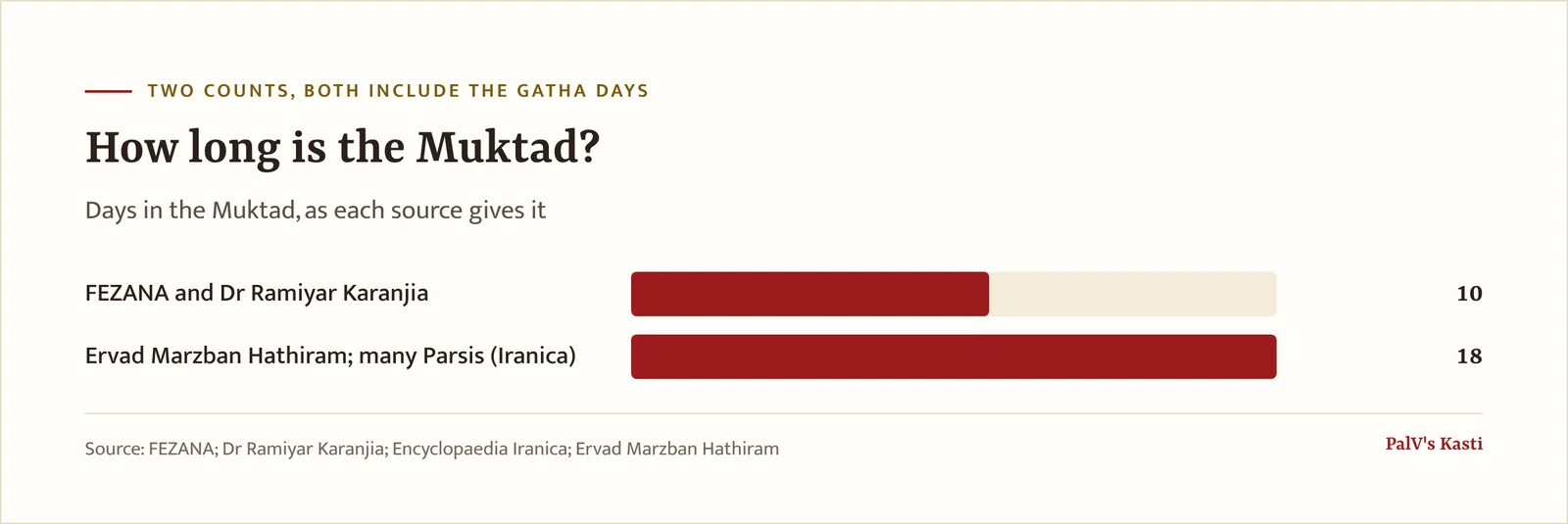

- Ten days. FEZANA's calendar lesson counts the last five days of Spendarmad plus the five Gatha days as the ten Muktad days. Dr Ramiyar Karanjia gives the same ten, from Roj Ashtad of Spendarmad Mah to Vahishtoisht Gatha.
- Two halves of five. William Malandra, in the Encyclopaedia Iranica, writes that the festival "is divided into two five-day halves", and that the second half, the Gatha days, is known as the greater five (panj-e meh). Hathiram calls the same five days the Panj-i-Meh, the greater days.
- Eighteen days. Malandra adds that many Parsis observe "an extended duration of eighteen days". Hathiram, following the teaching of Ustad Saheb Behramshah Nowroji Shroff, writes that the complete Muktad is 18 days and begins on Roj Ashishvangh.
Ask your Agiary or family priest which count your family keeps.
Practice varies between families and Agiaries; your family priest's guidance comes first.
What is recited on the Gatha days?
The Gathas themselves, one a day. Boyce writes that reciting the five Gathas on these five days is "enjoined as highly meritorious". Dr Ramiyar Karanjia's Muktad guidance says each Gatha is to be recited on its own day, or, in its place, 1,200 Yatha Ahu Vairyo with the khshnuman of the Gatha. Hathiram gives the same advice: the specific Gatha on each day.
There is also a liturgy made for these days. Boyce writes that the Āfrīnagān ī Gāθābyō, the Afrinagan of the Gathas, "was created to be recited during its five days". In L. H. Mills's translation it honours each Gatha by name, starting with the Ahunavaiti, the Ushtavaiti and the Spenta-mainyu.
In the Agiary, the ceremonies are performed by priests. FEZANA lists the Afrinagan, Farokhshi, Stum and Baj among the prayers priests recite during the Muktad. Hathiram names the same four, recited in honour of the Gatha and the Gahambar on these days.
The last Gatha day has one more prayer. Karanjia writes that the Patet Pashemani is recited on Vahishtoisht Gatha to atone for the year's mistakes, which is why the day came to be called Pateti. Hathiram also names the Patet Pashemani as the prayer for Vahishtoisht Gatha, preferably in the Ushahin Geh.
Practice varies between families and Agiaries; your family priest's guidance comes first.
Were the Gatha days always at the end of the year?
No, according to the Encyclopaedia Iranica. Panaino reports that in the Sasanian-era corrections of the calendar, the five extra days were placed after Ābān, the eighth month. Boyce describes the same move: the five days went "between 30 Ābān and 1 Ādar".
The five days weren't always welcome, either. Boyce writes that at first they were met with general distrust as "stolen" days. Today the three Parsi calendars share the same day and month names, with the five Gatha days at the end of the last month.
Why a 365-day year was built from 360 days plus five is a separate question, and our article on the 360+5 structure of the Zoroastrian year takes it up.
How does a Zoroastrian calendar app or converter show the Gatha days?
On a calendar app or converter, these five days look different from the rest of the year. Each goes by a Gatha name, not one of the thirty Roj names, and on our own calendar they sit outside every month. So if you convert a date in the days just before 21 March on the Fasli calendar, or one just before the August Navroz on the Shahenshahi calendar, expect a Gatha name where a Roj would normally be.
Our Parsi Roj calendar shows each Shahenshahi day with its Kadmi and Fasli days alongside. Its free A4 PDF has the twelve months and the five Gatha days, one month per page. The Zarthosti Anjuman of Northern California (ZANC) also runs an online converter that works from a Gregorian date to a Shenshai Roj and Mah, or back again.
To make sense of the other entries on a printed calendar, see how to read a Parsi Roj calendar. The year number that changes at Navroz is explained in the Zoroastrian calendar year. For the whole system, start with our guide to the Zoroastrian calendar, and for how every ordinary day gets its name, read why the Zoroastrian calendar has no weeks.
Frequently asked questions
How many Gatha days are there in the Zoroastrian calendar?
There are five Gatha days. They follow the twelfth month, Spendarmad, and take the year from 360 days, twelve months of thirty, to 365. The Bundahishn, in E. W. West's translation, calls them the five supplementary days at the end of Spendarmad, and West's footnote calls them the five Gatha days.
What are the names of the five Gatha days?
In order, they are Ahunavad, Ushtavad, Spentomad, Vohu Khshathra and Vahishtoisht. Each is named after one of the five Gathas of the Yasna: Ahunavaiti, Ushtavaiti, Spentamainyush, Vohukhshathra and Vahishtoishti. Spellings vary between sources. FEZANA, for example, writes the fifth day as Vahistoisht, so don't worry if your calendar differs.
Are the Gatha days the same as the Muktad?
The Gatha days are part of the Muktad, but not all of it. FEZANA and Dr Ramiyar Karanjia count ten Muktad days, the last five days of Spendarmad plus the five Gatha days. The Encyclopaedia Iranica notes that many Parsis observe eighteen days, and Ervad Marzban Hathiram writes that the complete Muktad is eighteen days.
Why is the fifth Gatha day called Pateti?
On Vahishtoisht Gatha, the last day of the year, the Patet Pashemani is recited to atone for the year's mistakes. Dr Ramiyar Karanjia writes that this is why the day came to be known as Pateti, and Ervad Marzban Hathiram also names the Patet Pashemani as the prayer for that day.
What does a Parsi calendar show during the Gatha days?
During these five days a Parsi calendar shows a Gatha name where one of the thirty Roj names would normally be, because each day is named after a Gatha. On the Fasli calendar they come just before 21 March, and on the Shahenshahi calendar just before the August Navroz. Our Parsi Roj calendar lists all five by name.
Why are they called Gatha days?
Each of the five takes its name from one of the five Gathas, the hymns of Zarathushtra in the Yasna. Antonio Panaino writes in the Encyclopaedia Iranica that the five days "took their names from the five Gathas". Mary Boyce adds that some call them "the five gathic times", and the Gathas are recited one a day across them.