PalV's Kasti
On this page
Rapithwin Geh is the noon watch of the Zoroastrian day, and it's kept only in the religious summer. The Bundahishn, a Pahlavi text, counts a summer of seven months, from Mah Farvardin to Mah Meher. In those months the day has five Gehs because Rapithwin is celebrated. In the five winter months, it says, the spirit of Rapithwin goes below the ground to where the springs are and keeps the water warm, so his Geh isn't celebrated. Parsis recite Havan Geh at noon instead, which Dr Ramiyar Karanjia's website calls the biji (second) Havan. Rapithwin returns on Roj Hormazd of Mah Farvardin, the New Year day. On the name, Dr Karanjia's website records an older term, Arempithwa, for the part of the day from noon to sunset, and Mary Boyce writes in Encyclopaedia Iranica that the Geh runs "from noon till 3 o'clock".
શહેરેવર રોજ
Shehrevar Roj, Tir Mah · 1396 Y.Z.
What does the name Rapithwin mean?
There are two readings, and they come from different standpoints. We set out both and don't pick between them.
Dr Karanjia's website describes a division of the day into three parts that came before the five Gehs: Usha from 3 am to 12 noon, Arempithwa from 12 noon to sunset, and Khshapa from sunset to 3 am. The site doesn't spell out that Rapithwin's name comes from Arempithwa, but the noon watch sits inside that older midday part.
Ervad Marzban J. Hathiram, writing on his website Frashogard from the Khshnoom teaching of Ustad Saheb Behramshah Shroff, reads the name as "arem", righteous or timely, and "pithwa", nourishment. For him Rapithwin is the divine being who gives timely nourishment.
Which divinities are invoked in the Rapithwin Gah prayer?
The prayer answers this itself. In the English translation on avesta.org, credited there to James Darmesteter, the first verse is addressed "To Rapithwin, Ashavan, the master of Asha", and to Fradat-fshu and Zangtuma. Verse 2 offers propitiation "of Asha Vahishta and Atar, (son) of Ahura Mazda". Verse 5 begins "We worship Rapithwin" and goes on to the five Gathas. Fradat-fshu and Zantuma return in verse 6. The first chapter of the Yasna, in L. H. Mills's translation, names the same two companions alongside Rapithwin.
Boyce, in her Iranica article on Ardwahisht (the Avestan Asha Vahishta, Ardibehesht in Persian), writes: "His gāh is Rapithwin". Dr Karanjia's website likewise names Ardibahesht Ameshaspand as the associated divine being of Rapithwan Geh, with Rapithwina and Fradat-fshu as its Yazads. Our article on Ardibehesht (Asha Vahishta) covers the Amesha Spenta himself.
| Point | What the source says | Source |
|---|---|---|
| Who the prayer is addressed to | Rapithwin, "the master of Asha", with Fradat-fshu and Zangtuma | Rapithwin Gah, v. 1 (Darmesteter) |
| Propitiation | Asha Vahishta and Atar | Rapithwin Gah, v. 2 |
| Companions | Fradat-fshu and Zantuma | Rapithwin Gah, v. 6, and Yasna 1 (Mills) |
| Amesha Spenta of the Geh | Ardibehesht (Asha Vahishta) | Boyce, Iranica "Ardwahišt", and Dr Karanjia's website |
Practice varies between families and Agiaries; your family priest's guidance comes first.
How is Rapithwin linked with the summer season?
The link is written into chapter 25 of the Bundahishn, the chapter on the religious year. In E. W. West's translation, summer runs from Ohrmazd day of the month Frawardin to Anagran day of the month Mihr, seven months in all. Winter runs from Ohrmazd day of Aban to the end of the five supplementary days. That's five months.
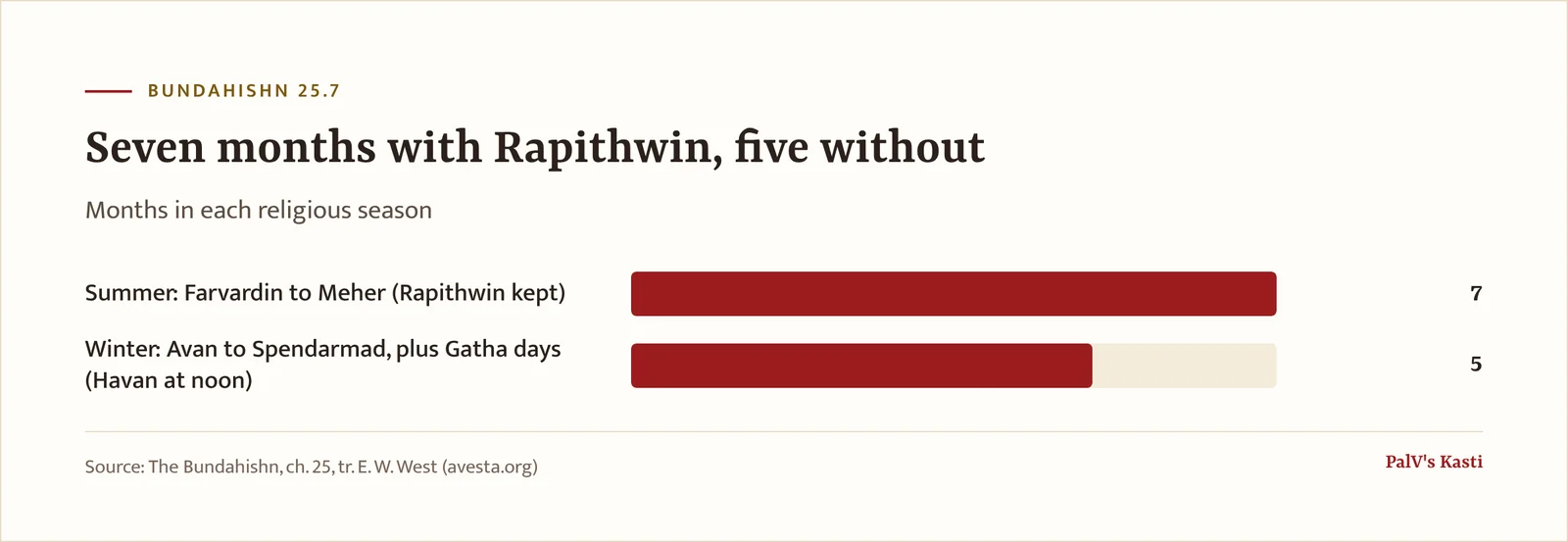
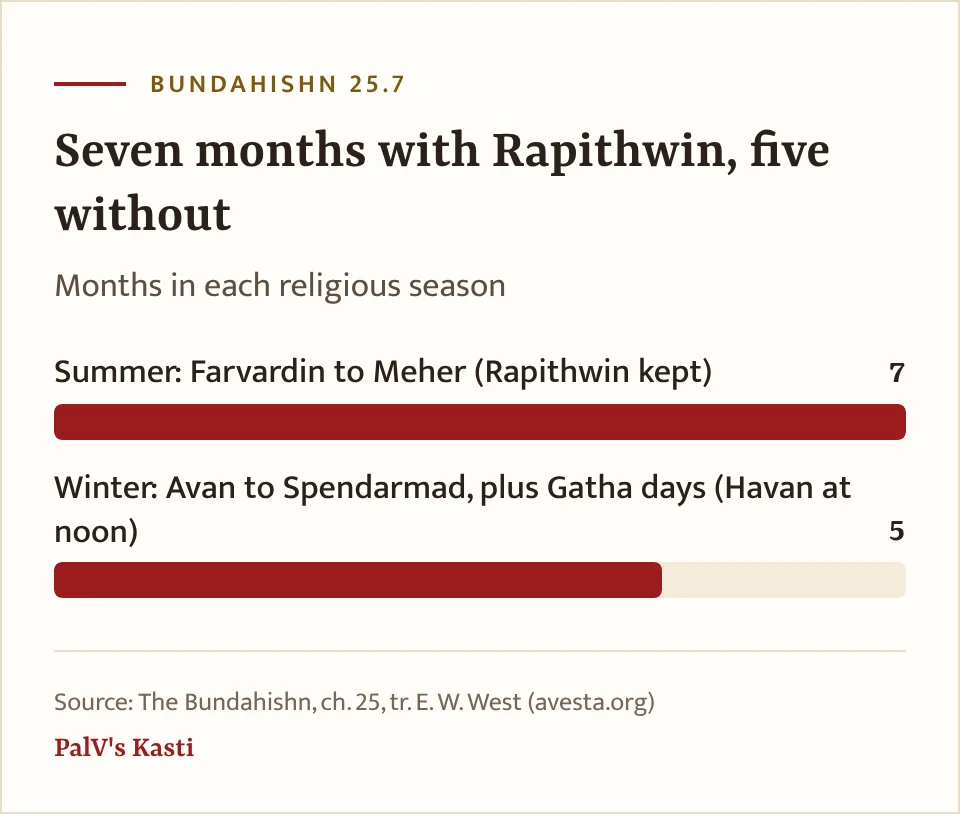
The same chapter ties the Gehs to those seasons. In those seven months, it says, the day and night have five periods "since one celebrates the Rapithwin" (25.9). In winter there are four periods, because from daybreak till Uzerin "is all Hawan" (25.10).
| Religious season (Bundahishn 25.7) | Months | Watches in the day | The noon watch |
|---|---|---|---|
| Summer, seven months | Farvardin to Meher | Five (25.9) | Rapithwin |
| Winter, five months | Avan to Spendarmad, plus the five Gatha days | Four (25.10) | Havan continues |
The text says the priest uses this summer-and-winter reckoning for the rules about a corpse and other matters (25.8). It's separate from the same chapter's grouping of the year into four seasons of three months each, where Farvardin, Ardibehesht and Khordad are spring (25.20). So the "summer" of Rapithwin is a religious season counted by Roj and Mah, not the hot weather outside.
For the exact Roj and Mah on which Rapithwin stops and starts, see our guide to when Rapithwin begins and ends.
What time is Rapithwin Geh?
Boyce gives the span as noon till 3 o'clock. Dr Karanjia's website gives the same 12 noon to 3 pm, and adds that in India, because Indian Standard Time is used rather than local time, it runs from 12:38 pm to 3:38 pm IST.
Treat those as a guide, not a fixed rule. The Gehs on either side are tied to the sun: the same website starts Havan Geh at sunrise and ends Uziran Geh at sunset, "whatever the time". So the length of the day's watches changes through the year and from place to place. Our guide to the five Gehs explains how the timings are worked out.
Practice varies between families and Agiaries; your family priest's guidance comes first.
What happens to Rapithwin in winter?
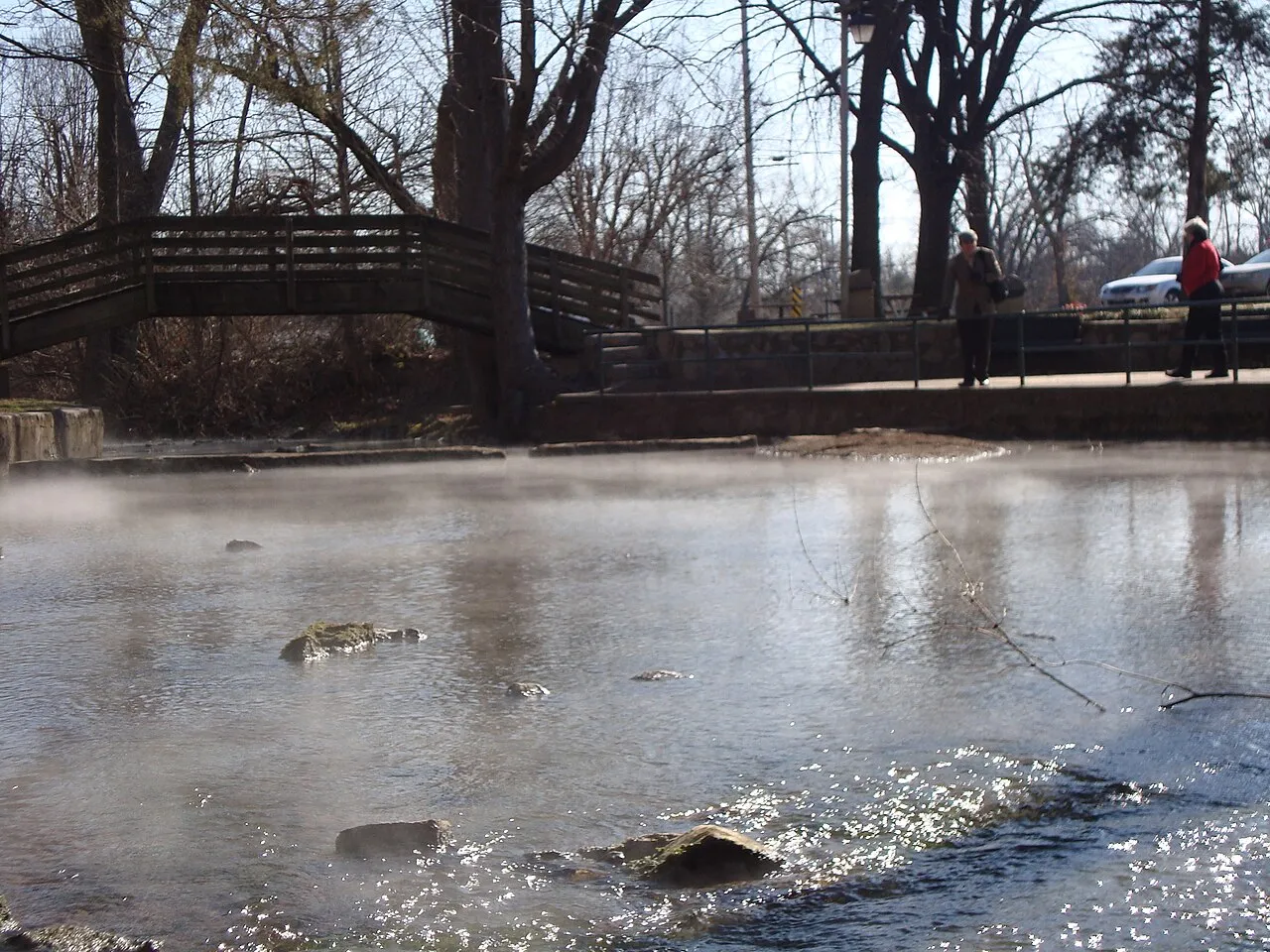
The Bundahishn says that on Ohrmazd day of Aban the winter "acquires strength and enters into the world". The spirit of Rapithwin then goes below ground, "where the spring (khani) of waters is". Through the five winter months the water of springs and conduits stays warm because Rapithwin "keeps warmth and moisture there", and his period is not celebrated (25.10, 25.12). Writing in Parsi Times in March 2025, Noshir H. Dadrawala describes the same picture: Rapithwin goes underground, symbolically, to protect roots and life through the winter cold.
In Parsi practice the noon prayer of these months is Havan Geh. Dr Karanjia's website says that from the beginning of Avan Mah to the Vahishtoisht Gatha, Rapithwan Geh is not recited and Havan Geh is recited in its place, as the biji (second) Havan Geh. Ervad Hathiram describes the same substitution for the five months from Avan to Spendarmad. How the second Havan is timed is covered in our article on the second Havan Geh.
Practice varies between families and Agiaries; your family priest's guidance comes first.
When does Rapithwin return?
On Roj Hormazd of Mah Farvardin, the first day of the new year. The Bundahishn says that as Ohrmazd day of Farvardin advances, winter's strength diminishes, and Rapithwin "comes up from below-ground" and ripens the fruit of trees (25.13, 25.14). Ervad Hathiram writes that from New Year's day, Roj Hormuzd of Mah Fravardin, the Rapithwin Geh is started again, and Dadrawala's Parsi Times article gives the same first day.
Rapithwin also has an Afrinagan of his own. In Mills's translation on avesta.org, the Afrinagan-i Rapithwin opens "for Rapithwina, the holy lord of the ritual order", with Fradat-fshu and Zantuma, and offers propitiation to Asha Vahishta and "the Fire, Ahura Mazda's son".
Practice varies between families and Agiaries; your family priest's guidance comes first.
How do the traditions explain Rapithwin?
The explanations differ, and we report them without taking a side.
- The Bundahishn's account is seasonal and protective. Rapithwin shelters the waters and the roots of trees through winter, then returns to ripen the fruit.
- Mary Boyce, in her Iranica article on Ardwahisht, notes that noon "is regarded as the perfect time". The sun stood still at that hour at creation, she writes, and will stand still again after Frashegird.
- The Khshnoom reading, as Ervad Hathiram presents it, speaks of two spiritual seasons (Hingam). In the seven months of the Hingam of Hamin, Mino Rapithwin gives timely and adequate nourishment. In the five months of the Hingam of Zam he leaves the surface of the earth and spreads heat and nourishment to the frozen ground, which is why his Geh is set aside.
To see which Roj and Mah fall today, use our Parsi Roj calendar.
Frequently asked questions
Is Rapithwin Geh prayed all year round?
No. The Bundahishn says Rapithwin is celebrated in the seven summer months, Farvardin to Meher, and not in the five winter months from Avan to the end of the Gatha days. In those winter months Havan Geh is recited at noon instead, which Dr Ramiyar Karanjia's website calls the biji, or second, Havan Geh.
What does the word Rapithwin mean?
Ervad Marzban Hathiram, following the Khshnoom teaching, reads the name as "arem", righteous or timely, and "pithwa", nourishment, so Rapithwin gives timely nourishment. Dr Ramiyar Karanjia's website adds that, before the five Gehs, the part of the day from noon to sunset was called Arempithwa. The noon watch falls inside it.
Which Amesha Spenta is linked with Rapithwin Geh?
Ardibehesht, the Avestan Asha Vahishta. Mary Boyce writes in Encyclopaedia Iranica that "His gāh is Rapithwin", and Dr Ramiyar Karanjia's website names Ardibahesht Ameshaspand as the associated divine being. The Rapithwin Gah prayer itself, in its second verse, offers propitiation to Asha Vahishta and to Atar, the fire.
Where does Rapithwin go in winter?
The Bundahishn (chapter 25, E. W. West's translation) says the spirit of Rapithwin goes below ground on Ohrmazd day of Aban, to where the springs of water are, and keeps warmth and moisture there through the five winter months. That is why, it says, spring water is warm in winter and cold in summer.
What time is Rapithwin Geh?
Mary Boyce gives it as noon till 3 o'clock. Dr Ramiyar Karanjia's website gives 12 noon to 3 pm, or 12:38 pm to 3:38 pm IST in India. These are guides only: the neighbouring Gehs begin at sunrise and end at sunset, so the watches shift through the year and from place to place.