PalV's Kasti
On this page
- Which days are the Dae days, and what are they called?
- Why don't the Dae days have names of their own?
- What does the Sirozah say on a Dae day?
- How do the Dae days divide the month?
- Are the Dae days counted with Hormazd's hamkars?
- How many Dae days are there in a year?
- Were the Dae days always dedicated to the Creator?
- What happens when a Dae day falls in Dae Mah?
- How do you find the next Dae day?
- Frequently asked questions
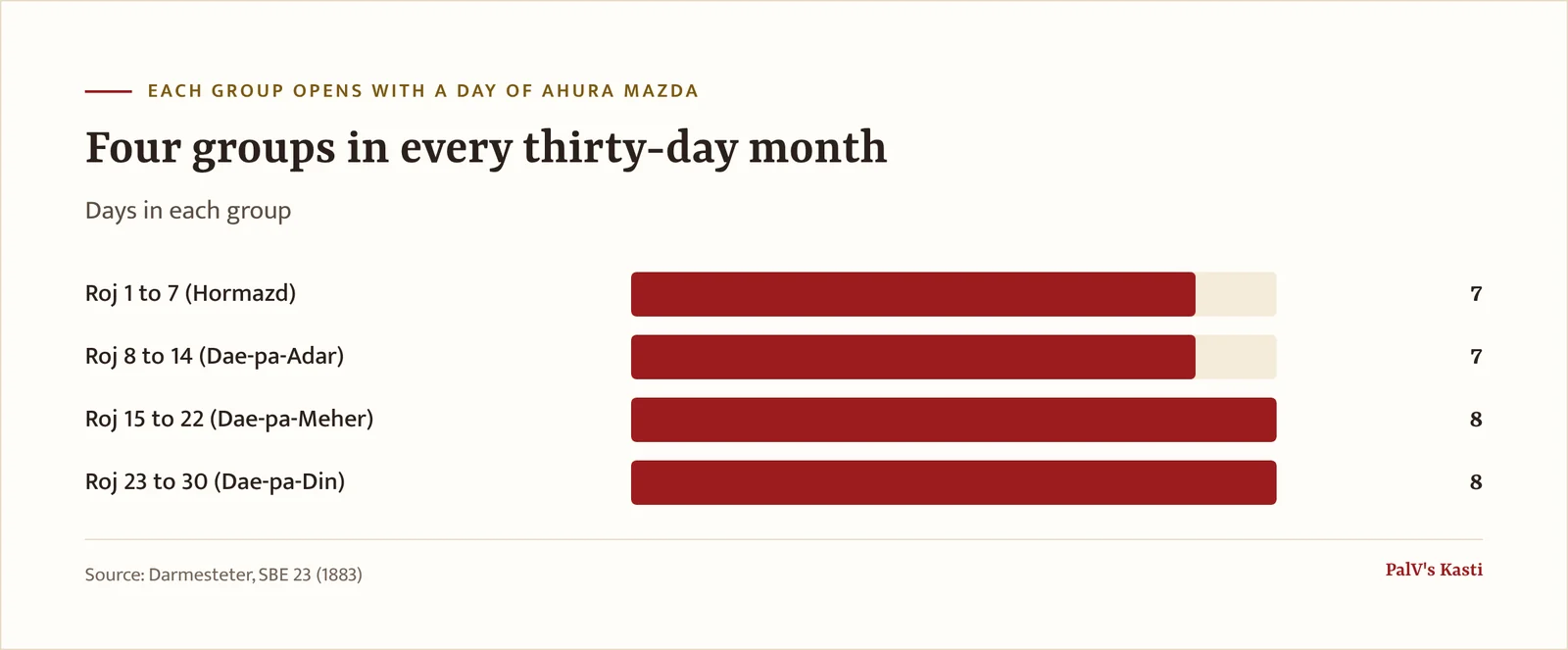
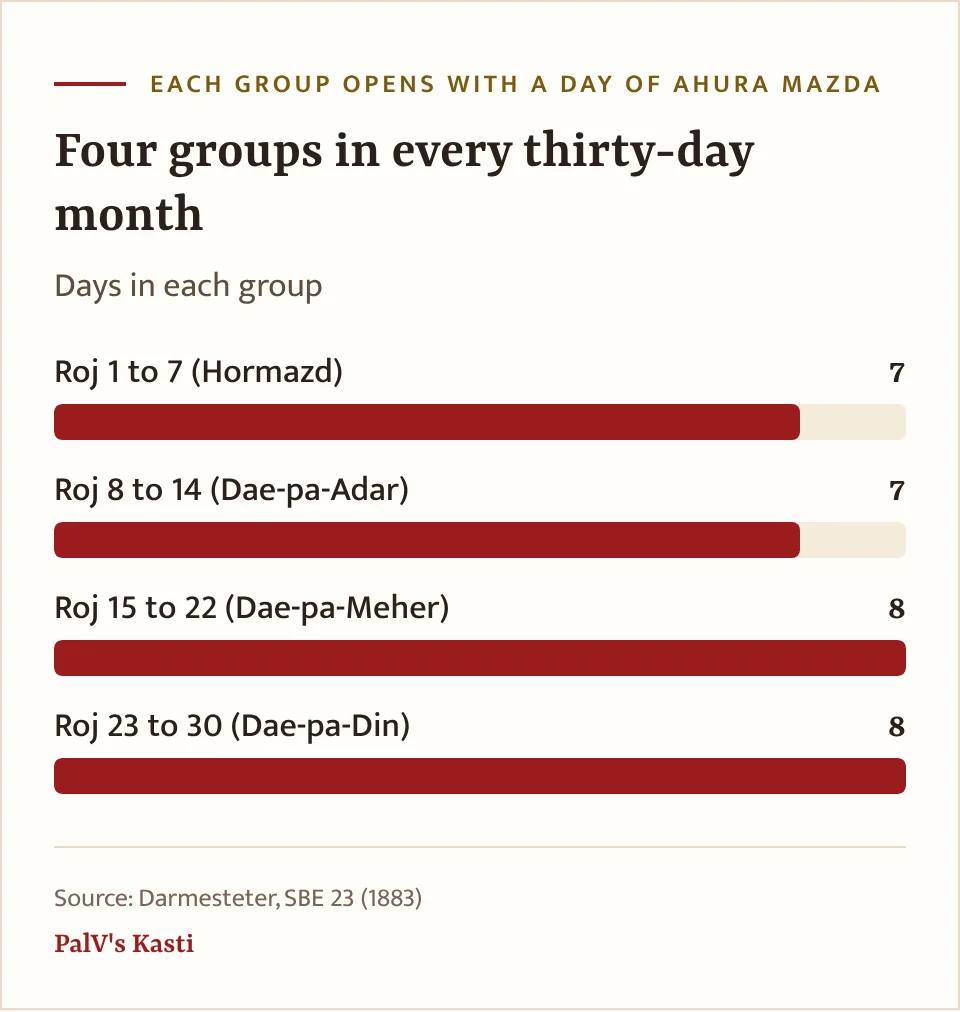
The Dae days are three days in every Parsi month, the 8th, 15th and 23rd, dedicated to Ahura Mazda as the Creator. They are Dae-pa-Adar, Dae-pa-Meher and Dae-pa-Din. In the Avestan calendar each of them bore the epithet daθušō, "(day) of the Creator", as William Malandra writes in the Encyclopaedia Iranica. None of the three has a name of its own. Each is named after the day that follows it, so Dae-pa-Adar is the Creator's day before Adar Roj. Together with Roj Hormazd on the 1st, the Dae days give Ahura Mazda four days in every month and mark the month off into groups of 7, 7, 8 and 8 days.
અસપંદામેદ રોજ
Asfandarmad Roj, Tir Mah · 1396 Y.Z.
Which days are the Dae days, and what are they called?
The Dae days are Roj 8, Roj 15 and Roj 23 of every month. Each one sits directly before a day named after another divinity, and takes that day's name after "Dae-pa".
| Roj | Parsi name | Darmesteter (1883) | Pahlavi, per Malandra | avesta.org gloss | The day that follows |
|---|---|---|---|---|---|
| 8 | Dae-pa-Adar | Dai pa Âdar | day pad ādur | "The Creator's day before Adar" | 9, Âdar |
| 15 | Dae-pa-Meher | Dai pa Mihir | day pad mihr | "The day of the Creator before Mithra" | 16, Mihir |
| 23 | Dae-pa-Din | Dai pa Dîn | day pad dēn | "The day of the Creator before Den" | 24, Dîn |
You'll also see the spellings Dae-pa-Aadar and Dae-pa-Deen, both used in a Weekly Zoroastrian Scripture Extract hosted on avesta.org. The North American Mobeds Council writes "Dae-pa-Aadar, Dae-pa-Meher and Dae-pa-Din".
Why don't the Dae days have names of their own?
All three belong to Ahura Mazda, and their shared name, "Creator", is his title. James Darmesteter explains it in a footnote to his translation of the Sirozah, published in 1883 in the Sacred Books of the East. The 8th, 15th and 23rd, he writes, are "under the rule of Ahura and the Amesha-Spentas", like the first day. For that reason, he says, they have "no name of their own" and take their names from the day after. He glosses Dai pa Âdar as "The day before Âdar".
The Avestan name for each of these days was simply "(day) of the Creator". Malandra notes that in Pahlavi the three days are further specified by the days that follow, giving day pad ādur, day pad mihr and day pad dēn.
The same word names the tenth month: Malandra writes that it was named daθušō, "(month) of the creator". We explain the month itself in our guide to Dae Mah.
What does the Sirozah say on a Dae day?
Darmesteter's Sirozah has one numbered entry for each of the thirty days of the month. On all three Dae days it addresses Ahura Mazda as "the Maker". Roj 1 addresses him by name alone. Here is the wording in Darmesteter's translation:
| Roj | Sirozah I | Sirozah II |
|---|---|---|
| 1 Hormazd | "To Ahura Mazda, bright and glorious, and to the Amesha-Spentas." | "We sacrifice unto the bright and glorious Ahura Mazda" |
| 8 Dae-pa-Adar | "To the Maker Ahura Mazda, bright and glorious" | "We sacrifice unto the Maker Ahura Mazda" |
| 15 Dae-pa-Meher | "To the Maker Ahura Mazda, bright and glorious" | "We sacrifice unto the Maker Ahura Mazda" |
| 23 Dae-pa-Din | "To the Maker, Ahura Mazda, bright and glorious" | "We sacrifice unto the Maker Ahura Mazda" |
Darmesteter also gives a table matching the days to the Yashts. He pairs Roj 1 with the Ormazd Yasht, and Roj 16 and Roj 24 with the Mihir and Dîn Yashts. Against Roj 8, 15 and 23 he lists no Yasht, as he does for a few other days such as Roj 4 and Roj 22. For the prayers recited in the month of Dae, see Prayers associated with Dae Mah.
Practice varies between families and Agiaries; your family priest's guidance comes first.
How do the Dae days divide the month?
The Dae days split the thirty-day month into four groups, each opening with a day of Ahura Mazda. In Darmesteter's footnote, the month "was divided into four weeks": the first two of seven days, the last two of eight. A Weekly Zoroastrian Scripture Extract (No. 106) hosted on avesta.org describes the same thirty Rojs as "arranged in four groups of 7, 7, 8 and 8".
| Group | Opens with | Roj numbers | Days |
|---|---|---|---|
| 1 | Hormazd | 1 to 7 | 7 |
| 2 | Dae-pa-Adar | 8 to 14 | 7 |
| 3 | Dae-pa-Meher | 15 to 22 | 8 |
| 4 | Dae-pa-Din | 23 to 30 | 8 |
How all thirty Roj names fall into families is the subject of our guide to how the 30 Roj are grouped.
Are the Dae days counted with Hormazd's hamkars?
Yes. J. J. Modi, in his 1922 study of Parsi ceremonies, writes that Daepadar, Daep-Meher and Daepdin "are the Hamkars" of Oharmazd. FEZANA's calendar lesson for Grades 6 to 8 links Hormazd, the day of humans, to "Dae pa Adar, Dae pa Mehr, Dae pa Din". The Scripture Extract mentioned above calls the three Dae days "Hamkaars (co-workers) of Dadar Ahura Mazda".
How many Dae days are there in a year?
There are 36 Dae days in a year. FEZANA's lesson gives the year as 12 months of 30 days, and each month has its 8th, 15th and 23rd. The five Gatha days at the end of the year add none: FEZANA describes them as five additional days after the twelve months, and Modi notes that they have no corresponding day in the months. Add the twelve Roj Hormazd days and Ahura Mazda presides over 48 days of the year.
Were the Dae days always dedicated to the Creator?
The historian Mary Boyce thought not. In her Iranica article on Zoroastrian festivals, she writes that at an earlier stage these three days were devoted, "it seems", to Apam Nąpāt, Haoma and Dahma Āfriti. Later, "possibly under Zurvanite influence", they were rededicated to the "Creator (Dadvah) Ahura Mazdā". Boyce hedges both statements, and Darmesteter's earlier translation records only the present dedication. We give her view as hers.
What happens when a Dae day falls in Dae Mah?
When a Dae day falls in Dae Mah, the day and the month share the same dedication, and that makes it a feast. Boyce gives the rule: whenever a day-name and a month-name had the same dedication, "the day was celebrated as a festival for that yazata". Because Roj Hormazd and the three Dae days all fall inside Ahura Mazda's month, there were from then on, in her words, "four festivals for Ahura Mazdā" in the month Dadvah. J. J. Modi's 1922 list of Jashan days names the same four: the 1st, 8th, 15th and 23rd of Dae Mah. Read about the Jashan held in this month in Jashans in Dae Mah.
Practice varies between families and Agiaries; your family priest's guidance comes first.
How do you find the next Dae day?
Find the next 8th, 15th or 23rd Roj of the current Mah in your calendar. The Dae days are always Roj 8, 15 and 23, so the only question is which Gregorian date your calendar puts them on. The Shenshai, Kadmi and Fasli calendars give different answers. On 3 June 2013, for example, a North American Mobeds Council note gave the Fasli date as Roj Dae-pa-Meher of Mah Khordad, while the Shenshai date that day was Roj Behram of Mah Dae.

Our Parsi calendar shows today's Roj and Mah. To work out when the whole month of Dae falls in each calendar, see when Dae Mah falls in the Shenshai, Kadmi and Fasli calendars.
Frequently asked questions
What are the Dae days in the Parsi calendar?
The Dae days are Roj 8, Roj 15 and Roj 23 of every month: Dae-pa-Adar, Dae-pa-Meher and Dae-pa-Din. All three are dedicated to Ahura Mazda as the Creator. In the Avestan calendar each was called "(day) of the Creator", according to the Encyclopaedia Iranica, and today each is named after the day that follows it.
What does Dae-pa-Adar mean?
Dae-pa-Adar is the Creator's day before Adar. It is Roj 8, and it takes its name from Roj 9, Adar. The Pahlavi form is day pad ādur. Darmesteter's 1883 translation glosses it as "The day before Âdar", and the avesta.org day list gives "The Creator's day before Adar". Dae-pa-Meher and Dae-pa-Din follow the same pattern.
Why are the Dae days named after the next day?
All three Dae days are under the rule of Ahura Mazda, and in Avestan each was simply "(day) of the Creator". James Darmesteter wrote that, for this reason, they have no name of their own and borrow the name of the next day. William Malandra notes that Pahlavi specifies each by the following day, as in day pad ādur.
How many Dae days are there in a year?
There are 36. Each of the twelve thirty-day months has three Dae days, on Roj 8, 15 and 23. The five Gatha days at the end of the year sit outside the thirty Roj names, so they add no Dae days. With the twelve Roj Hormazd days, Ahura Mazda presides over 48 days of the year.
Do the Dae days divide the month into weeks?
Darmesteter wrote that the month "was divided into four weeks", the first two of seven days and the last two of eight. Those four groups open with the four days of Ahura Mazda: Roj 1, 8, 15 and 23. So the groups run Roj 1 to 7, 8 to 14, 15 to 22 and 23 to 30.