PalV's Kasti
On this page
Families and institutions hold a Jashan in Dae Mah because the month belongs to the Creator, and a Jashan is a service of thanks. J. J. Modi's 1922 study of Parsi ceremonies records that "the 10th month Deh is sacred to Ahura Mazda himself", and he lists four of its days as Jashan days. FEZANA calls the Jashan "an important Zoroastrian thanksgiving ritual". Modi adds that most public Jashans are held to thank the Almighty "for His bountiful blessings". Put the two together and Dae Mah is the natural month to say thank you, at home, at the office or at the Agiary. In June 2019 alone, Parsi Times reported Dae Mah Jashans held by two banks, a colony recreation centre, a sports and welfare league and a Dadgah in Pune.
For the month itself, start with our guide to Dae Mah.
શહેરેવર રોજ
Shehrevar Roj, Tir Mah · 1396 Y.Z.
What is a Jashan?
A Jashan is a religious celebration of an occasion, carried out with liturgical prayers. Modi's definition covers happy and sad occasions alike: an important event, "whether joyful or melancholy", marked "in a religious and solemn way". FEZANA's glossary is shorter: "An outer ceremony of thanksgiving and praise".
On the word itself, Modi links Jashan to "Yazashna or Ijashna meaning an homage of praise". FEZANA's glossary traces it to the Avestan yasna, and Noshir H. Dadrawala, writing in Parsi Times in May 2023, calls Jashan the Pahlavi term for Yasna, "act of worship". Modi also notes that some derive the word from chash, to taste, because a Jashan ends with everyone present sharing the consecrated food.
Modi lists five services that may be performed in a Jashan: the Afringan, the Baj, the Yasna, the Farokhshi and the Satum. The first two are generally performed. He calls the Afringan "indispensably necessary" and the "Jashan proper". FEZANA's glossary describes the Afringan as "One section of the Jashan ceremony", and Dadrawala calls it "an important part of the Jashan ceremony". What is recited during the month is covered in Prayers associated with Dae Mah.
Practice varies between families and Agiaries; your family priest's guidance comes first.
Why is Dae Mah a natural month for a Jashan?
Because the Creator's name and title fall on four days of Dae Mah, the month has four Jashan days instead of one. Modi explains the general rule: the day that bears the name of the Yazata who also presides over the month "is held as a sacred Jashan day". Dae Mah is sacred to Ahura Mazda, and Modi gives its four Jashan days as the 1st (Hormazd), 8th (Dae-pa-Adar), 15th (Dae-pa-Meher) and 23rd (Dae-pa-Din).
Mary Boyce, in the Encyclopaedia Iranica, describes the same pattern as "four festivals for Ahura Mazdā" in the month Dadvah. In Parsi Times in May 2023, Dadrawala called it "most meritorious" to perform a Jashan on each of the four special days. Why these four days come round in every month is explained in The Dae Days of Every Month.
Practice varies between families and Agiaries; your family priest's guidance comes first.
Why do institutions hold a Dae Mah Jashan?
Modi gives two reasons for public Jashans in general. The first is thanksgiving: "To a great extent they are thanks-giving services." The second is fellowship. Public Jashans, he writes, "are intended to cement the tie of brotherhood", and the celebrant prays for the reward of all his prayers to go to "the treasury of Ahuramazda", which Modi explains as the good of all his fellow creatures.
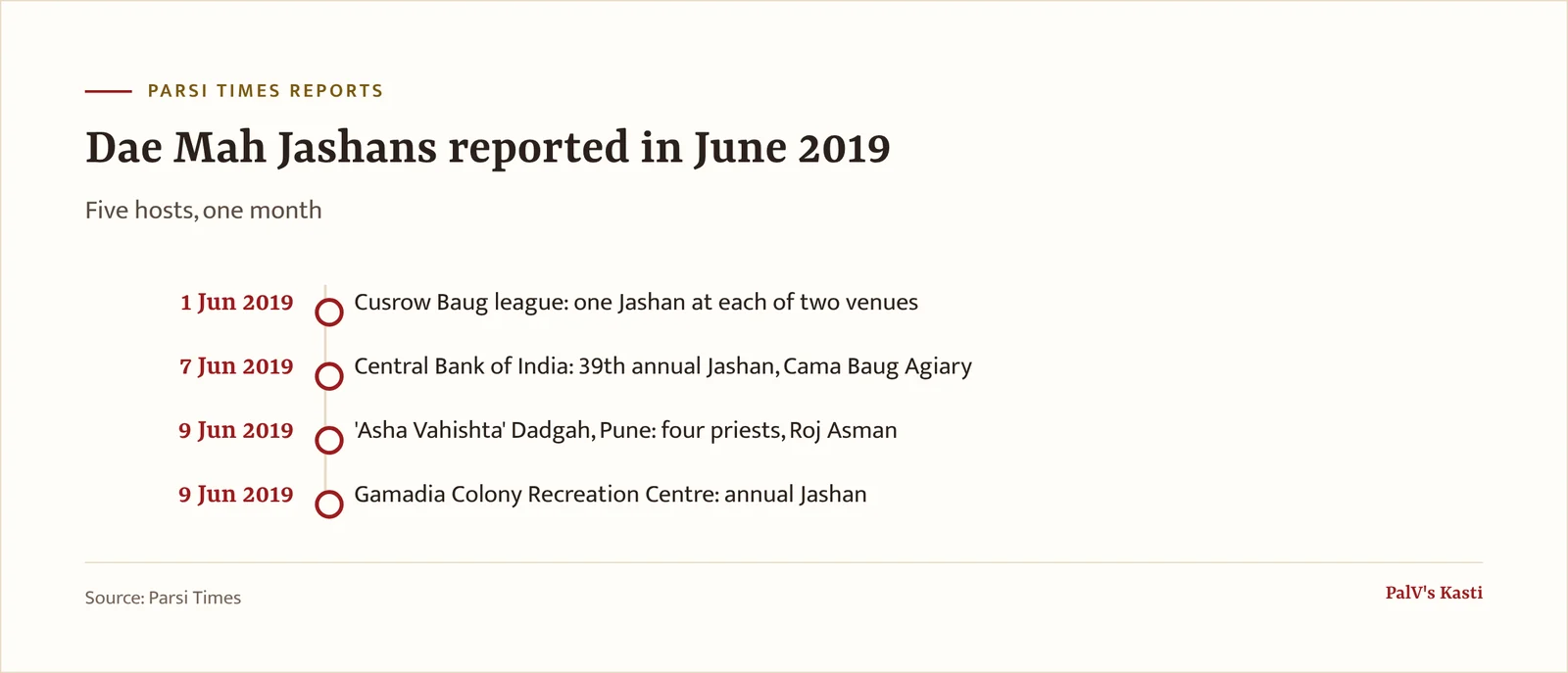

Parsi Times reports from June 2019 show who kept the custom that year. Two of the hosts, both banks, tied the Jashan directly to the prosperity of the institution.
| Host (as reported) | Where | Reported detail |
|---|---|---|
| Central Bank of India | Cama Baug Agiary, Mumbai | Its 39th annual Dae Mah Jashan on 7 June 2019, conducted by Vada Dasturji Er. Keki Ravji for the bank's prosperity |
| 'Asha Vahishta' Zoroastrian Centre Dadgah | Pune | Performed by four priests on 9 June 2019 (Roj Asman, Mah Dae), followed by a Humbandagi and chasni |
| Cusrow Baug United Sports and Welfare League | Cusrow Baug Gym premises and Sir Cusrow Wadia Pavilion | Its "customary Dae Mahino Jashan celebrations" on 1 June 2019, with one Jashan at each venue |
| Gamadia Colony Recreation Centre | At the Centre | Its "annual Dae Mahino Jashan" on 9 June 2019, followed by Humbandagi and chashni |
| The Zoroastrian Co-operative Bank | Corporate Office, Worli | Held on Asmaan Roj to mark the "auspicious Dae Mah" and for the bank's prosperity |
One detail in that table stands out. The Pune Dadgah's Jashan and the Zoroastrian Co-operative Bank's Jashan both fell on Roj Asman, the 27th, which is not one of Modi's four Creator days. So the institutions in these reports chose a day within the month, not only the four Jashan days.
Can a family hold a Dae Mah Jashan at home?
Yes. A Jashan is built on the Afringan, which Modi classes among the outer liturgical services. These, he writes, "can also be performed in any ordinary or private house or place". Dadrawala says the same of the Jashan in 2023: it is an outer liturgical ceremony that "can be performed at any clean place". In Dae Mah, he adds, Parsis perform Jashan ceremonies "by way of thanks-giving at home", and also at work, in community centres and in places of worship.
You'll usually need two or more priests. Modi says Afringans "are performed generally by two or more priests", and only very rarely by one, when a second priest isn't available. Maneck F. Kanga's Encyclopaedia Iranica entry agrees: "Two or more priests perform the āfrīnagān ceremony", an officiating priest (zōd) and an assistant (rāspī). Your family priest will advise on the arrangements and the day. Our Parsi calendar shows when Dae Mah and its Creator days fall this year.
Practice varies between families and Agiaries; your family priest's guidance comes first.
What is set out for a Jashan, and what happens afterwards?
The offerings are simple and edible. Modi describes the arrangement: a fire vase opposite the officiating priest, a tray of sandalwood and frankincense, and a tray holding "fruit, flowers, milk, wine, water, sherbet, etc." Kanga lists the same core items: fire in a fire vase, sandalwood and incense, and "votive offerings of fruit, flowers, milk, wine, and water".
After the prayers, everyone shares the blessed food. Modi explains that eating the consecrated offerings, the myazda, "is spoken of as 'chashni' (lit., tasting)". FEZANA's glossary defines chasni as "Consecrated food/post religious ceremony", and Dadrawala compares it to the Hindu prasad. Two of the 2019 reports mention a Humbandagi after the Jashan, which FEZANA glosses as "communal prayer".
Modi's own summary of the point of it all is worth keeping: "Prayer, praise and righteousness are the best offerings acceptable to God." The customs that surround the Jashan in this month are in How Parsis observe Dae Mah.
Practice varies between families and Agiaries; your family priest's guidance comes first.
Frequently asked questions
Why do Parsis hold a Jashan in Dae Mah?
Dae Mah is sacred to Ahura Mazda, and a Jashan is a thanksgiving service. J. J. Modi records four sacred Jashan days in the month, the 1st, 8th, 15th and 23rd, and describes public Jashans as services of thanks to the Almighty. That makes Dae Mah the natural month for a Jashan of gratitude to the Creator.
Which day of Dae Mah is best for a Jashan?
Modi lists the 1st (Hormazd), 8th (Dae-pa-Adar), 15th (Dae-pa-Meher) and 23rd (Dae-pa-Din) as the sacred Jashan days of Dae Mah. Parsi Times reports from 2019 show institutions also holding their Dae Mah Jashan on other days, such as Roj Asman. Ask your family priest which day suits your family.
Can a Dae Mah Jashan be performed at home?
Yes. The Afringan at the heart of a Jashan is an outer liturgical service, which Modi says can be performed in any ordinary or private house. Noshir H. Dadrawala writes that Parsis perform Jashans of thanksgiving at home in Dae Mah. Offices, colonies, banks and Agiaries hold them too.
How many priests are needed for a Jashan?
Usually two or more. J. J. Modi says Afringans are generally performed by two or more priests, and only very rarely by one. Maneck F. Kanga's Encyclopaedia Iranica entry also says two or more priests perform the Afringan, an officiating zōd and an assisting rāspī. The Pune Dadgah's 2019 Dae Mah Jashan used four priests.
What is chasni at a Jashan?
Chasni is the blessed food shared after the Jashan prayers. Modi explains that eating the consecrated offerings, the myazda, is called chashni, literally "tasting". FEZANA's glossary defines it as consecrated food after a religious ceremony. Fruit, milk and other eatables from the Jashan tray are shared among those present.