PalV's Kasti
On this page
Dae Mah is the tenth month of the Parsi year, so in every calendar it begins 270 days after Navroz: nine months of thirty days each. What changes between the Shenshai, Kadmi and Fasli calendars is the Navroz you count from. The Fasli year always opens on 21 March, so Fasli Dae Mah runs from 16 December to 14 January every year. Shenshai Navroz fell on 15 August in 2026, and Shenshai Dae Mah begins 270 days after it. The Kadmi calendar runs a month ahead of the Shenshai, so Kadmi Dae Mah opens 30 days before Shenshai Dae Mah. For the exact Shenshai and Kadmi days in 2027, use our Parsi calendar or your Agiary's printed calendar. Below we show how the count works and test it against dates published by Parsi Times and the North American Mobeds Council.
શહેરેવર રોજ
Shehrevar Roj, Tir Mah · 1396 Y.Z.
When does Dae Mah fall in each calendar?
Dae Mah falls on three different stretches of the Gregorian year, one for each calendar. Here is where each one starts:
| Calendar | Navroz (day 1 of the year) | Dae Mah begins |
|---|---|---|
| Fasli | 21 March, every year | 16 December, every year (ends 14 January) |
| Shenshai | 15 August in 2026 | 270 days after Shenshai Navroz |
| Kadmi | 30 days before Shenshai Navroz | 30 days before Shenshai Dae Mah |
In the Fasli calendar the four days named for the Creator fall on fixed dates too. avesta.org's Fasli calendar for 2025 marks the Jashan of Dadvah on 16 December (Roj Hormazd), 23 December (Dae-pa-Adar), 30 December (Dae-pa-Meher) and 7 January (Dae-pa-Din).
We haven't found a published Shenshai or Kadmi calendar for 2027 that names the Gregorian dates of Dae Mah, so we don't print them here. Before you fix a family occasion or one of the Jashans in Dae Mah, check the day on our Parsi calendar and against the printed calendar of your own Agiary or Anjuman.
How do you work out when Dae Mah begins?
You count 270 days on from your calendar's Navroz. Here is the method, step by step:
- Find your calendar's Navroz. This is Roj Hormazd of Mah Farvardin, day 1 of the year. On avesta.org's Fasli calendar for 2025, 21 March is marked "r. Ohrmazd, m. Farvardin, Noruz".
- Count nine full months. The Zoroastrian calendar "consisted of twelve months of thirty days each", as Antonio Panaino writes in the Encyclopaedia Iranica. Dae is the tenth month, after Farvardin, Ardibehesht, Khordad, Tir, Amardad, Shehrevar, Meher, Avan and Adar, in FEZANA's list of the twelve. Nine months of thirty days is 270 days.
- Leave the Gatha days out. FEZANA describes the five Gatha days as "added to the 12th month to make a 365-day year". They come at the end of the year, so none of them falls before Dae Mah.
- Add 270 days to Navroz. That date is Roj Hormazd of Mah Dae, the first day of the month.
- Count on for the Dae days. Dae-pa-Adar is 7 days after Roj Hormazd, Dae-pa-Meher 14 days after and Dae-pa-Din 22 days after. The last day of the month is 29 days after.
The Encyclopaedia Iranica's entry on the month, by William W. Malandra, explains why those days matter: the eighth, fifteenth and twenty-third days "bore the epithet daθušō", the "(day) of the Creator". They have their own guide, The Dae Days of Every Month.
Where does each calendar's Navroz fall?
Each calendar starts its year on a different Gregorian date, so each gives a different Dae Mah.
Shenshai. On 14 August 2026, All India Radio reported President Droupadi Murmu's greetings "On the eve of Parsi New Year Navroz". On 15 August 2026, the Prime Minister's Office published Narendra Modi's message "Greetings on the start of the Parsi New Year". So Shenshai Navroz fell on 15 August 2026, and Shenshai Dae Mah begins 270 days later, in 2027.
Kadmi. FEZANA's calendar lesson says the Kadmi calendar "differs by one month" from the Shenshai, a gap it puts down to "a difference in calculation". The avesta.org calendar page shows which way. For 2016 to 2019 it gives Navroz as 17 August in the Shahanshahi calendar and 18 July in the Qadimi (Kadmi) calendar, 30 days earlier. Every Kadmi month, Dae included, starts 30 days before its Shenshai counterpart.
Fasli. FEZANA records that the Fasli calendar was "instituted in 1906" so that its new year would start "on the Spring Equinox (21st March)". Count 270 days from 21 March and you reach 16 December. The avesta.org month table, which starts Frawardin on 21 March, gives that same date for the month of Day and starts the next month, Vohuman (Bahman), on 15 January.
Why the three calendars split in the first place is covered in our guide to Shenshai, Kadmi and Fasli.
Does this method match dates published elsewhere?
Yes. We tested it against two dated sources, and both agree.
- Parsi Times, May 2025. Noshir H. Dadrawala wrote that in the Shahanshahi calendar the holy month of Dae "commenced on 12th May" 2025. Counting back 270 days gives a Navroz of 15 August 2024. That's two days earlier than the 17 August avesta.org gives for 2016 to 2019, and two Gregorian leap days, 29 February 2020 and 29 February 2024, fell in between.
- NAMC, 3 June 2013. The North American Mobeds Council dated a newsletter "Shehenshahi Mah (Month) Dae – Kadmi Mah Behman" and "Fasli Mah Khordad Roj Dae-pa-Meher". Take the Fasli date first. Khordad, the third month, begins 60 days after 21 March, on 20 May, and its fifteenth day, Dae-pa-Meher, is 3 June. That matches. And with the Kadmi calendar a month ahead, Kadmi Parsis had already finished Dae Mah and moved into Mah Behman, as the newsletter says.
Why does Dae Mah fall in such different seasons?
Only one of the three calendars is tied to the seasons. The Fasli year is set to begin at the spring equinox, so Fasli Dae Mah always comes in December and January. That fits the month's origin. Mary Boyce, in the Encyclopaedia Iranica, describes Dadvah, the old name of Dae, as "a midwinter month", a time when the Creator's power, and the worship and joy of his creatures, were "especially needed". The Creator here is Ahura Mazda.
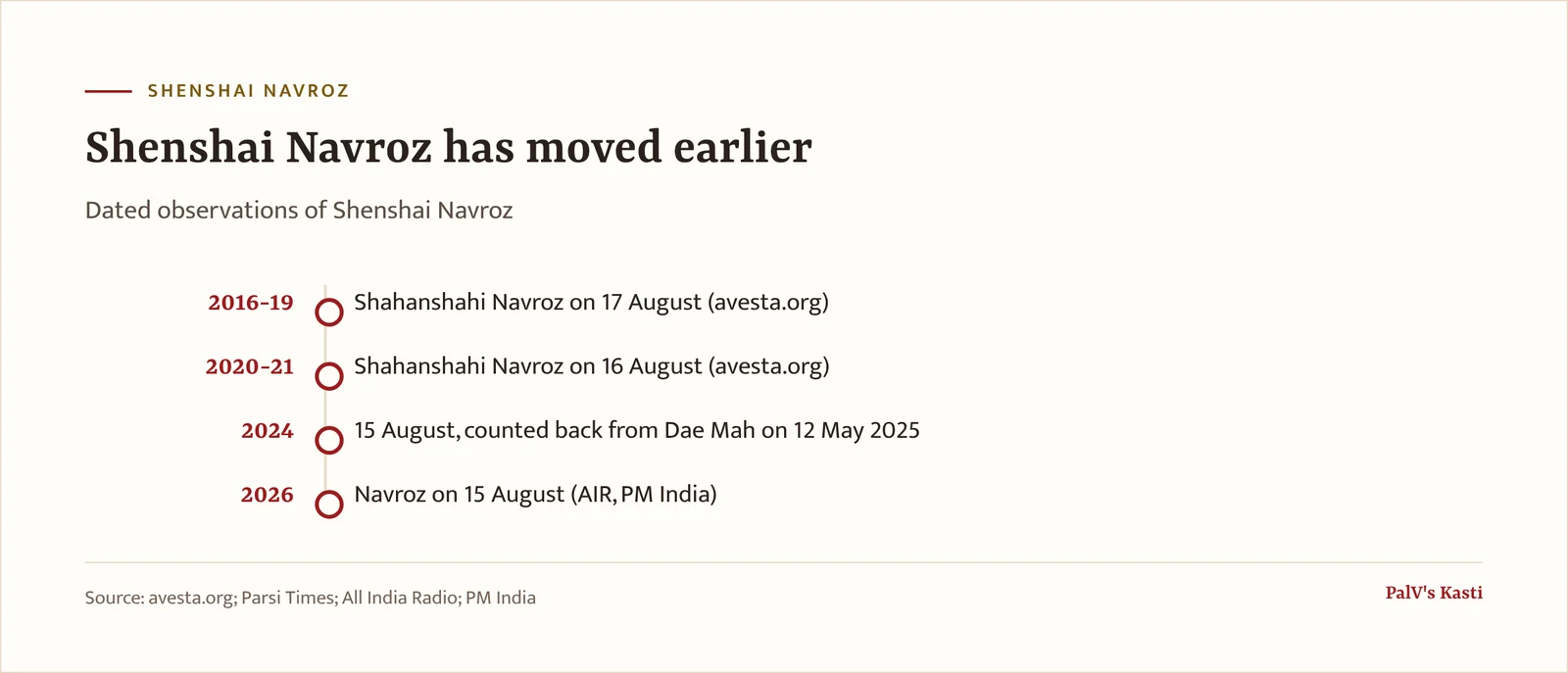
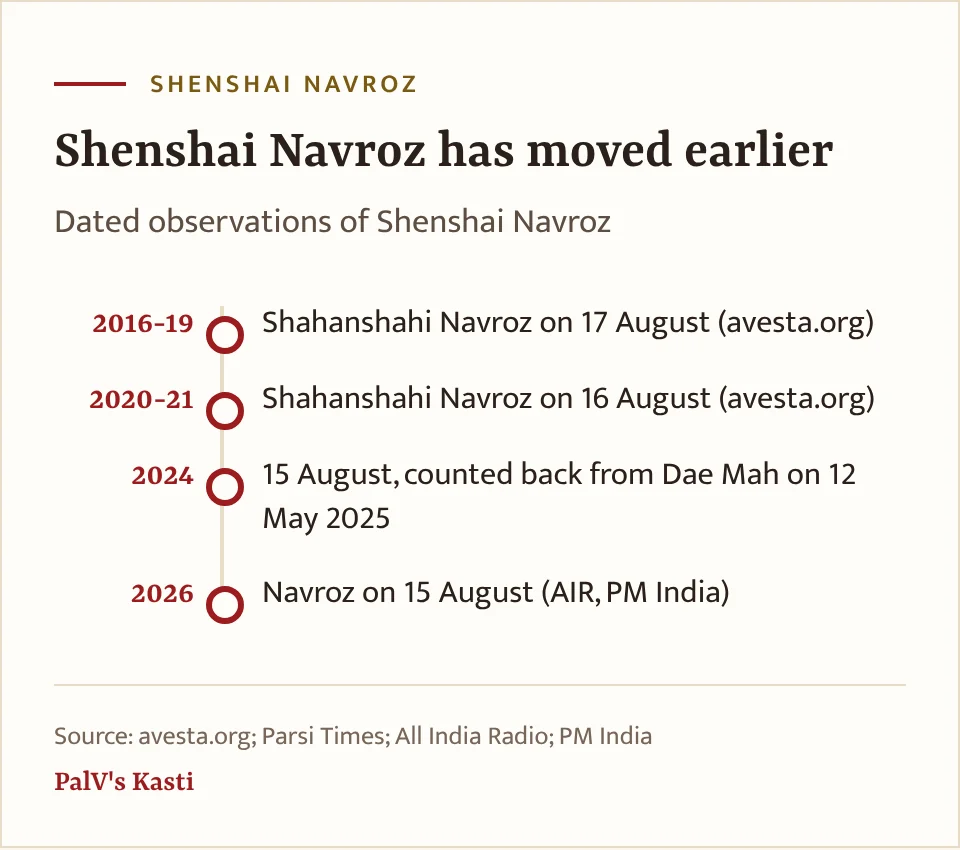
The Shenshai and Kadmi dates have moved well away from midwinter. avesta.org gives Shahanshahi Navroz as 17 August for 2016 to 2019 and 16 August for 2020 and 2021, and in 2026 it fell on 15 August. That's two days in seven years. What the month means, and what is recited in it, is covered in What is Dae Mah? and Prayers associated with Dae Mah.
Frequently asked questions
When is Dae Mah in the Fasli calendar?
Fasli Dae Mah runs from 16 December to 14 January every year. The Fasli year begins on 21 March, and Dae, the tenth month, starts 270 days later. The avesta.org month table gives the same 16 December start, and its 2025 Fasli calendar marks the Dae days on 23 December, 30 December and 7 January.
When does Shenshai Dae Mah begin?
Shenshai Dae Mah begins 270 days after Shenshai Navroz. In 2026 Navroz fell on 15 August, going by All India Radio's report of the President's greetings on the eve and the Prime Minister's message on the day. In 2025, Parsi Times reported that Shenshai Dae Mah began on 12 May.
When is Dae Mah in the Kadmi calendar?
Kadmi Dae Mah begins 30 days before Shenshai Dae Mah. FEZANA notes that the Kadmi calendar differs from the Shenshai by one month, and avesta.org shows Kadmi Navroz 30 days earlier, on 18 July against 17 August for 2016 to 2019. Every Kadmi month starts 30 days before its Shenshai counterpart.
How many days after Navroz does Dae Mah begin?
Dae Mah begins 270 days after Navroz in all three calendars. Dae is the tenth month, and each of the nine months before it has thirty days. FEZANA places the five Gatha days at the end of the year, after the twelfth month, so they never come between Navroz and the start of Dae Mah.
Does the Shenshai date of Dae Mah change every year?
Not every year, but it has moved. The avesta.org calendar page gives Shahanshahi Navroz as 17 August for 2016 to 2019 and 16 August for 2020 and 2021, and in 2026 it fell on 15 August. Dae Mah begins 270 days after Navroz, so its Shenshai start moves with those dates.