PalV's Kasti
On this page
Farvardin Mah (also spelt Fravardin or Frawardin) is the first of the twelve months of the Zoroastrian religious year, and it takes its name from the Fravashis, the spirits the Avesta praises as the "Fravashis of the faithful". Mary Boyce writes in Encyclopaedia Iranica that "a day and a month are dedicated to them" in the Zoroastrian calendar. That day is Roj Farvardin, the 19th of every month. The month that shares its name opens with Roj Hormazd, the New Year, holds Khordad Sal on Roj Khordad, and reaches the Fravashis' own feast on Roj Farvardin. When Farvardin Mah actually begins depends on which Parsi calendar your family follows.
શહેરેવર રોજ
Shehrevar Roj, Tir Mah · 1396 Y.Z.
Why is the first month named after the Fravashis?
Every day and every month of the religious calendar belongs to a divine being. The calendar page on avesta.org puts it in one line: "Each month and each day of the religious calendar", it says, "is presided over by a spiritual being". On that page the 19th day, Frawardin, is glossed "The Guardian Angels", with its Avestan form given as Fravashis.
The Avesta says the same. In the Sirozah, the entry for the 19th day, headed Frawardin, reads in James Darmesteter's translation: "To the awful, overpowering Fravashis of the holy ones." The month Farvardin carries that same dedication.
Boyce explains what follows when a day and a month share a name. Wherever a day-name and a month-name had the same dedication, that day was kept as a festival for the divine being concerned, and she lists the Fravashis among those who gained such a feast. avesta.org marks these coinciding days as "Name day feasts". In Boyce's words, the Fravashis "have an annual name-day feast on the day Farvardīn" of the month Farvardin.
Farvardin's place at the head of the year is old. The Bundahishn, in E. W. West's translation, calls Tir "the fourth month of the year" and lists "the auspicious month Frawardin" first among the spring months. William Malandra, also in Iranica, places the five extra days of the year "between Esfand and the first month, Farvardīn".
Who are the Fravashis?
Boyce defines fravashi as "the Avestan word for a powerful supernatural being", a concept that early on "became blended with that of the urvan", the soul. Darmesteter, introducing his translation of the hymn to the Fravashis, put it differently. For him the Fravashi is "the inner power in every being", the one "that maintains it and makes it grow".
That hymn is the Farvardin Yasht (Yasht 13). Boyce calls it "the principal source for knowledge of them" and notes it is the longest of the Yashts, at 158 verses. It opens with Ahura Mazda asking Zarathushtra to proclaim "the vigour and strength, the glory, the help and the joy" of the Fravashis of the faithful (Yasht 13.1). We go through the rest of the hymn in The Fravashis in the Farvardin Yasht, and the word itself in our guide to the meaning of Fravashi.
What does the word "fravashi" mean?
Nobody has settled it. Boyce reports that "scholars have divided into two groups" and that the candidates are many: "a wealth of Indo-European and Indo-Iranian verbal roots". The main proposals she records:
| Scholar | Proposed root or sense |
|---|---|
| Söderblom | from a root meaning "turn" |
| Moulton | from a root meaning "make/be pregnant" |
| Bailey | a term first used in a hero-cult |
| Lommel | "decisive choice" |
| Narten | simply "choice" |
Boyce herself says the reading of the Old Avestan word as a common noun meaning "choice" "appears highly dubious". So if you've been told one confident meaning for the word, treat it as one view among several.
Which days in Farvardin Mah are marked?
Three days of the month stand out in the sources we checked.
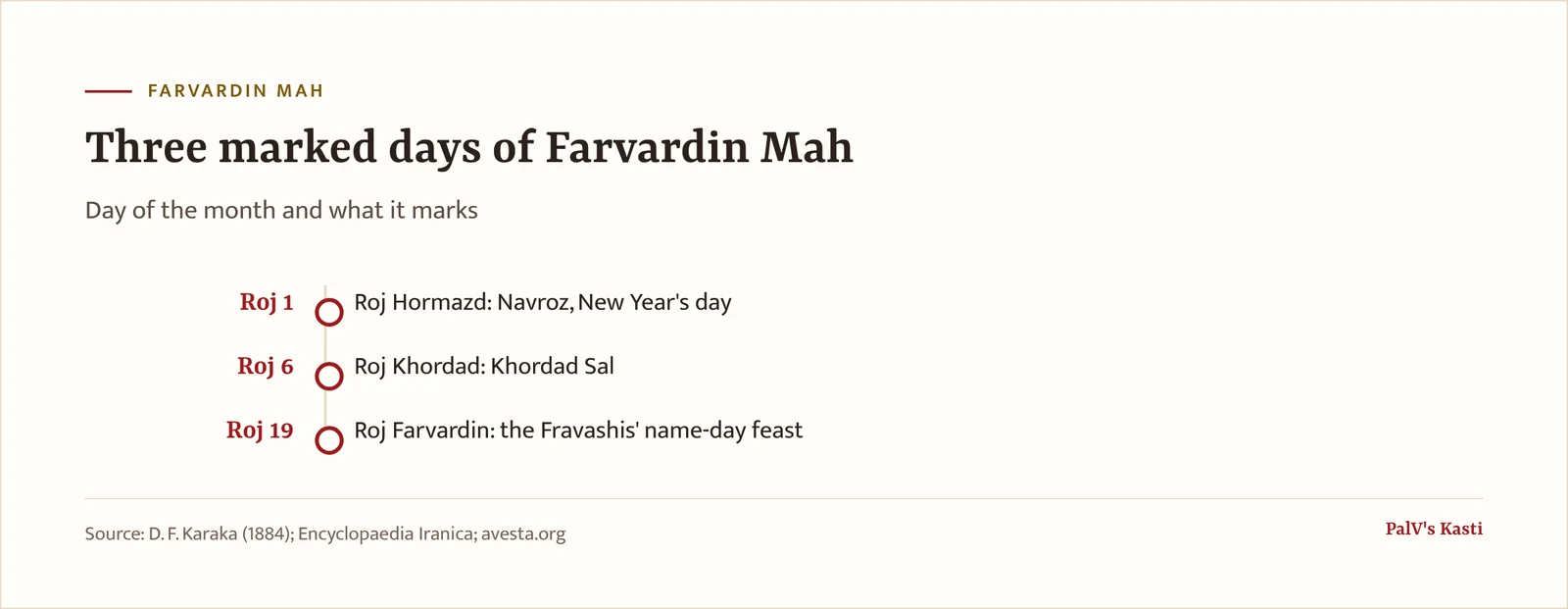
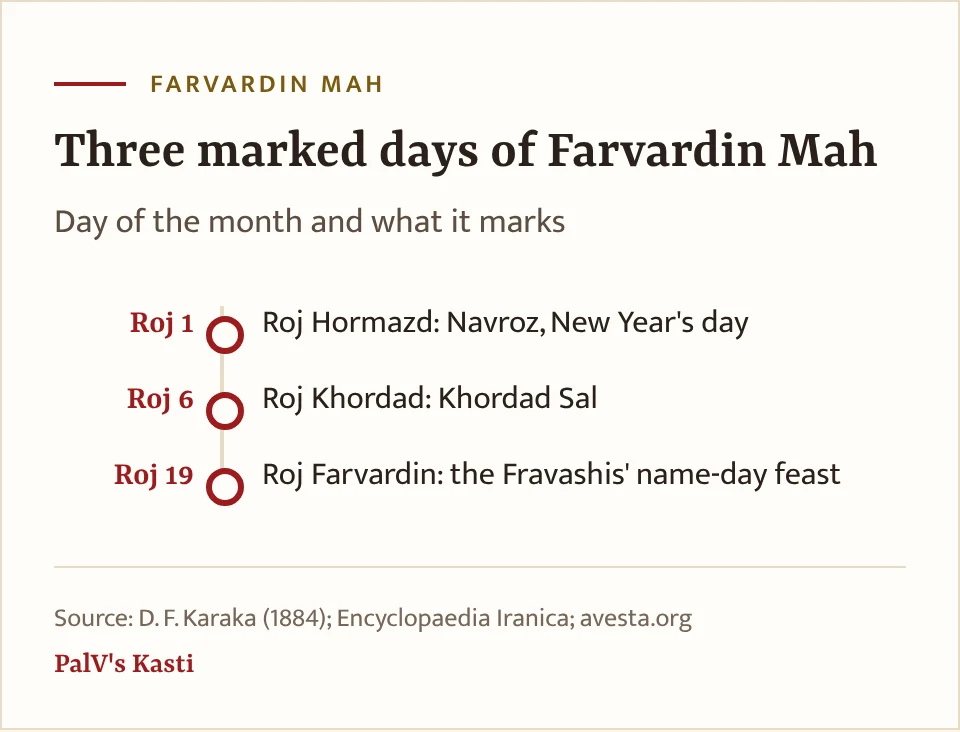
| Roj | Day of month | What it marks |
|---|---|---|
| Hormazd | 1 | New Year's day of the religious year (Navroz) |
| Khordad | 6 | Khordad Sal |
| Farvardin | 19 | The Fravashis' name-day feast (Farvardin Jashan) |
Roj Hormazd: Navroz
Dosabhai Framji Karaka, writing in his History of the Parsis (1884), described Parsi New Year's day under the name then in common use, Pateti, and called it "the day of Ahura Mazda in the month of Fravardin", adding that it "should be properly called Naoroz". avesta.org's calendar lists the day as "Noruz ('New Year's Day')".
Roj Khordad: Khordad Sal
Karaka says Khordad Sal marks events that took place "on the day of Khordad in the month of Fravardin", set out in a short Pehlevi tract. He adds that it was kept "in honour of the revelation of Ahura Mazda to Zarathushtra" and of the anniversary of the Prophet's birth. The community still keeps it that way. In August 2023 the Free Press Journal reported Parsis getting ready to celebrate Khordad Sal as "Prophet Zarathushtra's birth anniversary", and said he was born on the sixth day of the first month.
Roj Farvardin: Farvardin Jashan
Boyce describes this as the day when the devout, "especially those who have lost a relative during the year", "go to the daḵmas" and have ceremonies performed for the souls of their departed. A weekly scripture newsletter on avesta.org, signed "Soli", says the same of this day: most Parsis and Iranis go to the Doongerwadi in Mumbai, or the dokhma in other towns, where the mobeds perform the Farokhshi (Farvardin Yasht) for the departed. Our post on Farvardin Roj Parab covers the day in more detail.
Karaka also translated a Pehlevi tract on the days of the month, which he attributes to Adarbad Marespand, a dastur he places in the fourth century. Its entry for the 19th day calls it "the time (for the coming) of the Frohars (into this world)". It goes on to recommend the Yazashne, Darun, Myazd or Afringan "in the name of all the pious Frohars". Karaka noted that Adarbad's precepts "no longer form a guide" to daily life for the Parsis of his time.
Practice varies between families and Agiaries; your family priest's guidance comes first.
How does Farvardin Mah connect with Muktad?
The Fravashis are honoured on both sides of the turn of the year, and Muktad comes first. Malandra describes Frawardigan as a ten-day festival at the end of the year that "immediately preceded the New Year's festival". He adds that "among Parsis the term moktād is also used" and that "among the Parsis many observe an extended duration of eighteen days". Karaka says the same ten days, the last five of Spendarmad plus the five Gatha days, "are dedicated to the pious Frohars".
So the Fravashis are remembered in the ten days that close the old year, and their own name-day feast comes on Roj Farvardin, nineteen days into Farvardin Mah. The observance itself is covered in our guide to the Muktad days.
Practice varies between families and Agiaries; your family priest's guidance comes first.
What else changes when Farvardin Mah begins?
In the Bundahishn's reckoning the first month also starts the seven-month summer of the religious year. Summer runs from "the auspicious day Ohrmazd of the month Frawardin" to Roj Anagran of Mah Mihr, and in those seven months, the text says, the periods (gas) of day and night "are five". In that season Rapithwin "comes up from below-ground" to ripen the fruit of the trees. Karaka records that the Rapithwin ceremony, held on the third day of the first month, was "originally" meant "to announce the commencement of the summer", and that it no longer did so because the leap year had not been accounted for. What the season means for daily prayer is explained in our article on the Rapithwin Geh.
When does Farvardin Mah begin each year?
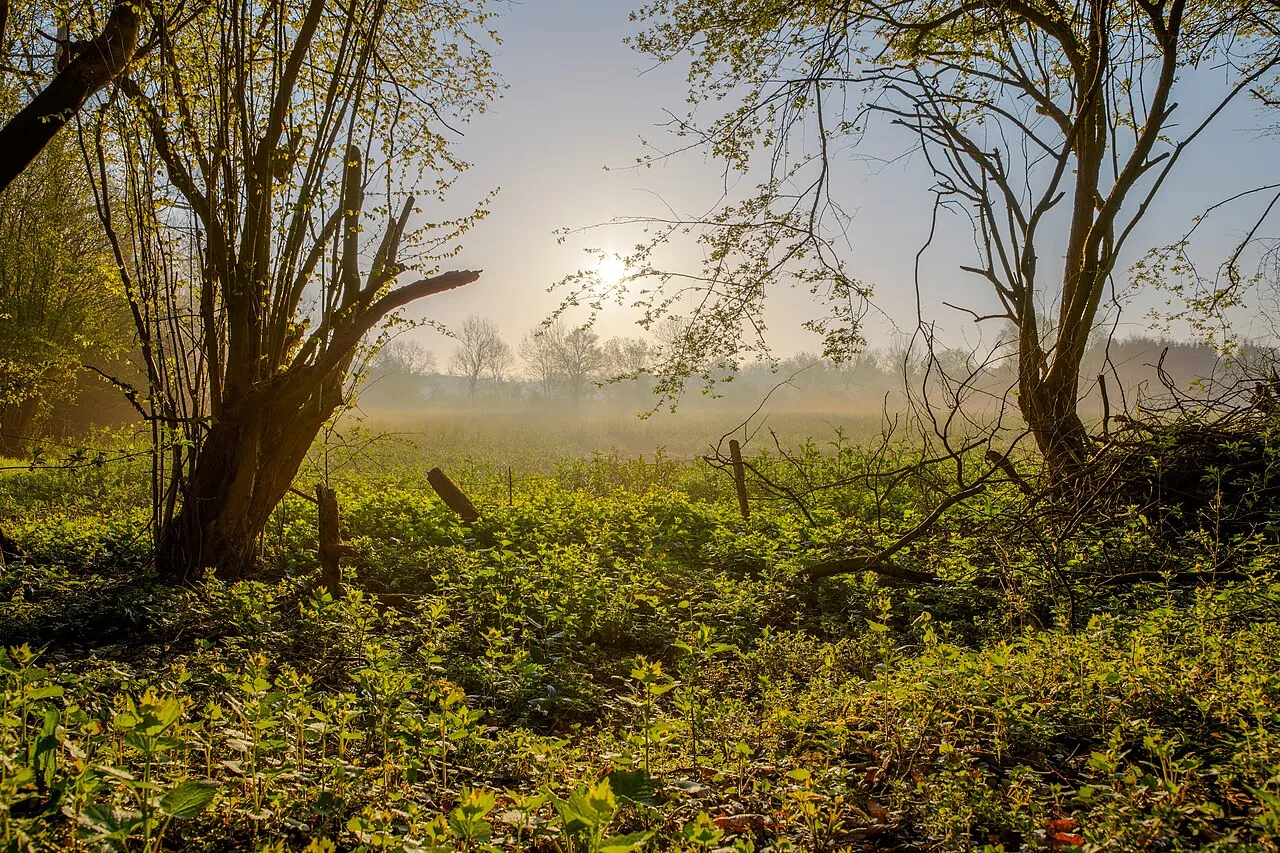
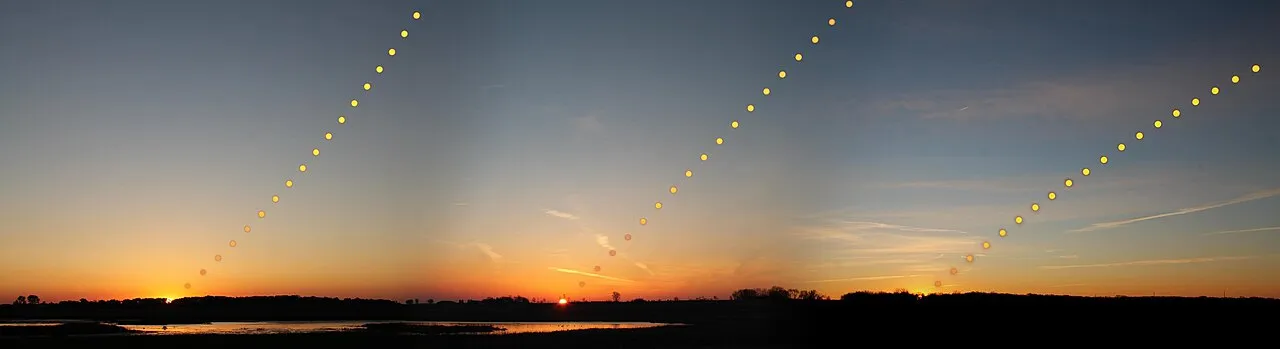
It depends on the calendar. avesta.org's feast table gives New Year's day, and so the start of Farvardin, as 21 March in the Fasli calendar. For the years 2016 to 2021 the same table puts the Shenshai New Year on 16 or 17 August and the Kadmi one on 17 or 18 July. Karaka noted the same one-month gap in 1884. Among the Kadmis, he wrote, the New Year "falls one month earlier than amongst the Shehenshais". Why the three calendars differ is covered in Shenshai, Kadmi and Fasli. For this year's dates, check our Parsi calendar.
Frequently asked questions
What is Farvardin Mah?
Farvardin Mah is the first month of the Zoroastrian religious year. It is named after the Fravashis, the guardian spirits of the faithful, who also preside over Roj Farvardin, the 19th day of every month. Encyclopaedia Iranica notes that in the Zoroastrian calendar both a day and a month are dedicated to the Fravashis.
Why is the 19th day of Farvardin Mah special?
Roj Farvardin falling in Mah Farvardin is the Fravashis' name-day feast, because the day and the month share one dedication. Mary Boyce records that on this day the devout, especially families bereaved during the year, go to the dakhmas and have ceremonies performed for departed relatives.
Is Khordad Sal in Farvardin Mah?
Yes. Khordad Sal falls on Roj Khordad, the sixth day of Farvardin Mah. D. F. Karaka wrote in 1884 that it honours the revelation to Zarathushtra and the anniversary of his birth, and the Free Press Journal reported in 2023 that Parsis celebrate it as the Prophet's birth anniversary.
What does "fravashi" mean?
There is no agreed meaning. Encyclopaedia Iranica lists several scholarly proposals, deriving the word from roots meaning "turn", "make or be pregnant" or "choice", or linking it to a hero-cult. Mary Boyce notes that scholars fall into two groups and calls the reading "choice" highly dubious.
Does Farvardin Mah start on the same date for all Parsis?
No. In the Fasli calendar Farvardin begins on 21 March. Between 2016 and 2021 avesta.org's table put the Shenshai New Year in mid-August and the Kadmi one a month earlier, in mid-July. For the current year's date, check a Parsi calendar such as ours.
How is Farvardin Mah linked to Muktad?
Muktad, or Frawardigan, is the ten-day observance at the end of the year, dedicated to the Fravashis, and Encyclopaedia Iranica notes that many Parsis keep it for eighteen days. It ends just as Farvardin Mah begins, so the Fravashis are remembered before Navroz and again on Roj Farvardin.