PalV's Kasti
On this page
Rapithwin Geh is recited for seven months of the Zoroastrian year, from Roj Hormazd of Mah Farvardin, the New Year day, to Roj Aneran, the last day of Mah Meher. From Roj Hormazd of Mah Avan until the last of the five Gatha days, Rapithwin isn't recited and Havan Geh is said at noon in its place, as the biji (second) Havan. The Bundahishn, a Pahlavi text, sets out this seven-month summer and five-month winter. The website of Dr Ramiyar P. Karanjia, Principal of the Dadar Athornan Institute, gives the same span for the second Havan, and so does Noshir H. Dadrawala, writing in Parsi Times in March 2025. Rapithwin comes back on the next Roj Hormazd of Mah Farvardin. For the Gregorian dates in your own calendar, look up those two Roj in our Parsi calendar.
શહેરેવર રોજ
Shehrevar Roj, Tir Mah · 1396 Y.Z.
What is the seven-month rule for Rapithwin?
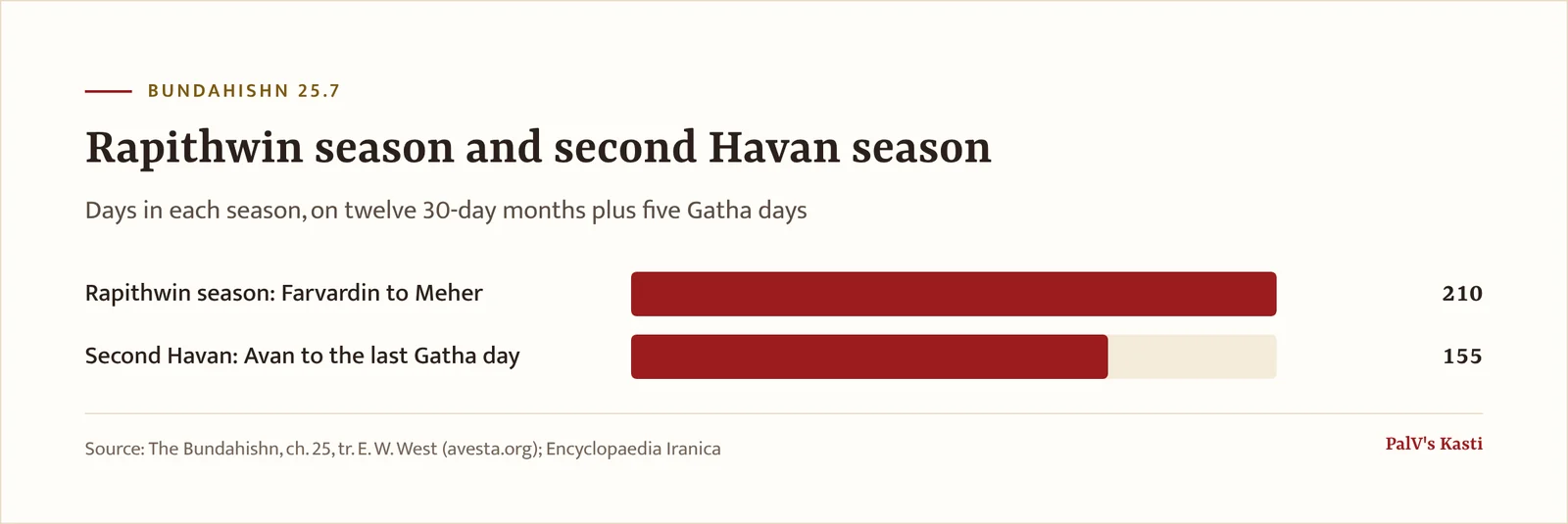
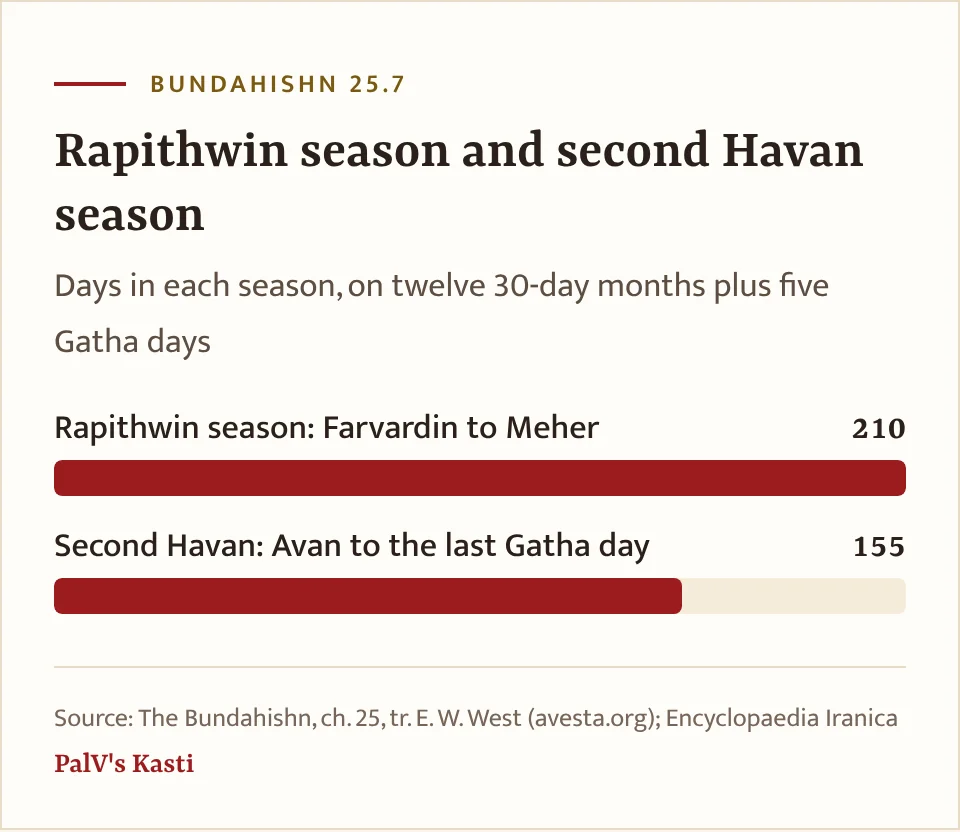
The rule comes from chapter 25 of the Bundahishn, the chapter on the religious year. In E. W. West's translation (Sacred Books of the East, volume 5), summer runs from Ohrmazd day of the month Frawardin to Anagran day of the month Mihr. Winter runs from Ohrmazd day of Aban, through Spandarmad, to the end of the five supplementary days (25.7).
Verse 25.9 then ties Rapithwin to that summer. In those seven months, it says, the day and night have five periods "since one celebrates the Rapithwin".
| Period | Starts | Ends | Length | Noon watch |
|---|---|---|---|---|
| Rapithwin season | Roj Hormazd, Mah Farvardin | Roj Aneran, Mah Meher | 7 months (210 days) | Rapithwin Geh |
| Second Havan season | Roj Hormazd, Mah Avan | Last of the five Gatha days | 5 months plus 5 days (155 days) | Havan Geh (second Havan) |
The day counts in the table are our own arithmetic on the structure of the year. Antonio Panaino writes in Encyclopaedia Iranica that "The Zoroastrian calendar consisted of twelve months of thirty days each". Seven such months make 210 days, and five months plus the five extra days make 155. Panaino also notes that those five extra days "took their names from the five Gathas". They're explained in our article on the five Gatha days.
On which day does Rapithwin stop?
On Roj Hormazd, the first day of Mah Avan, the eighth month. So the last Rapithwin Geh of the year is the one recited on Roj Aneran of Mah Meher.
The Bundahishn says that on Ohrmazd day of Aban the winter "acquires strength and enters into the world". The spirit of Rapithwin then goes from above the ground to below it (25.10). Dr Karanjia's website marks the same turn from the beginning of Avan Mah. Dadrawala's Parsi Times article puts the end of Rapithwan Gah on Roj Aneran of Mah Meher, "the last day of the seventh month".
What is recited at noon while Rapithwin is not observed?
Havan Geh. Dr Karanjia's website states that from the beginning of Avan Mah to the Vahishtoisht Gatha, "Rapithwan geh is not recited" and Havan Geh is said instead. It calls the Havan said at this time the biji (second) Havan Geh. Dadrawala writes that from Roj Hormazd of Mah Avan to the day of the last Gatha, the second Havan is observed instead of Rapithwan.
The Bundahishn describes the same arrangement in its own terms. In winter the day has four periods, not five, because from daybreak till Uzerin "is all Hawan" (25.10).
How the second Havan is timed within the day is covered in our article on the second Havan Geh.
Practice varies between families and Agiaries; your family priest's guidance comes first.
On which day does Rapithwin return?
On Roj Hormazd of Mah Farvardin, the first day of the new year. The Bundahishn says that as Ohrmazd day of Frawardin advances, winter's strength diminishes, and Rapithwin "comes up from below-ground" and ripens the fruit (25.13, 25.14). Dadrawala's article gives the same day, Roj Hormazd of Mah Farvardin, as the first on which Rapithwan Gah is observed.
What the return means, and how the traditions explain it, is covered in our guide to Rapithwin Geh, its meaning and the summer season.
Practice varies between families and Agiaries; your family priest's guidance comes first.
Is the seven-month rule about the weather?
No. It's a religious reckoning counted by Roj and Mah. The Bundahishn says the priest applies the summer-and-winter calculation to the rules about a corpse and other matters (25.8). The same chapter, separately, groups the year into four seasons of three months each, with Farvardin, Ardibehesht and Khordad as spring (25.20). So the "summer" of Rapithwin and the hot weather outside are two different things.
Why the Parsi calendars move against the solar year is the subject of our article on the astronomy behind the Parsi calendar.
How do you find this year's Rapithwin dates?
Look up two days in the calendar your family and Agiary follow: Roj Hormazd of Mah Avan, when the second Havan begins, and Roj Hormazd of Mah Farvardin, when Rapithwin returns. We don't print Gregorian dates here, because they differ between calendars and we couldn't confirm them from two sources. Our Parsi Roj calendar shows the Roj and Mah for any date. If you're unsure which calendar applies to you, our explainer on Shenshai, Kadmi and Fasli sets out the difference between the three.
Frequently asked questions
For how many months is Rapithwin Geh recited?
Seven. The Bundahishn (chapter 25, E. W. West's translation) counts a summer of seven months, from Ohrmazd day of Farvardin to Anagran day of Meher, and says the day has five watches in those months because Rapithwin is celebrated. With the 30-day months Antonio Panaino describes, that comes to 210 days.
When does the second Havan begin?
On Roj Hormazd of Mah Avan, the first day of the eighth month. Dr Ramiyar Karanjia's website states that from the beginning of Avan Mah to the Vahishtoisht Gatha, Havan Geh is recited instead of Rapithwan. The Bundahishn places the start of winter on the same day, Ohrmazd of the month Aban.
Is Rapithwin recited during the Gatha days?
No. The Bundahishn counts the five supplementary days at the end of the year as part of the five-month winter, when Rapithwin is not celebrated. Dr Karanjia's website runs the second Havan to the Vahishtoisht Gatha, and Noshir Dadrawala in Parsi Times to the last Gatha day, so Havan Geh is recited at noon.
When is Rapithwin Geh first recited again?
On Roj Hormazd of Mah Farvardin, the New Year day. The Bundahishn says Rapithwin comes up from below the ground as that day advances, and ripens the fruit on the trees. Noshir Dadrawala, writing in Parsi Times in March 2025, also gives Roj Hormazd of Mah Farvardin as the first day Rapithwan Gah is observed.
Where does the seven-month rule come from?
From chapter 25 of the Bundahishn, the Pahlavi chapter on the religious calendar. Verse 25.7 defines a seven-month summer and five-month winter, verse 25.9 gives five watches in summer, and verses 25.10 to 25.14 describe Rapithwin going below ground in winter and returning on Ohrmazd day of Farvardin.