PalV's Kasti
On this page
- How is the 365-day Parsi year built?
- How long is the solar year the calendar has to match?
- How fast does a 365-day calendar drift?
- How was the drift meant to be corrected?
- Where has the drift taken the Parsi New Year?
- Does the Kadmi calendar drift too?
- How does the Fasli calendar stop the drift?
- Frequently asked questions
The Parsi calendar has 12 months of 30 days plus five Gatha days, a year of exactly 365 days. The sun does not keep to that count. The old Zoroastrian method of correction was built on a solar year of 365¼ days, so a plain 365-day calendar falls behind by a quarter of a day every year. That comes to one day every four years and a whole 30-day month every 120 years, and the traditional remedy was to add an extra month every 120 years. Without regular adjustment, the Shahenshahi (Shenshai) New Year has moved away from spring and now falls in August. In 2026 it fell on Saturday, 15 August. The Fasli calendar avoids this by using leap-year adjustments to stay with the spring equinox.
શહેરેવર રોજ
Shehrevar Roj, Tir Mah · 1396 Y.Z.
How is the 365-day Parsi year built?
The Parsi year is built from twelve 30-day months and five extra days. Antonio Panaino, writing in the Encyclopaedia Iranica, states that the Zoroastrian calendar had "twelve months of thirty days each", and that the five extra days "took their names from the five Gathas". FEZANA's calendar lesson plan for children sets out the same sum: 12 months of 30 days, plus five "Gathas days" added after the 12th month to make a 365-day year. Dosabhai Framji Karaka described the Parsi year the same way in his 1884 History of the Parsis.
| Part of the year | Count | Days |
|---|---|---|
| Months (Mah) of 30 days | 12 | 360 |
| Gatha days at the year's end | 5 | 5 |
| Total | 365 |
Why the year is built as 360 plus 5 is covered in our article on the 360+5 structure of the Zoroastrian year. This page is about what happens when that 365-day count meets the sun.
How long is the solar year the calendar has to match?
The Zoroastrian tradition took the solar year to be about 365¼ days. Reza Abdollahy's Encyclopaedia Iranica article on calendars in the Islamic period describes the old Zoroastrian method of intercalation as "based on a solar year of 365 1/4 days". Panaino likewise speaks of correcting "the cumulative lag of an additional quarter-day" each year.
Al-Biruni's figures give a slightly longer year. Panaino notes that multiplying al-Biruni's figures gives 365.2586 days, and sets this beside the sidereal year of 365.25636 days. For the arithmetic of the Parsi calendar, the quarter day is the figure the tradition itself used.
How fast does a 365-day calendar drift?
A 365-day calendar falls behind the seasons by about one day every four years. That follows directly from the quarter-day shortfall the Iranica sources give.
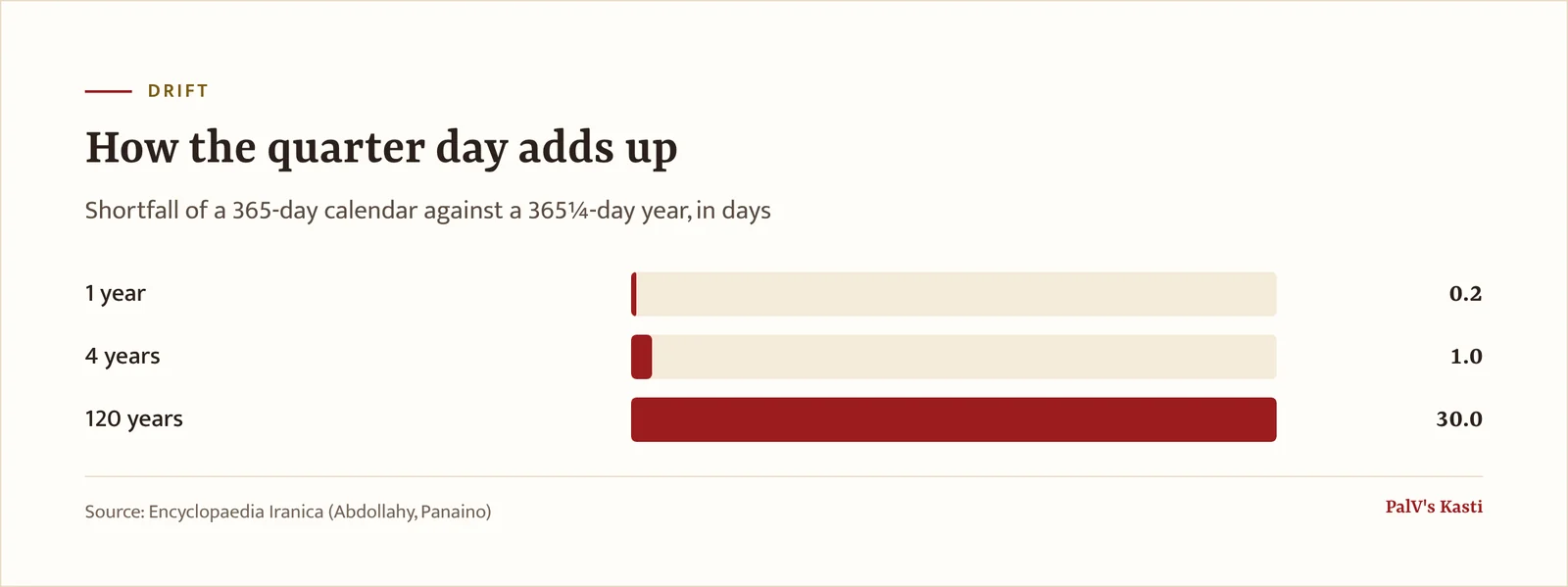

| Years of a 365-day calendar | Shortfall against a 365¼-day year |
|---|---|
| 1 | ¼ day |
| 4 | 1 day |
| 120 | 30 days, one full month |
The last row is the reason the number 120 matters. Abdollahy describes a cycle of ordinary 365-day years in which a 30-day month was added after 120 years, thirty being 120 x ¼.
How was the drift meant to be corrected?
The traditional correction was to add one whole month every 120 years, not a day every four years. Panaino writes that the quarter-day lag was corrected, at least in theory, by inserting one month every 120 years. He also reports a second system described by the medieval scholar al-Biruni: one month inserted "in every 116 years", to recover the quarter-days plus a fifth of an hour a year.
Whether this correction was actually carried out, and how often, is disputed. We set the accounts out here without taking a side.
- Panaino states plainly: "The sources are contradictory". He reports al-Biruni's account that under Yazdegerd son of Shapur (399-420) "two extra months were inserted", one to make up the lag and one to forestall future error. He also reports the astronomer Kushyar's account that intercalation stopped and was "reintroduced in 375 Yazdegerdī (a.d. 1006)".
- Karaka, writing in 1884, reports that the Zoroastrians of Iran gave up the 120-year intercalation after they lost their kingdom, while the Parsis "are reported to have once intercalated" while living in Khorasan. That one difference, he says, is what brought the two Parsi sects into being.
The quarrel that followed in India is told in our article on the Kadmi split.
Where has the drift taken the Parsi New Year?
The drift has carried the first day of Farvardin, the Parsi New Year, away from the spring equinox. Karaka put it in one line in 1884: had the intercalations been kept up regularly, the Parsi New Year would fall on 21 March, the start of the solar year.
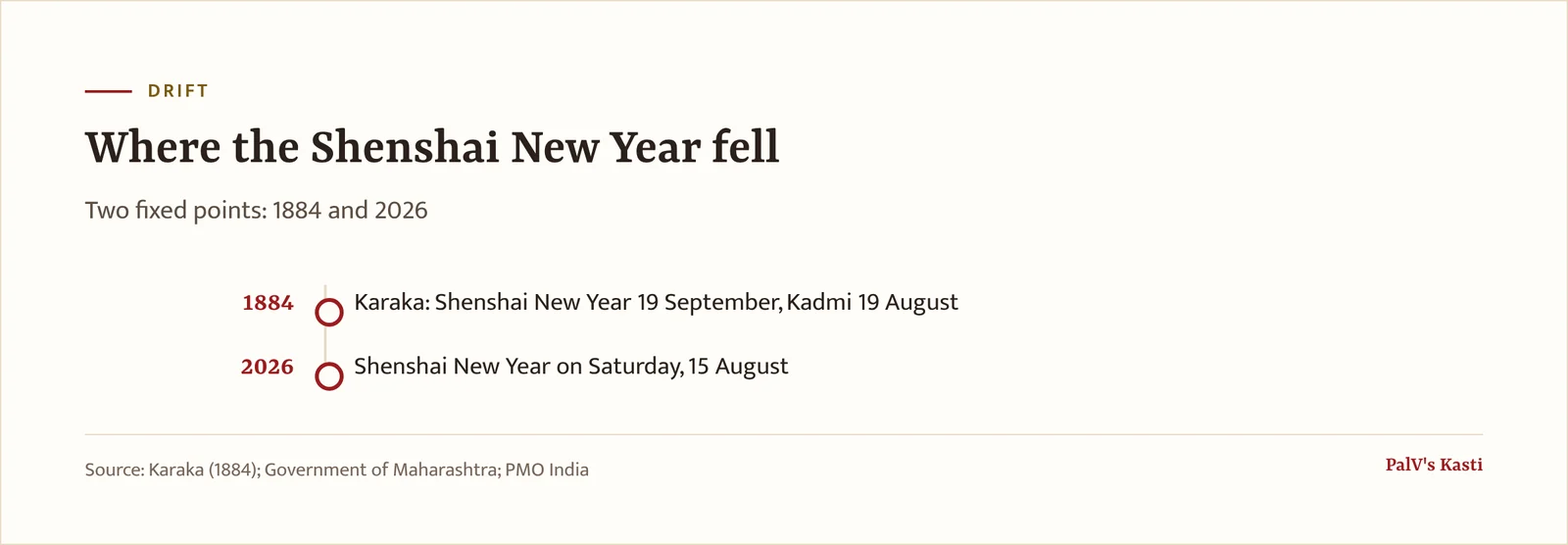
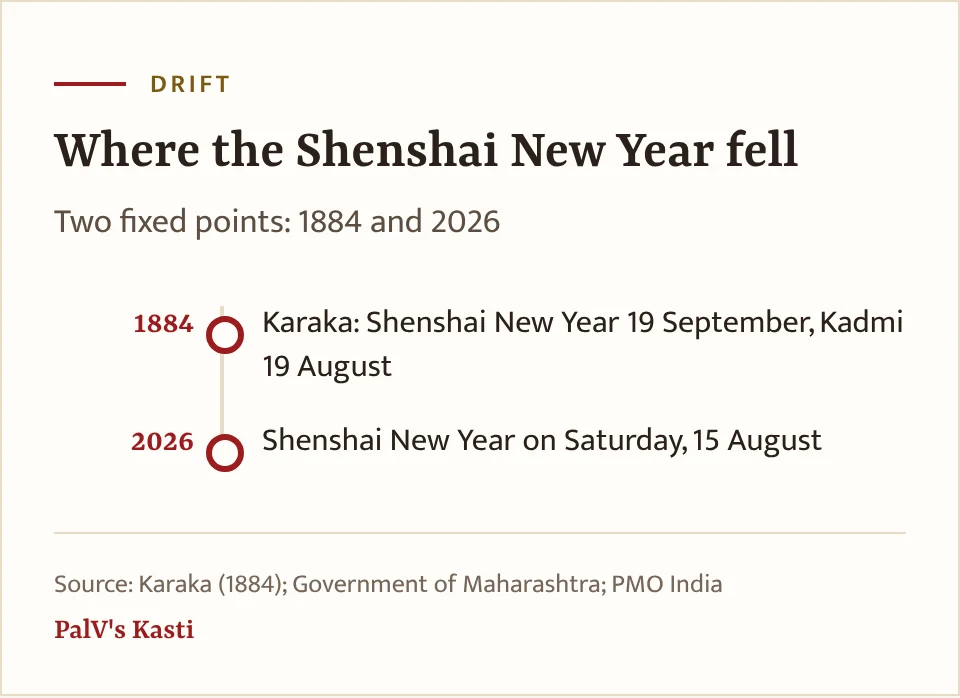
Two fixed points show the movement since then. Karaka gives the Shenshai New Year of his day as 19 September, and the Kadmi New Year as 19 August. In 2026 the Shenshai New Year fell on 15 August: the Government of Maharashtra's 2026 public holiday notification lists "Parsi New Year (Shahenshahi)" on Saturday, 15 August 2026, and the Prime Minister's Office posted greetings on the start of the Parsi New Year that same day. That is 35 days earlier in the Gregorian year than in Karaka's time.
The Zoroastrian Society of British Columbia explains why: the Shenshai calendar drifted away from the seasons "because leap-year adjustments were not consistently applied", and the New Year now falls in August. To see where any Gregorian date falls in Roj and Mah, use our Parsi calendar. Why there are now two Parsi New Years, one in August and one in March, is the subject of our article on the two Parsi New Years.
Does the Kadmi calendar drift too?
Yes. The Kadmis follow the Iranian reckoning: Ramiyar P. Karanjia's Encyclopaedia Iranica entry records that a Surat group adopted the Irani calendar in 1745, and most Parsis kept the old one. Karaka, for his part, says the Iranian Zoroastrians had stopped intercalating altogether. So, on Karaka's account, the Kadmi year is also a plain 365-day count, and Karaka's two dates, 19 August for the Kadmis and 19 September for the Shenshais, show both New Years sitting a month apart in late summer. Why the two calendars are a month apart is covered in our article on why Kadmi and Shenshai New Years are a month apart, and the calendar itself in the Kadmi calendar.
How does the Fasli calendar stop the drift?
The Fasli calendar stops the drift by adding leap-year days, so its New Year stays at the spring equinox. The Zoroastrian Society of British Columbia says the Fasli calendar keeps the New Year in step with the spring equinox "through the use of leap-year adjustments". FEZANA describes it as set up to start "the new year on the Spring Equinox (21st March)". The Fasli structure and its leap day are explained in our article on the Fasli calendar, and all three calendars are compared in our guide to Shenshai, Kadmi and Fasli.
Frequently asked questions
Why does the Parsi calendar drift?
The Parsi calendar drifts because its year is exactly 365 days, while the Zoroastrian tradition reckoned the solar year at about 365¼ days. The missing quarter day adds up to one day every four years. The Shahenshahi calendar has not applied leap-year adjustments consistently, so its New Year has moved away from spring into August.
How much does the Parsi calendar lose each year?
A 365-day Parsi year falls about a quarter of a day short of the 365¼-day solar year on which the old Zoroastrian correction was based. Over four years the shortfall is one day. Over 120 years it reaches 30 days, which is why the traditional remedy was to add a full month every 120 years.
What was the 120-year rule?
The 120-year rule was the traditional way of correcting the 365-day Zoroastrian year. Instead of a leap day every four years, a whole extra month of 30 days was to be added every 120 years. Encyclopaedia Iranica notes that al-Biruni also described a variant with one month every 116 years.
Did the Parsis ever add the extra month?
Karaka's 1884 History of the Parsis reports that the Parsis are said to have intercalated once, while living in Khorasan, and not again in India. Medieval accounts reported by Antonio Panaino in the Encyclopaedia Iranica describe intercalations in Iran, but he notes that the sources contradict each other.
Does the Fasli calendar drift?
No. FEZANA says the Fasli calendar was set up to start the new year on the spring equinox, 21 March, and the Zoroastrian Society of British Columbia says it uses leap-year adjustments to stay there. The Shahenshahi calendar has not applied those adjustments consistently, so it drifts, and the Kadmi calendar drifts with it.
How far has the Shenshai New Year moved since the 1880s?
Dosabhai Framji Karaka gave the Shenshai New Year of his day as 19 September in his 1884 History of the Parsis. In 2026 it fell on 15 August, according to the Government of Maharashtra's holiday notification and the Prime Minister's Office. That is 35 days earlier in the Gregorian year.