PalV's Kasti
On this page
The new year of Parsis comes twice because two different ways of counting the year are in use. The religious New Year, Navroz, is Roj Hormazd of Mah Farvardin, the first day of the year, in the Shahenshahi (Shenshai) calendar. Encyclopaedia Iranica notes that most Parsis kept this reckoning and "are known as Shenshahis". That calendar runs 365 days with no leap-year correction, so its New Year has slipped away from spring and now falls in mid-August, as Ervad Ramiyar Karanjia notes. In 2026 it fell on Saturday, 15 August: the Comptroller and Auditor General of India's 2026 holiday list gives "Parsi New Year's Day / Nauraj" on that date, and Maharashtra's 2026 list, as reported by Sakshi Post, put "Parsi New Year (Shahenshahi)" on the same Saturday. Jamshedi Navroz is different. It is kept on 21 March, the spring equinox, and is named after the legendary King Jamshed. The Fasli calendar also begins its year on that March date.
શહેરેવર રોજ
Shehrevar Roj, Tir Mah · 1396 Y.Z.
What is the New Year of Parsis called?
The New Year of Parsis is called Navroz, also spelt Nowruz. The word means "new day" in Persian, as the United Nations explains for the wider Nowruz. Karanjia glosses the Parsi Navroz as "the new (year) day", celebrated on Roj Hormazd of Mah Farvardin.
The name is shared, but the date is not. The Pluralism Project at Harvard University notes that Zoroastrians today follow three religious calendars, Fasli, Shenshai and Kadmi, and that "three New Year celebrations are also observed".
Why does the Parsi New Year fall in August?
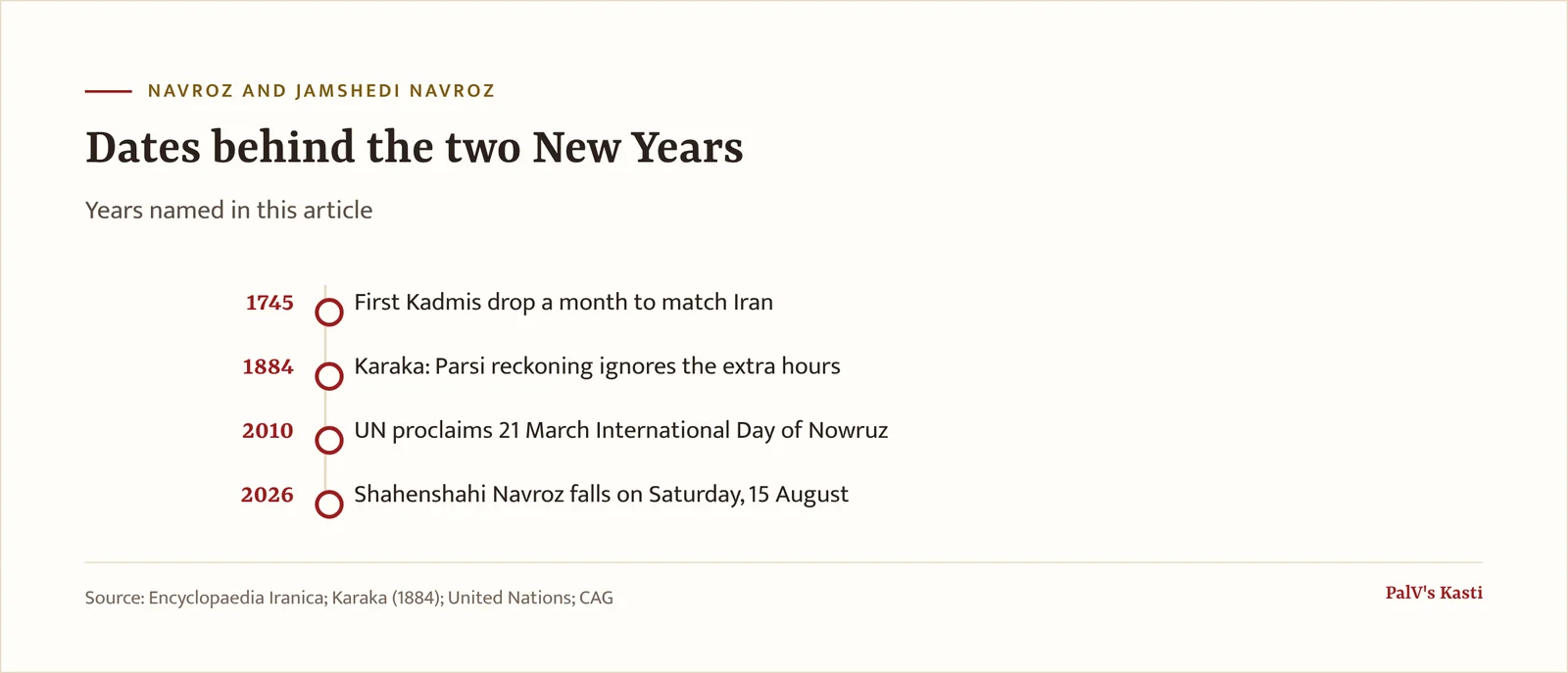
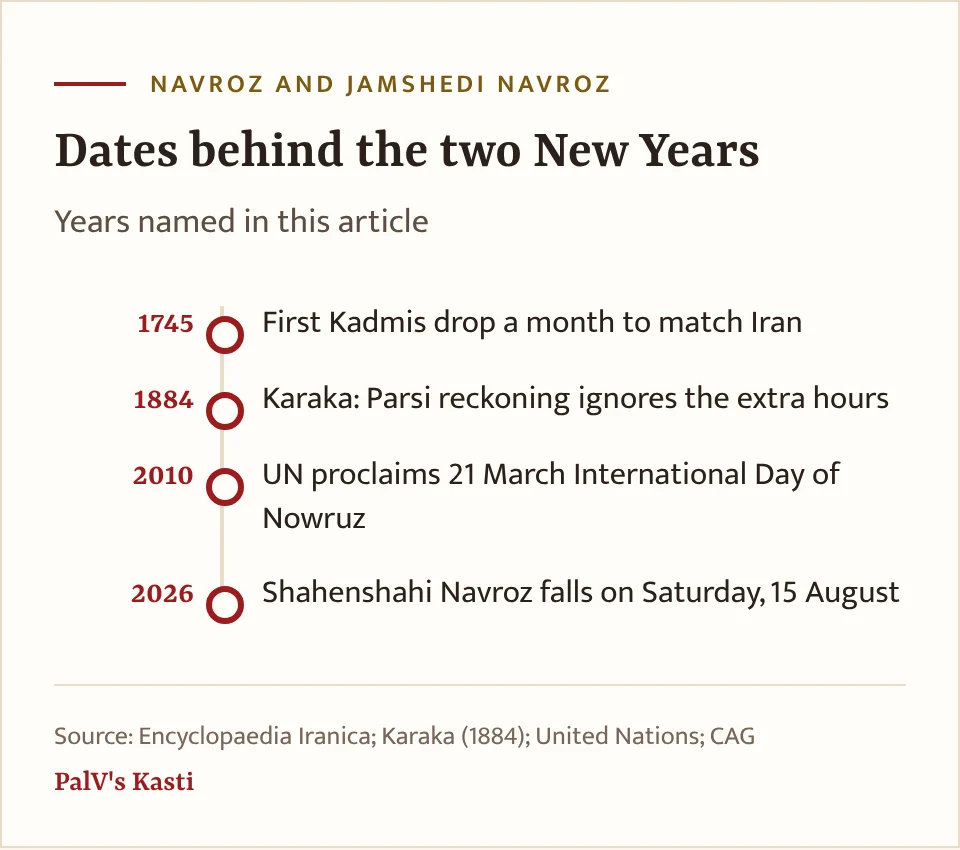
The August Navroz falls where it does because the Shahenshahi year is exactly 365 days long. The solar year is about a quarter-day longer, and Dosabhai Framji Karaka's 1884 History of the Parsis records that those extra hours "are not taken into consideration" in Parsi reckoning. A quarter-day a year adds up to a full day every four years.
The old Zoroastrian remedy, according to Reza Abdollahy's entry on calendars in the Islamic period in Encyclopaedia Iranica, rested on a solar year of 365 1/4 days: a normal year of 365 days, with "an extra month of thirty (120 x 1/4) days" added after 120 years. Once that extra month stopped being added, the first of Farvardin kept moving through the seasons. Our article on the astronomy behind the Parsi calendar works through the arithmetic.
The holiday lists show the result. The CAG's 2026 list of closed and restricted holidays gives Parsi New Year's Day on Saturday, 15 August 2026. In Maharashtra it fell on Independence Day, and Sakshi Post reported that the two holidays were observed together that year. For the date in any other year, use our Parsi calendar.
What is Jamshedi Navroz and why is it on 21 March?
Jamshedi Navroz is a New Year kept on 21 March, at the spring equinox, and named after King Jamshed. The Parzor Foundation, in its Google Arts & Culture exhibition "Jamshedi-Navroze", says that Zoroastrians in India keep it "as the New Year" on the vernal equinox, 21 March, every year. The Pluralism Project likewise says Jamshedi Navroz "takes its name from King Jamshed" and falls at the spring equinox.
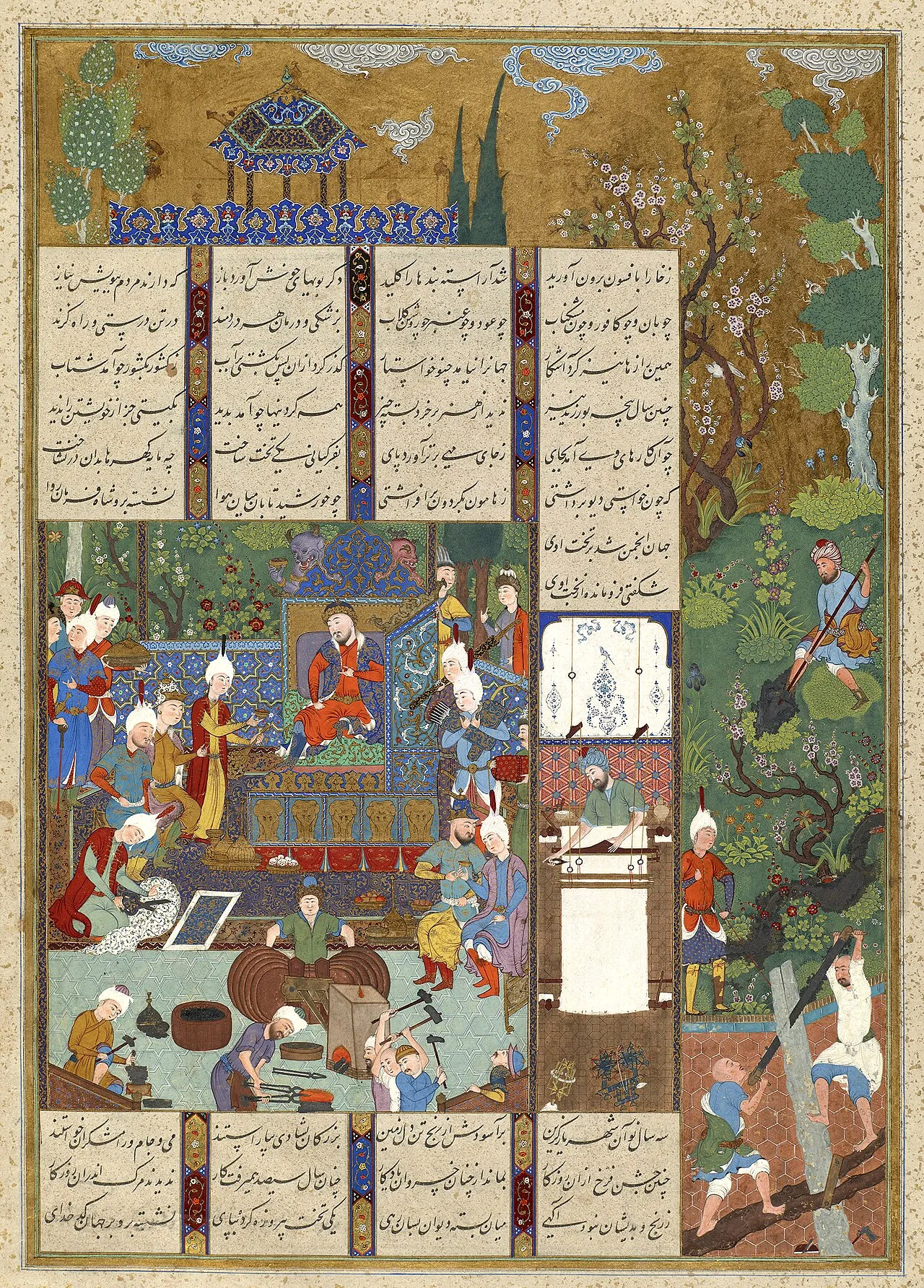
Who was Jamshed? Parzor points to Firdausi's Shah Nameh, the Book of Kings, as the text that credits the origin of Navroze to a legendary king of Persia, "Jamshed son of Tehmooraz of the Peshdadian dynasty".
The March date is also the Nowruz of the wider Iranian world. The UN General Assembly proclaimed 21 March as the International Day of Nowruz in resolution A/RES/64/253 of 2010, and India is one of the 13 states named on UNESCO's listing of Nowruz as intangible cultural heritage.
Which New Year belongs to which Parsi calendar?
Each of the three calendars places the first day of Farvardin on a different Gregorian date. The table sets out what the sources say.
| Calendar | When its New Year falls | What the sources say |
|---|---|---|
| Shahenshahi (Shenshai) | Mid-August; 15 August in 2026 | Karanjia places it in mid-August; the CAG's 2026 list gives 15 August |
| Kadmi | Mid-July, one month before the Shahenshahi | Karanjia places it in mid-July; FEZANA says the Kadmi calendar "differs by one month" from the Shahenshahi; the first Kadmis dropped a month in 1745, per Encyclopaedia Iranica |
| Fasli | 21 March, the spring equinox | FEZANA says it was set up to start the year on the spring equinox, 21 March; Karanjia says its Navroz is the same as Jamshedi Navroz |
So for a Fasli Zoroastrian, the March date is the religious New Year itself. For a Shahenshahi Parsi, the religious Navroz comes in August, and Jamshedi Navroz in March is a separate day. Our guide to Shenshai, Kadmi and Fasli compares the three calendars in full, and the Shahenshahi (Shenshai) calendar explains the reckoning most Parsis follow. For how the March New Year relates to each calendar, see Jamshedi Navroz and the three calendars. The one-month gap is explained in why the Kadmi and Shenshai New Years are a month apart.
Practice varies between families and Agiaries; your family priest's guidance comes first.
How can you check the Navroz date for a given year?
The August date moves, so check it each year rather than assuming. Government holiday lists, such as the CAG's list of closed and restricted holidays, name Parsi New Year's Day with its Gregorian date. To see the Roj and Mah for any day, including the first of Farvardin, use our Parsi Roj calendar.
Frequently asked questions
When was the Parsi New Year in 2026?
The Shahenshahi Parsi New Year fell on Saturday, 15 August 2026. The Comptroller and Auditor General of India's 2026 holiday list gives Parsi New Year's Day on that date, and Maharashtra's list put Parsi New Year (Shahenshahi) on the same day. Because 15 August is also Independence Day, the two holidays were observed together.
Why do Parsis celebrate two New Years?
Parsis celebrate two New Years because two reckonings are in use. The religious Navroz follows the Shahenshahi calendar, a 365-day year without leap-year correction, so it now falls in mid-August. Jamshedi Navroz is kept on 21 March, the spring equinox, and is named after the legendary King Jamshed, as Parzor and Harvard's Pluralism Project note.
Is Jamshedi Navroz the same as the Parsi New Year?
Not for most Parsis in India. Their religious New Year is Roj Hormazd of Mah Farvardin in the Shahenshahi calendar, which fell on 15 August in 2026. Jamshedi Navroz is kept on 21 March. For Zoroastrians who follow the Fasli calendar, however, 21 March is the start of their religious year, as Karanjia notes.
Who was King Jamshed?
King Jamshed is a legendary king of Persia of the Peshdadian dynasty, the son of Tehmooraz, as the Parzor Foundation describes him. Firdausi's Shah Nameh, the Book of Kings, credits him with the origin of Navroze. Harvard's Pluralism Project notes that Jamshedi Navroz takes its name from him and falls at the spring equinox.
What does the word Navroz mean?
Navroz, also spelt Nowruz, means "new day" in Persian, as the United Nations explains. Its General Assembly proclaimed 21 March as the International Day of Nowruz in 2010. For Parsis, Ervad Ramiyar Karanjia glosses Navroz as the new year day, celebrated on Roj Hormazd of Mah Farvardin, the first day of the year.
Why does the date of the August Navroz shift over time?
The August Navroz shifts because a 365-day year is about a quarter-day shorter than the solar year, which adds up to a day every four years. Karaka recorded in 1884 that Parsi reckoning ignores those extra hours. Without a leap-year correction, the Shahenshahi first of Farvardin keeps moving, which is why it now falls in August.