PalV's Kasti
On this page
- What is Jamshedi Navroz?
- How does Jamshedi Navroz relate to the Fasli calendar?
- How does Jamshedi Navroz relate to the Shenshai calendar?
- How does Jamshedi Navroz relate to the Kadmi calendar?
- Did the religious New Year ever fall on the spring equinox?
- Is Jamshedi Navroz fixed on 21 March, or tied to the equinox?
- Frequently asked questions
Jamshedi Navroz is the spring New Year, named after King Jamshed and placed by J. J. Modi (1922) on 21 March, the day of the vernal equinox. How it relates to the three Parsi calendars depends on which one a family follows. In the Fasli calendar it is the religious New Year itself, because the Fasli Navroz is fixed on 21 March. In the Shenshai and Kadmi calendars it is a separate day. Their religious New Year, Roj Hormazd of Mah Farvardin, now falls in August and July, so Jamshedi Navroz sits about four to five months earlier. Modi wrote that the Parsi New Year "corresponded at one time" with the Jamshedi Naoroz day but no longer did, because the Parsis had stopped intercalating.
શહેરેવર રોજ
Shehrevar Roj, Tir Mah · 1396 Y.Z.
What is Jamshedi Navroz?
Jamshedi Navroz is the New Year day of the spring equinox, named after Jamshed. Jivanji Jamshedji Modi, in The Religious Ceremonies and Customs of the Parsees (1922), calls 21 March "the day of the Vernal Equinox" and the Jamshedi Naoroz day. He explains the name by citing Firdousi: Jamshed, a king of the Peshdadian dynasty, "first observed it with eclat" on the equinox.

The Jamshed link is much older than Modi. In his Chronology of Ancient Nations, translated by C. Edward Sachau in 1879, al-Biruni collected Persian accounts tying the day to Jamshid, including one in which Jamshid "renovated the religion", and the day of his work "was called New-Day".
Today Jamshedi Navroz sits alongside the community's other New Years. Noshir H. Dadrawala, writing in Parsi Times in 2017, lists "three of our own": Jamshedi Navroz on 21 March, the Kadmi New Year and the Shenshai New Year. He adds that the community celebrates Jamshedi Navroz as "Nature's New Year" on or around 21 March.
Why Parsis have two New Years at all is a separate question, answered in our article on the two Parsi New Years. This page looks only at how the March date sits inside each calendar.
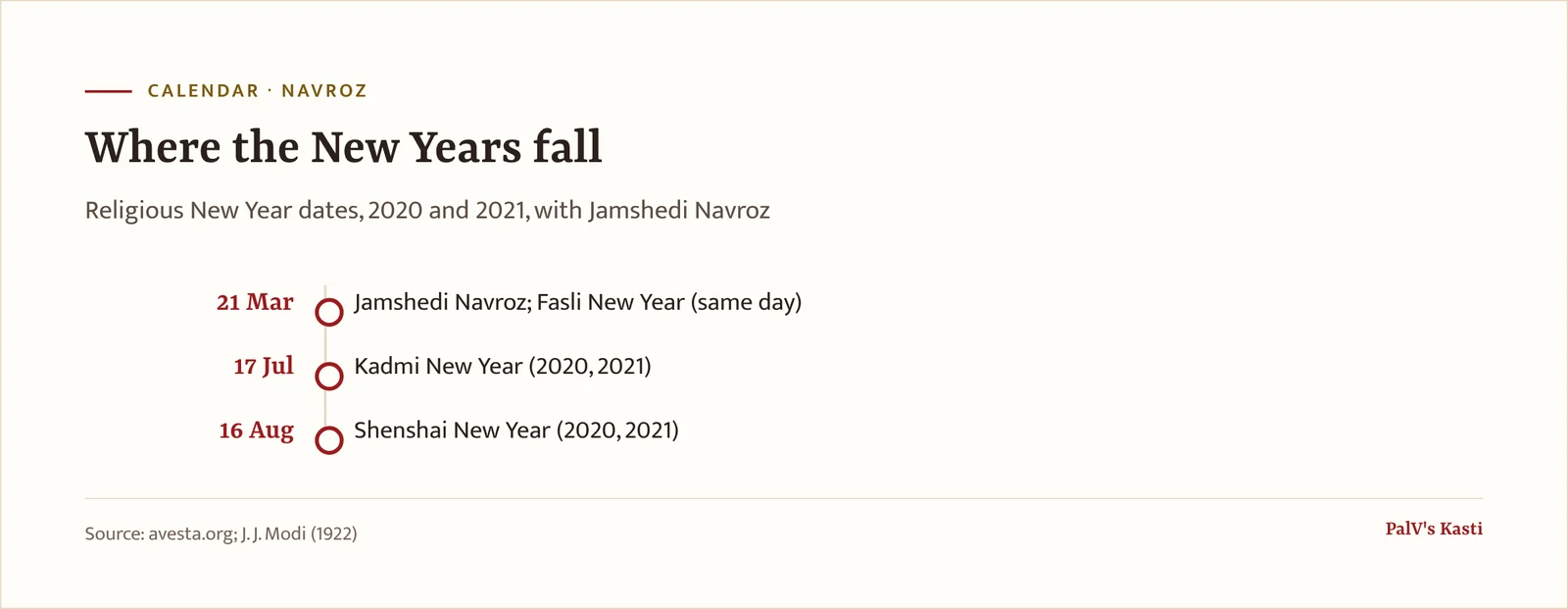
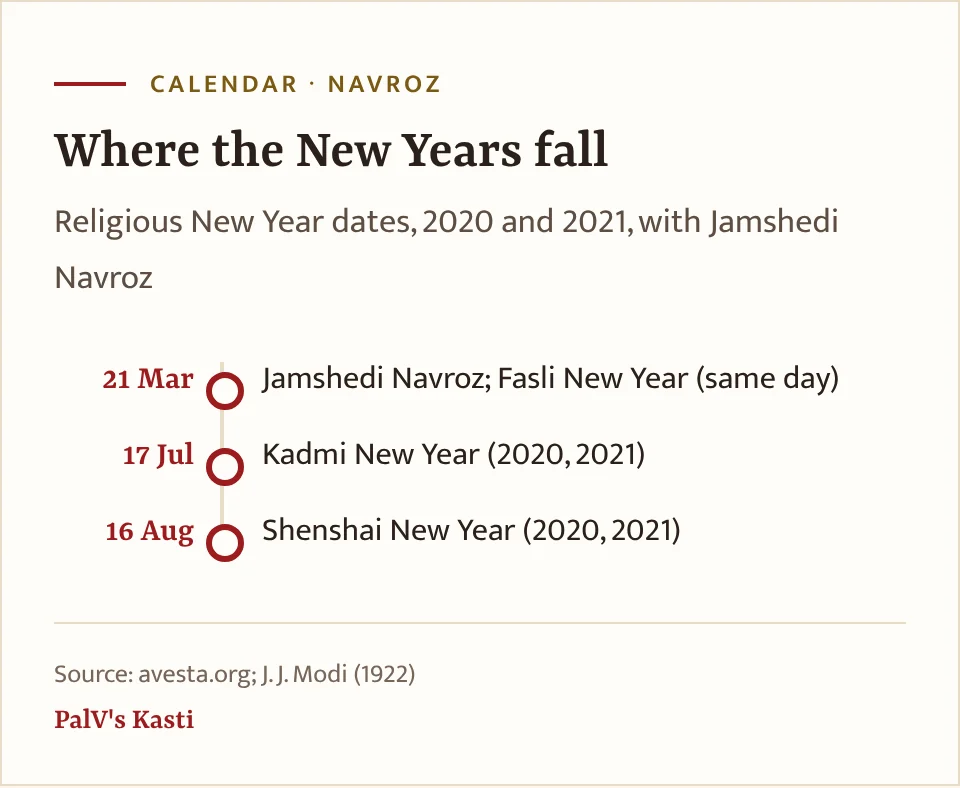
| Calendar | Religious New Year (Roj Hormazd, Mah Farvardin), 2016 to 2021 | How 21 March relates to it |
|---|---|---|
| Fasli | 21 March every year | Same day: Jamshedi Navroz and the Fasli New Year coincide |
| Shenshai (Shahenshahi) | 17 August (2016 to 2019), 16 August (2020, 2021) | Separate day, about five months earlier |
| Kadmi | 18 July (2016 to 2019), 17 July (2020, 2021) | Separate day, about four months earlier |
The New Year dates in this table come from the religious calendar published on avesta.org. For any other year, check our Parsi calendar.
How does Jamshedi Navroz relate to the Fasli calendar?
In the Fasli calendar, Jamshedi Navroz and the religious New Year fall on the same day. Mary Boyce, in Encyclopaedia Iranica, describes the Fasli calendar as one "with a fixed Nowruz on 21 March", kept in place by "a day intercalated every fourth year after the epagomenae". FEZANA's teaching notes say the Fasli calendar was instituted in 1906 to start the new year on the spring equinox, 21 March. Dadrawala credits its introduction in India to the scholar K. R. Cama and notes that it "never gained much popularity in India".
So a Fasli family's first day of Farvardin is the same 21 March that Modi calls the Jamshedi Naoroz day. That was the point of the reform. Its leap day stops the date from moving, and avesta.org lists the Fasli Noruz on 21 March in every year from 2016 to 2021. How the calendar is built is covered in the Fasli calendar.
How does Jamshedi Navroz relate to the Shenshai calendar?
In the Shenshai calendar, Jamshedi Navroz and the religious New Year are two different days, about five months apart. The avesta.org calendar lists the Shenshai Noruz on 17 August from 2016 to 2019 and on 16 August in 2020 and 2021. Jamshedi Navroz stays in March.
Modi explains how the two came apart. The Parsi New Year's day "corresponded at one time with the Jamshedi Naoroz day", but because the Parsis "have ceased to observe intercalation since their imigration to India", it no longer falls on 21 March. Elsewhere in the same book he says that "since the Arab conquest of Persia, the Parsees have not been regularly keeping the leap year".
For a Shenshai family, then, Jamshedi Navroz is a March observance that sits apart from the Shenshai Roj and Mah count. Which Roj and Mah it lands on in a given year is a conversion question, covered in converting Parsi dates.
How does Jamshedi Navroz relate to the Kadmi calendar?
It isn't the Kadmi religious New Year either. Boyce writes that the Shenshai calendar "was a month behind" that of the Persian Zoroastrians, whose calendar came to be called "the Qadimi (Parsi Kadmi)". So the Kadmi New Year falls about a month before the Shenshai one. The avesta.org calendar lists the Kadmi Noruz on 18 July from 2016 to 2019 and on 17 July in 2020 and 2021. A Parsi Times report in 2023 set out the order of the year plainly: Jamshedi Navroz comes in March, then the Kadmi New Year in July, then the Shenshai New Year in August.
For a Kadmi family, as for a Shenshai one, Jamshedi Navroz is a separate spring day. The Kadmi side of the story is covered in the Kadmi calendar.
Did the religious New Year ever fall on the spring equinox?
Yes. Boyce writes that in 1006 CE, 1 Frawardin "came to coincide with the spring equinox". Al-Biruni, describing his own time, said that Nauroz "has receded from its original proper place", so that in his day it coincided with the sun entering Aries, "the beginning of spring".
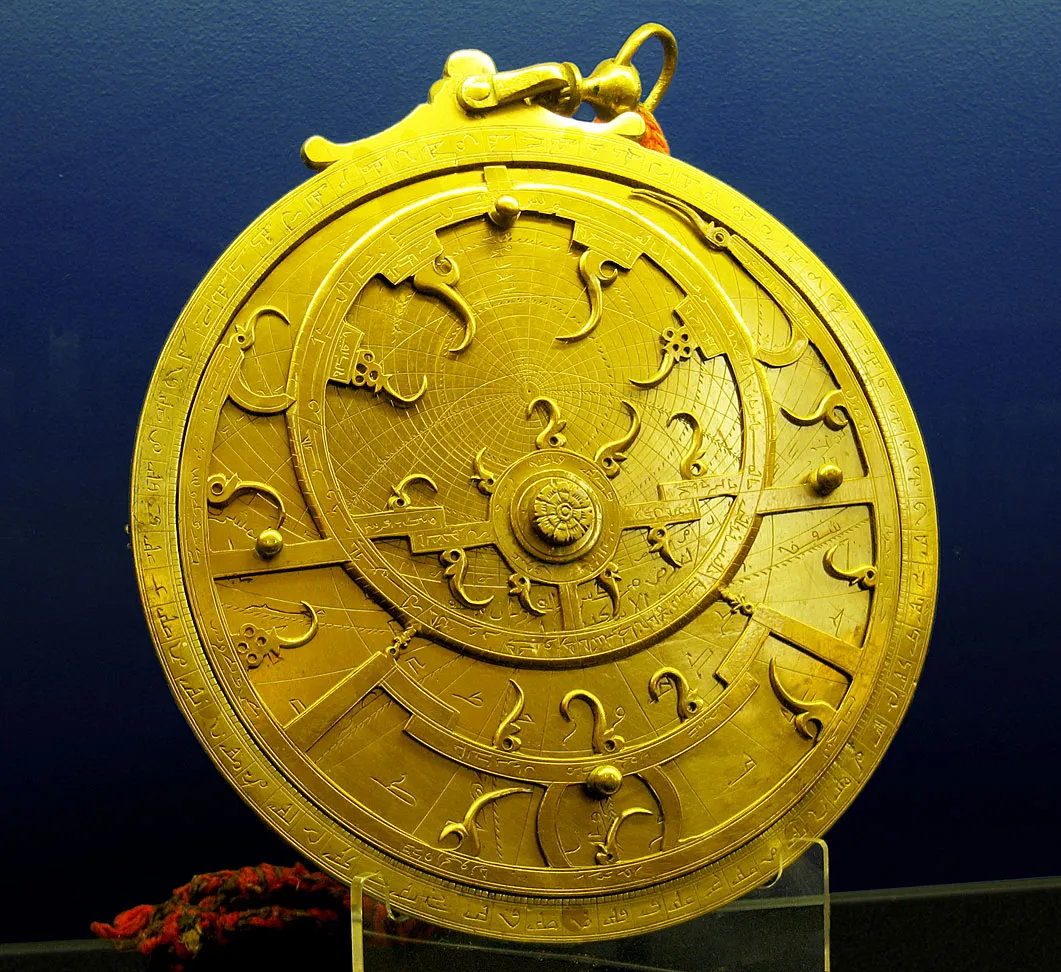
The match didn't last. Al-Biruni already noted that the epagomenae had stayed where they were "on account of their neglecting intercalation". Boyce records that the Parsis later repeated a month "in order to bring 1 Frawardin back to the spring equinox", and that this is why the Shenshai calendar ended up a month behind the Iranian one. How that one-month difference arose is covered in our guide to Shenshai, Kadmi and Fasli calendars.
Is Jamshedi Navroz fixed on 21 March, or tied to the equinox?
Our sources don't speak with one voice here. Modi (1922) treats the two as the same day, calling 21 March "the day of the Vernal Equinox". Boyce gives the Fasli calendar "a fixed Nowruz on 21 March". Dadrawala, writing in 2017, is looser and says the community celebrates it "on or around 21st March", because it marks the spring equinox.
So we'd put it this way. The 21 March date is what the printed sources give, and the reason behind it is the equinox. For the date in 2027, check our Parsi calendar or your Agiary's calendar.
The wider system of Roj, Mah and the year is explained in our guide to the Zoroastrian calendar.
Frequently asked questions
Is Jamshedi Navroz the same as the Fasli New Year?
Yes, in practice. Mary Boyce describes the Fasli calendar as having a fixed Nowruz on 21 March, held in place by a leap day every fourth year, and J. J. Modi calls 21 March the Jamshedi Naoroz day. So for families who follow the Fasli calendar, the first day of Farvardin and Jamshedi Navroz fall on the same date.
Is Jamshedi Navroz the Shenshai Parsi New Year?
No. The Shenshai religious New Year falls in August; avesta.org lists it on 16 August in 2020 and 2021. Jamshedi Navroz falls in March. Modi wrote in 1922 that the two once coincided, but the Shenshai date moved away because the Parsis stopped intercalating after they came to India.
Do Kadmi Zoroastrians celebrate Jamshedi Navroz?
For Kadmis, Jamshedi Navroz is a separate spring day, not their religious New Year. The Kadmi New Year falls in July, about a month before the Shenshai one; avesta.org lists it on 17 July in 2020 and 2021. Parsi Times describes the community's year as Jamshedi Navroz in March, Kadmi New Year in July and Shenshai in August.
Why is Jamshedi Navroz named after Jamshed?
J. J. Modi explains, citing Firdausi, that Jamshed, a Peshdadian king, first observed the day with eclat on the vernal equinox. Al-Biruni's Chronology of Ancient Nations records older Persian accounts in which Jamshid renovated the religion and the day of his work was called New-Day, the meaning of Navroz.
Does Jamshedi Navroz always fall on 21 March?
The printed sources give 21 March. Modi (1922) calls it the Jamshedi Naoroz day, the 21st of March and the vernal equinox, and the Fasli calendar fixes its New Year on 21 March with a leap day. Noshir Dadrawala writes "on or around 21st March", because the festival marks the spring equinox.