PalV's Kasti
On this page
- What do the three Parsi calendars share, and where do they differ?
- How do you convert a Shenshai date to Kadmi?
- How do you convert between Fasli and Gregorian dates?
- How do you convert a Shenshai or Kadmi date to Gregorian?
- Why does the gap between Shenshai and Fasli keep changing?
- What does a worked conversion look like?
- What should you check before trusting a conversion?
- Frequently asked questions
Converting a Parsi date comes down to two offsets and one count. All three Zoroastrian calendars use the same twelve months of 30 days, the same five Gatha days and the same Roj and Mah names. The Kadmi calendar runs one month (30 days) ahead of the Shenshai calendar. The Fasli calendar is tied to the Gregorian one, with Navroz on 21 March every year. Shenshai and Kadmi have no leap day, so after each Gregorian leap year their New Year comes one day earlier. To convert, find the Gregorian date of the right calendar's Navroz, then count forward 30 days per month and 5 Gatha days at the end. In 2026, Shenshai Navroz fell on Saturday, 15 August.
That's the whole method. The rest of this page shows each step, with worked examples you can check against a published calendar. If you want the background first, start with Shenshai, Kadmi and Fasli: the three Parsi calendars.
શહેરેવર રોજ
Shehrevar Roj, Tir Mah · 1396 Y.Z.
What do the three Parsi calendars share, and where do they differ?
They share their whole structure. FEZANA's calendar lesson plan says all three use "the same names of the days and months", and describes a year of 12 months of 30 days with "5 additional days known as the Gathas days" to make 365. Mary Boyce writes in the Encyclopaedia Iranica that the three calendars celebrate the same festal days, "but on different dates".
What differs is where each year starts and whether it has a leap day. For the calendar as a whole, see our guide to the Zoroastrian calendar.
| Shenshai (Shahenshahi) | Kadmi | Fasli | |
|---|---|---|---|
| Months and Gatha days | 12 × 30 + 5 | 12 × 30 + 5 | 12 × 30 + 5, plus a leap day every fourth year |
| Navroz, 2016 to 2019 | 17 August | 18 July | 21 March |
| Navroz, 2020 and 2021 | 16 August | 17 July | 21 March |
| Navroz, 2026 | 15 August | See our Parsi calendar | 21 March |
| Moves against the Gregorian calendar? | Yes, one day earlier after a leap year | Yes, one day earlier after a leap year | No |
The 2016 to 2021 dates come from the religious calendar published on avesta.org. The 2026 Shenshai date is from the Government of Maharashtra's 2026 public holiday notification. We haven't found a published Kadmi Navroz date for 2026 that two sources agree on, so we don't print one here. Check it in our Parsi Roj calendar or a printed Kadmi calendar.
How do you convert a Shenshai date to Kadmi?
Add 30 days. FEZANA's lesson says the Kadmi calendar "differs by one month from the Shehenshahi calendar", and avesta.org says the Qadimi (Kadmi) calendar "is one month ahead of the Shahanshahi". Its tables show the gap in every year: in 2016 Shenshai Navroz is 17 August and Kadmi Navroz 18 July, and the Maidyozarem Gahambar is 26 to 30 September (Shenshai) against 27 to 31 August (Kadmi). Every pair is 30 days apart.
For most of the year the result is easy to read. Because every month has 30 days, the Kadmi date carries the same Roj in the next month. Shenshai Navroz, the first day of Fravadin, is the first day of Ardibehesht in the Kadmi calendar.
The year end is the exception, and it's the easiest place to go wrong. The Gatha days sit between the twelfth month and Navroz. So when a Kadmi family enters its Gatha days, the Shenshai calendar is still on days 1 to 5 of Aspandarmad. Kadmi Navroz therefore falls on day 6 of Aspandarmad in the Shenshai calendar, not on day 1. From there until Shenshai Navroz, the Roj on the two calendars differ by five days instead of matching.
Why Kadmi runs a month ahead has two answers. Boyce writes that after a Parsi intercalation the Shenshai calendar "was a month behind" the Persian Zoroastrian one. Antonio Panaino's Iranica article records that the Shenshai side argued the reverse: that the Iranian community was the one behind, because it had skipped the extra month due "after each cycle of 120 years". We don't take a side. The full story is in why the Kadmi and Shenshai New Years are a month apart.
How do you convert between Fasli and Gregorian dates?
By a fixed table, because the Fasli calendar is built on the Gregorian one. Boyce describes it as "the Gregorian calendar, known as the Faṣlī", with Nowruz fixed on 21 March and a day added every fourth year after the epagomenae (the Gatha days). Panaino calls it "a new calendar similar to the Gregorian", adopted in 1906.
So a Fasli date falls on the same Gregorian date every year. The avesta.org calendar lists Fasli Navroz on 21 March and each Fasli Gahambar on the same dates for all six years from 2016 to 2021, and its Fasli day table gives the Gregorian date of every Roj in every month. Its 2026 calendar again starts Farvardin on 21 March. The structure and month names are covered in the Fasli calendar.
One caution. In the year the Fasli leap day is added, the extra day sits after the Gatha days, just before Navroz. For dates between 29 February and 20 March of a Gregorian leap year, use a printed Fasli calendar for that year rather than a fixed table.
How do you convert a Shenshai or Kadmi date to Gregorian?
Start from that calendar's Navroz in the right year and count forward:
- Find the Gregorian date of Navroz for the year you need. For Shenshai in 2026 this is 15 August, listed by the Government of Maharashtra as "Parsi New Year (Shahenshahi)". For Kadmi, take the Shenshai date and subtract 30 days, then check the result against a printed Kadmi calendar.
- Work out how many days the date is after Navroz. For a date in month M on day D, that's (M − 1) × 30 + (D − 1). The months run (1) Fravadin, (2) Ardibehesht, (3) Khordad, (4) Tir, (5) Amardad, (6) Shehrevar, (7) Meher, (8) Avan, (9) Adar, (10) Dae, (11) Bahman and (12) Aspandarmad.
- For one of the five Gatha days, the count is 360 plus the Gatha day's position minus one, since the Gatha days come after the twelfth month.
- Add that number of days to the Navroz date.
To go the other way, count the days back to the most recent Navroz of that calendar and reverse steps 2 and 3. If the date falls before that year's Navroz, count from the previous year's Navroz instead. The Roj names that go with each day number are in our guide to the thirty Roj names. If you'd rather not count by hand, our Parsi Roj calendar shows the Roj and Mah for each day.
Why does the gap between Shenshai and Fasli keep changing?
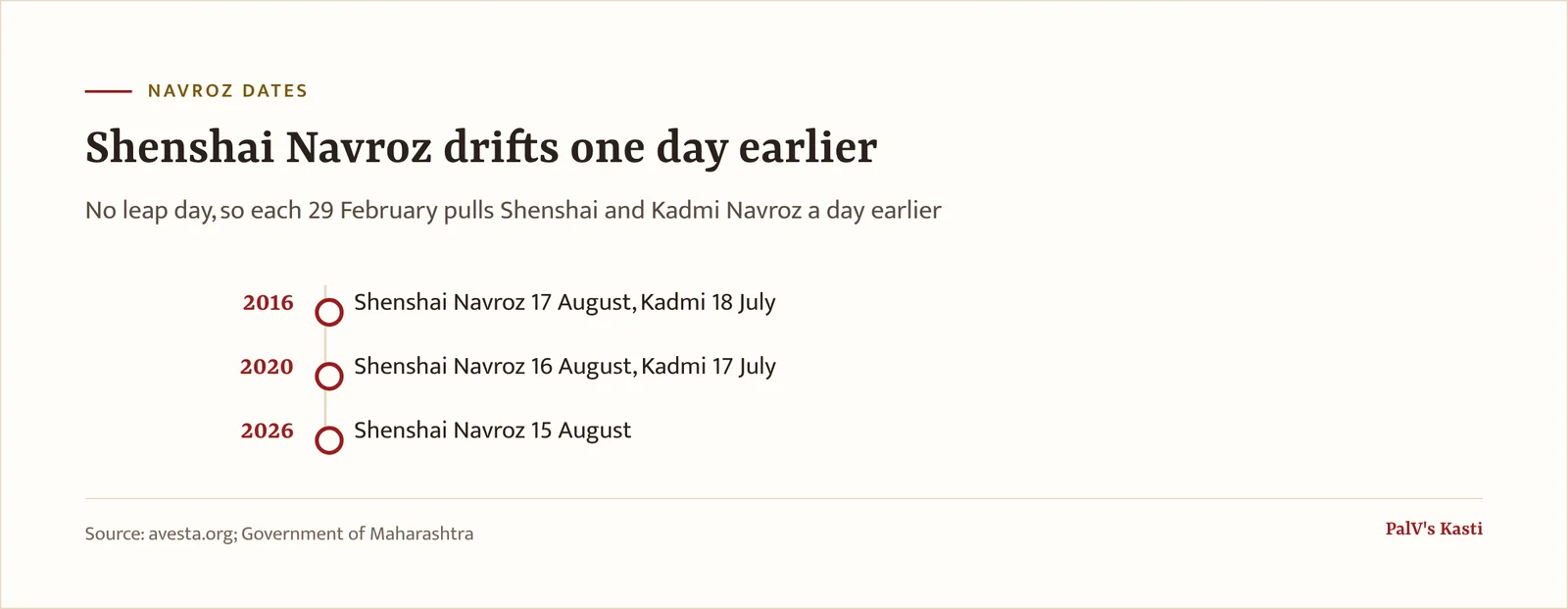
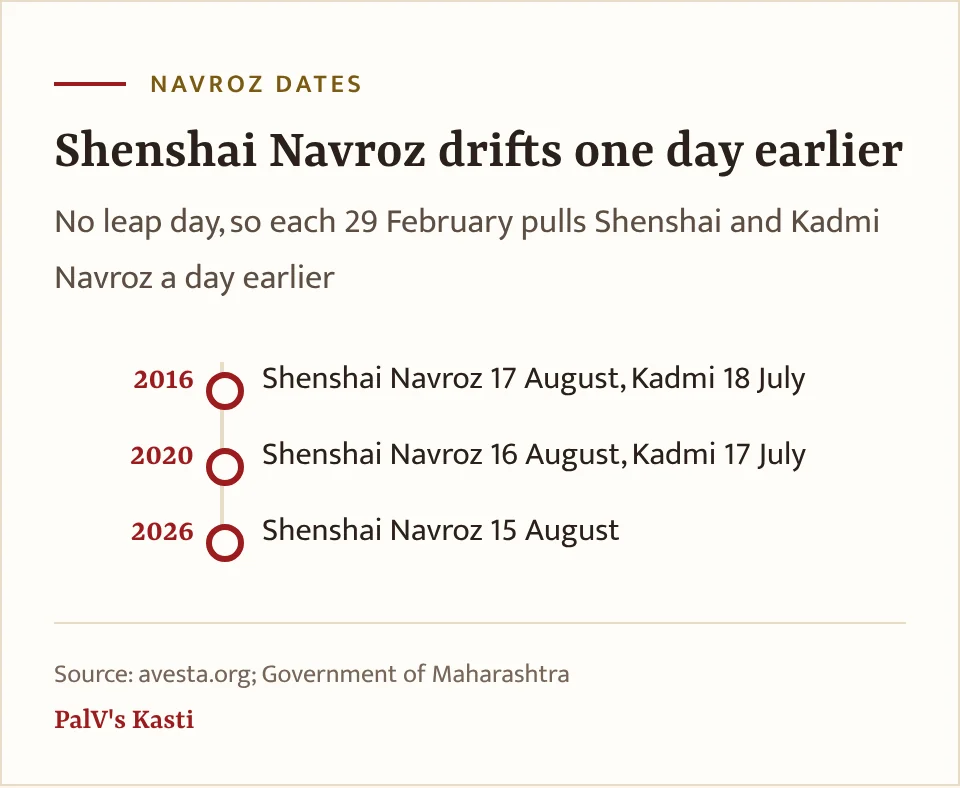
Because only the Fasli calendar has a leap day. Shenshai and Kadmi years are 365 days every year, so each Gregorian leap day pushes their dates one day earlier. The published Navroz dates show it happening:

| Year | Fasli Navroz | Shenshai Navroz | Days between them |
|---|---|---|---|
| 2016 to 2019 | 21 March | 17 August | 149 |
| 2020 and 2021 | 21 March | 16 August | 148 |
| 2026 | 21 March | 15 August | 147 |
So a Shenshai-to-Fasli rule that worked for one four-year block is off by a day in the next. J.J. Modi gave the cause in 1922: the Shenshai New Year "corresponded at one time" with the 21 March Jamshedi Naoroz, but the Parsis stopped intercalating after they came to India, and since then "this Naoroz does not fall on the 21st of March". The astronomy behind the drift is in the astronomy behind the Parsi calendar.
What does a worked conversion look like?
We've worked these examples in 2017 because every anchor for that year is printed in the avesta.org tables: Shenshai Navroz on 17 August 2016 and 2017, Kadmi Navroz on 18 July 2016 and 2017, and Fasli Navroz on 21 March. For the current year, use our Parsi calendar.
| Gregorian date | Shenshai | Kadmi | Fasli |
|---|---|---|---|
| 21 March 2017 | Avan, day 7 | Adar, day 7 | Fravadin, day 1 (Navroz) |
| 18 July 2017 | Aspandarmad, day 6 | Fravadin, day 1 (Navroz) | Tir, day 30 |
| 17 August 2017 | Fravadin, day 1 (Navroz) | Ardibehesht, day 1 | Amardad, day 30 |
You can test the count against the same tables. Maidyozarem Gahambar runs from day 11 of Ardibehesht, which by our count is 26 September 2017 for Shenshai and 27 August 2017 for Kadmi. Those are the dates avesta.org prints. The Fasli column matches its Fasli day table, which gives 18 July for the last day of Tir and 17 August for the last day of Amardad.
Look at the second row. On Kadmi Navroz the Shenshai calendar is on day 6 of its last month, not day 1, because the five Gatha days fall in between. The first row is Jamshedi Navroz, and how it sits in each calendar is the subject of Jamshedi Navroz and the three Parsi calendars.
What should you check before trusting a conversion?
- Year numbers share one starting point. Panaino notes that the Kadmi and Shenshai calendars are both "dated from the coronation of the last Sasanian king, Yazdegerd III".
- Leap years matter twice. They move Shenshai and Kadmi dates a day earlier, and they add the Fasli leap day before 21 March.
- Published dates are the anchor. Every conversion here rests on a published Navroz date. Check the current year's date in a Parsi calendar or an official holiday list before you rely on a count.
Explaining this to a child? Our simpler guide, the Parsi calendar explained for children, covers the months, the Roj and the Gatha days without the arithmetic.
Frequently asked questions
How many days apart are the Shenshai and Kadmi calendars?
The Kadmi calendar runs 30 days, one month, ahead of the Shenshai calendar. The avesta.org religious calendar shows every Shenshai and Kadmi date 30 days apart, for example Navroz on 17 August (Shenshai) and 18 July (Kadmi) in 2016. To convert a Shenshai date to Kadmi, add 30 days.
Is a Fasli date always on the same Gregorian date?
Yes. Mary Boyce describes the Fasli calendar as the Gregorian calendar with Navroz fixed on 21 March and a day added every fourth year after the Gatha days. So each Fasli Roj falls on the same Gregorian date every year. Only the weeks just before Navroz in a leap year need a printed calendar.
When was Shenshai Navroz in 2026?
Shenshai Navroz fell on Saturday, 15 August 2026. The Government of Maharashtra's 2026 public holiday notification lists Parsi New Year (Shahenshahi) on that date, the same day as Independence Day, and All India Radio reported Navroz greetings that day. For the Kadmi date, check our Parsi calendar or a printed Kadmi calendar.
Why does the Shenshai New Year move by a day every few years?
The Shenshai year is always 365 days, with no leap day, while the Gregorian calendar adds 29 February every fourth year. The avesta.org calendar shows Shenshai Navroz on 17 August from 2016 to 2019 and on 16 August in 2020 and 2021. In 2026 it fell on 15 August.
How do I find the Gregorian date of a Shenshai Roj and Mah?
Take that year's Shenshai Navroz date. Count 30 days for each month before the one you need, then add the day number minus one. For a Gatha day, count 360 days plus its position minus one. Add the total to the Navroz date, and you have the Gregorian date.