PalV's Kasti
On this page
- What is the Fasli calendar?
- How is a Fasli year built?
- What is the Fasli leap day, Avardad-sal-Gah?
- What are the Fasli month names, and when does each month begin?
- Do Fasli dates change from year to year?
- Who introduced the Fasli calendar, and who follows it today?
- Why is the Fasli calendar contested?
- Is the Zoroastrian Fasli calendar the same as the Fasli year in Indian…
- Frequently asked questions
The Fasli calendar is the seasonal form of the Zoroastrian religious calendar. It keeps the same twelve months of 30 days, the same five Gatha days and the same Roj and Mah names as the Shenshai and Kadmi calendars. What it adds is one extra day every fourth year, placed after the Gatha days, so that Navroz stays fixed on 21 March. FEZANA and Encyclopaedia Iranica both date its introduction to 1906, and Mary Boyce writes that the Parsis who adopted it were inspired by Kharshedji Rustamji Cama. In practice, Fasli Navroz falls on the same Gregorian date every year, while Shenshai and Kadmi dates slowly move.
શહેરેવર રોજ
Shehrevar Roj, Tir Mah · 1396 Y.Z.
What is the Fasli calendar?
The Fasli calendar is one of the three religious calendars Zoroastrians use today, alongside Shenshai (Shahenshahi) and Kadmi, according to the Pluralism Project at Harvard University. FEZANA's teaching notes call it "Fasli or the seasonal calendar" and date it to 1906, when it was set up so that the year would open on the spring equinox, 21 March.

Mary Boyce, writing in Encyclopaedia Iranica, describes it more bluntly: a group of Parsis adopted the Gregorian calendar, "known as the Faṣlī", with Nowruz fixed on 21 March and a day intercalated every fourth year after the epagomenae. The epagomenae are the five Gatha days at the end of the year. Antonio Panaino's Iranica article likewise calls it "a new calendar similar to the Gregorian".
All three calendars celebrate the same festal days. They simply place them on different Gregorian dates, as Boyce notes. For how the three compare side by side, see our guide to Shenshai, Kadmi and Fasli.
How is a Fasli year built?
A Fasli year has the same skeleton as every Zoroastrian year. There are 12 months (Mah) of 30 days each, which makes 360 days, and five Gatha days follow the twelfth month to bring the year to 365. Each of the 30 days has a name rather than a number, and FEZANA notes that all three calendars share the names of the days and months.
The difference is the leap day. Once every four years a Fasli year gets a 366th day, and it's this day that sets the Fasli calendar apart from the other two.
| Part of the year | Length | Shared with Shenshai and Kadmi? |
|---|---|---|
| 12 months (Mah) | 30 days each, 360 in all | Yes |
| Gatha days | 5 days after the 12th month | Yes |
| Leap day (Avardad-sal-Gah) | 1 day, every fourth year | No, Fasli only |
| New Year (Navroz) | Fixed on 21 March | No, Fasli only |
What is the Fasli leap day, Avardad-sal-Gah?
The Fasli leap day is called Avardad-sal-Gah. The Zarthosti Anjuman of Northern California (ZANC) explains that the Fasli calendar adds this day every four years, and that it's patterned on the Gregorian calendar's leap day.
Boyce gives its position: the extra day comes every fourth year after the epagomenae, that is, after the fifth Gatha day. Since Fasli Navroz is fixed on 21 March, the extra day sits immediately before the New Year. So in a leap year the Fasli year has six days between the end of the twelfth month and Navroz instead of five.
This one rule is what keeps Fasli dates still. The avesta.org religious calendar shows the effect: between 2019 and 2020 its Shenshai and Kadmi dates move one day earlier, while its Fasli dates don't move at all. Our article on the astronomy behind the Parsi calendar explains why the calendars without a leap day drift.
What are the Fasli month names, and when does each month begin?
The Fasli month names are the same twelve names used in the Shenshai and Kadmi calendars. Only the Gregorian dates differ. The table gives them in FEZANA's spelling, alongside the older forms, such as Frawardin and Ardwahisht, that the avesta.org calendar uses.
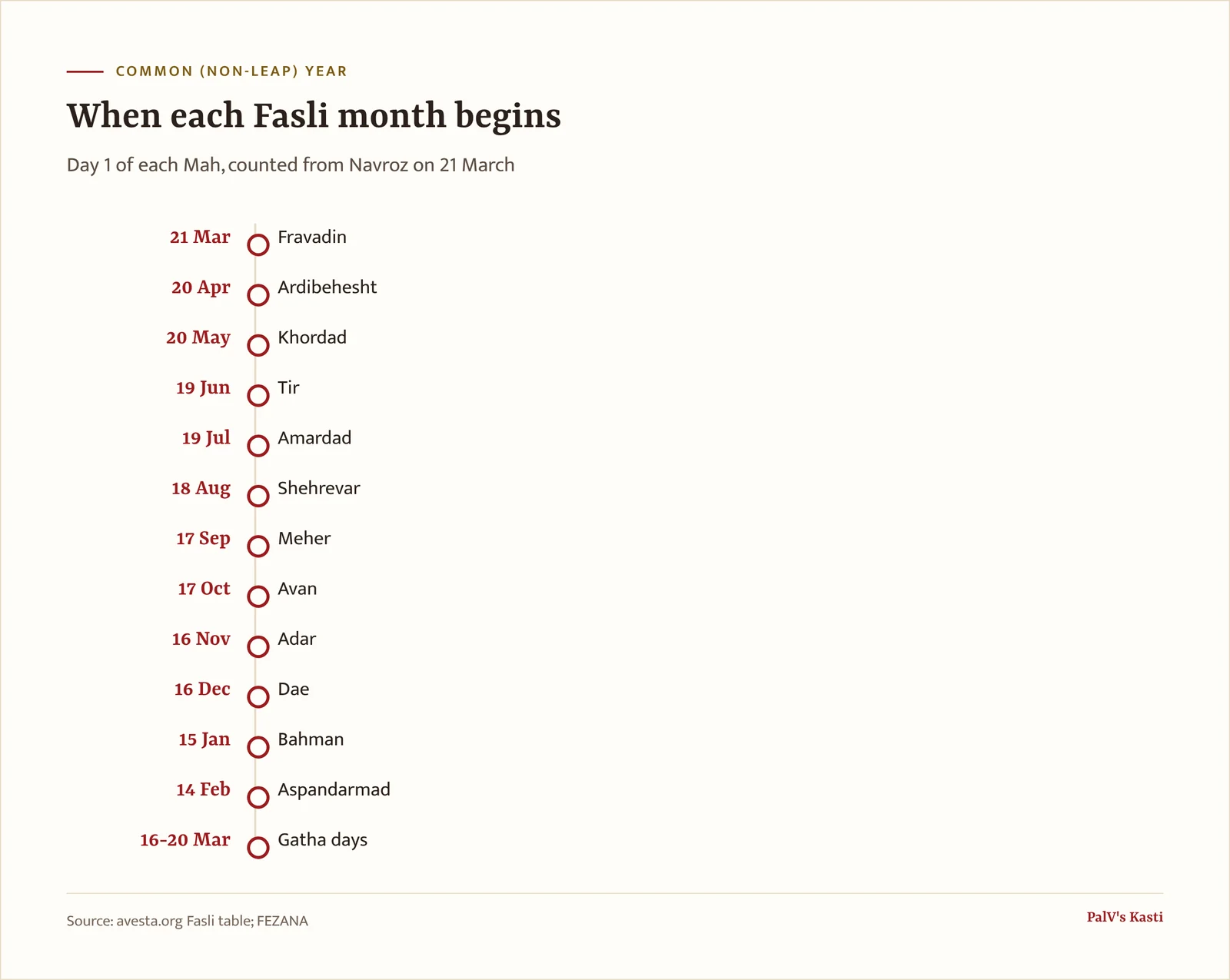
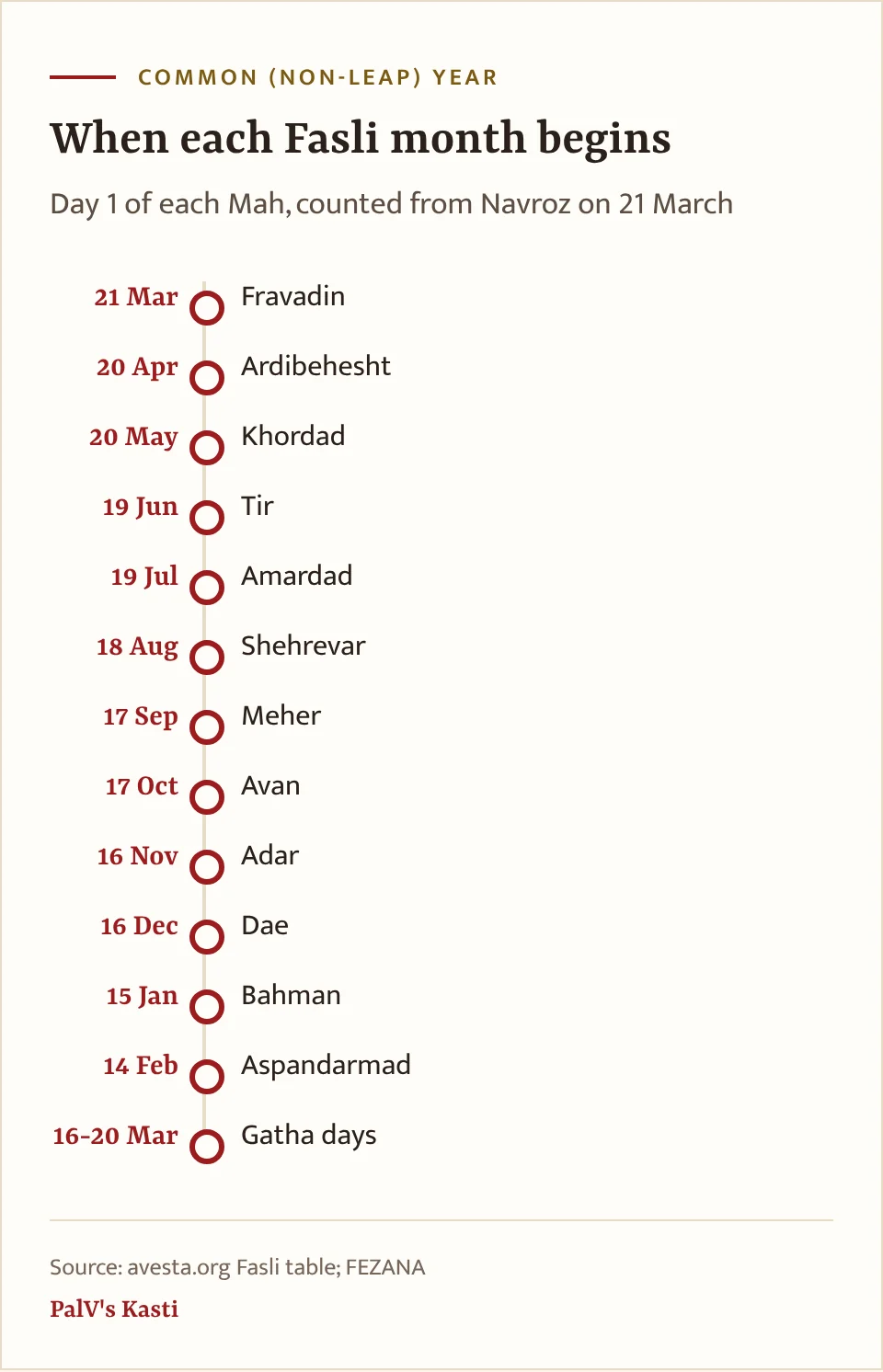
Because Fravadin 1 always falls on 21 March and every month is 30 days long, the start of each Fasli month can be counted forward from Navroz. The table shows that count for a common (non-leap) year. Our count matches the Fasli day-by-day table published on avesta.org.
| No. | Mah (FEZANA spelling) | avesta.org spelling | Day 1 falls on (common year) |
|---|---|---|---|
| 1 | Fravadin | Frawardin | 21 March |
| 2 | Ardibehesht | Ardwahisht | 20 April |
| 3 | Khordad | Hordad | 20 May |
| 4 | Tir | Tir | 19 June |
| 5 | Amardad | Amurdad | 19 July |
| 6 | Shehrevar | Shahrewar | 18 August |
| 7 | Meher | Mihr | 17 September |
| 8 | Avan | Aban | 17 October |
| 9 | Adar | Adar | 16 November |
| 10 | Dae | Day | 16 December |
| 11 | Bahman | Vohuman | 15 January |
| 12 | Aspandarmad | Spandarmad | 14 February |
| Gatha days | Ahunawad to Wahishtoisht | 16 to 20 March |
The meaning and presiding divinity of each month is a subject of its own. Our guide to the twelve Parsi months covers it, and the Zoroastrian calendar explains the wider system.
Do Fasli dates change from year to year?
No. Because the leap day keeps the Fasli year in step with the Gregorian one, each Fasli day returns to the same Gregorian date every year. The avesta.org religious calendar lists the same Fasli dates for its Gahambars in every year it covers, from 2016 to 2027, and keeps Fasli Navroz on 21 March.
The same avesta.org table shows the contrast. Shenshai Navroz is listed on 17 August for 2016 to 2019 and on 16 August for 2020 and 2021, and Kadmi Navroz moves from 18 July to 17 July over the same years. We haven't found a second independent source for the exact Fasli Gahambar dates, so we don't list them here. For any year's Gahambar and Navroz dates, check our Parsi calendar, and for working out moving dates, see converting dates between Shenshai, Kadmi, Fasli and Gregorian.
Who introduced the Fasli calendar, and who follows it today?
Two Iranica authors place the reform in the early twentieth century. Panaino writes that in 1906 an attempt was made to resolve the controversy by adopting a new calendar similar to the Gregorian. The controversy he means is the older Shenshai and Kadmi dispute, which the Kadmi split covers. Boyce writes that "a group of Parsis", inspired by Kharshedji Rustamji Cama, adopted it. ZANC, spelling the name Khurshedji Cama, says he devised the Fasli calendar.
On who follows it, the sources describe different communities at different times:
- Panaino (1990) says the reform led to a new group, the faṣlīs, concentrated mainly in western India.
- The Pluralism Project at Harvard says the Fasli calendar is most often followed by Irani Zoroastrians, while Parsis more often follow Shenshai or Kadmi.
We haven't found a reliable count of how many families keep the Fasli calendar today, so we give none.
Why is the Fasli calendar contested?
Panaino traces the calendar dispute among Parsis back to 1720, when a priest from Kerman visiting Surat found the Parsi calendar a month behind Iran's, and the 1906 reform added a third position to it. Even its name is read two ways. FEZANA calls it "the seasonal calendar". Panaino glosses the word faṣlīs as "(separatists)".
The Pluralism Project notes that Zoroastrians are still debating whether to adopt a unified calendar. We take no side here. The Kadmi side of the story has its own page: the Kadmi calendar.
Is the Zoroastrian Fasli calendar the same as the Fasli year in Indian land records?
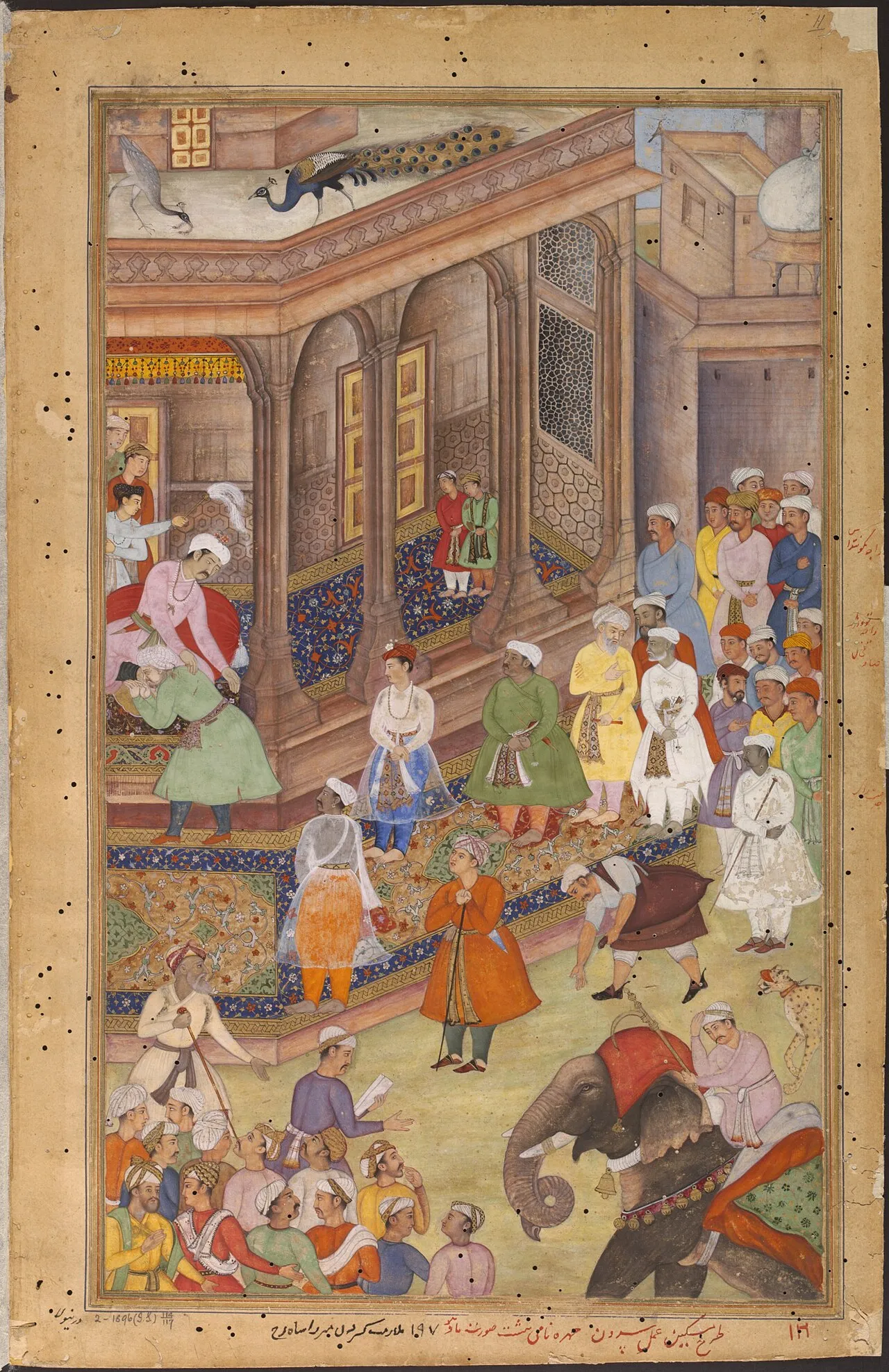
No. The word "Fasli" also names an unrelated reckoning. Encyclopaedia Britannica describes the Faṣlī era as a chronological system the Mughal emperor Akbar devised for land revenue in northern India. That revenue Fasli year has nothing to do with Roj, Mah, Gatha days or Navroz. If you have a "Fasli year" on a land document, this article isn't the conversion you need.
Frequently asked questions
What is the Fasli New Year date?
Fasli Navroz falls on 21 March every year. Mary Boyce, in Encyclopaedia Iranica, describes the Fasli calendar as having Nowruz fixed on 21 March, and FEZANA's teaching notes give the same date. Shenshai and Kadmi New Years, by contrast, have fallen in August and July in recent years and move slowly against the Gregorian calendar.
How often does the Fasli calendar add a leap day?
The Fasli calendar adds one day every fourth year. Boyce places it after the epagomenae, that is, after the five Gatha days, just before Navroz on 21 March. The Zarthosti Anjuman of Northern California names this day Avardad-sal-Gah and says it's patterned on the Gregorian leap day.
Are the Fasli month names different from Shenshai and Kadmi month names?
No. FEZANA states that all three Zoroastrian calendars use the same names for the days and the months. The twelve months run from Fravadin to Aspandarmad, followed by five Gatha days. Only the Gregorian date on which each month begins differs between Fasli, Shenshai and Kadmi, with Fasli Fravadin always starting on 21 March.
When was the Fasli calendar introduced?
FEZANA and Antonio Panaino's Encyclopaedia Iranica article both give 1906 as the year the Fasli calendar was instituted. Mary Boyce writes that the Parsis who adopted it were inspired by Kharshedji Rustamji Cama, and the Zarthosti Anjuman of Northern California credits Khurshedji Cama with devising it.
Why do Fasli dates stay the same every year?
Fasli dates stay put because the leap day keeps the Fasli year in step with the Gregorian year. The avesta.org calendar lists the same Fasli Gahambar dates every year from 2016 to 2027 and Navroz on 21 March, while its Shenshai and Kadmi dates shift by a day between 2019 and 2020.
Is the Zoroastrian Fasli calendar the same as the Fasli year used in land records?
No. Encyclopaedia Britannica describes the Faṣlī era as a separate system devised by the Mughal emperor Akbar for land revenue in northern India. It shares the name only. The Zoroastrian Fasli calendar is a religious calendar of Roj and Mah names with Navroz fixed on 21 March.