PalV's Kasti
On this page
The 12 Parsi calendar months (Mah), by name and in order, are Fravadin, Ardibehesht, Khordad, Tir, Amardad, Shehrevar, Meher, Avan, Adar, Dae and Bahman, with Aspandarmad last. That is how FEZANA's calendar lesson plan spells them. Each month is named after a divinity. Six carry the names of the Amesha Spentas: Ardibehesht, Khordad, Amardad, Shehrevar, Bahman and Aspandarmad. The other six honour the Fravashis (Fravadin), the star Tishtrya (Tir), Mithra (Meher), the Waters (Avan), the Fire (Adar) and the Creator, Ahura Mazda (Dae). Mary Boyce, writing in the Encyclopaedia Iranica, explains that the twelve months were dedicated to "twelve out of the same thirty yazatas" who already had days of the month. The table below gives each month's number, divinity and meaning.
શહેરેવર રોજ
Shehrevar Roj, Tir Mah · 1396 Y.Z.
What are the 12 Parsi months, in order?
The order is the same in FEZANA's lesson plan and in the Pahlavi Bundahishn as translated by E. W. West. The meanings come from Boyce's Iranica article on the Amesha Spentas and from the month table on avesta.org, which says it is based on Antonio Panaino's Iranica article on calendars.
| Mah | Name | Divinity | Meaning of the name | Season (Bundahishn) |
|---|---|---|---|---|
| 1 | Fravadin | The Fravashis | Guardian spirits | Spring |
| 2 | Ardibehesht | Asha Vahishta | Best Righteousness | Spring |
| 3 | Khordad | Haurvatat | Wholeness | Spring |
| 4 | Tir | Tishtrya | The star Sirius | Summer |
| 5 | Amardad | Ameretat | Immortality | Summer |
| 6 | Shehrevar | Khshathra Vairya | Desirable Dominion | Summer |
| 7 | Meher | Mithra | "A contract" | Autumn |
| 8 | Avan | The Waters | Waters | Autumn |
| 9 | Adar | Atar | Fire | Autumn |
| 10 | Dae | Ahura Mazda as Creator | The Creator | Winter |
| 11 | Bahman | Vohu Manah | Good Purpose | Winter |
| 12 | Aspandarmad | Spenta Armaiti | Holy Devotion | Winter |
FEZANA's lesson plan adds five more days after the twelfth month, the Gathas, to make a 365-day year. They are not a thirteenth month, and they have their own article: the five Gatha days.
How did the Parsi months get their names?
The months took their names from the divinities of the days. Boyce writes that the calendar was first given a Zoroastrian form when each of the thirty days in a month was dedicated to a yazata. The month names came later. In her view the month dedications were probably made in the Achaemenid period, "for there is no listing of them in the Avesta". Antonio Panaino makes the same point in his Iranica article: Avestan sources name all thirty days but only seven of the twelve months.
Set the two lists side by side and the link is plain. Eleven of the twelve month names are also day names in Darmesteter's translation of the Siroza, the prayer to the thirty divinities of the days, as published on avesta.org. Frawardin is the 19th day, Ardwahisht the 3rd, Tishtar the 13th, Mihr the 16th, and so on. Dae is the exception. No day is called simply Dae. Instead, days 8, 15 and 23 are headed Dai-pa-Adar, Dai-pa-Mihr and Dai-pa-Den, and each is offered to "the Maker", Ahura Mazda. Ahura Mazda's own day, the 1st, is Ohrmazd (Hormazd).
How the days themselves are named is covered in the thirty Roj names and their meanings. For all the calendar's named units in one place, see Parsi calendar names.
Which Parsi months are named after the Amesha Spentas?
Six months carry the names of the Amesha Spentas, a title Boyce translates as "Holy/Bounteous Immortal". Each Amesha Spenta also guards one of the creations. The table sets Boyce's translations beside the avesta.org month table and FEZANA's lesson plan, which links each of the first seven Roj with a creation (Hormazd with humans). Only the six month names are shown here.
| Mah | Amesha Spenta | Boyce's translation | avesta.org table | Creation (Boyce) | Creation (FEZANA) |
|---|---|---|---|---|---|
| 2 Ardibehesht | Asha Vahishta | Best Righteousness | "Highest Asha" | Fire | Fire |
| 3 Khordad | Haurvatat | Wholeness | "Wholeness (Perfection or Health)" | Water | Water |
| 5 Amardad | Ameretat | Immortality | "Immortality or Life" | Plants | Plants |
| 6 Shehrevar | Khshathra Vairya | Desirable Dominion | "Desirable Dominion" | Metals | Sky |
| 11 Bahman | Vohu Manah | Good Purpose | "Good Mind or Purpose" | Cattle | Animals |
| 12 Aspandarmad | Spenta Armaiti | Holy Devotion | "Holy (or Beneficent) Devotion" | Earth | Earth |
The one real disagreement is Shehrevar. Boyce gives metals, FEZANA gives the sky. Boyce explains the overlap herself. R. C. Zaehner pointed out Avestan and Pahlavi texts in which the sky is said to be made of metal, and H. W. Bailey noted that Zoroastrian scholar-priests defined crystal as both a stone and a metal, so lordship over metals took in the sky.
Khordad, the third month, is a common search on its own. Its divinity, Haurvatat, is "Wholeness" in Boyce's translation, and both Boyce and FEZANA connect it with water. Bahman, the eleventh month, belongs to Vohu Manah, the Good Purpose, guardian of cattle.
Which Parsi months honour other divinities?
Six months are named after divinities who are not Amesha Spentas. James Darmesteter's translations from the Sacred Books of the East, published on avesta.org, describe each of them.

Fravadin (Mah 1)
Fravadin belongs to the Fravashis. Darmesteter, introducing the Farvardin Yasht, defines the Fravashi as "the inner power in every being", the power that keeps it alive and makes it grow, and adds that the Fravashis were originally "the everlasting and deified souls of the dead". The avesta.org table calls them "The Guardian Spirits or Angels". The first month has its own article: Farvardin Mah.
Tir (Mah 4)
Tir belongs to Tishtrya. The avesta.org edition of the Tir Yasht opens with a note calling Tishtrya "the angel (Yazad) of the star Sirius". The same note says Tishtrya presides over the fourth month and the 13th day, and directs the rain. The month table agrees: "Tishtrya, the Star Sirius".
Meher (Mah 7)
Meher belongs to Mithra. Darmesteter's introduction to the Mihir Yasht says that "Originally Mithra was the god of the heavenly light", and his note explains that "mithra, as a common noun, means 'a contract'". The avesta.org table describes him as "Mithra, Yazad of the Contract".
Avan (Mah 8)
Avan belongs to the Waters. The Aban Yasht, the "Hymn to the Waters", is offered to "the good Waters, made by Mazda" and to "the holy water-spring" Ardvi Anahita. In the Siroza, the day of the same name is offered "To the good Waters, made by Mazda".
Adar (Mah 9)
Adar belongs to Atar, the Fire. The Siroza addresses the day "To Atar, the son of Ahura Mazda", and the English Atash Niyayesh on avesta.org says "Unto thee, O Fire, son of Ahura Mazda". The month table glosses the name simply as "Fire".
Dae (Mah 10)
Dae belongs to Ahura Mazda as Creator. The avesta.org table glosses it "The Creator", and the Siroza's Dai-pa days are offered to "the Maker", Ahura Mazda. More on this month is in Dae Mah.
Which Parsi months fall in which season?
The Pahlavi Bundahishn divides the twelve months into four seasons of three months each. In West's translation (Sacred Books of the East, volume 5, chapter 25, verse 20) it names "the auspicious month Frawardin", with Ardwahisht and Hordad, as spring. Tishtar, Amurdad and Shahrewar follow as summer, Mihr, Aban and Adar as autumn, and Din, Vohuman and Spandarmad as winter.
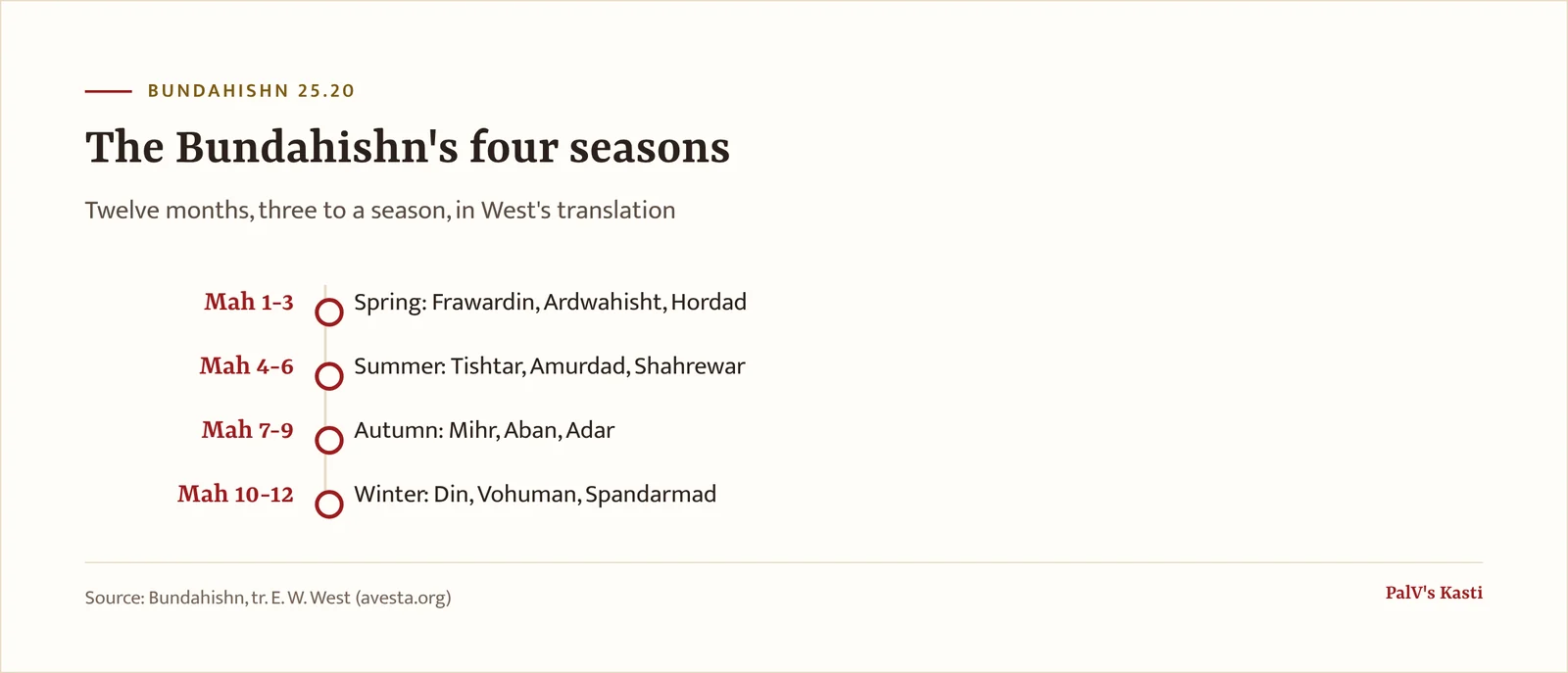

Two details stand out. The tenth month appears in this translation as "Din", where Parsi calendars write Dae. And the same chapter also gives a second scheme, a summer of seven months and a winter of five. Both are the text's own seasons, not today's weather. How the Shenshai, Kadmi and Fasli calendars line up with the Gregorian year is explained in Shenshai, Kadmi and Fasli.
What happens when a month's name day comes round?
Once in each month, the Roj with the same name as the Mah comes round, and that day becomes a feast. Boyce gives the rule: "whenever a day- and month-name had the same dedication (such as day of Mithra, month of Mithra), the day was celebrated as a festival for that yazata". FEZANA's lesson plan calls such a day a "Parabh" and gives Tirgan, Mehergan and Adaryan among its examples.
Using the Siroza order, each month's name day falls on these Roj:
| Mah | Roj of the same name |
|---|---|
| Fravadin | Roj 19 |
| Ardibehesht | Roj 3 |
| Khordad | Roj 6 |
| Tir | Roj 13 |
| Amardad | Roj 7 |
| Shehrevar | Roj 4 |
| Meher | Roj 16 |
| Avan | Roj 10 |
| Adar | Roj 9 |
| Dae | No Roj is called simply Dae; Ahura Mazda's days are Roj 1, 8, 15 and 23 |
| Bahman | Roj 2 |
| Aspandarmad | Roj 5 |
Practice varies between families and Agiaries; your family priest's guidance comes first.
How a Roj and Mah are written together as a date is the subject of what a Roj date is, and a short thought for each day's divinity is in a reflection for each Roj. To see which Mah is running today, use our Parsi Roj calendar.
Frequently asked questions
What is the 4th month of the Parsi calendar?
The fourth month of the Parsi calendar is Tir, named after Tishtrya. The avesta.org edition of the Tir Yasht calls Tishtrya the Yazad of the star Sirius, presiding over the fourth month and the thirteenth day, who also directs the rain. In E. W. West's translation of the Bundahishn it is Tishtar, the first month of summer.
What does Khordad mean in the Parsi calendar?
Khordad is the third Parsi month, named after the Amesha Spenta Haurvatat. Mary Boyce translates the name as "Wholeness", and avesta.org's month table gives "Wholeness (Perfection or Health)". Both Boyce and FEZANA connect Haurvatat with water. Khordad is also the sixth Roj, so Khordad Roj in Khordad Mah is that month's name day.
Which Parsi month is Bahman?
Bahman is the eleventh Parsi month, coming after Dae and before Aspandarmad. It is named after the Amesha Spenta Vohu Manah, whose name Mary Boyce translates as "Good Purpose" and who guards cattle. The Bundahishn lists it, as Vohuman, among the three winter months. Bahman is also the second Roj of every month.
Which Parsi month is dedicated to Ahura Mazda?
Dae, the tenth month, is dedicated to Ahura Mazda as Creator. Avesta.org's month table glosses the name as "The Creator", and the Siroza offers the Dai-pa days to "the Maker", Ahura Mazda. Ahura Mazda also has four days in every month: Roj 1, Hormazd, and the three Dai-pa days, Roj 8, 15 and 23.
Which Parsi month is the month of the Fravashis?
Fravadin, the first Parsi month, belongs to the Fravashis. James Darmesteter describes a Fravashi as the inner power in every being that keeps it alive and growing, and says the Fravashis were originally the deified souls of the dead. The 19th Roj carries the same name, so Fravadin Roj is the first month's name day.
Are the Parsi month names the same as the day names?
Mostly, yes. Eleven of the twelve month names are also Roj names in Darmesteter's Siroza translation, from Frawardin (Roj 19) to Spandarmad (Roj 5). The exception is Dae, the month of the Creator. No Roj is called simply Dae, but Roj 8, 15 and 23 are Dai-pa days offered to the Maker, Ahura Mazda.