PalV's Kasti
On this page
- What does "intercultural amalgam" mean for Parsi embroidery?
- What are the four strands of Parsi embroidery?
- Which elements of Parsi embroidery are Persian?
- What did China add to Parsi embroidery?
- What did India add to Parsi embroidery?
- What did Europe add to Parsi embroidery?
- How do the four traditions meet on a single piece?
- Where do Zoroastrian motifs fit in?
- Frequently asked questions
Parsi embroidery is an intercultural mix: its motifs, stitches, cloth and garments come from four traditions, Persian, Chinese, Indian and European. The Parzor Foundation describes motifs and styles "cross borrowed from Iran, China, India and Europe", and designer Ashdeen Lilaowala names the same four influences. Persia gave the Simurgh, the cypress and a taste for imperial purple. China gave silk grounds, chain stitch and motifs such as the divine fungus. India gave the sari itself, the peacock, kunku red and the aari and mochi stitches. Europe gave scallops, bows, ribbons and lace. On several pieces in Parzor's exhibition, three or four of these sit side by side on a single gara or child's jhabla. For the garment forms themselves, the gara, kor, jhabla and ijar, see our guide to Parsi embroidery.
શહેરેવર રોજ
Shehrevar Roj, Tir Mah · 1396 Y.Z.
What does "intercultural amalgam" mean for Parsi embroidery?
"Parsi Embroidery: An Intercultural Amalgam" is the title the Parzor Foundation uses for its research on the craft. It appears as a chapter in the volume Global Textile Encounters (December 2017, edited by Marie-Louise Nosch, Zhao Feng and Lotika Varadarajan), and its introduction traces today's "Parsi embroidery" back to complex roots and routes. Parzor's craft page names the Iranian, Indian, Chinese and European design traditions, and says Parsi embroidered saris brought together silk weaving from India and China with stitches and motifs from China and Europe. TRC, the Textile Research Centre in Leiden, describes the outcome as a "more hybrid style" developed by Parsi women.
We couldn't open the full chapter, so this article is built from Parzor's online exhibition of the same name, Parzor's craft page, TRC, the RISD Museum and the V&A collection records. The exhibition's credits say it draws on "The Embroidery Cupboard: Oral Accounts of Parsi Embroidery", an article in the 2010 book Peonies & Pagodas, and on oral history interviews that Parzor researchers recorded in India, China and Iran.
What are the four strands of Parsi embroidery?
| Strand | Motifs | Stitches and techniques | Cloth, colour and garments |
|---|---|---|---|
| Persian | Simurgh, birds in a gul-e-bulbul arrangement, cypress, trellis, the sun, chinar paisley, the Sassanian "circlet of pearls" | Parzor traces an older Iranian embroidery tradition that Zoroastrian women guarded | Imperial purple, a colour Parzor says the Persian tradition favoured |
| Chinese | Divine fungus, endless knot, pagodas, Chinese figures, peonies, chrysanthemums, baskets | Chinese chain stitch, Peking stitch, satin stitch and knots on China-made pieces | Embroidered silk satin and gauze, white thread on purple, red or black grounds |
| Indian | Peacock, lotus, ambi | Aari and mochi stitches learnt from Gujarati women, Deccani zardozi | The sari itself, kors and a designed pallav, kunku red, Surti gaaj jacquard |
| European | Scallops, bows, ribbons, Swiss roses | Machine embroidery in imitation of broderie anglaise | Lace on the sudreh, seen in an 1888 portrait |
Which elements of Parsi embroidery are Persian?
Parzor says Zoroastrian women carefully guarded their embroidery traditions, and shows a 19th-century bridal shawl from Iran, photographed courtesy of the late Elizabeth Gersivitch of Cambridge, whose motifs are so fine that a magnifying glass is needed to see them clearly. That shawl carries a sun motif, a "chinar paisley", peacocks and the fish, called ariz. The paisley has its own history, which we trace in our article on the boteh (paisley) motif.
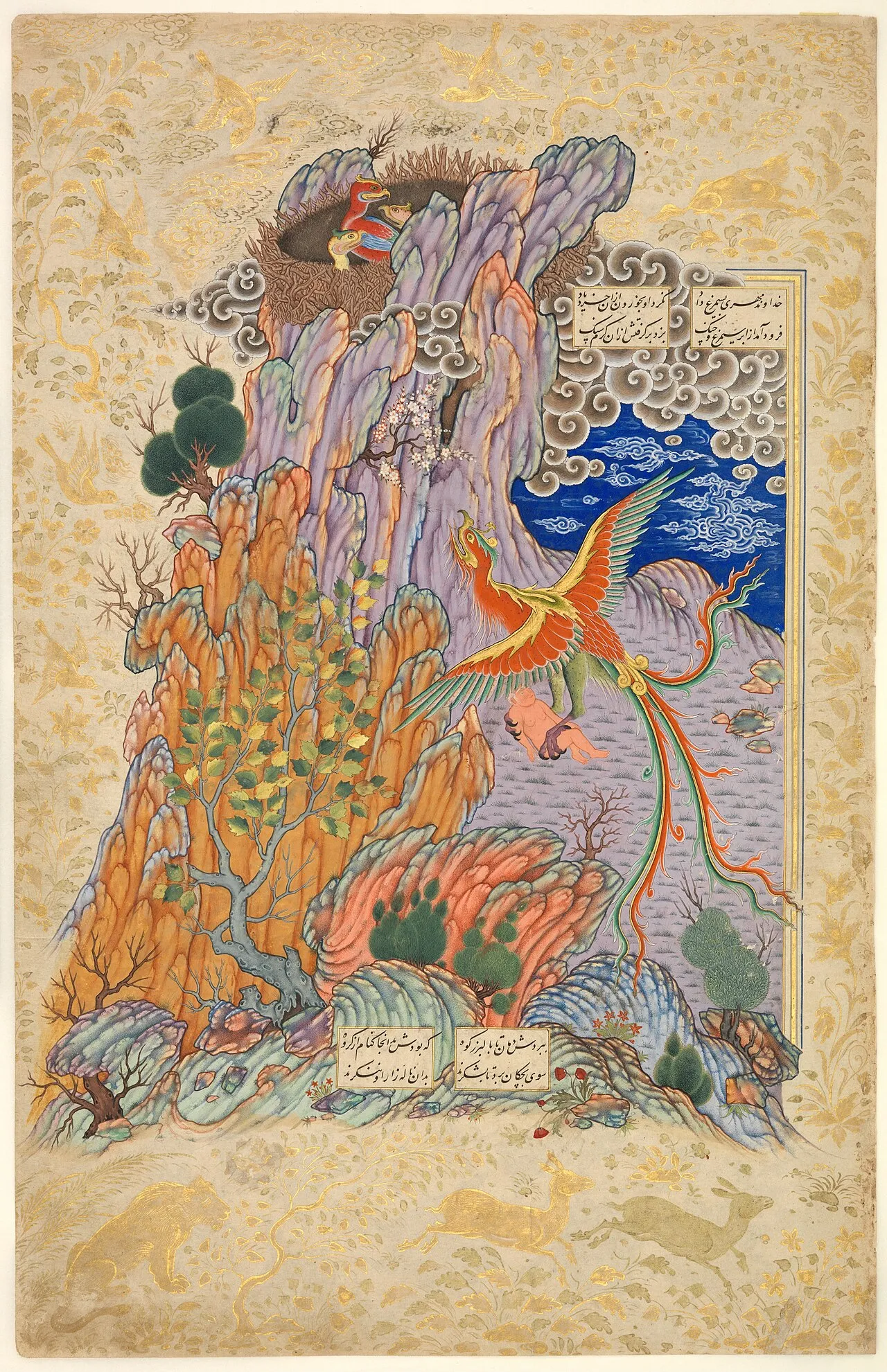
On Parsi pieces from India, Parzor identifies these Persian elements:
- The Simurgh, the mythical Iranian bird, as the central motif of a child's jhabla.
- Birds set in a Persian gul-e-bulbul pattern.
- The Persian cypress, combined with the Indian ambi on pallavs.
- Persian trellis and flowers on a Surat engagement gara.
- The Sassanian "circlet of pearls", which Parzor says travelled from Zoroastrian Persia to China and came back to the Parsis embroidered on the gara.
TRC is more cautious. It says the cypress tree and the chakla chakli (paired birds) are "both allegedly recalling the Iranian origins of the Parsis". That "allegedly" is worth keeping in mind when you read confident claims about Persian symbolism online.
Some Persian and Chinese elements overlap. The RISD Museum essay says the Chinese phoenix was taken up by Parsis as the Simurgh. Dr Shernaz Cama of Parzor told the South China Morning Post that once the Silk Route opened, the two cultures "began looking to one another for their wealth of embroidery".
What did China add to Parsi embroidery?
Parzor's craft page credits China with silk-weaving techniques, embroidery stitches and motifs, alongside Indian silk weaving and European stitches and motifs. Parzor records Chinese chain stitch appearing beside the Parsi khakho (seed pearl stitch), satin stitch, and long and short stitch. TRC records white silk thread worked on purple, red or black grounds, and Chinese peonies, roses and chrysanthemums that Parsi women kept using even as their style changed. Chinese motifs on Parsi pieces include the divine fungus, the endless knot, pagodas and figures of Chinese men.
Pieces made in China were not purely Chinese in design. TRC notes that China-made Parsi pieces often blended Chinese designs with older European export patterns. How the China trade brought all this to India, from Canton workshops to the pedlars on Parsi verandas, is the subject of our article on the Chinese roots of Parsi embroidery.
What did India add to Parsi embroidery?
India gave Parsi embroidery its main garment. Parzor's craft page says that after leaving Iran, the Zoroastrians from Pars adopted Indian costume, including the sari. The V&A says the same of the Parsis who settled in Gujarat: Parsi women adopted the sari there. Parzor adds that, following Indian tradition, Parsi women began designing kors (borders) to match the inner embroidery, and designed the pallav to show off the work.
Indian motifs and colours followed:
- Peacocks, which Parzor calls part of the Indian tradition, appear on a child's jhabla and a Surat engagement gara. TRC adds the lotus and the peacock as motifs "recalling their new habitat in India".
- The Indian ambi appears on pallavs.
- Kunku red, or vermilion, became a favourite colour as Indian influence grew.
Stitches came from Indian neighbours. Parzor records that Parsi women picked up the aari and mochi stitches from Gujarati women who were their friends, and that Deccani zari work turned up on Parsi jhablas and on children's prayer caps in the Deccan. Parsis who settled in the Deccan took up zardozi embroidery as well.
Surat was a centre. In its record for a Parsi child's tunic dated to about 1850, the V&A says Surat was an important source of embroidery for the Parsi community. Another V&A jhabla from Surat, dated about 1855, is red satin embroidered with flowers and peacocks. Parzor shows an engagement gara made in Surat on Surti gaaj, or jacquard.
Even the names became Indian. Ashdeen Lilaowala writes that as the gara took on more Indian influence, Parsis gave its motifs Gujarati names such as kanda papeta (onions and potatoes, for polka dots), karolia (spiders) and marga marghi (rooster and hen). And the work itself changed in Indian hands. Parzor says Chinese embroidery was marked by fine thread and a balanced use of colour, while Parsi women in India brought in a wider range of colours.
What did Europe add to Parsi embroidery?
Parzor says Europe's imperial presence added scallops, bows and ribbons, which in its words brought "together four cultures" in the Parsi sari. Parzor's craft page adds Swiss roses and bows, used on garas, jhablas and kors alongside traditional Indian motifs.
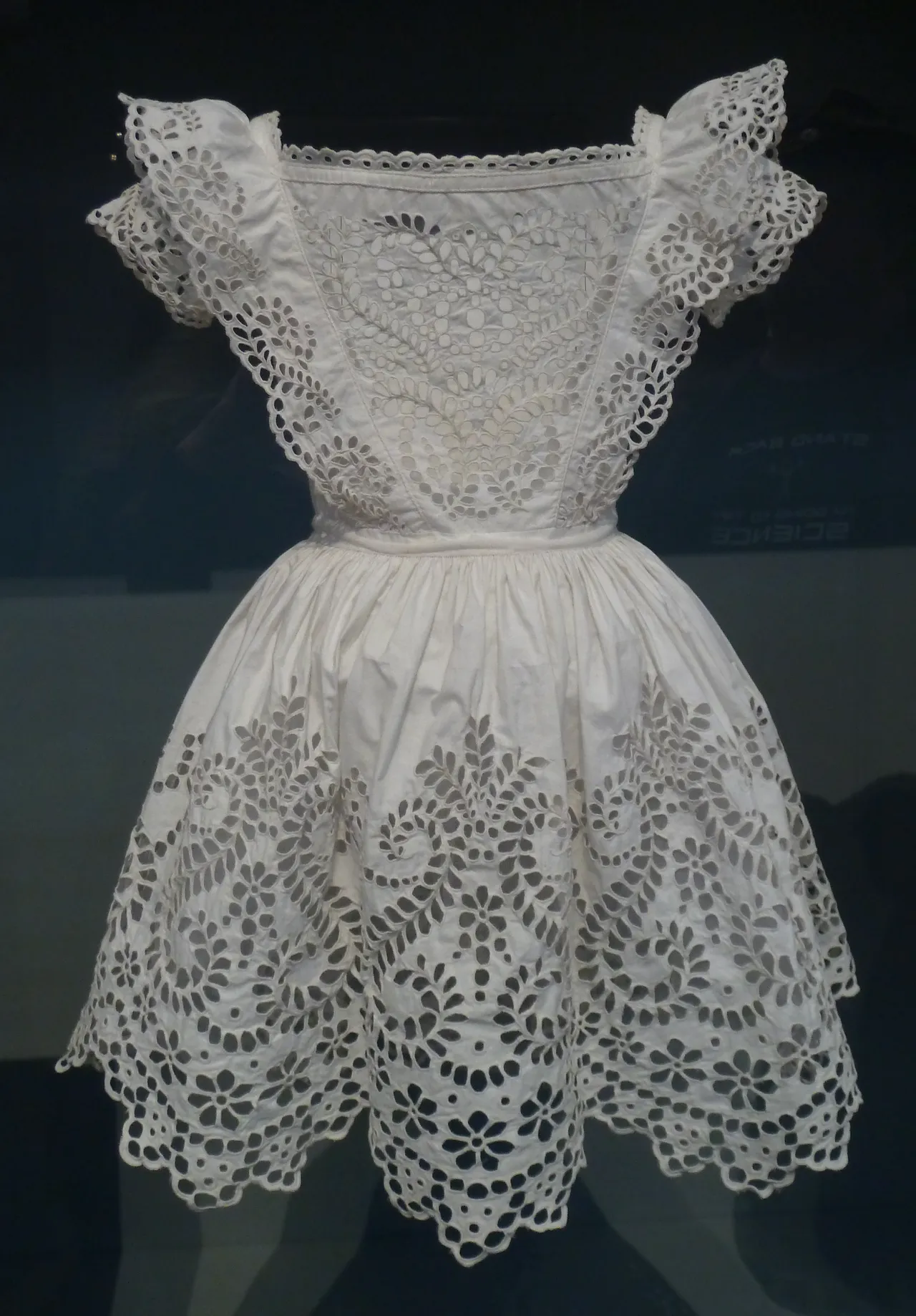
Lace was another route. Parzor's exhibition shows an 1888 portrait of Lady Bachubai Vakil of Ahmedabad wearing an embroidered velvet kor gara with her sudreh in lace, which Parzor calls a European influence.
TRC records two more European threads. The first is the European export patterning already present on China-made pieces. The second is a popular Parsi garment: a white sari machine-embroidered in imitation of broderie anglaise. The RISD Museum essay adds the wider context: chinoiserie was the rage in European fashion and decorative arts, and Parsis tended to present themselves as close to the British by mirroring their tastes.
How do the four traditions meet on a single piece?
The clearest evidence of the mix is on individual pieces. These examples are all from Parzor's exhibition:
| Piece | Persian | Indian | Chinese | Other |
|---|---|---|---|---|
| Child's jhabla | Simurgh as the central motif, Persian florals | A pair of peacocks | ||
| Red child's jhabla | Divine fungus | Rooster, which Parzor assigns to the Zoroastrian tradition | ||
| Undated khakho jhabla | Birds in a gul-e-bulbul pattern | Birds seated on an adapted divine fungus | ||
| Embroidered sari pallav | Cypress | Ambi | Baskets | |
| Surat engagement gara on Surti gaaj | Trellis and flowers | Peacocks, Surat jacquard | Endless knot | |
| Embroidered sari | Scallops, bows and ribbons from Europe |
Where do Zoroastrian motifs fit in?
Parsi women chose what to keep. Parzor says their pieces show a preference for the rooster and the fish, which have significance in Zoroastrian tradition, over the dragons and snakes popular in Chinese work. Parzor's exhibition also shows a kor with a water lily that it links to Ava Yazad. The meanings of these motifs are covered in our guide to gara embroidery designs and motifs.
Parzor's own conclusion is that Parsi embroidery is not just costly silk embroidery designed by Chinese craftsmen and ordered by rich Parsi traders for their women, "it is much more". We agree, and the dated museum pieces support it. The V&A holds Surat-made Parsi children's tunics dated to about 1850 and about 1855, and several pieces in Parzor's exhibition combine elements from three or four traditions on one garment.
Frequently asked questions
What are the four influences on Parsi embroidery?
Parsi embroidery draws on Persian, Chinese, Indian and European traditions. The Parzor Foundation describes motifs and styles cross-borrowed from Iran, China, India and Europe, and designer Ashdeen Lilaowala names the same four. The mix shows in motifs, stitches, colours and garments, often on a single gara or jhabla.
Is the Simurgh on Parsi embroidery Persian or Chinese?
Both traditions meet in it. The Parzor Foundation describes the Simurgh on Parsi pieces as a mythical Iranian bird. The RISD Museum notes that the Chinese phoenix, a common motif on Chinese embroidery, was taken up by Parsis as the Simurgh, so the bird on a gara can draw on both.
Which European motifs appear on Parsi garas?
The Parzor Foundation names scallops, bows and ribbons as European additions to the Parsi sari, and its craft page adds Swiss roses. Parzor also counts lace on the sudreh as a European influence, and TRC Leiden records Parsi white saris machine-embroidered in imitation of broderie anglaise.
Which stitches did Parsi women learn in India?
According to the Parzor Foundation, Parsi women learnt the aari and mochi stitches from their Gujarati women friends. In the Deccan, Deccani zari work appeared on Parsi jhablas and children's prayer caps, and Parsis settled there also took up zardozi embroidery alongside the stitches that came from China.
Is Parsi embroidery just Chinese embroidery?
No. The Parzor Foundation argues that Parsi embroidery is much more than Chinese silk embroidery ordered by Parsi traders. Parsi women added Persian and Indian motifs, learnt Indian stitches and adopted European decoration, and the V&A holds Surat-made Parsi children's tunics dated to about 1850.