PalV's Kasti

On this page
- What does the word boteh mean?
- Did the boteh come from the Zoroastrian cypress?
- How was the boteh used in Iranian textiles, carpets and tiles?
- How did the boteh become the Kashmir shawl motif?
- How did the motif reach Europe and the town of Paisley?
- Where does the boteh appear in Parsi textiles?
- Frequently asked questions
The paisley (boteh) motif is the curving plant shape that English speakers call paisley. The Victoria and Albert Museum (V&A) in London describes "boteh" as "a Persian word for a flowering shrub" and calls the motif an important element in nineteenth-century Persian textile design. In northern India the same shape is known as buta or boteh, meaning "flower". Its first meaning is less certain. Encyclopaedia Iranica notes that some scholars read it as a stylised cypress whose top is bent by the wind. Its journey is better documented. Museum records follow it from Iranian and Kashmiri textiles to shawl weavers in Norwich, Paisley and France, and to the Scottish town whose name it now carries.
શહેરેવર રોજ
Shehrevar Roj, Tir Mah · 1396 Y.Z.
What does the word boteh mean?
Boteh is a Persian word for a flowering shrub, according to the V&A's catalogue entry for a nineteenth-century Iranian prayer mat whose printed backing carries the motif. The same museum glosses the Indian name buta or boteh as "flower", in its record of a Kashmir shawl fragment. Encyclopaedia Iranica gives the fuller Persian names of the motif as bot(t)a jeqqa(ʾī) or būta ḵerqaʾī.
So the word points to a plant, and the museum records describe one. The V&A's earliest Kashmir example in this article, a shawl-border fragment it dates to the early eighteenth century, shows "a single flowering plant motif (boteh)".
You'll meet the motif as boteh or buta in these records, and as paisley in English.
Did the boteh come from the Zoroastrian cypress?
The sources we found treat it as a theory, not a fact. Houshang Alam's 1993 entry on the cypress in Encyclopaedia Iranica says the bota jeqqa motif, which often occurs on shawls, carpets and other textiles, is "believed by some scholars" to be a stylised cypress bent by the wind. The entry presents this as one interpretation. The RISD Museum in the United States, in its exhibition "What's in a Name? The Paisley Pattern in Kashmir Shawls", also calls the cypress or tree-of-life idea "one theory", and sets beside it another: a single flower flanked by leaves, established in Persian art by the seventeenth century.
Why the cypress? Iranian tradition links the tree to Zoroaster himself. Iranica retells the story from Daqiqi's verses in the Shahnameh: Zoroaster brought the cypress from paradise to King Goshtasp, who planted it near the first fire temple at Kashmar in Khorasan. It grew so large that "a lasso could not surround its trunk".
Iranica records a second tradition about a different site, the cypress of Bost at Keshmir near Nishapur, also said to have been planted by Goshtasp. The caliph al-Motawakkel ordered that cypress "felled and cut into pieces" and sent to Baghdad. The Zoroastrians offered to ransom the tree, and the offer was ignored. In the story, al-Motawakkel was murdered before the pieces reached Baghdad.
The cypress also lived on in poetry. Iranica notes that the cypress often appears in classical Persian poetry as a garden tree of distinction, and that poets used it for the graceful figure of the beloved.
One object shows the two side by side. The V&A holds an embroidered cover from Kerman, dated about 1850, with a central cypress tree flanked by birds and interlacing strapwork that includes the boteh. It doesn't prove the boteh grew out of the cypress. It does show Iranian embroiderers using both in one design.
How was the boteh used in Iranian textiles, carpets and tiles?
In the V&A's nineteenth-century Iranian holdings, the boteh turns up on carpets, tiles and textiles alike. The museum says designers found "many different effects" within its "rather rigid, curving form". Four objects show the range.
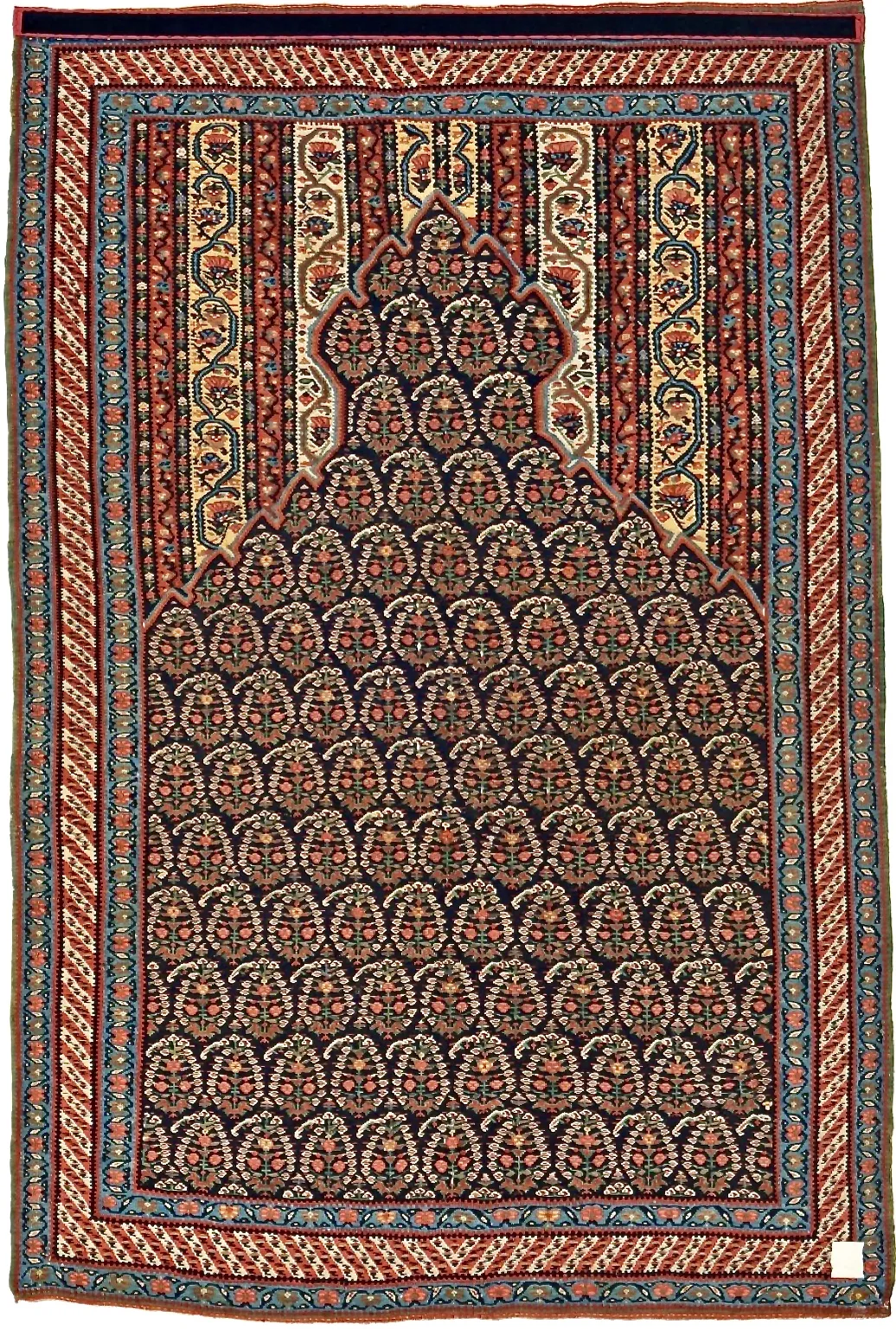
| Object | Place and date (V&A) | How the boteh appears |
|---|---|---|
| Carpet, 836-1877 | Possibly Mashhad, 1870 to 1875 | "A riot of botehs", each large boteh holding three small ones, sometimes called a "pregnant" boteh |
| Tile, 13:5/2-1877 | Iran, possibly 1800 to 1870 | Repeat pattern of offset boteh motifs in turquoise and purple |
| Prayer mat, 833-1876 | Iran, 1830 to 1850 | Printed on the cotton backing |
| Cover, ME.36-2011 | Kerman, about 1850 | In the strapwork around a central cypress tree |
The carpet, possibly from Mashhad, has a royal story. The V&A records that it was among carpets given to the museum by the Shah of Iran, chosen by his ministers as "the very best" being made in Iran in 1876.
How did the boteh become the Kashmir shawl motif?
Kashmir weavers took a flowering plant and slowly abstracted it. The V&A's early-eighteenth-century fragment already shows "a rather ungainly stylisation" of the naturalistic plant on earlier shawls, though not yet the "totally un-naturalistic" form that later became popular in the West. By the time an early-nineteenth-century shawl in the same collection was woven, the classic boteh, derived from flowering plants, "had become stylised".
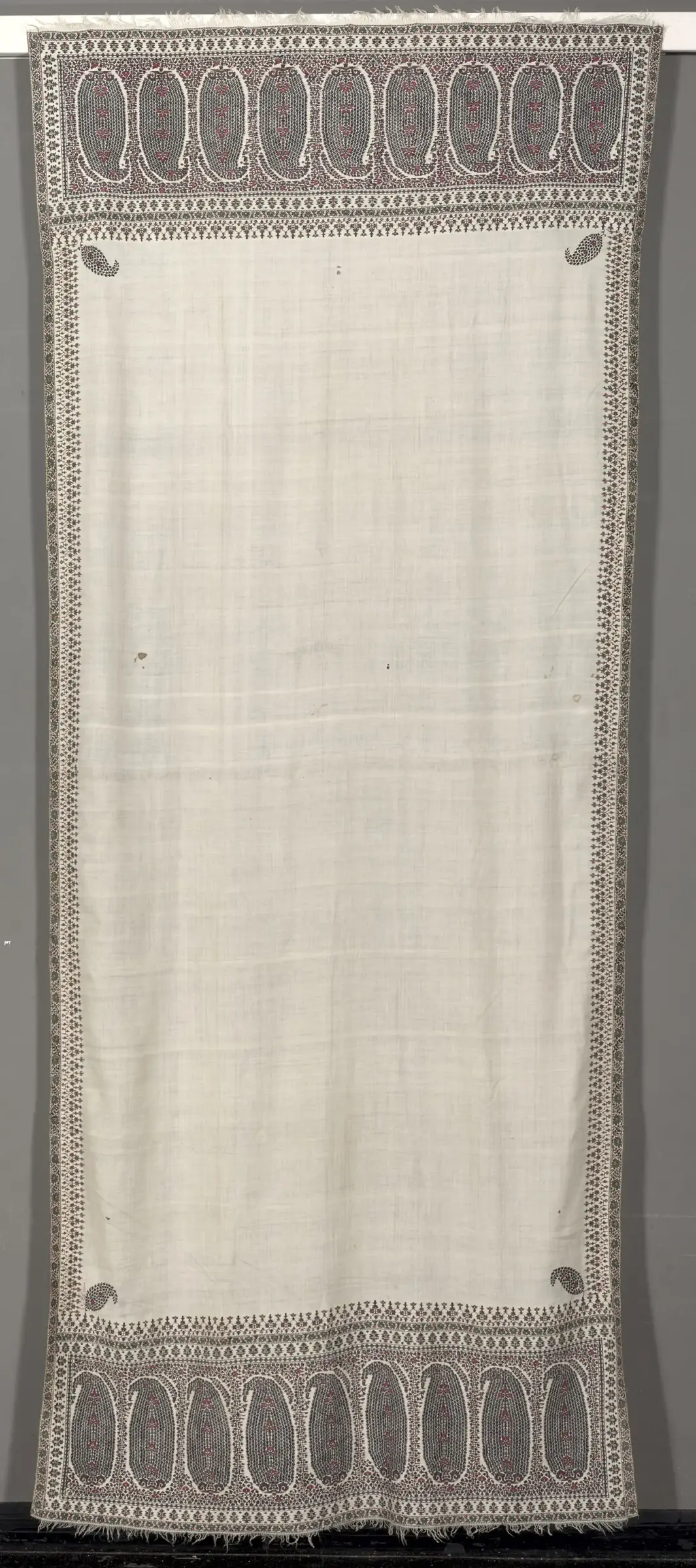
The V&A ties that change to the market. Western demand, it says, affected Kashmiri production. By the 1850s, according to another V&A record, the Kashmir shawl industry was "largely controlled by European agents", who supplied pattern books of their own for local weavers to copy.
The technique stayed slow and skilled. Patterned Kashmir shawls were woven in twill-tapestry, with coloured weft threads put in by hand for each part of the design.
How did the motif reach Europe and the town of Paisley?
It went west as fashion. The V&A says Kashmir shawls were brought back to Europe and were fashionable there through the eighteenth and nineteenth centuries. Copies followed, "notably in Norwich, Paisley and France", with other yarns and more and more mechanised processes such as the Jacquard loom.
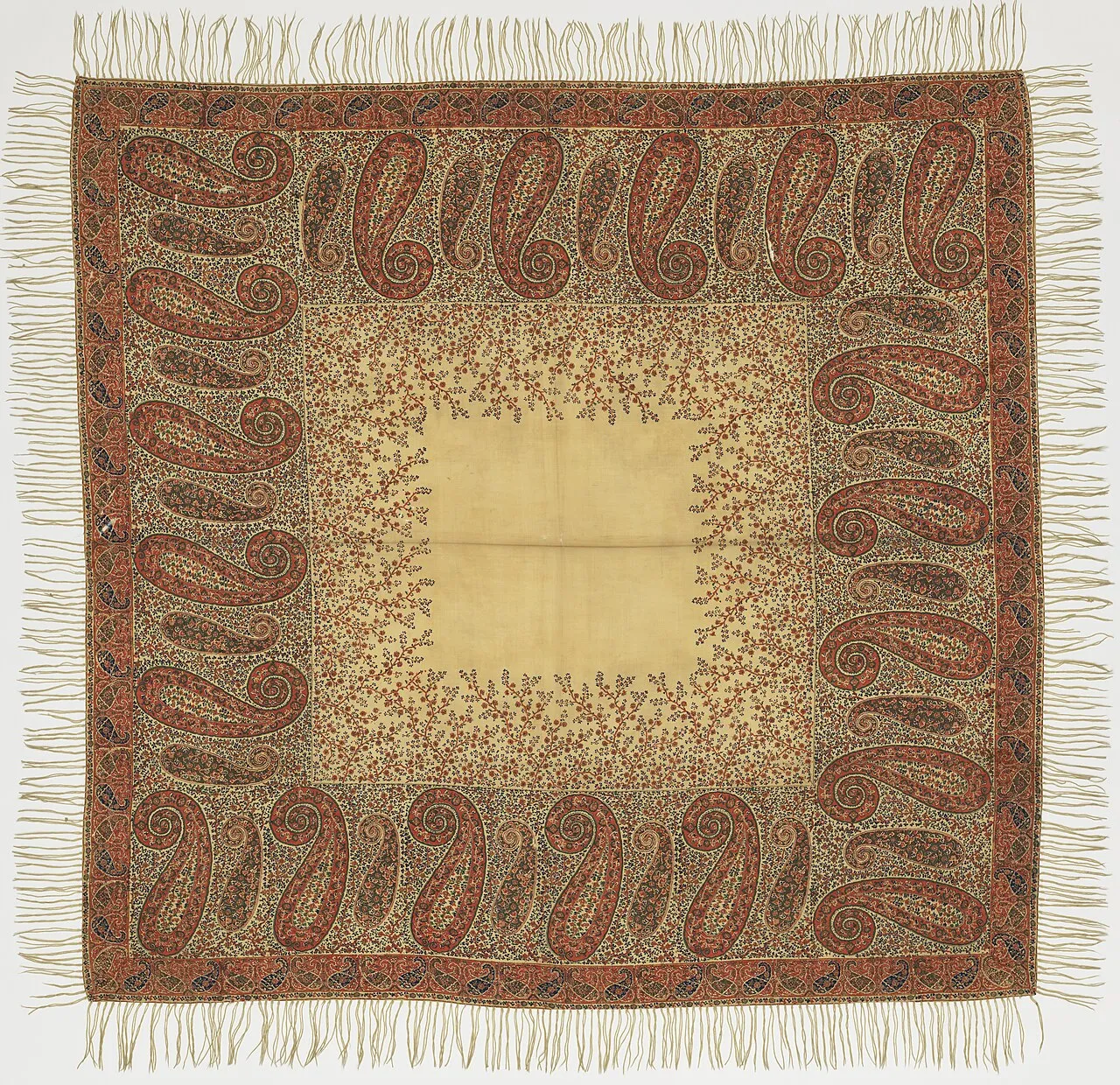
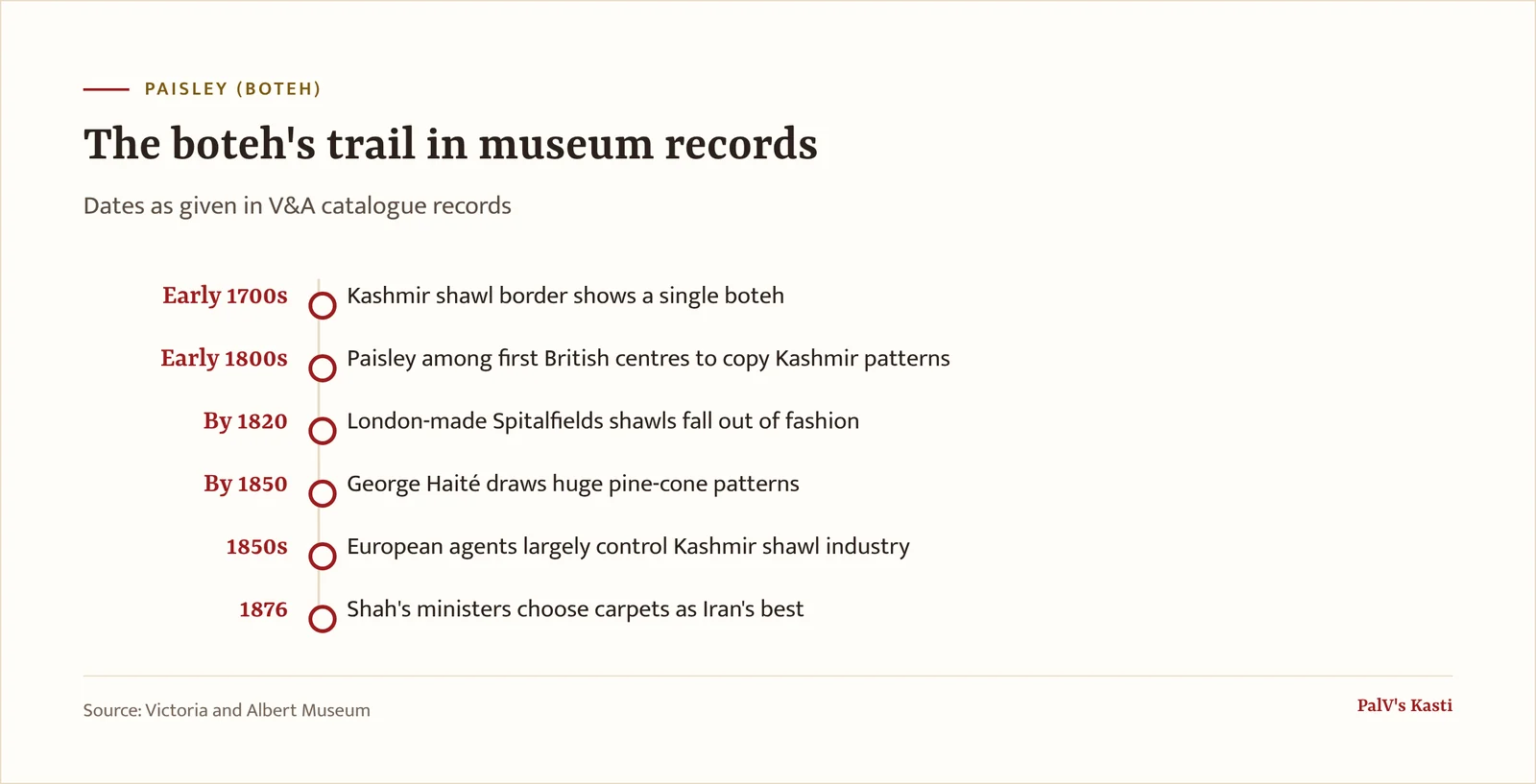
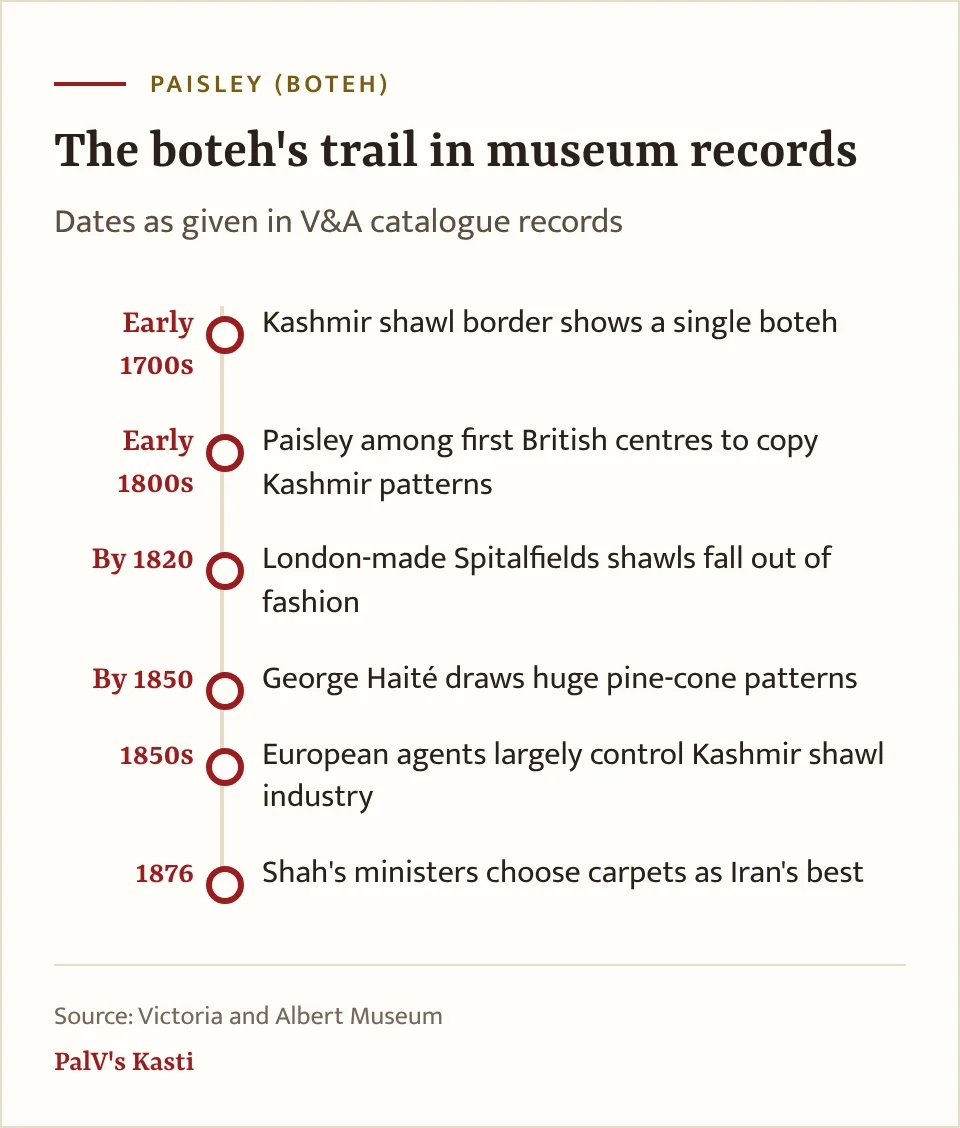
Paisley in Scotland is the town whose name the motif carries in English. The RISD Museum describes the small town of Paisley in south-western Scotland as one of the most important centres for imitating Kashmir shawls on mechanised looms, and says shawls of this type, wherever they were made, gradually became commonly known as Paisley shawls. The V&A adds that Paisley was one of the first British centres to attempt exact reproductions of Kashmir patterns, in the early nineteenth century.
Machines changed the economics. Paisley shawls woven on the Jacquard loom were generally cheaper than the hand-woven Indian ones, the V&A notes, and the loom let makers produce "more elaborate designs" faster. Designers pushed the motif to new sizes. A V&A record of the designer George Haité says that by 1850 he and his colleagues were producing "enormous and fantastic" all-over designs based on pine cones.
Not every British copy won buyers. London's Spitalfields silk weavers made shawls inspired by the Kashmir fashion. The V&A says those London shawls fell out of fashion by 1820, judged less desirable than the Indian originals or the closer imitations made in Norwich, Edinburgh or Paris.
Where does the boteh appear in Parsi textiles?
Parsi textiles draw on the same family of motifs. Describing Parsi embroidery, the Parzor Foundation writes that Indian Ambi and Persian Cypress "combined to create powerful motifs" used on pallavs, in a passage on the embroidered Parsi sari, the Parsi gara saree. Parzor also captions a nineteenth-century Zoroastrian bridal shawl from Iran with "a distinct 'Chinar Paisley'". Our guide to Parsi embroidery covers the wider mix of Persian, Indian and Chinese designs.
The motif also turns up in woven silk. The V&A holds a tanchoi sari from Gujarat whose end borders carry rows of "'cone' devices". Tanchoi, a woven silk the V&A calls popular with the Parsi market of western India, has its own story in tanchoi and its silk route to India.
Frequently asked questions
Is paisley Persian or Indian?
Both, in different ways. The V&A describes boteh as a Persian word for a flowering shrub and an important element in Persian textile design. The same museum records the motif on Kashmir shawls, where it is called buta or boteh. The English word paisley is shared with the Scottish town that became famous for copying those shawls.
Where did the paisley motif originate?
No single source pins down a birthplace. Museum records show the boteh in Kashmir shawls from at least the early eighteenth century and widely in nineteenth-century Iranian textiles. Encyclopaedia Iranica and the RISD Museum both report the theory that it began as a stylised cypress, which would point to an Iranian root.
What country is paisley from?
Paisley is a town in Scotland. The RISD Museum calls it one of the most important centres for machine-made copies of Kashmir shawls, which became known as Paisley shawls. The motif itself is older than those shawls and reached Scotland through the Kashmir shawls that Paisley's weavers imitated.
What does boteh mean?
Boteh means a flowering shrub in Persian, according to the Victoria and Albert Museum. In northern India the motif is called buta or boteh, which the V&A glosses as "flower". Encyclopaedia Iranica gives its fuller Persian names as bot(t)a jeqqa(ʾī) or būta ḵerqaʾī.
Is the paisley a Zoroastrian symbol?
None of the sources we used calls it one. Encyclopaedia Iranica reports that some scholars read the boteh as a stylised cypress, and the cypress is linked with Zoroaster in the Shahnameh. That connection remains a theory. Treat claims that the boteh is a Zoroastrian emblem as unproven.