PalV's Kasti

On this page
- What did the Medes and Achaemenid Persians wear on their heads?
- What was the Persian tiara, or kidaris?
- How did the Magi cover their heads?
- Did women in ancient Persia cover their heads?
- What did Parthian kings wear?
- Why does every Sasanian king seem to wear a different crown?
- What did Persians wear on their heads under the Safavids and Qajars?
- How did Reza Shah change what Iranian men wore on their heads?
- Frequently asked questions
Persian headgear history runs dynasty by dynasty, and for most of it what a man wore on his head showed his rank. Under the Achaemenids, Persians and Medes wore a soft felt hood that Greek writers called the tiara or kidaris, and only the great king could wear his upright. Parthian kings wore a tall, rounded miter bound with a fillet. Sasanian kings went further. Robert Göbl's view, as Elsie Peck reports it in Encyclopaedia Iranica, is that each king had a crown designed for him alone. In the Safavid period a red cap wrapped in a turban signalled loyalty to the ruling house. Qajar men wore a tall black astrakhan cap. And in the twentieth century Reza Shah's government ordered men into a peaked "Pahlavi cap", then into a European brimmed hat in 1935.
શહેરેવર રોજ
Shehrevar Roj, Tir Mah · 1396 Y.Z.
What did the Medes and Achaemenid Persians wear on their heads?
The Achaemenid court used several kinds of headgear, not one. A. Shapur Shahbazi's entry on Median and Achaemenid clothing in Encyclopaedia Iranica sorts them by type, drawing on the Persepolis friezes, royal tomb reliefs and other evidence. Peter Calmeyer's Iranica entry on crowns adds the king's own headdress.

| Headgear | What it looked like | Who wore it |
|---|---|---|
| Twisted headband | A simple twisted band | The royal guard |
| Fillet or circlet | A band round the head, narrow or wide | Elamites, many Persian soldiers, royal attendants |
| Head scarf | A long scarf of wool, linen or possibly silk, wrapped round the head | Court figures (one of Shahbazi's types) |
| Cylindrical hat | A plain cylinder | Kings and court |
| Fluted hat | Shorter and taller fluted hats | Mainly Persian dignitaries |
| Crenellated crown | "A rigid cylinder with crenellated decoration" | The ruler, the crown prince, other members of the court |
| Rounded cap | A plain rounded cap | Most often "Median" dignitaries |
Rank showed in the details. Calmeyer notes that the crown prince was generally shown in the same crown type as his father, while the crowns of lower-ranking people were "often less tall". It's not known whether the king's crown had a special colour or material, he adds.
Greek writers saw the ordinary Persian at closer range. Strabo, in the Loeb translation hosted on the University of Chicago's LacusCurtius site, says the men who served in the army wore "a tower-like hat", while most people wore "a piece of linen cloth round the head".
What was the Persian tiara, or kidaris?
The tiara was a soft hood, not a metal crown. Shahbazi describes "a hood or cap of felt" that covered the head, neck, ears, cheeks and chin. Greek authors called it tiára, kídaris or kítaris, and Calmeyer warns that ancient authors "do not always distinguish clearly among these terms". The Old Persian word for it hasn't survived.
How you wore it mattered. "Only the great king had the right to wear his tiara" upright, with the top erect, Shahbazi writes. Calmeyer agrees that the "upright (orthē) tiara" belonged to the king. The Greeks mockingly compared the upright version to a cockscomb.
A ribbon, the diadem, could be tied round the hat. The king's kinsmen wore it, Shahbazi records, as "the mark of distinction". Members of the seven aristocratic families could wear it "knotted on the forehead", Calmeyer notes.
The shape outlived the empire. The Greeks labelled one form of it the "Phrygian cap", though Calmeyer says nearly all Iranian tribes wore it, and Shahbazi traces its survival "with slight modifications, in Roman and European cultures".
How did the Magi cover their heads?
Strabo describes the Magi at a fire temple making incantations in "high turbans of felt" that came down over the cheeks and covered the lips. Shahbazi, drawing on Strabo, writes that the Magi also used a covering for their noses and mouths, worn loosely.
That is the ancient record, not a rule for today. For the Zoroastrian practice now, we explain the religious reason in why Zoroastrians cover their heads, and the garments Parsis wear in Parsi traditional dress. Practice varies between families and Agiaries; your family priest's guidance comes first.
Did women in ancient Persia cover their heads?
Some did, and the evidence changes period by period. For the Achaemenid era, Shahbazi records an overgarment that, like the modern chador, covered the head and neck. "The face, however, was always uncovered," he adds.
Sasanian women are harder to see, because most images show queens or goddesses. Elsie Peck points to the harpists on the hunting reliefs at Taq-e Bostan as rare evidence for "head coverings worn by Sasanian women of the lower ranks". Two of them wear soft turbans. Two others wear rectangular headdresses with wide hanging bands of cloth or ribbon.
In the Safavid period, Nazanin Hedayat Munroe of the Metropolitan Museum of Art describes a square cloth, the chahar-qad, set on the crown of the head and fastened with a thin silk ribbon, sometimes with a chin strap of pearls or gems. Outdoors, women wore a chador "covering the body and lower face". Layla Diba's Iranica entry records a darker chador, in black or dark blue, appearing in the Qajar period. After the 1979 revolution, the head and neck were to be entirely covered, according to Iranica.
What did Parthian kings wear?
The Parthian (Arsacid) kings first took the Greek diadem, presenting themselves "as heirs to the power of the Seleucids", Elsie Peck writes in Iranica. Their most characteristic royal headdress was "the tall, rounded miter decorated with various crests and emblems and always bound by a fillet".
Neighbouring rulers copied it. Peck notes the miter on the coins of Elymais, Persis and Edessa, and says the Kushans borrowed it with local changes. The rulers of Persis also showed themselves in "the triple-stepped crenellated crown of Achaemenid kingship". For the wider story of these empires, see our guide to ancient Persian civilization.
Why does every Sasanian king seem to wear a different crown?
Because, on Robert Göbl's reading, each one did. Peck reports his view that "each Sasanian king had his own crown which was designed especially for him". Coins are the key here, since coin portraits paired with the ruler's name became "the chief means of identifying royal representations in other Sasanian media". Peck adds a caveat: "some kings had more than one crown type".
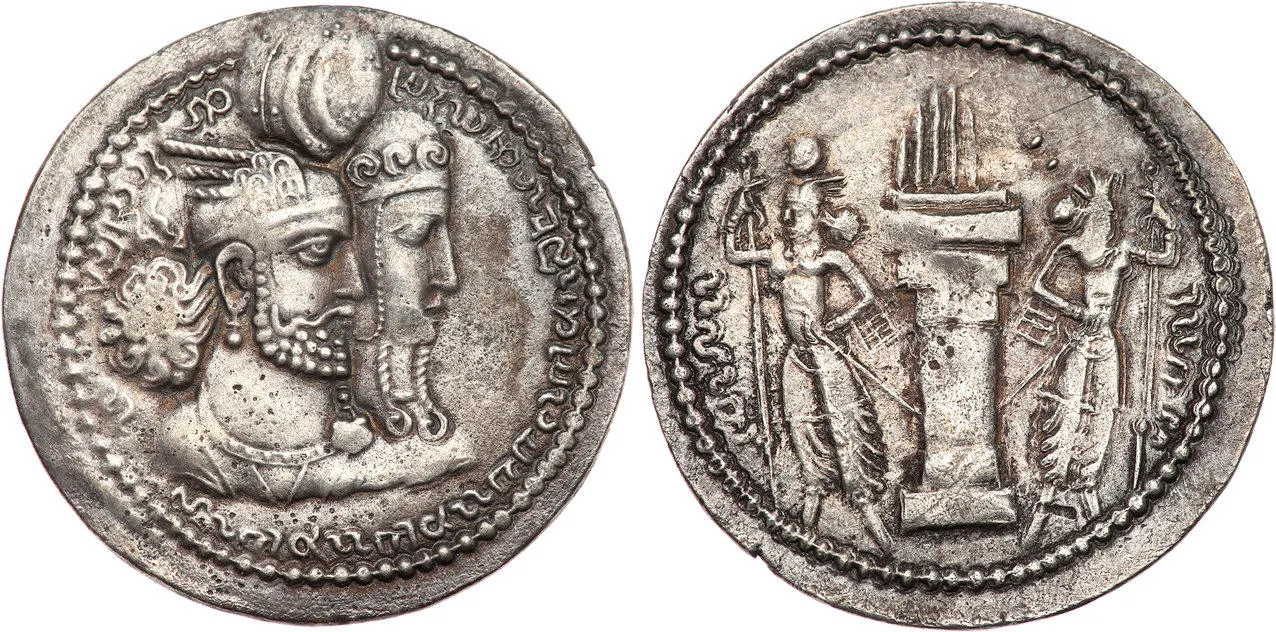
Ardashir I's crown was battlemented, with a simple diadem "through which a globe of heavy curls was pulled", a feature known as the corymbus. Early Sasanian kings each added a divine attribute to the crown, and a later king changed the globe itself. Peck's examples:
| King | On the crown |
|---|---|
| Bahram I | The solar rays of Mithra |
| Bahram II | The eagle wings of Verethragna |
| Narseh | The stylised leaves of Anahita |
| Khosrow II | A star in the crescent, replacing the globe |
Nobles had their own fashions. Peck describes the two most common headdresses of Sasanian nobles, both seen from the early years of the empire: a rounded tall hat borrowed from royal Parthian fashion, and a soft "Phrygian" cap whose point fell forward, sometimes ending in the head of a bird or animal. Late in the dynasty, the boar-hunt and stag-hunt reliefs at Taq-e Bostan show the king and his entourage in a low, square cap, the king's tied with a short fillet.
What did Persians wear on their heads under the Safavids and Qajars?
Headgear became a badge of political loyalty under the Safavids. Diba describes a turban wrapped round a "twelve-gored felt or brocade cap (tāj)", symbolising the twelve Shiʿite imams. Munroe's Met essay describes white turbans of twelve folds over a red felt cap with a baton, called the taj Haidari or taj-i Safavi, and calls it "the ultimate signifier of political allegiance". Note the difference: Diba puts the twelve in the gores of the cap, Munroe in the folds of the turban.

Fashion moved on within the dynasty. In the era of Shah Abbas, Munroe writes, "the elongated taj-i Safavi has been abandoned for a wide, bulbous turban adorned with an aigrette for men". Diba notes that white turbans were later superseded by coloured brocades.
Later rulers brought in their own caps. Diba's entry records these:
- Nader Shah introduced a "four-pointed cap (kolāh-e nāderī)", usually red, representing the first four caliphs.
- Karim Khan Zand "replaced the kolāh-e nāderī with a tall cylindrical cap".
- Under the Qajars, drawing on the traveller Morier, Diba describes "the mandatory Qajar kolāh, a tall black astrakhan cap angled at the top".
- Late in the Qajar period, notables wore an astrakhan cap shaped like a pillbox, while the lower and religious classes kept their turbans.
How did Reza Shah change what Iranian men wore on their heads?
He made headgear a matter of law. Encyclopaedia Iranica's entry on Pahlavi-era clothing records a cabinet decree ordering government workers and schoolboys to wear "cylindrical hats with bills", the Pahlavi cap (kolāh-e pahlavī), instead of "the customary fur hats, turbans, or ovoid hats". The clergy were exempt.
The Pahlavi cap didn't last. In 1935 a further decree made the European brimmed hat compulsory for men, and the stated reason was that the brim would protect outdoor labourers from sunburn. Britannica records that in 1935, "angered over popular resistance to Reza Shah's order that men wear European-style hats", officials had soldiers fire on a crowd in Mashhad. Iranica places the killings among people who had taken refuge in the Gowharshad mosque.
The long-term effect was fewer hats, not more. After 1935, Iranica notes, men gradually stopped wearing headgear at all, and among urban men only soldiers and clerics kept it. Houchang Chehabi, writing in Iranian Studies in 1993, argues that Reza Shah's dress policies "were mainly meant to promote nation-building".
Frequently asked questions
What is a kidaris?
A kidaris is one of the Greek names for the soft Persian tiara. Encyclopaedia Iranica describes it as a hood or cap of felt that covered the head, neck, ears, cheeks and chin. Greek writers also called it tiára or kítaris, and ancient authors didn't always tell these terms apart clearly.
What did the kings of ancient Persia wear on their heads?
Achaemenid kings wore a tiara that only they could wear upright, and a rigid crenellated crown. Parthian kings wore a tall rounded miter bound with a fillet. Sasanian kings wore elaborate crowns carrying divine symbols, and on Robert Göbl's reading, as Iranica reports it, each king had his own design.
What was the Safavid taj?
The Safavid taj was a red felt cap worn under a turban. Encyclopaedia Iranica describes it as twelve-gored, symbolising the twelve Shiʿite imams, while the Metropolitan Museum of Art describes a white turban of twelve folds over a red cap with a baton. It signalled political allegiance to the Safavid house.
What was the Pahlavi hat?
The Pahlavi hat, or kolāh-e pahlavī, was a cylindrical cap with a bill that Reza Shah's cabinet ordered government workers and schoolboys to wear in place of fur hats, turbans and ovoid hats. The clergy were exempt. In 1935 a new decree replaced it with the European brimmed hat, which met resistance and bloodshed in Mashhad.
Did women in ancient Persia cover their faces?
Not in the Achaemenid period, according to Encyclopaedia Iranica. Some women wore an overgarment that covered the head and neck, like the modern chador, but "the face, however, was always uncovered". Later periods differ. The Metropolitan Museum of Art notes that Safavid women's outdoor chador covered the body and lower face.
How do historians identify Sasanian kings' crowns?
Mainly through coins. Coin portraits carry the ruler's name, so Encyclopaedia Iranica calls them the chief means of identifying royal images in other Sasanian media, such as reliefs and silver. Elsie Peck cautions that some kings had more than one crown type, which makes matching a crown to a king harder than it looks.