PalV's Kasti
On this page
- Where does traditional Parsi dress come from?
- What do Parsi men wear?
- What do Parsi women wear?
- What do Parsi children wear?
- What do Parsi priests wear?
- What do Parsis wear for weddings, navjotes and funerals?
- How do Parsi men and women cover the head?
- Is traditional Parsi dress still worn?
- Frequently asked questions
Parsi dress is the clothing the community took up in Gujarat and Bombay, not the dress of ancient Iran. Dosabhai Framji Karaka wrote in 1884 of the "great resemblance" between the men's angrakha and turban, the women's sari, and the dress of the Hindus of Gujarat. UNESCO Parzor says the Zoroastrians who left Iran "came to adopt Indian costumes, including the sari". Next to the skin, men and women wear the Navjote.">Sadra and Kusti. Over these, women wear the sari with a blouse and a small white head cloth called the mathabana. In the 19th century men wore loose trousers, a skull-cap, an angrakha coat and a turban, and changed into the white jama and pichhori for weddings and funerals. Today the dagli, which The Voice of Fashion calls a "traditional jacket-style garment", is the ceremonial menswear for weddings and navjotes.
અસપંદામેદ રોજ
Asfandarmad Roj, Tir Mah · 1396 Y.Z.
Where does traditional Parsi dress come from?
From Gujarat. Karaka set the angrakha, the turban and the sari beside the dress of Gujarat's Hindus and found them alike, and he thought the costume suited the climate. Parzor puts the same history plainly: Indian costume, sari included, was adopted after the migration from Iran. How and why that happened, and how the wardrobe kept changing through the 19th and 20th centuries, is told in how Parsi dress changed.
What do Parsi men wear?
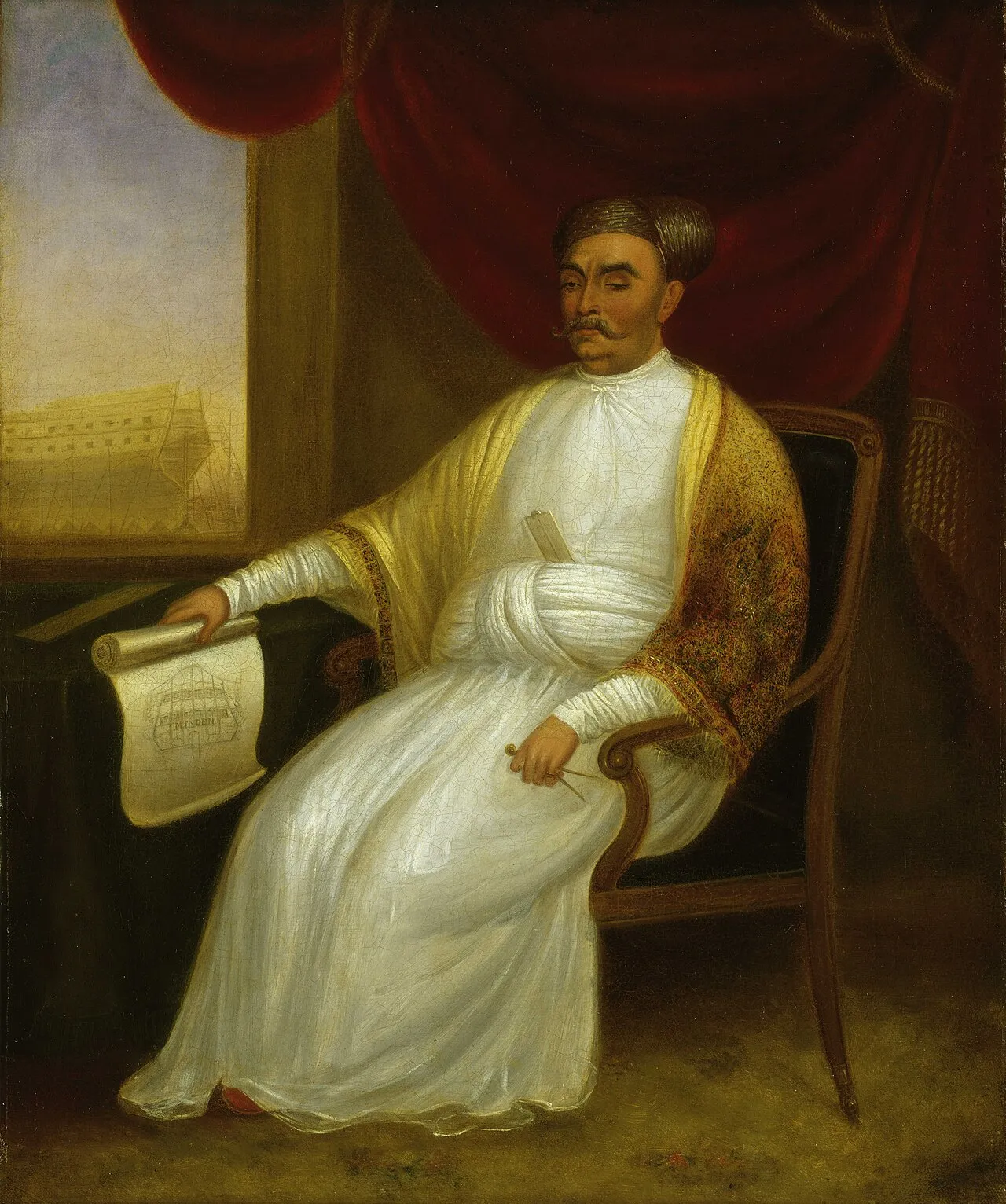
Karaka's account is the most detailed early description of a Parsi man's clothes we could find. At home, he wrote, a man wore a long muslin sudra and the Kusti, a sleeved waistcoat of white cloth or chintz, loose cotton trousers, slippers and a skull-cap of China silk. To go out he added an angrakha, "a loose coat without a belt", with sleeves twice the length of the arm, and a turban "generally of a dark chocolate colour" worn over the skull-cap. Wealthier men wore silk trousers, socks and English shoes or boots.
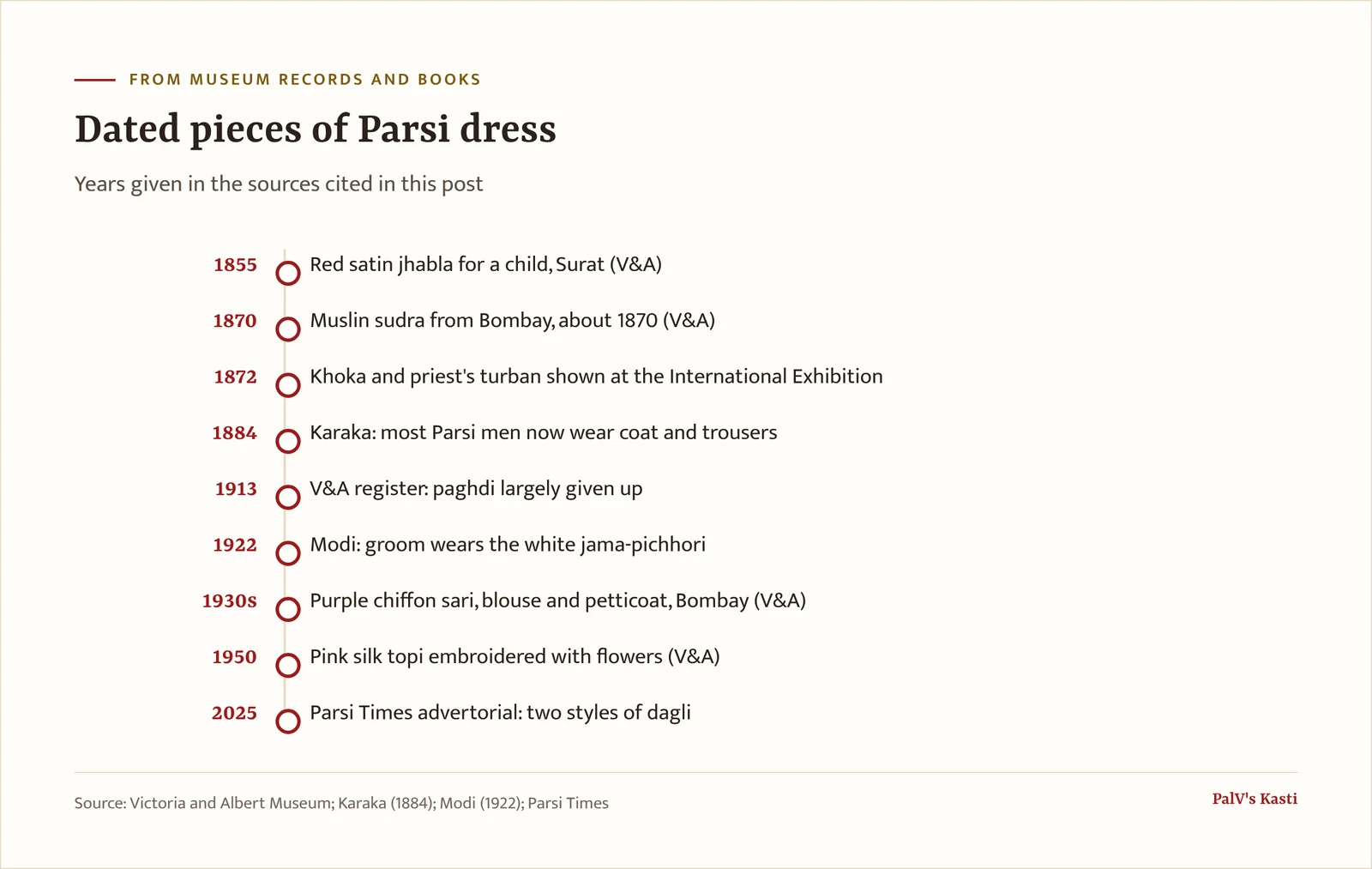
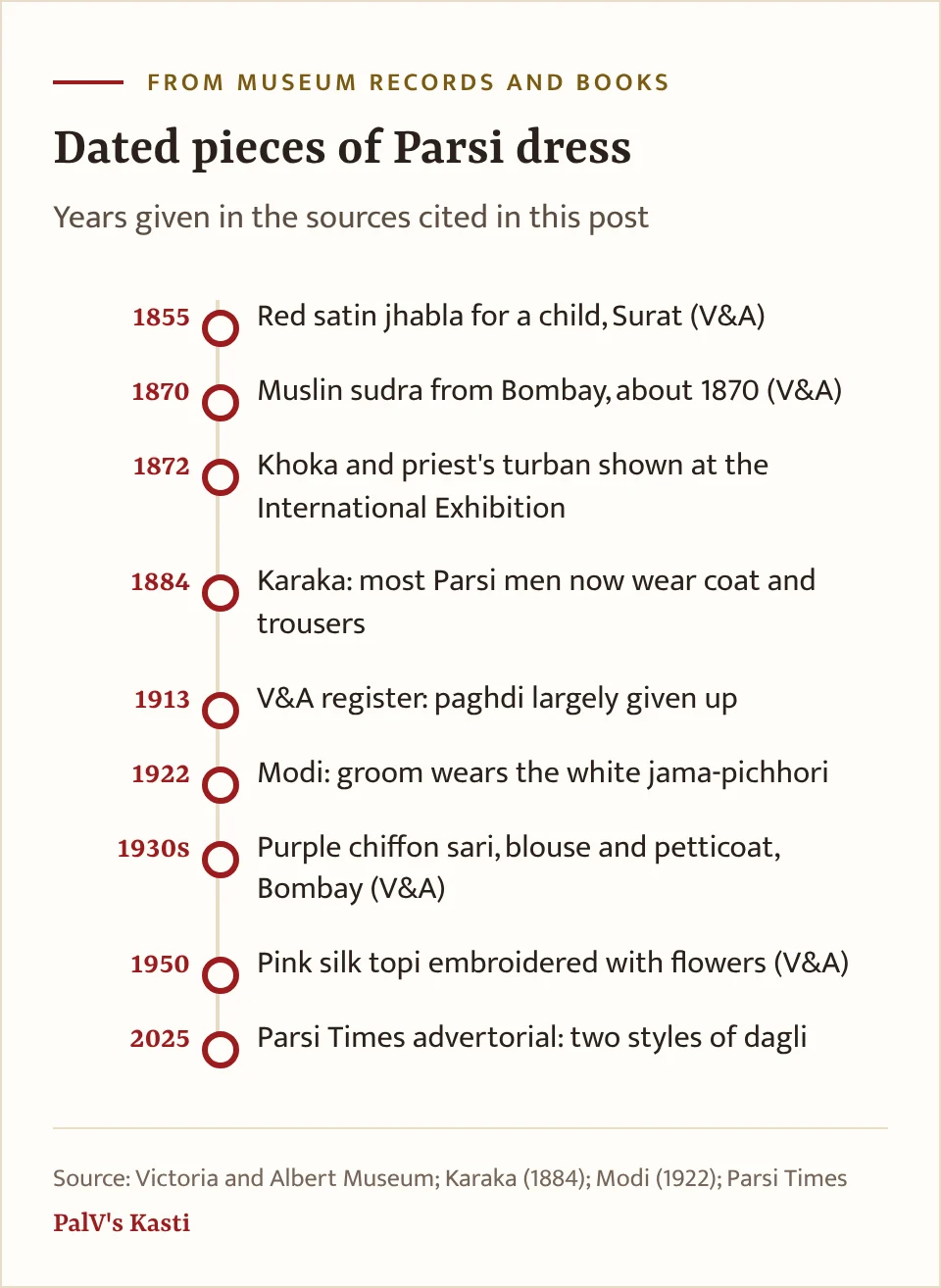
| Garment | What it is | When it is worn |
|---|---|---|
| Sadra and Kusti | White muslin undershirt and the sacred cord tied over it. The V&A holds a short-sleeved muslin sudra from Bombay, about 1870 | Every day, under all other clothes |
| Topi | Skull-cap. The V&A holds a pink silk topi embroidered with flowers, dated about 1950 | At home, and under the turban |
| Angrakha | Loose, beltless coat with very long sleeves | Outdoor wear in the 19th century |
| Paghdi | Stiff turban of varnished printed cotton on shaped cardboard | Largely given up by 1913, but still "a general rule on ceremonial occasions" |
| Khoka | Turban of glazed printed cotton on a wickerwork base | Shown at the 1872 International Exhibition and registered as "Worn by Parsees" |
| Jama and pichhori | Long white double-breasted coat falling in folds to the ankle, with a long cloth wound round the waist | Weddings, funerals and formal occasions |
| Dagli | Jacket-style ceremonial coat | Weddings and navjotes |
| Coat and trousers | A modified English suit | Worn by "the great majority" of Parsis by 1884 |
That last row matters. Even in 1884, Karaka noted that most Parsi men had already moved to coat and trousers. They kept the turban, though he found it cumbrous, and the jama and pichhori came out only for weddings, funerals and state occasions. The dagli has its own page: the Parsi dugli (dagli), the man's ceremonial coat.
What do Parsi women wear?
Like the men, Karaka wrote, women wore the sudra next to the skin, silk trousers, and the Kusti tied over the sudra. Over these came the sari, about six yards long and usually of bright-coloured silk or satin. Some were embroidered in silk, and those fringed with deep gold lace were kept for great occasions. It was wrapped round the waist and the rest thrown over the head, falling on the right arm. For draping one this way today, see how to drape a sari Parsi style.
Under the sari, women had worn a short-sleeved silk vest called the kanchri or choli. By 1884 Karaka found it "almost entirely superseded" by a bodice cut more in the English fashion. You can see where that led in an ensemble at the Victoria and Albert Museum, from the Feroza Jamsheed Marker collection of Parsi clothing: a purple silk blouse, an ankle-length purple silk petticoat made to go under the sari, and a purple chiffon sari with a bird border embroidered in petit point, all from Bombay in about the 1930s. The museum notes the border may be European work.
The embroidered pieces are what most people now picture when they hear "Parsi dress". Parzor names the gara, the kor, the topi and the ijar as garments "embellished with perfect embroidery", and records that Parsi women made their own garas, jhablas and kors. Start with what a Parsi gara saree is, and read how Parsi women shaped the modern sari for the blouse and petticoat story.
The head was covered with the mathabana, which Karaka described as a thin white linen cloth "of the size of a small handkerchief". Our page on the mathabana covers it in full.
What do Parsi children wear?
Up to the age of seven, Karaka wrote, a child wore a single loose shirt called the jabhla, of cotton, flannel or silk, reaching from the neck to below the knees. Boys and girls were dressed alike, with a topi on the head and light shoes. Among better-off families, light trousers had "recently" been added. On festival days and birthdays, he wrote, parents dressed children in rich embroidered silks.
Surviving pieces bear him out. The V&A holds a jhabla from Surat dated about 1855, in red satin embroidered in white, blue and yellow silk at the neck, sleeves and hem. For more, see jhablas and ijars.
What do Parsi priests wear?
White. Karaka recorded in 1884 that Shenshai priests generally wore the same costume as laymen, with one difference: all of it, turban included, was "made solely of white cotton cloth". A few Kadmi priests, he added, wore a garb copied from their late high priest Mulla Firoz, which looked like Armenian or Turkish dress.
The V&A has a white cotton turban on an oval paper base, received from the 1872 International Exhibition and entered as "Worn by Parsee priests". J.J. Modi, in his 1922 book on Parsi ceremonies, describes priests putting on their "full sacerdotal dress", the jama and pichhori. Practice varies between families and Agiaries; your family priest's guidance comes first.
What do Parsis wear for weddings, navjotes and funerals?
For a wedding, Modi wrote, the bridegroom puts on "the usual ceremonial dress", the jama-pichhori, a loose flowing garment full of folds that is "always white in colour". Karaka said the same pair was worn at funerals and weddings, and that some men also wore it to a ball or reception at Government House. Those who walk with a funeral procession to the Tower of Silence, Modi noted, are "clothed in full white dress".
The Voice of Fashion describes the dagli as ceremonial menswear for weddings and navjotes. What the bride, the groom, the navjote child and the guests wear now is covered in our guide to Parsi wedding attire. Practice varies between families and Agiaries; your family priest's guidance comes first.
How do Parsi men and women cover the head?
Men wore the topi at home and a turban over it outdoors, either the paghdi or the khoka. Women wore the mathabana, with the end of the sari thrown over the head. Each has its own page: the Parsi topi, the Parsi paghdi, and our guide to why Zoroastrians cover their heads.
Is traditional Parsi dress still worn?
Yes, though mostly for occasions. In a Parsi Times advertorial of 27 September 2025, Kaizad Wadia described two styles of dagli on offer, a traditional one and a contemporary one drawn from the bandhgala, each sold with a shirt and pant. On the women's side, Parzor reports a revival of Parsi kor embroidery spreading across India and credits itself with starting it.
The Sadra and Kusti are the one part of Parsi dress that never became occasional. The Pluralism Project at Harvard says the sudreh is "to be worn each day", and Karaka wrote that the sudra is "always worn next to the skin". For what the Sadra is and why it matters, read what a Parsi Sadra means. We stitch Sadras to measure, and you can buy a Parsi Sadra online from us. Practice varies between families and Agiaries; your family priest's guidance comes first.
Frequently asked questions
What is the traditional dress of Parsis?
Traditional Parsi dress is Gujarati in origin. Men wore loose trousers, a skull-cap called the topi, an angrakha coat and a turban, with the white jama and pichhori for ceremonies. Women wore a six-yard silk sari over a blouse, with a white mathabana on the head. Both wear the Sadra and Kusti underneath.
What do Parsi men wear?
Karaka described it in 1884. At home a man wore the Sadra and Kusti, a waistcoat, loose trousers and a topi. Outdoors he added the angrakha coat and a turban. For weddings and funerals he wore the white jama and pichhori. By then, he noted, the great majority had taken to coat and trousers.
How did Parsi women traditionally wear the sari?
Karaka described it in 1884. The sari, about six yards of bright silk or satin, was wrapped round the waist and the remaining length thrown over the head so that it fell on the right arm. Underneath, women wore the Sadra, silk trousers, the Kusti, and a choli or later an English-style bodice.
What is the mathabana?
The mathabana is the head covering of a Parsi woman. Dosabhai Framji Karaka described it in 1884 as a thin cloth of white linen about the size of a small handkerchief, worn over the hair. He also noted that younger women had begun wearing it further back on the head.
Do Parsis wear the Sadra and Kusti every day?
Yes. The Pluralism Project at Harvard University describes the sudreh as a white muslin undershirt to be worn each day, with the Kusti tied around the waist over it. Karaka's 1884 account says the sudra is always worn next to the skin, and lists the Sadra and Kusti as the first layer for men and women.
What do Parsi priests wear?
Parsi priests dress in white. Karaka wrote in 1884 that Shenshai priests wore the same costume as laymen, but made entirely of white cotton cloth, turban included. J.J. Modi, writing in 1922, describes priests putting on the white jama and pichhori as their full sacerdotal dress for a ceremony.