PalV's Kasti
On this page
A Parsi cap, or topi, is the small fitted prayer cap that Parsi men and boys wear to keep the head covered. The Phoebe A. Hearst Museum of Anthropology records that Parsi men and children wore it "while praying, going to temple or for any religious ceremony". It isn't the same thing as the paghdi, the stiff formal hat. Documented topis include brocaded "kasabi" topis, zari-embroidered velvet caps for children and heavily worked zardozi caps that a groom might have worn. Ervad Dr Ramiyar Karanjia writes that a head covering "should be preferably white". Today the topi is worn mainly for prayer, for rituals such as the Navjote, and for visits to the Agiary.
અસપંદામેદ રોજ
Asfandarmad Roj, Tir Mah · 1396 Y.Z.
What is a Parsi topi?
The topi is the traditional head covering of Parsi men. Karanjia lists the traditional head coverings as "topi (cap) or paghdi for men" and a scarf or mathabanu for women. Noshir H. Dadrawala, writing in Parsi Times in February 2022, describes the same split: "Men usually wear a skull cap," and women a head scarf. The women's scarf has its own guide: the mathabana.
Museums file the topi under religious dress. The Hearst Museum at the University of California, Berkeley, records a Parsi topi from Mumbai under the function "Religion and Divination". The Chhatrapati Shivaji Maharaj Vastu Sangrahalaya (CSMVS) in Mumbai notes that caps were considered important "especially at religious and certain social functions".
Why the head is covered at all, and what priests wear instead of a topi, is explained in our hub guide on Zoroastrian head covering.
Is a Parsi topi the same as a paghdi?
No. Museum records keep them apart.
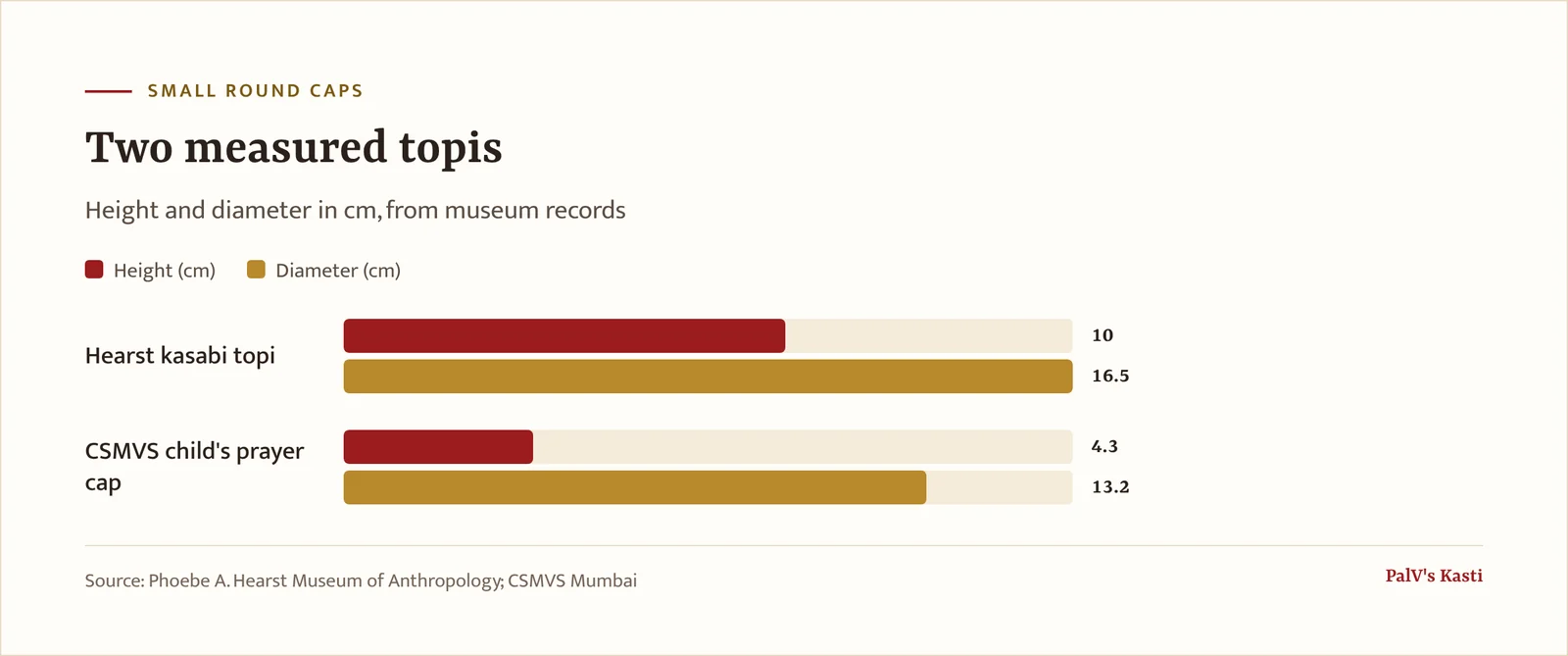
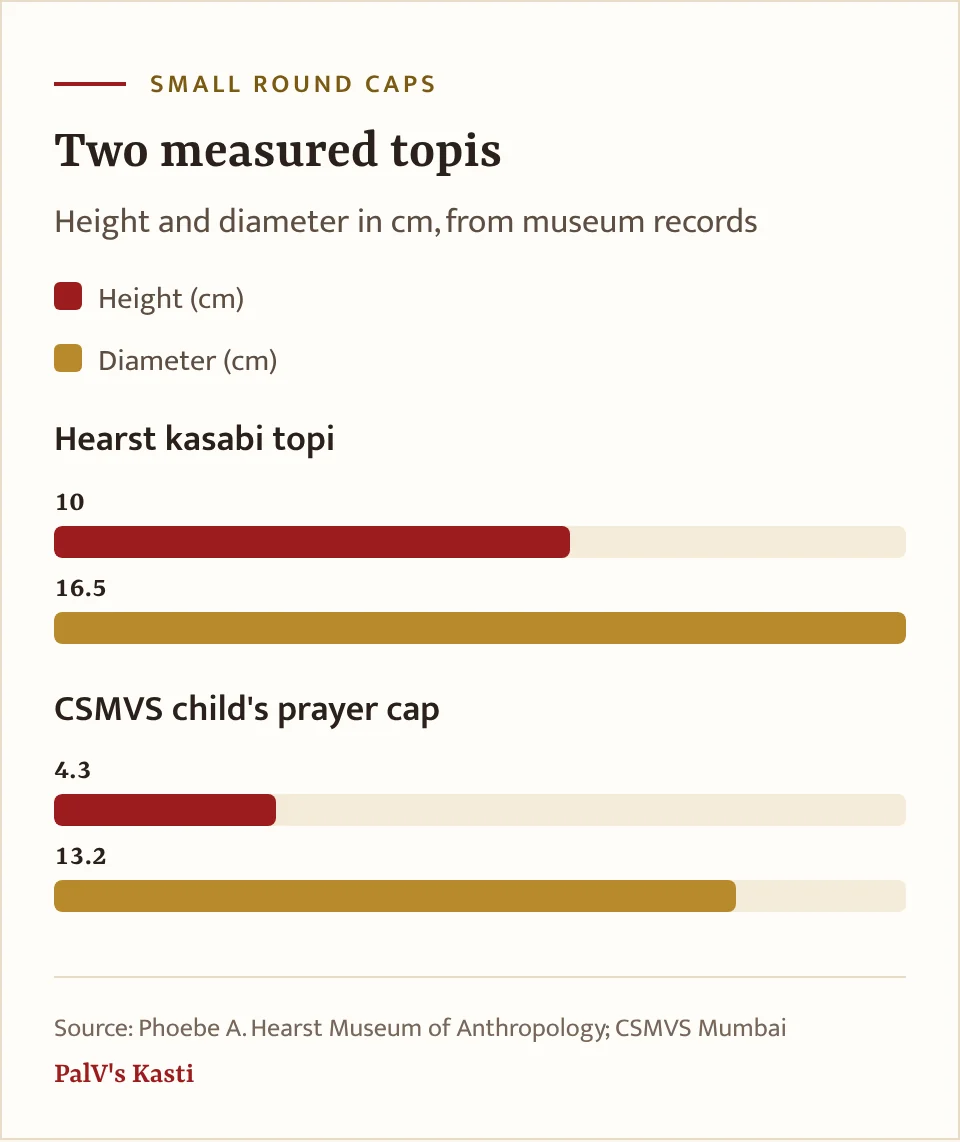
The topi is a small round cap. Measured examples are small: the Hearst Museum's kasabi topi is 10 cm high with a 16.5 cm diameter, and a CSMVS child's prayer cap is 4.3 cm high with a 13.2 cm diameter.
The paghdi is a formal hat built on a frame. The Victoria and Albert Museum's 1913 register describes one as "varnished printed cotton fabric, partly padded, stretched upon shaped cardboard". The paghdi and its origins are covered in the Parsi paghdi, and the pheta in the Parsi pheta.
What types of Parsi caps are there?
Museum collections give the clearest record of what Parsi topis have looked like. Here's what we could verify, object by object.
| Type of topi | What the museum record says | Collection |
|---|---|---|
| Kasabi topi (brocaded cap) | Gold brocade on red silk, two inset crown panels of gold brocade on blue, striped cotton lining. Worn by men and children for prayer and ceremonies | Phoebe A. Hearst Museum of Anthropology |
| Child's velvet prayer cap | Black velvet embroidered largely in zari with flora and bird motifs, stiffened with buckram and/or cardboard. Popular in the early 20th century | Roots.gov.sg, National Heritage Board, Singapore (2009-01456) |
| Child's silk prayer cap | Silk with zari, made in Mumbai, 20th century | CSMVS, Mumbai |
| Child's cap in a full outfit | Cap of red Chinese silk with flower motifs, part of a cap, tunic and trousers set from Gujarat, c.1874 | Victoria and Albert Museum (1426&A to B-1874) |
| Embroidered silk topi | Pink silk cap embroidered with a floral design in coloured silk, made in China, c.1950 | V&A, Feroza Jamsheed Marker collection of Parsi clothing (IS.16-2004) |
| Zardozi topi (possibly a groom's) | 19th-century cap heavily embellished with zardozi, embroidery in gilt thread or gold and silver wire | Roots.gov.sg (2015-00045) |
Two things stand out. Three of the six caps in this table were made for children. And China turns up twice: Chinese silk in the 1874 child's cap, and a cap made in China around 1950.
CSMVS notes that over time the cap "developed a decorative dimension", and that cap making in Western India became "a highly specialized craft".
What colour is a Parsi topi?
White, by preference. Karanjia writes that a head covering "should be preferably white", and adds that it is often black or dark coloured "for reasons of convenience". The museum pieces above show that coloured and embroidered topis were made too, especially for children and for festive wear.
When is the Parsi topi worn?
The topi goes on whenever the head should be covered. The sources name these occasions:
- Prayer and the Kusti. Dr Shernaz Cama of UNESCO Parzor notes that "while tying the kusti, one must cover the head". Dadrawala calls covering the head while praying, even at home, mandatory for every Zoroastrian.
- The Navjote. Cama describes the child at the initiation with the head "covered with a topi or cap" before walking with the priest to the dais. J.J. Modi, in his 1922 account of the nahn, the purificatory bath every child takes at the Navjote, lists the cap with the trousers and the Sadra among what is put on after the bath.
- The Agiary. Karanjia writes that most Parsis now cover their heads only while praying, taking part in a ritual or going to a fire temple. Dadrawala adds funerals to that list.
- Weddings. The National Heritage Board record for the zardozi topi says such a cap "could likely have been worn by a groom".
Karanjia also notes how much this has shrunk: until about three generations ago, Parsis kept their heads covered "throughout the day and night".
Practice varies between families and Agiaries; your family priest's guidance comes first.
Why is the seam of the topi kept at the back?
The diagonal seam on a topi is called the shetā. Karanjia defines it as "the diagonally stitched seam on the outside of the topi", and notes that there is a tradition of wearing it at the back.
He gives two possible explanations: appearance, so the seam isn't visible at the front, and a pun, since shetā sounds like shetān, "devil". But he's clear that there is "no purely religious reason or compulsion" to keep the shetā at the back. On his reading, the back seam is custom rather than religious law.
Practice varies between families and Agiaries; your family priest's guidance comes first.
Frequently asked questions
What is the Parsi cap called?
The Parsi cap is called a topi (also written topee). It is a small round prayer cap worn by Parsi men and boys. A brocaded version is known as a kasabi topi, according to the Phoebe A. Hearst Museum of Anthropology. The frame-built formal hat is a different item, the paghdi.
Is the Parsi topi the same as the paghdi?
No. The topi is a small fitted cap for prayer and religious occasions. The paghdi is a formal hat. A Victoria and Albert Museum record describes one made of varnished printed cotton, partly padded and stretched over shaped cardboard. Men wore the paghdi on ceremonial occasions and the topi for prayer.
Do Parsi boys wear a topi at the Navjote?
Yes. Dr Shernaz Cama of UNESCO Parzor describes the child at the Navjote with the head covered by a topi or cap before walking with the priest to the dais. Museum collections in Mumbai, Singapore and London hold Parsi children's caps in velvet, silk and zari.
What colour should a Parsi topi be?
White is preferred. Ervad Dr Ramiyar Karanjia writes that a head covering "should be preferably white", though it is often dark for convenience. Museum examples include a black velvet child's cap with zari, a gold-brocade kasabi topi on red silk and a pink silk cap made in China around 1950.
Why is the topi seam worn at the back?
The seam, called the shetā, is traditionally kept at the back. Ervad Dr Ramiyar Karanjia suggests this may be for appearance, or from the likeness of "shetā" to "shetān" (devil). He states there is no purely religious reason or compulsion to keep it there.