PalV's Kasti
On this page
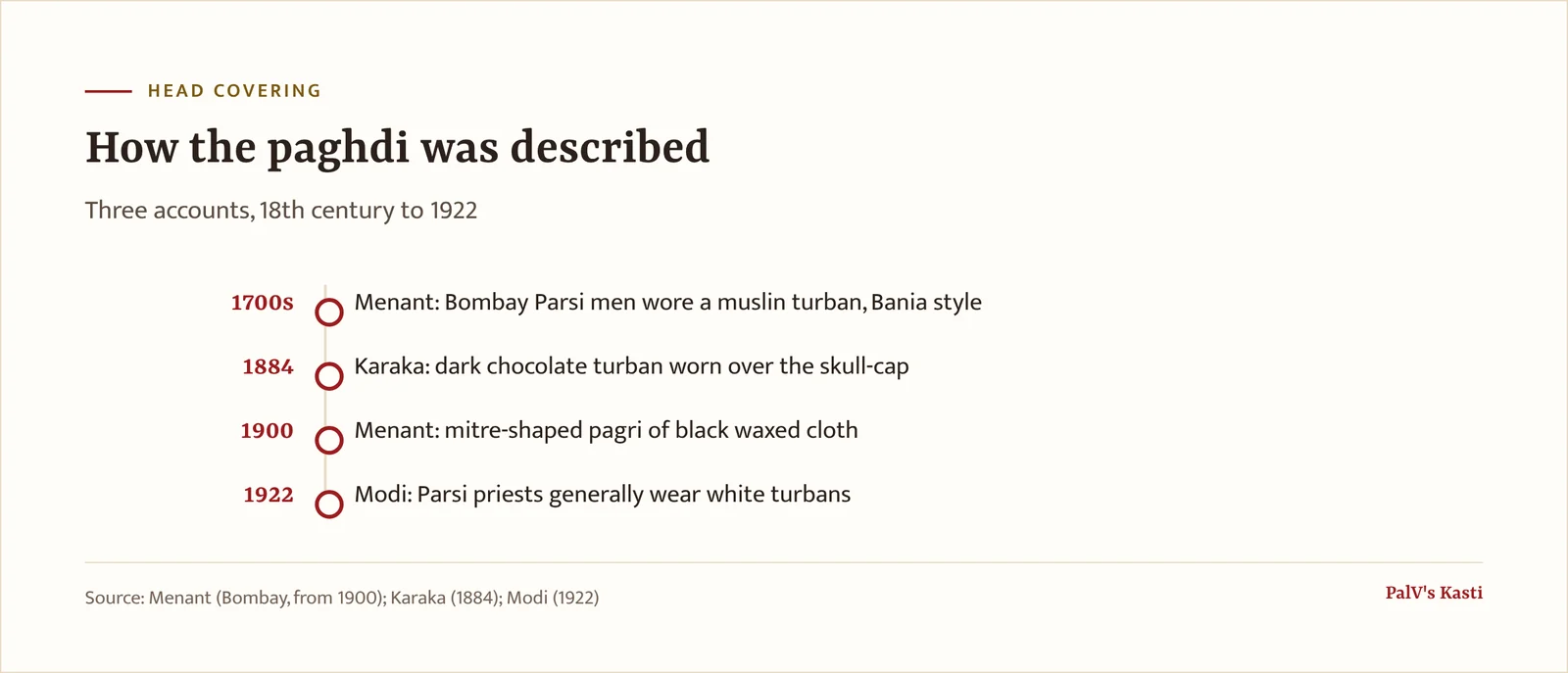
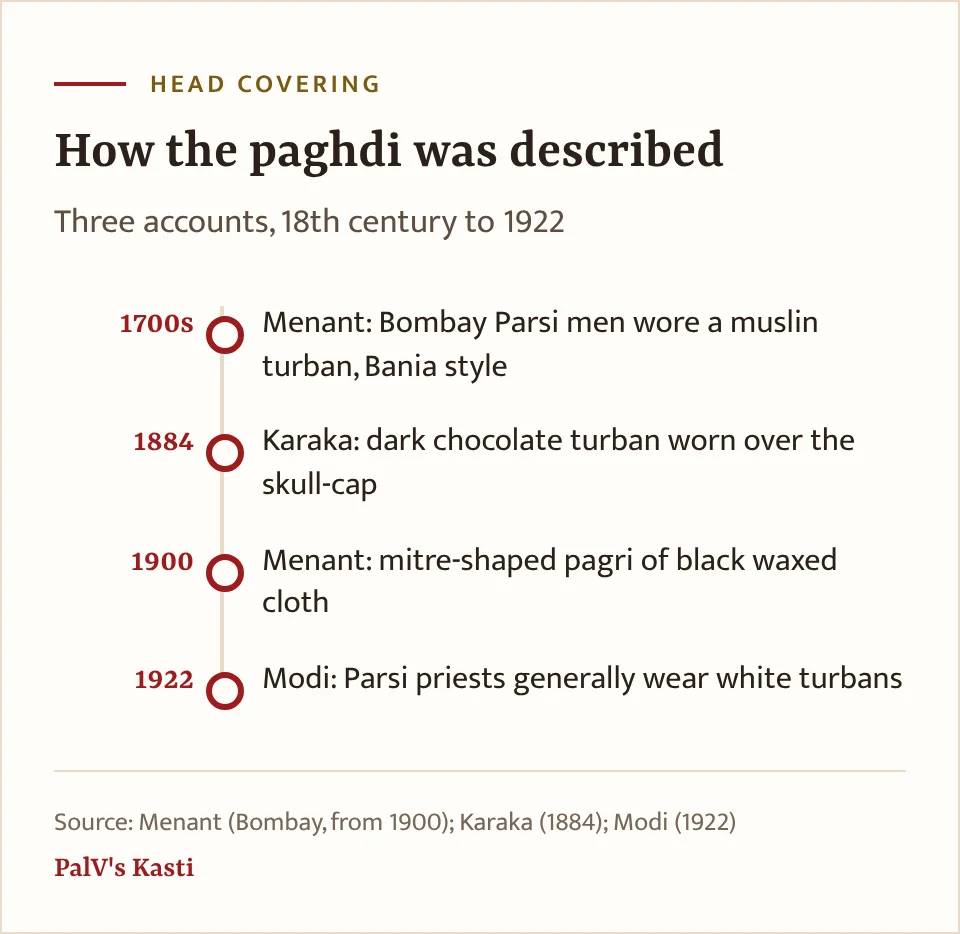
The Parsi paghdi (also written pagri or pagdi) is the dark formal headdress that Parsi men once put on whenever they went out, set on top of the skull-cap they wore at home. Delphine Menant, who studied the Parsis of Bombay from October 1900, described it as a turban shaped like a bishop's mitre, usually made of black waxed cloth and sometimes of brown silk. Its roots are in Gujarat. Dosabhai Framji Karaka wrote in 1884 that the Parsi man's turban resembled that of Gujarati Hindus because the community took up local dress after settling in India. Laymen wore it dark. Priests wore white: Karaka wrote that Shenshai priests generally dressed like laymen but entirely in white cotton, "including the turban", and J.J. Modi (1922) wrote that Parsi priests "generally wear white turbans".
અસપંદામેદ રોજ
Asfandarmad Roj, Tir Mah · 1396 Y.Z.
What is a Parsi paghdi?
A Parsi paghdi is an outdoor head covering worn over a cap, not a cap in its own right. Both of the early descriptions we found say so. Karaka (1884) wrote that the turban "forms the outdoor covering of the head", placed over the skull-cap. Menant (writing after 1900) said Parsi men going out put "a kind of turban in the shape of a bishop's mitre, called pagri" on top of their cap.
The two accounts differ on colour and material.
| Detail | Karaka, 1884 | Menant, after 1900 |
|---|---|---|
| Term used | Turban | Pagri |
| Shape | Not described | Like a bishop's mitre |
| Colour | Generally dark chocolate | Mostly black, sometimes brown |
| Material or finish | "Flowered fancifully" | Black waxed cloth, sometimes brown silk |
| Worn over | The skull-cap | The cap |
| When | Outdoors | When going out |
One surviving example sits in Singapore. The Indian Heritage Centre's catalogue lists a 20th-century "Parsi Pagri with Box" from Bombay, made of cloth, cardboard and metal.
Where did the Parsi paghdi come from?
The paghdi came from Gujarat, not Persia. Karaka wrote that the dress of India's Parsis "differs from that worn by their ancestors in Persia", and that they took it up under an agreement with "the Hindu princes who received them in India". That, he said, explains why the men's angrakha (coat) and turban, and the women's sari, look so like the dress of Gujarat's Hindus.
The settlement story Karaka refers to is told in the Qissa-i Sanjan. John Hinnells, summarising it in Encyclopaedia Iranica, lists among the local ruler's conditions that "the women should adopt the local dress". In Hinnells's summary, the dress condition names women only. Karaka applies the adoption of local dress to the men's turban as well.
Menant was more specific about the model. She wrote that Bombay Parsi dress was borrowed from the Banias of Surat. In the 18th century, she said, it consisted of a long robe pleated at the hips like a skirt, with a muslin turban on the head. By her own time the outdoor headdress she saw was the mitre-shaped pagri described above.
Who wore the paghdi?
Parsi laymen wore it outdoors, while Shenshai priests wore a white turban.
Laymen. Karaka and Menant both describe the paghdi as what an ordinary Parsi man put on to go out. Karaka recorded that it survived the move to Western clothes. By 1884, he wrote, most Parsi men had switched to coat and trousers, yet "they have not discarded the turban", even though it was "a cumbrous and inconvenient head-dress". Ervad Ramiyar Karanjia, writing about Zoroastrian practice, names the topi or paghdi for men, and the scarf or mathabana for women, as "an essential part of the attire" of Zoroastrians.
Formal occasions. The Indian Heritage Centre's catalogue notes that Parsis, as in many Indian communities, wore headgear for ceremonies and weddings, and sometimes to show "their social standing".
Priests. Karaka wrote that Shenshai priests generally dressed like laymen, except that everything was "made solely of white cotton cloth, including the turban". J.J. Modi, writing in 1922, confirmed that "The Parsee priests generally wear white turbans". Modi also noted that priests of the Kadmi sect wore a different hat, the fenta, which he called "a hat of an Irani type". Karaka had likewise noted in 1884 that a few Kadmi priests wore a garb of their own. The fenta is explained in our guide to the Parsi pheta.
What did a Parsi man wear with the paghdi?
Karaka's 1884 account gives the full outfit. At home a Parsi man wore his Navjote.">Sadra (Karaka spells it sudra) and Kusti, a waistcoat, loose cotton trousers, slippers and a China silk skull-cap. Going out, he added an angrakha, a loose beltless coat, and placed the turban over his skull-cap. Full dress added a white linen jama (a long double-breasted coat) and a pichori (a long cloth wound round the waist), worn at funerals and weddings and by some on state occasions. Menant gives the outdoor version as a white overcoat with the pagri.
For the cap worn underneath, see the Parsi cap (topi). And for why Zoroastrians cover their heads at all, read our guide to Zoroastrian head covering.
Frequently asked questions
What is a Parsi paghdi?
It's the formal outdoor headdress of Parsi men, worn over a skull-cap. Dosabhai Framji Karaka described it in 1884 as a turban, generally dark chocolate in colour and flowered. Delphine Menant, writing after 1900, called it a pagri shaped like a bishop's mitre, usually of black waxed cloth and sometimes of brown silk.
Why does the Parsi paghdi resemble Gujarati headwear?
Because the Parsis took up local dress in Gujarat. Dosabhai Framji Karaka wrote in 1884 that they adopted their costume under an agreement with the Hindu princes who received them, which is why the men's turban resembles Gujarati Hindu dress. Delphine Menant traced Bombay Parsi dress to the Banias of Surat.
Did Parsi priests wear the paghdi?
Priests wore a white turban. Dosabhai Framji Karaka wrote in 1884 that Shenshai priests generally dressed like laymen but entirely in white cotton, turban included. J.J. Modi (1922) wrote that Parsi priests generally wear white turbans, and noted that Kadmi priests wore the fenta, a hat he described as of an Irani type.
What is worn under a Parsi paghdi?
A skull-cap. Both early accounts agree on this. Dosabhai Framji Karaka (1884) wrote that the turban is placed over the skull-cap, and Delphine Menant, describing Bombay Parsis after 1900, said men put the pagri on top of their cap when going out. At home, Karaka noted, the cap was China silk.
When did Parsi men wear the paghdi?
Whenever they went out. Dosabhai Framji Karaka (1884) called the turban the outdoor covering of the head, and Delphine Menant, after 1900, said Bombay Parsi men put the pagri on when going out. Singapore's Indian Heritage Centre notes that Parsis wore headgear for formal occasions such as ceremonies and weddings.