PalV's Kasti

On this page
The mathabana (also spelt mathabanu) is the small white cloth that Parsi Zoroastrian women have worn over their hair. In his History of the Parsis (1884), Dosabhai Framji Karaka described it as "a thin cloth of white linen" about the size of a small handkerchief, and wrote that a Parsi woman of his day was never without it. That round-the-clock habit has faded. Ervad Ramiyar Karanjia writes that most Parsis now cover their heads only while praying, taking part in a ritual or going to a fire temple, and he lists the "scarf or mathabanu" as the woman's part of traditional Zoroastrian attire. So it isn't a Zoroastrian hat at all. It's a head cloth, and today it comes out mainly for prayer.
શહેરેવર રોજ
Shehrevar Roj, Tir Mah · 1396 Y.Z.
What is a mathabana?
A mathabana is a plain white head cloth, not a stitched cap. Karaka's 1884 description is the most precise we found: thin white linen, about the size of a small handkerchief, worn so that the hair is hidden. He added that it had come to be seen as "a token of feminine modesty".
Our sources don't agree on the fabric. Karaka says linen. Writing 138 years later in Parsi Times (2022), Noshir Dadrawala calls it a white muslin headscarf. Both agree on the colour. Karanjia says head coverings should "preferably" be white, though black or dark colours are often used for convenience.
Is the mathabana a Zoroastrian hat?
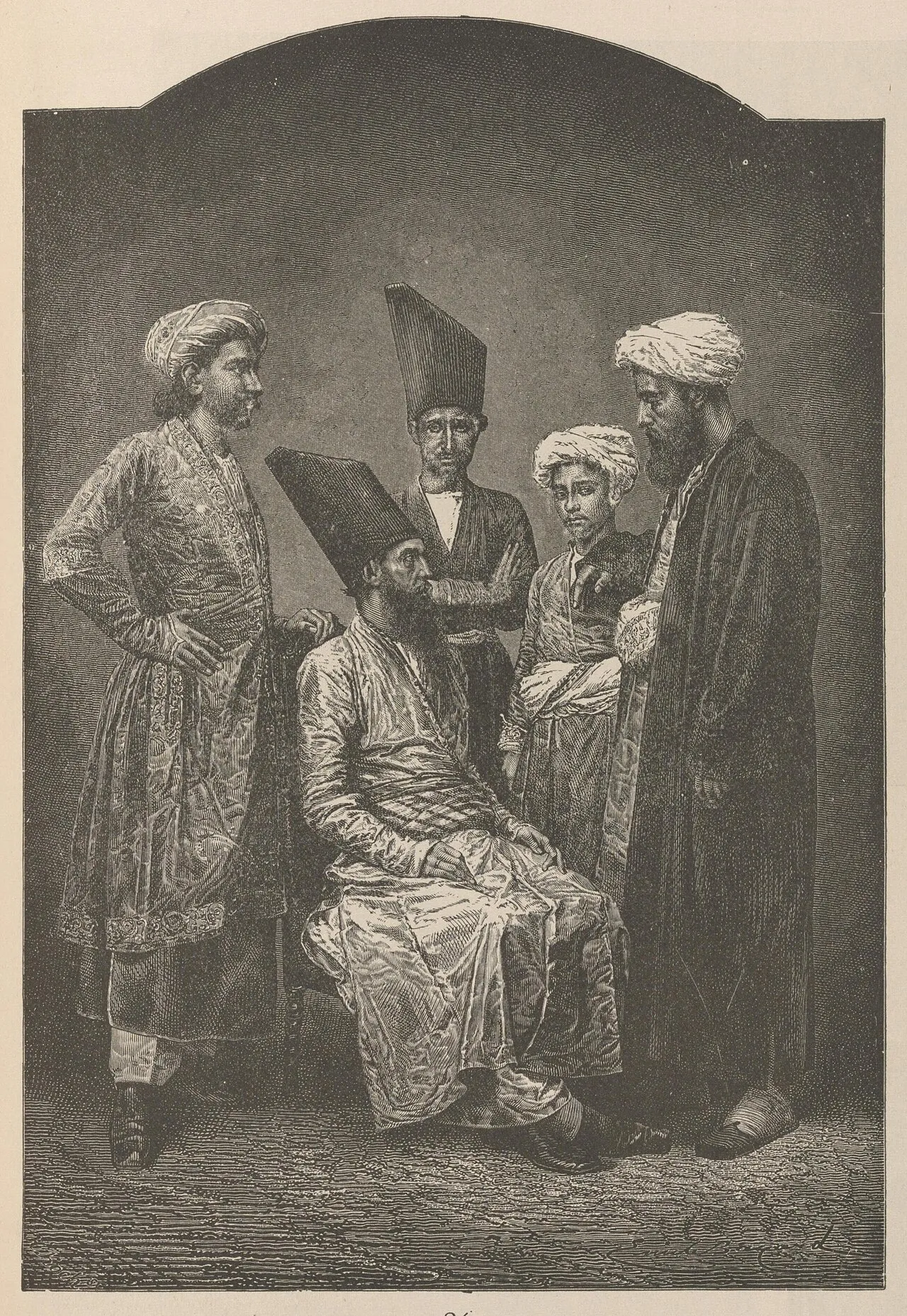
No. When people search for a "Zoroastrian hat" or "Parsi hat", they usually mean a man's head covering. Karaka set the two side by side in 1884: a Parsi man was "never without his skull-cap", a woman never without her mathabana. Karanjia makes the same split: the topi (cap) or paghdi for men, and the scarf or mathabanu for women, each "an essential part of the attire" of Zoroastrians.
| Who | Head covering | Source |
|---|---|---|
| Parsi woman | Mathabana, a thin white cloth over the hair | Karaka, 1884 |
| Parsi man at home | China silk skull-cap | Karaka, 1884 |
| Parsi man outdoors | Turban placed over the skull-cap | Karaka, 1884 |
| Women | Scarf or mathabanu | Karanjia |
| Men | Topi (cap) or paghdi | Karanjia |
The men's side has its own pages: the Parsi cap (topi) and the Parsi paghdi.
Is covering the head a religious rule for Zoroastrian women?
Our sources disagree, so here are both positions, each with its author. J.J. Modi wrote in 1922 that "all Zoroastrians are required to have their heads covered". Delphine Menant, who came to Bombay in October 1900 to continue her study of the Parsis, also tied the women's head cloth to a religious precept against going bareheaded. Karaka took the opposite view in 1884. He wrote that there is "no religious injunction" against an uncovered head, and that the belief came from long usage brought from Persia. Karanjia, who holds that the religion expects the head to be covered at all times, still notes that "Religious texts do not explicitly state the reasons". The reasons themselves are covered in our guide to Zoroastrian head covering.
Practice varies between families and Agiaries; your family priest's guidance comes first.
When is the mathabana worn today?
In 1884 the answer was simple: always. Karaka recorded the belief that it was wrong to leave the head uncovered "by either day or night". Karanjia traces how that narrowed. Until about three generations ago, he writes, Parsis kept their heads covered throughout the day and night. Later, "for reasons of style, fashion or assimilation", Parsis kept them covered only in the house.
| Occasion | Head covered? | Source |
|---|---|---|
| Praying, including at home | Yes | Dadrawala, Karanjia |
| Visiting a fire temple | Yes | Dadrawala, Karanjia |
| Taking part in a ritual | Yes | Karanjia |
Dadrawala adds that the rule for prayer applies to men and women alike, with men usually in a skullcap and women in a head scarf.
Practice varies between families and Agiaries; your family priest's guidance comes first.
How did the way Parsi women wore the mathabana change?
Fashion moved it backwards, quite literally. Karaka wrote in 1884 that half a century earlier Parsi ladies "would have scouted the idea" of showing any hair above the forehead. The girls of his own day pushed the mathabana as far back as they could, to show neatly parted hair, and older women were starting to copy them. Elderly women who kept to the old style were teased by younger ones for hiding their grey hair.
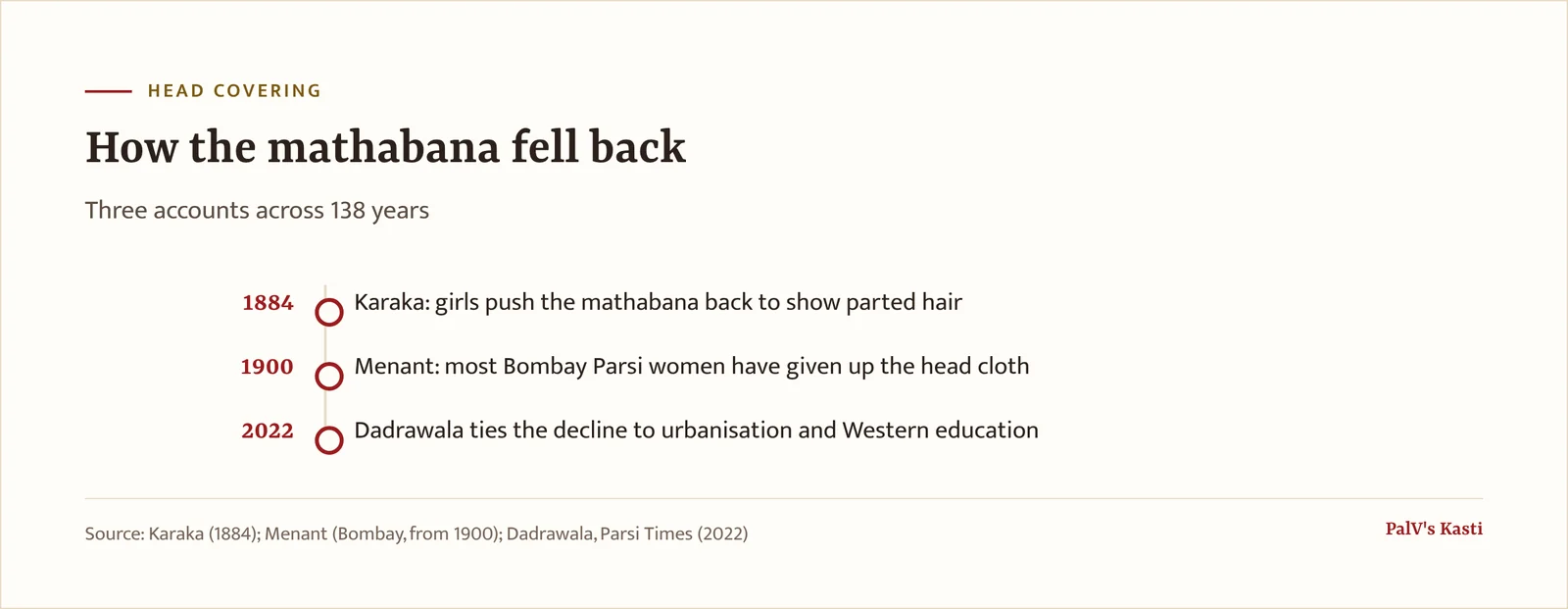
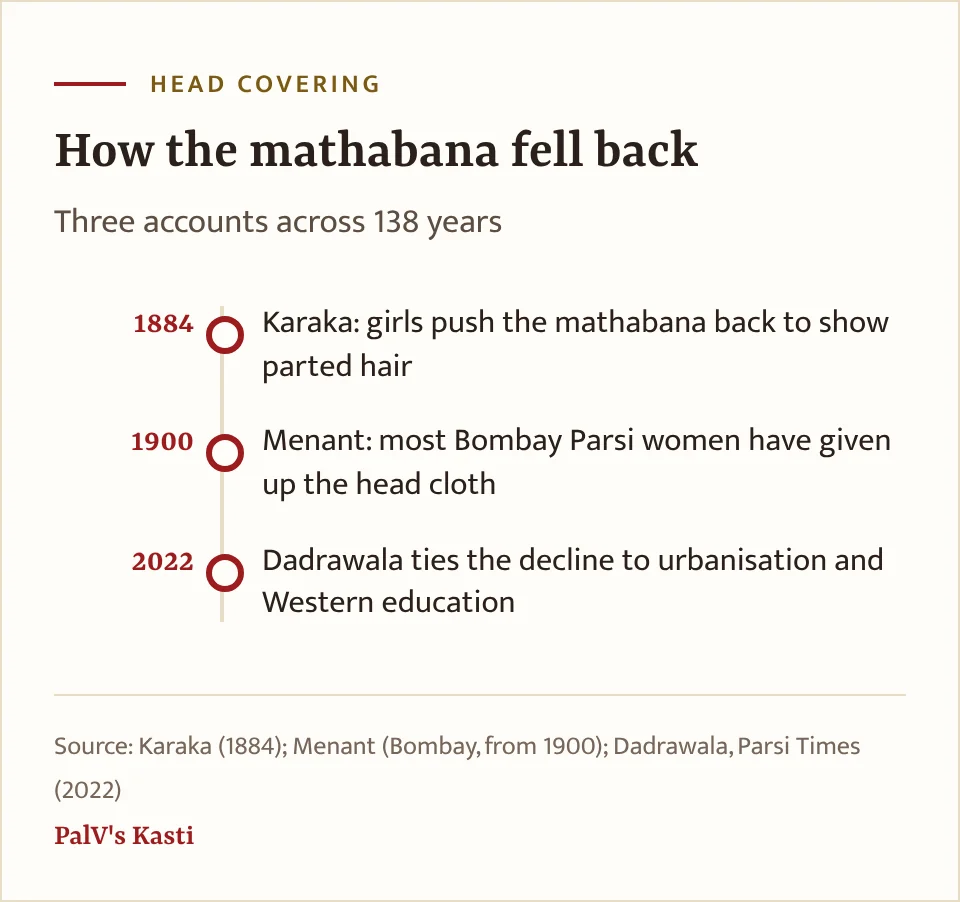
When Delphine Menant studied the Parsis of Bombay from October 1900, she found that most women there had given up the head cloth altogether. She noted that the cloth caught travellers' eye, and wrote that it gave the wearers the look of pious Catholic sisters of charity. She also wrote that the reformist paper Rast Goftar had carried the community's arguments about how women came to leave off the cloth that covered their hair. Village life was different. Among the Parsis of the Gujarat villages she visited, Menant described the woman as going about her work with her head covered by a white cloth.
Noshir Dadrawala links the decline to urbanisation and Western education. Until those took over, he writes, the mathabana was part of the daily dress of every Parsi lady.
Can a sari be worn over the head instead?
Yes, and it was part of the traditional drape. Karaka described the Parsi woman's sari, about six yards long, as wrapped round the waist with the rest "gracefully thrown over the head", falling onto the right arm.
Frequently asked questions
What is the Parsi woman's head scarf called?
It's called the mathabana, also spelt mathabanu. Dosabhai Framji Karaka described it in 1884 as a thin cloth of white linen about the size of a small handkerchief, worn over the hair. Ervad Ramiyar Karanjia names the scarf or mathabanu as the woman's traditional head covering, alongside the topi or paghdi worn by men.
Do Parsi women have to cover their heads?
Writers disagree. J.J. Modi (1922) wrote that all Zoroastrians are required to cover their heads, and Ramiyar Karanjia says the religion expects it at all times. Dosabhai Framji Karaka (1884) held there was no religious injunction, only a long-standing custom from Persia. Karanjia notes the religious texts don't state the reasons explicitly.
What colour is a mathabana?
White. Karaka's 1884 description is of white linen, and Noshir Dadrawala, writing in Parsi Times in 2022, calls the mathabana a white muslin headscarf. Ramiyar Karanjia says Zoroastrian head coverings should preferably be white, while noting that black or dark colours are often used today for convenience.
When do Parsi women wear the mathabana today?
Mostly for prayer. Ramiyar Karanjia writes that most Parsis now cover their heads only while praying, taking part in a ritual or going to a fire temple. Noshir Dadrawala, writing in Parsi Times in 2022, says the rule for prayer applies to men and women alike, with women usually in a head scarf.
Is the mathabana the same as a hijab?
No. The mathabana is its own Parsi tradition. Karaka described it in 1884 as a thin white cloth about the size of a small handkerchief, worn to hide the hair. Delphine Menant's account of rural Gujarat around 1900 notes that Parsi village women covered their heads with a white cloth but did not wear a veil while at work.
What do Zoroastrian men wear on their heads?
A cap. Karaka wrote in 1884 that a Parsi man was never without his skull-cap at home, adding a turban over it when he went out. Ramiyar Karanjia names the topi (cap) or paghdi as the man's traditional head covering. Both have their own guides on this site, linked above.